Why they get confused
At first glance, Art Nouveau and Art Deco seem like natural siblings. Both movements broke decisively with the Victorian habit of recycling historical styles — Gothicism, Renaissance classicism, Baroque pomp — and both asserted that architecture deserved a fresh visual language suited to a modern world. Both swept across national boundaries, producing recognizable work in cities as different as Brussels, Paris, New York, and Buenos Aires. And both celebrated the decorated surface at a time when later modernism would declare ornament a crime.
The confusion deepens because the two movements appear in rapid succession. Art Nouveau flourished roughly between 1890 and 1910, and Art Deco emerged in the 1920s and dominated through the late 1930s. For a brief transitional decade around 1910 to 1920, elements of both were present in the same cities, occasionally in the same buildings. Designers who had trained in Art Nouveau studios produced work that edged toward the geometric vocabulary that would become Art Deco. The gap in time is narrow enough that even specialists sometimes disagree about which category certain transitional buildings belong to.
But once you understand the underlying cultural logic of each movement, the visual difference becomes stark. Art Nouveau was a product of Symbolism and Romanticism: it looked at the natural world — plant growth, insect wings, flowing female hair, the curving stem of a lily — and found in those organic forms the truest expression of beauty and vitality. Ornament should feel as if it has grown out of the building rather than been imposed on it. Art Deco, by contrast, was a product of the machine age. It absorbed Cubism, the angular geometry of Egyptian and Aztec motifs (both newly fashionable), and the exuberant energy of a post-war economic boom. Its ornament is proud, angular, and unabashedly man-made. Where Art Nouveau curves toward nature, Art Deco steps boldly upward toward the skyscraper sky.
These are not just different aesthetic preferences but opposite cultural moods, and once you internalize that opposition, misidentification becomes almost impossible.
Art Nouveau: motifs and materials
The single most reliable visual signature of Art Nouveau is the organic line — specifically what critics called the coup de fouet, or whiplash: a long sinuous curve that bends back on itself like a cracking whip or an unfurling fern frond. This line appears everywhere in Art Nouveau buildings. Facades curve outward in shallow bows. Window openings adopt petal shapes. Stone or plaster ornament flows across surfaces as if the building were growing. Iron railings twist into vines and tendrils. Balcony supports look like the stalks of enormous flowers.
The subject matter of Art Nouveau ornament is equally distinctive. Irises, waterlilies, and peacocks dominate the tile and ceramic work. Female figures with long flowing hair appear in relief panels, their hair becoming part of the decorative pattern. Dragonflies, beetles, and butterflies contribute their wing forms to iron grilles and stained glass. The color palette drawn from glazed ceramic tiles runs toward deep blues, greens, and golds — the colors of river plants and iridescent insects.
The dominant materials are wrought iron, glazed ceramic tile, and stained glass. Iron allowed the sinuous whiplash curve to be realized in structural elements — stair balustrades, lamp standards, gate supports — without requiring expensive stone carving. Ceramic tile served both as weather protection on exterior facades and as a medium for pictorial ornament. Stained glass filled not only windows but also skylights and interior light wells, suffusing Art Nouveau interiors with colored light that enhanced their otherworldly quality.
It is worth noting that Art Nouveau ornament, for all its organic vitality, is typically applied to a conventional structure. The masonry walls and floors of most Art Nouveau buildings are entirely standard. The ornament wraps around and flows over a conventional load-bearing skeleton. The one great exception is Antoni Gaudí, discussed separately below. Key practitioners include Victor Horta (Brussels), Hector Guimard (Paris), Otto Wagner (Vienna), and Antoni Gaudí (Barcelona), each of whom developed a recognizably personal interpretation of the shared vocabulary.
Art Nouveau geography
Art Nouveau did not emerge uniformly around the world. It had five cities of maximum intensity, and understanding their geography makes the game significantly easier.
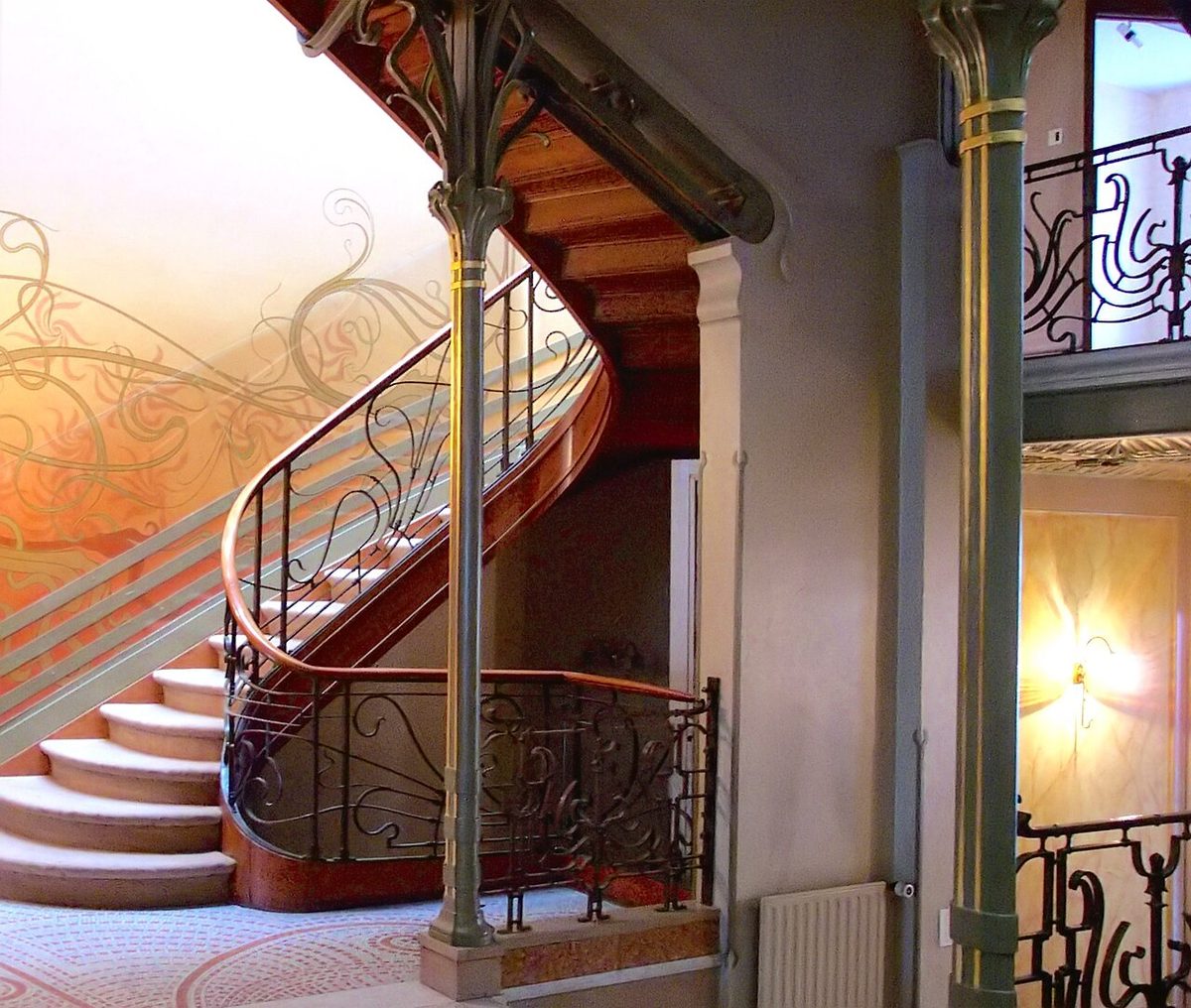
Brussels is where Art Nouveau began, with Victor Horta's Hôtel Tassel of 1893 — widely acknowledged as the first fully realized Art Nouveau building. The house introduced the whiplash line into structural ironwork visible from the street, covering exposed columns and beams in the interior with organic motifs continuous with the ornament of floors and walls. The Hôtel van Eetvelde and the Maison du Peuple followed in rapid succession. Brussels retains an extraordinary density of Art Nouveau townhouses, many open to visitors.
Paris is home to Hector Guimard's Paris Métro entrances of 1900, perhaps the most photographed Art Nouveau work in the world and an ideal game reference point. The green cast-iron canopies, the insect-wing lettering panels, and the organic lamp standards are unmistakable. Guimard also designed private houses across the city, most notably the Castel Béranger.
Vienna produced its own distinct variant: the Vienna Secession, led by Joseph Maria Olbrich (Secession Building, 1898, with its golden leaf dome) and Otto Wagner (Post Office Savings Bank, 1906, whose aluminum bolt-heads create a precise riveted surface). Viennese Art Nouveau tends toward greater geometric restraint than Brussels or Paris — an early sign of the move toward Deco.
Barcelona gave us Lluís Domènech i Montaner's Palau de la Música Catalana (1908) and Gaudí's full portfolio. Riga, Latvia, has the highest concentration of surviving Art Nouveau apartment facades in the world, built in a rapid burst of development around 1900–1906. When you spot ornate iron balconies with leaf or insect motifs alongside curving facade lines, your first hypotheses should include one of these five cities.
Art Deco: motifs and materials
Where Art Nouveau draws curves, Art Deco draws straight lines that step, angle, and zigzag. The definitive Art Deco decorative vocabulary consists of chevrons (V-shaped repeated patterns), zigzags, sunburst or fan patterns radiating outward from a center point, stylized animals (eagles and antelopes are favorites on American skyscrapers), and stepped forms that produce the distinctive ziggurat profile visible on New York skyscrapers from below. The setbacks imposed by New York's 1916 zoning law — which required buildings to step back from the street as they rose, to admit light to the streets below — accidentally produced a building profile that matched perfectly with Deco geometry.
The Egyptian revival element deserves special mention. Howard Carter's opening of Tutankhamun's tomb in 1922 triggered a worldwide obsession with Egyptian aesthetics. Lotus flower capitals, stylized scarabs, and hieroglyph-like geometric borders appeared on everything from cinema interiors to apartment lobbies. The Egyptian influence blended seamlessly with Art Deco's existing taste for flat geometric ornament, producing one of the style's most recognizable sub-vocabularies.
Art Deco materials are sleek and hard-surfaced: polished black granite, creamy travertine, terracotta panels, aluminum, and chrome. These materials are smooth and flat; the ornament is carved or cast in low relief rather than projecting boldly outward. The surface conveys luxury without fussiness. Art Deco buildings want to look expensive and modern at the same time — they succeed with these material choices in a way Art Nouveau never attempted.
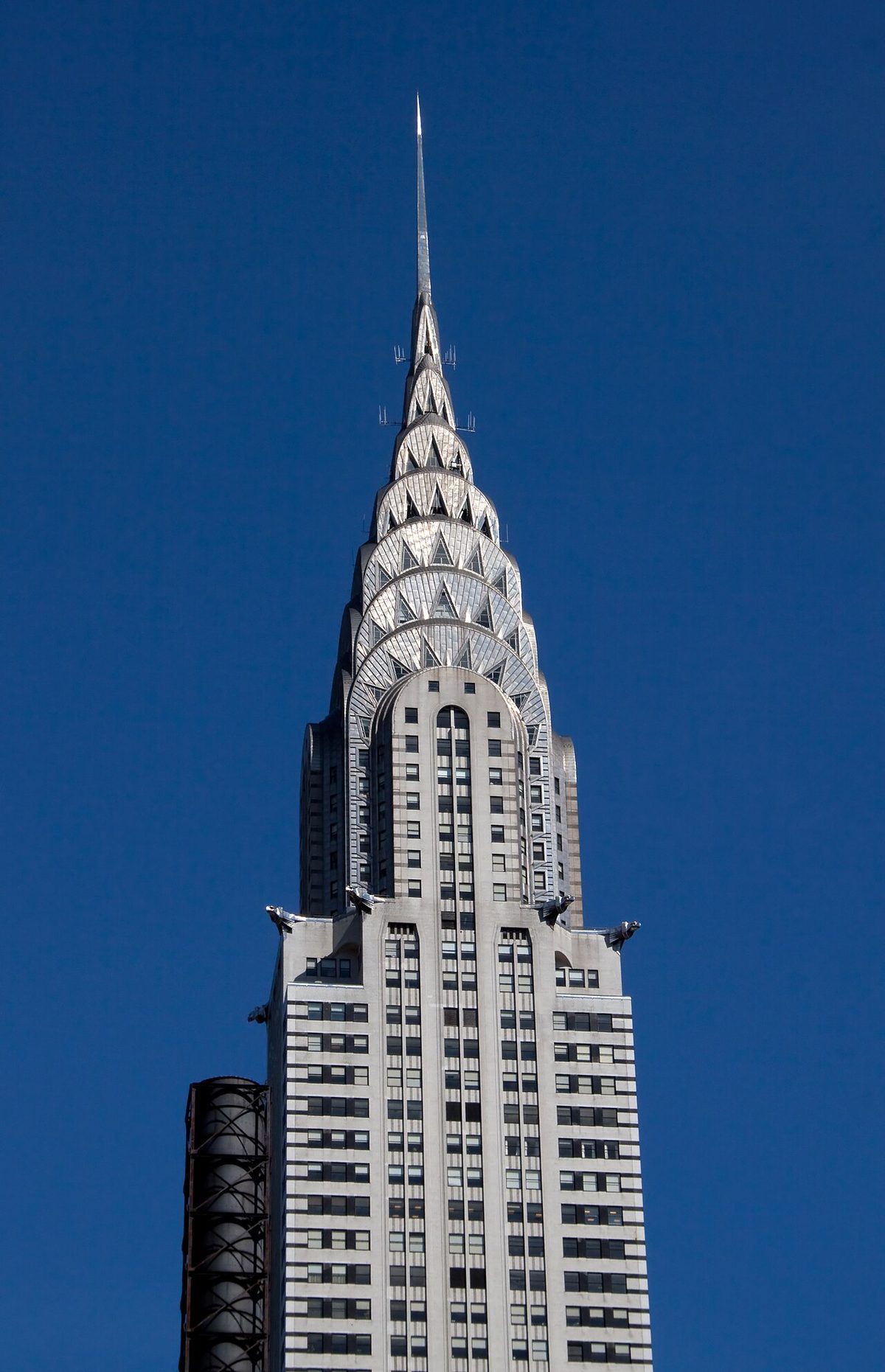
Key buildings include the Chrysler Building (1930, New York, William Van Alen) — stainless-steel sunburst crown, eagle gargoyles, radiator-cap ornaments — the Palais de Chaillot (1937, Paris), and Eltham Palace (1936, London), an extraordinary interior that grafts full Art Deco fittings onto a medieval great hall.
Art Deco geography
Art Deco spread far more widely than Art Nouveau because it coincided with a global economic boom in the 1920s and with the acceleration of mass media — cinema, illustrated magazines, and radio — that carried style across borders faster than ever before. Every major city that underwent significant construction between 1925 and 1940 has Art Deco buildings.
The New York skyscraper district is the most famous concentration: the Chrysler Building (1930), the Empire State Building (1931), and 30 Rockefeller Plaza (1933) form a cluster of canonical Art Deco towers within a few blocks of each other in Midtown Manhattan. The lobby interiors of these buildings — gilded murals, travertine floors, polished metal elevator doors — are as important as the facades for game identification.
The Miami Beach South Beach district is the largest surviving concentration of Art Deco residential and hotel buildings in the world. Roughly 800 buildings constructed between 1930 and 1942 survive in the historic district, their pastel facades decorated with eyebrow windows, porthole details, and nautical finials derived from the ocean-liner aesthetic fashionable at the time. The entire district was threatened with demolition in the 1970s before preservationists secured its designation.
Further afield: Mumbai's Marine Drive (the Queen's Necklace waterfront) is lined with Art Deco apartment blocks built in the 1930s, making Mumbai one of the world's major Art Deco cities — largely unrecognized in Western architectural histories. Napier, New Zealand, was almost entirely rebuilt in Art Deco after the 1931 earthquake. Havana's Vedado district contains a high density of Art Deco civic and residential buildings from the 1930s, relatively well-preserved due to limited development since the 1960s.
The quick identification test
When a building image appears in the game, you need a reliable fast-pass test. Here is a two-branch decision tree you can run in under five seconds.
Branch 1 — flowing curves? If the facade curves in a sinuous arc; if balcony railings are shaped like vines or stems; if window surrounds adopt petal or wing shapes; if stained glass panels show irises, peacocks, or dragonflies; if iron elements twist organically — you are looking at Art Nouveau. The building is almost certainly in Brussels, Paris, Vienna, Barcelona, or Riga. The date is approximately 1890–1910.
Branch 2 — geometric stepped forms? If the building profile steps back in terraces; if ornament consists of chevrons, zigzags, sunbursts, or fan patterns; if surfaces are smooth and polished rather than rippled or curved; if you see chrome or aluminum fittings; if eagle or antelope ornaments appear at corners; if Egyptian-inspired borders frame windows — you are looking at Art Deco. The building could be in New York, Miami, London, Paris, Mumbai, or dozens of other cities. The date is approximately 1920–1940.
When in doubt, use date as a tiebreaker. A highly ornamental building photographed before 1910 is almost certainly Art Nouveau. A highly ornamental building photographed in the 1920s or 1930s is almost certainly Art Deco. The transitional overlap period of 1910–1920 produced buildings that genuinely combine elements of both, particularly in Vienna and Germany, where geometric tendencies within Art Nouveau led toward angular abstraction years before the Deco explosion. These transitional buildings are the genuinely difficult cases — but they are also relatively rare in the game's image database.
One additional tell: the entrance door. Art Nouveau entrance doors are typically arched and filled with organic ironwork — entering an Art Nouveau building should feel like walking through a garden gate. Art Deco entrance doors are tall and rectangular, flanked by polished stone pilasters and framed by geometric relief panels — entering should feel like stepping into a luxury ocean liner.
Gaudí: the special case
Antoni Gaudí (1852–1926) is routinely grouped with Art Nouveau because he worked in Barcelona during Art Nouveau's peak years and his buildings share the movement's rejection of historical revival styles and embrace of rich surface ornament. In the game, players who struggle with his work often file it loosely under "Art Nouveau + Barcelona" and score correctly. That is a reasonable heuristic.
But Gaudí's architecture is different from Art Nouveau in a fundamental structural sense. Art Nouveau ornament is, as noted above, typically applied to conventional masonry. Gaudí's forms are not ornament applied to structure — they are the structure. The curving stone facade of the Casa Milà (La Pedrera, 1910) is not a decorative surface mounted on a conventional building behind it; the curves of that facade ARE the load-bearing walls. The building has no straight walls anywhere because Gaudí derived the structural geometry from catenary curves — the shape a hanging chain makes under gravity — inverted to produce columns and arches that carry loads purely in compression.
The Sagrada Família towers, still under construction a century after Gaudí's death, are shaped by paraboloids and hyperboloids derived from the same chain-model method. Gaudí suspended models of the church ceiling from above using strings and small sandbags, then photographed the hanging model and flipped the image — the compressed form of the hanging strings became the tensile form of the stone arches. This is a mathematical method with no parallel in Art Nouveau, Deco, or any other contemporary movement.
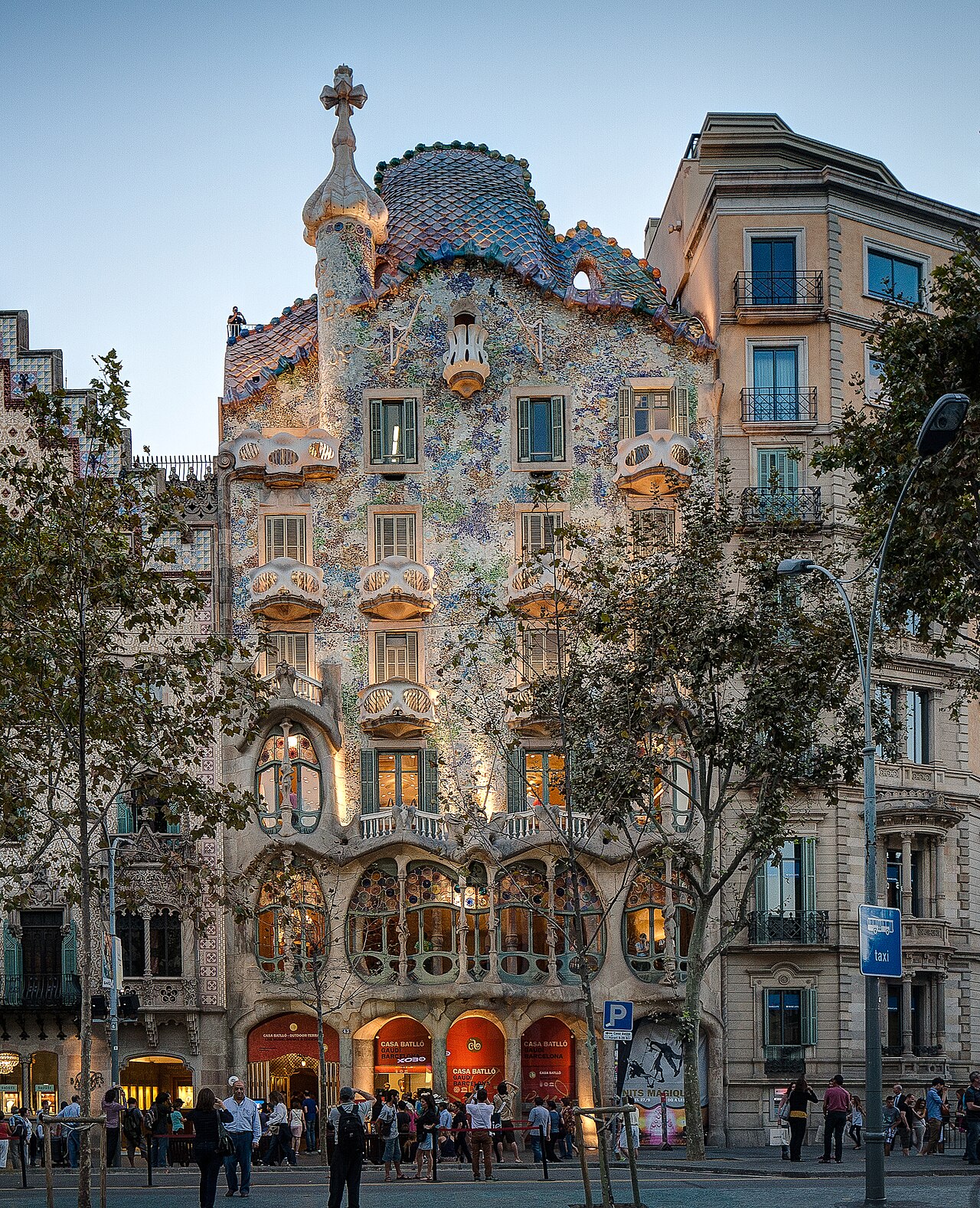
The practical game consequence is that Gaudí's buildings are uniquely recognizable because nothing else looks like them. Casa Batlló's dragon-scale roof, Casa Milà's undulating stone facade, and Sagrada Família's organic stone spires appear in the game repeatedly. Players who cannot name Gaudí on first encounter nonetheless recognize his work instantly on second and third — his buildings create the kind of indelible visual memory that Art Nouveau's more conventional practitioners, skilled as they were, rarely achieve.
For more on how decorative movements shaped tall building design, see our article on the evolution of the skyscraper. And for the twentieth century's deliberate rejection of ornament entirely, see brutalism explained.
Regional Variations
Art Nouveau reached its peak in different places at different moments, and the regional variants are distinct enough to constitute sub-traditions. Belgian Art Nouveau (Victor Horta, 1890s Brussels) was the earliest major European expression — the Hôtel Tassel of 1893 is the canonical founding work. What distinguished Horta's approach was the integration of exposed iron structure with organic ornament: the iron columns and beams in the interior were not hidden behind plaster or stone cladding but left visible, their surfaces covered in flowing plant-derived scrollwork so that the structural and the decorative were the same thing. Brussels retains more intact Art Nouveau interiors than any other city, partly because the style became unfashionable before the buildings were demolished and partly because Belgian heritage legislation was relatively protective of the pre-war city fabric.
French Art Nouveau (Hector Guimard's Paris Métro entrances, the Nancy school) was more emphatically decorative and applied. Guimard's Métro canopies of 1900 are probably the most photographed Art Nouveau objects in the world: the green cast-iron frames with their insect-wing lettering panels and organic lamp standards were a deliberate aesthetic program for the entire public transit system, applying avant-garde design to an everyday infrastructure. The Nancy school, centred on Émile Gallé and Louis Majorelle, produced furniture and decorative objects rather than buildings, and their influence was more on the applied arts than on architectural form. The Viennese Secession — led by Gustav Klimt (painting), Josef Hoffmann, and Joseph Maria Olbrich (architecture) — was a distinct regional variant with considerably more geometric restraint than Brussels or Paris. Otto Wagner's Postal Savings Bank (1906) uses aluminum bolt-heads arranged in a precise grid as its primary ornamental element: the ornament is geometric rather than organic, and the grid suggests the coming rationalism of early Modernism rather than the flowing forms of the Jugendstil (the German-language term for Art Nouveau, literally "youth style"). The Viennese Secession is the clearest bridge between Art Nouveau and Art Deco — more angular than the former and more historically conscious than the latter.
In Catalonia, Antoni Gaudí took the organic impulse of Art Nouveau far further than any other practitioner, but arrived at results so singular that they constitute a tradition of one. Gaudí did not apply organic ornament to conventional structure: his structural forms are themselves organic, derived from catenary curves and natural morphology in a way that merges the load-bearing and the decorative at a fundamental level. The result — Casa Batlló, Casa Milà, the Sagrada Família — has no parallel anywhere else in the world. Lluís Domènech i Montaner's Palau de la Música Catalana (1908) represents a more conventional version of Catalan Modernisme, using richly coloured ceramic tile mosaics, stained glass, and sculpted terracotta to transform the exterior and interior of a concert hall into a total artwork. Art Deco was largely a Paris invention of the 1910s and early 1920s — its public launch is usually dated to the 1925 Exposition Internationale des Arts Décoratifs et Industriels Modernes in Paris, which gave the style its name — but it reached its most theatrical expression in New York's skyscraper race of the late 1920s and early 1930s, where the 1916 zoning law's setback requirement accidentally produced a building silhouette that matched Art Deco geometry perfectly. The style's global reach — Miami, Mumbai, Napier, Havana, Shanghai — means it appears in more geographic contexts in the game than any other decorative movement.
The transition between Art Nouveau and Art Deco in the decade from roughly 1910 to 1920 is architecturally interesting precisely because it was not clean. Architects trained in Art Nouveau studios gradually geometricized their forms, shedding the most explicitly organic curves while retaining the commitment to surface richness and the rejection of historical revival. The work of Peter Behrens in Germany and Eliel Saarinen in Finland in this transitional decade produces buildings that belong fully to neither camp — too geometric for Art Nouveau, too ornamental for the International Style that was just beginning to emerge. These transitional buildings are the most difficult to classify in the game and the most rewarding to study for what they reveal about how architectural styles actually change: not through manifesto but through gradual formal evolution driven by individual designers responding to a shifting cultural climate.
Key Identifiers: Art Nouveau
- Organic, plant-derived curves — the "whiplash line" (coup de fouet): sinuous, asymmetrical, suggestive of growth rather than construction
- Asymmetrical composition — the facade or plan does not have a single axis of symmetry; elements flow around each other rather than mirroring
- Integration of structure and ornament — the iron frame, balcony support, or stair baluster IS the decoration; the two are not separable
- Stained glass, glazed ceramic tile, and wrought iron as the dominant material palette of the ornamental program
- Female figures with long flowing hair as a recurring motif in relief panels, stained glass, and ceramic tile
- Naturalistic subject matter: irises, waterlilies, dragonflies, peacocks, and other plants and animals rendered with botanical accuracy
- No historical pastiche — forms are invented, not borrowed from Greek, Gothic, or Renaissance precedent
Key Identifiers: Art Deco
- Geometric forms: chevrons, stepped ziggurats, sunburst/fan motifs, repeated angular patterns — all feel machined rather than grown
- Metallic finishes: chrome, aluminum, gold — the palette of the machine age and the luxury liner
- Stylised (not naturalistic) ornament — animals and human figures are angular and abstracted, not biologically detailed
- Setback silhouette on towers: the building steps back from the street as it rises, creating a ziggurat profile (partly from New York zoning law, partly aesthetic)
- Expensive exotic materials: ebony, lacquer, sharkskin (galuchat), tortoiseshell, and synthetic equivalents used for interior surfaces
- Egyptian and pre-Columbian references: lotus columns, scarab motifs, step-pyramid forms following the 1922 Tutankhamun discovery and the fashion for non-Western antiquity
- Speed, modernity, and luxury as explicit themes — the ocean liner and the automobile as aesthetic sources
A Closer Look: Chrysler Building vs. Casa Batlló
Placing the Chrysler Building and Casa Batlló in conversation reveals how thoroughly Art Deco and Art Nouveau differ not just in surface detail but in their underlying attitudes toward nature, the machine, and the act of making. Casa Batlló (Antoni Gaudí, Barcelona, remodelled 1904–1906) was a renovation of an existing apartment building on the Passeig de Gràcia. Gaudí stripped the facade to the structure and rebuilt it entirely: the lower two floors use irregular, bone-shaped stone columns and balconies whose shapes suggest skulls and vertebrae, earning the building one of its Catalan nicknames, Casa dels Ossos (House of Bones). The upper facade is covered in a mosaic of broken ceramic tile (trencadís) that shifts in colour from deep blue-green at the top — where the tiles catch the sky — to golden yellow and orange at the base. The roofline rises in a ridge that curves upward at each end like a reptilian spine, covered in arc-shaped ceramic tiles in green and blue that are interpreted as dragon scales. Every element of the building draws from the natural world: bone, scale, shell, and water are the metaphorical sources for forms that have no equivalent in any other tradition. Walking past the Casa Batlló on the Passeig de Gràcia, one has the continuous sensation that the building is alive — that it breathes, that it might shift.
The Chrysler Building (William Van Alen, New York, completed 1930) was conceived from the beginning as a monument to a specific kind of modernity: the automobile, the machine, and the ambition of American commerce. The building's most famous feature — its stainless-steel sunburst crown — was assembled in secret inside the building and raised through the roof in a single ninety-minute operation, solely to claim the world height record from the Bank of Manhattan before its developers could respond. The crown's seven stepped arcs of stainless steel, each with triangular windows, create a pattern of layered fans that catches and multiplies sunlight at the top of Midtown Manhattan's skyline. At the 61st floor, four chrome-plated eagle gargoyles project from the building's corners — they are the 1929 Chrysler radiator cap ornament reproduced at architectural scale, a direct transfer of automobile design into architectural ornament. The setbacks of the building below the crown follow the 1916 zoning law's rules precisely, creating a stepped silhouette that feels inevitable and calculated rather than organic. Where Gaudí's building seems to grow, Van Alen's building seems to have been assembled from prefabricated components, each one precisely machined. Both buildings are masterworks; they are masterworks of incompatible worldviews.
The contrast extends to how the two buildings age. Casa Batlló's ceramic mosaic, precisely because it is irregular and handmade, acquires additional character with time — the variations in the tiles become more visible, the relationship between the colours and the ambient light of the Barcelona sky more nuanced. The Chrysler Building's stainless steel crown, precisely because it is a precision industrial material, resists aging: the crown looks approximately the same today as it did in 1930, slightly duller perhaps, but essentially unchanged. One building embodies the belief that natural materials and natural forms are the truest sources of beauty; the other embodies the belief that industrial materials and industrial processes are. That argument, conducted in architecture, has not been resolved and probably never will be.
Spotting It in Building Guessr
The fastest way to distinguish Art Nouveau from Art Deco in the game is the curve question. Art Nouveau curves are organic and asymmetric — they feel grown, not designed; the line of a balcony railing or a facade outline suggests the stem of a plant bending under its own weight. Art Deco curves and angles are geometric and precise — they feel machined; a fan-shaped ornamental panel above an entrance is composed of identical radiating segments in a perfect arc. Art Nouveau buildings also tend to integrate their ornament into their structure in a way that makes it impossible to separate the decorative from the load-bearing: the iron balcony bracket IS the decoration. Art Deco ornament is typically applied to a conventional rectilinear structure underneath — strip away the decorative panels and you would have a perfectly ordinary office building. That distinction is visible in even a quick photograph: Art Nouveau facades have a quality of continuous surface where ornament and structure merge; Art Deco facades have a quality of applied decoration on a clear underlying geometry.
The Era filter set to Late 19th / Early 20th Century surfaces both styles; the Type filter for Residential or Commercial narrows the field toward the domestic and civic buildings where these styles were most commonly deployed. Geographic context helps significantly: Art Nouveau in the game almost always places in Brussels, Paris, Vienna, Barcelona, or Riga; Art Deco places in New York, Miami, London, Paris, Mumbai, or any major city that saw significant construction between 1925 and 1940. A highly ornate building with flowing curves in a northern European street context is almost certainly Art Nouveau; a highly ornate building with geometric stepped ornament and metallic surfaces in a New York or Miami context is almost certainly Art Deco. When the photograph shows an interior — an elevator lobby, a hallway, a staircase — Art Nouveau interiors have curving ironwork balustrades, ceramic tile floors in organic patterns, and stained glass skylights; Art Deco interiors have polished marble floors, gilded geometric panels, and elevator doors with fan or chevron ornament in chrome or bronze.
See if you can spot the difference between these styles in a live round.
Play Building GuessrFurther Reading
Sources & further reading
Reference material this page draws on, and where to read further. External links open third-party sites.
- Art Nouveau · Wikipedia
- Art Deco · Wikipedia
- Victor Horta · Wikipedia
- Antoni Gaudí · Wikipedia
- Chrysler Building · Wikipedia
- Hector Guimard · Wikipedia