The worst-named movement in architecture
Few architectural styles suffer from their name as much as brutalism. The word sounds like it is describing the buildings' emotional effect on passersby, which, depending on the passerby, can actually be pretty close to the truth. But the origin is pure linguistics: brutalism comes from the French béton brut, meaning raw concrete. A brutalist building is one that leaves its concrete visible and honest, without plaster, paint, or cladding to disguise it. The name is about materials, not about cruelty to humans.
That said, the reputation persists for a reason. Brutalism is one of the most polarizing movements in modern architecture. People either love it with the intensity of a subculture or hate it with the intensity of wanting it demolished. Both groups are reacting to something real in the work.
Origins at Unité d'Habitation
The key building in brutalism's origin story is Le Corbusier's Unité d'Habitation in Marseille, completed in 1952. France had been hollowed out by the war. Housing was in desperate short supply. Le Corbusier, by then the most famous architect in Europe, proposed a vertical village: a single massive concrete block raised on pilotis (sculptural legs), containing 337 apartments, a shopping street halfway up, a rooftop garden and running track, and a kindergarten. The whole building is concrete, cast in wooden forms that left the grain of the boards visible on the finished walls.
Unité demonstrated what concrete could do: spans that brick could not manage, sculptural shapes that steel could not justify, and a price point that let governments build quickly. Over the next fifteen years, architects across the world used the Unité vocabulary to design everything from university campuses to embassies to council estates to cathedrals.
Béton brut and honesty in materials
Brutalism is built on a philosophical claim: that architecture should be truthful. If a building is made of concrete, let it look like concrete. Do not hide the joints between formwork panels; celebrate them. Do not fake stone or polish away the rough texture; let the eye see the material as it is. Windows, ducts, stairs, and beams should be legible as what they are, not disguised behind a uniform skin.
This ethic extended into interiors. The Smithsons in Britain, Louis Kahn in the United States, Lina Bo Bardi in Brazil, and Kenzo Tange in Japan all produced work that exposes its bones. A Kahn library shows you every structural beam, every ventilation duct, every service riser; nothing is hidden behind a dropped ceiling. Done well, the effect is thrilling: a building that is teaching you, without words, how it stands up.
Postwar optimism and social housing
Brutalism flourished particularly in public commissions: universities, arts centers, council housing, government buildings. This was not an accident. In the optimistic quarter-century after the war, Western governments were investing heavily in education, social welfare, and urban renewal, and brutalism was cheap, fast, and visually serious. It read as modern without being frivolous.
The movement's high points in this period include the Barbican Estate in London, Boston City Hall in the United States, Habitat 67 in Montreal, the Ministry of Education and Health in Rio de Janeiro, the Geisel Library at UC San Diego, and the National Theatre on London's South Bank. Each is a landmark in its city even among people who do not like it.
Why people hated it
By the late 1970s, much brutalist work was unpopular enough that governments were planning demolitions. Several forces combined. Concrete weathers badly in wet, polluted cities; pale buildings turn streaky gray in a decade. Many brutalist housing projects were underfunded and poorly maintained, so they became associated with poverty and crime regardless of the design's original intentions. The scale of some brutalist buildings, especially when isolated on motorway-adjacent sites, made them feel antisocial even when they were well built. And the cultural conservatism of the Thatcher and Reagan era rejected the socialist-flavored optimism that brutalism carried.
The criticism turned into action. London's Trellick Tower narrowly escaped demolition; Chicago's Prentice Women's Hospital was torn down in 2014 despite preservation campaigns; hundreds of lesser brutalist schools and shopping centers came down without anyone noticing. Some losses are real. Some are good riddance.
The recent revival
Something strange happened in the 2010s. A generation too young to remember brutalism as new discovered it through photography and social media. Instagram accounts like This Brutal House and Socialist Modernism accumulated hundreds of thousands of followers by posting stark photos of concrete staircases, pilotis, and exposed beams. Brutalism, which had been the style adults were supposed to hate, became a subculture.
Serious preservation caught up. London's Trellick and Balfron towers are now listed heritage buildings with strong fan communities. Boston City Hall has been actively restored rather than demolished. A wave of new "neo-brutalist" commercial buildings, from luxury houses to urban hotels, openly borrows the vocabulary: raw concrete, cantilevered volumes, visible formwork. Whether this is homage or kitsch is itself a debate.
Brutalism beyond Britain: the global spread
Brutalism was not a local British phenomenon. Governments worldwide adopted it as the architectural language of modernization and social progress, each inflecting it through their own political and cultural circumstances. The common thread was ambition: these were nations that needed to build fast, build large, and be seen to be building seriously.
In the Eastern Bloc, brutalism became the default idiom for civic and university buildings across the Soviet sphere. The most extreme example is the Palace of the Parliament in Bucharest, begun in 1984 under Nicolae Ceaușescu. At roughly 365,000 square metres, it is the largest Brutalist structure in the world and the second-largest administrative building on earth. Its construction required the demolition of a significant portion of historic Bucharest and displaced tens of thousands of residents; the human and material cost was staggering even by the standards of authoritarian building programs. It remains one of the most debated monuments in contemporary Europe — a building of undeniable physical power and deeply troubling provenance.
Latin America produced a Brutalism that felt entirely different in character. Brasília, the new capital carved out of the Brazilian cerrado and inaugurated in 1960, was designed by Oscar Niemeyer and urban planner Lúcio Costa. Here the raw concrete of béton brut was shaped by Brazilian tropicalist tradition rather than British austerity or Soviet monumentality. Niemeyer's governmental buildings — the twin towers of the National Congress, the supreme court, the presidential palace — are lyrical and sculptural, their forms more suggestive of landscape and sky than of mass and weight. Brasília was designated a UNESCO World Heritage Site in 1987, one of the youngest buildings ever to receive that distinction.
In Africa and the Middle East, Brutalism arrived with postcolonial governments that saw it as ideologically neutral — neither the ornamental colonial past nor the Western commercial modernism of glass curtain walls. It was a style that could be claimed as modern without being American. The Kenyan parliament buildings in Nairobi, the National Theatre of Ghana in Accra, and university campuses across Nigeria and Tanzania all show this pattern. Some of these buildings are now in poor repair; others have been substantially altered. The question of whether they deserve the same preservation attention as their European counterparts is one the architectural community is only beginning to seriously address.
Notable Brutalist buildings to know
Any list of must-know Brutalist buildings is necessarily partial, but these seven repay close attention — both for what they achieve architecturally and for what they tell us about the movement's range and contradictions.
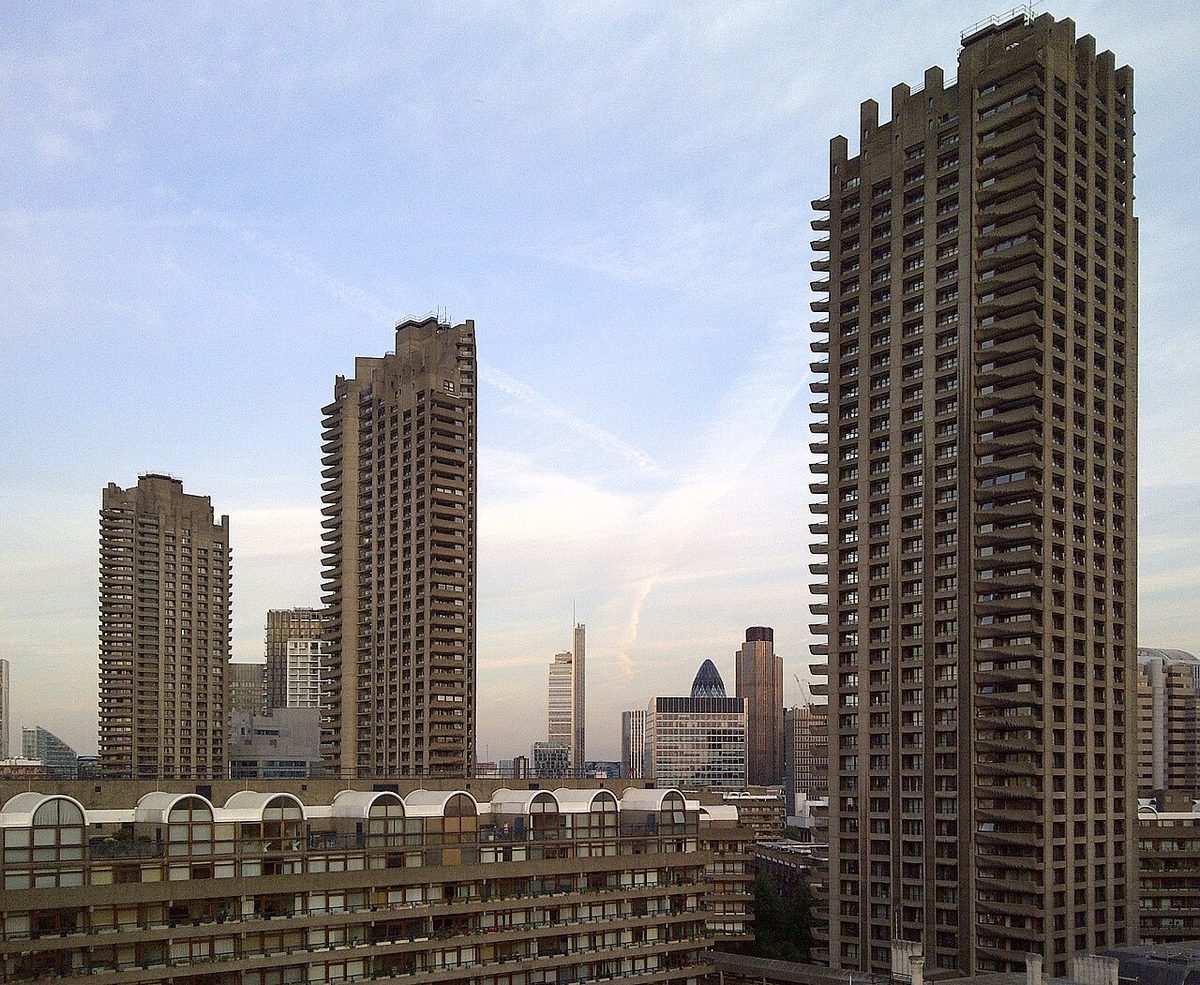
The Barbican Estate, London (completed 1982) is the largest Brutalist residential complex in Europe. Designed by Chamberlin, Powell and Bon, it is effectively a city within a city: three towers and a network of low-rise terraces, connected by elevated walkways, arranged around an artificial lake. Within the complex are a concert hall, a theater, a cinema, two schools, and a conservatory. It was initially unpopular as a place to live but has long since become one of the most sought-after residential addresses in central London. The Barbican shows what fully committed Brutalist urbanism looks like when it is maintained and invested in.
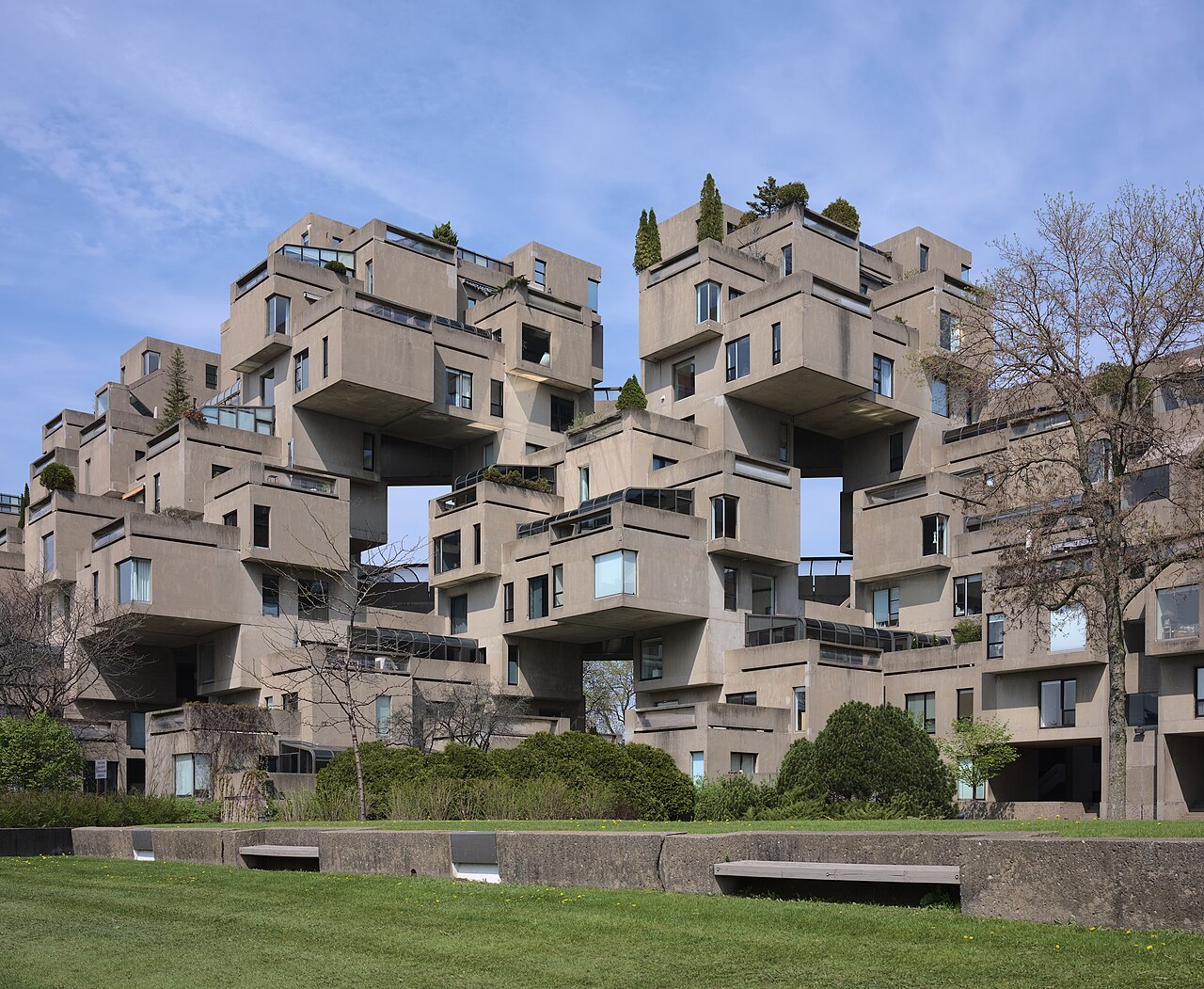
Habitat 67, Montreal (1967) was Moshe Safdie's graduation thesis made real, built for Expo 67 to demonstrate that prefabricated concrete construction could produce housing that felt individual rather than institutional. The 354 identical concrete modules are stacked and interlocked to create 148 apartments, each with its own rooftop garden. From a distance the complex looks like a geological formation, a mesa of human habitation. It remains a working residential building and a pilgrimage site for architecture students.
Boston City Hall (1968), designed by Kallmann, McKinnell and Knowles, has been consistently voted among the world's ugliest buildings in public polls, and it has faced serious demolition proposals several times. Its inverted pyramid form — the upper floors cantilever massively over an open civic plaza — was a deliberate rejection of traditional civic monumentality. The building was intended to feel accessible and public rather than imperial. Whether it succeeds is a matter of perpetual argument, and the open brick plaza it commands is one of the most windswept and inhospitable public spaces in American urban design.
The Chandigarh Capitol Complex, India (1963) was Le Corbusier's late-career masterwork, designed for the new capital of Punjab after Partition. The hyperbolic paraboloid roof of the Assembly building is one of the most audacious roof forms of the twentieth century — a concrete shell that appears to float above the building it covers, opening to the sky in a great curved aperture. The complex is now a UNESCO World Heritage Site, alongside Niemeyer's Brasília and the Unité d'Habitation, recognizing Le Corbusier's work as the foundational expression of the movement.
Trellick Tower, London (1972), designed by Ernő Goldfinger, is thirty-one storeys of council housing in North Kensington. Its most distinctive feature is the separated service tower — lifts and refuse chutes occupy a freestanding structure connected to the residential floors by bridges at every third floor. This separation keeps the service infrastructure entirely out of the apartments, eliminating noise and giving the building its immediately recognizable silhouette. Reviled on completion and associated with crime and neglect through the 1970s and 1980s, it is now Grade II* listed, one of the highest heritage designations in England, and the flats are highly sought after.
The National Theatre, London (1976), designed by Denys Lasdun, consists of three theatres stacked within layered concrete terraces that step down toward the Thames. Lasdun described the terraces as a continuation of the riverside landscape; critics in the 1980s called it a nuclear power station and Prince Charles notoriously described it as a carbuncle. The National Theatre is now a beloved London landmark, its concrete cleaned and its terraces used as public space year-round. The building's rehabilitation took about three decades and required almost no physical changes to the architecture.
The Yale Art and Architecture Building, New Haven (1963), designed by Paul Rudolph, is a monument to surface texture. The building's exterior and interior walls are made of concrete whose surface has been bush-hammered after casting — a process in which the cured concrete is struck repeatedly with a jackhammer-style tool to break away the smooth surface and expose the rough aggregate beneath. This creates the characteristic ribbed, corrugated texture that photographs as deeply shadowed and three-dimensional. The effect is not a product of the formwork but of manual labor applied after the fact, a distinction that matters both technically and philosophically.
The preservation debate
The question of which Brutalist buildings deserve to survive is one of the most contested issues in contemporary architectural preservation, and the answer varies dramatically by country and by who is asking.
In the United Kingdom, a number of key buildings have been formally listed, giving them legal protection. Trellick Tower, the Barbican, Preston Bus Station, and the Hayward Gallery are all protected to varying degrees. But many more face demolition, particularly social housing towers whose failure is attributed publicly to the architecture rather than to decades of underinvestment and deliberate policy neglect. The counterargument, made forcefully by preservation advocates, is that most so-called "failed" Brutalist housing estates were well-maintained and reasonably popular with residents through the 1970s. The deterioration came later, as housing policy changed, maintenance budgets were cut, and local councils were stripped of the resources to run large residential complexes effectively. The buildings did not fail; the funding did.
The question of whether to save Brutalist buildings is also entangled with whose cultural heritage is considered worth preserving. The residents of Brutalist council estates have rarely been the ones campaigning for preservation; the campaigns have more often been led by architects, academics, and middle-class enthusiasts. When a celebrated heritage body lists a social housing tower while the people living in it want it demolished and replaced, the politics of preservation become uncomfortable. This tension does not mean listed status is wrong, but it does mean the debate cannot be reduced to a simple architectural argument.
Outside the United Kingdom, the situation is often sharper. Boston City Hall has faced multiple serious demolition proposals, supported by mayors who found it architecturally indefensible and urbanistically damaging. Each time, preservation campaigns have narrowly succeeded, usually on the grounds of the cost and disruption of demolition rather than any consensus about the building's merit. In the Eastern Bloc, the calculus has been very different: hundreds of civic Brutalist buildings have been demolished since 1989 as symbols of the communist past. In countries that experienced Soviet-era rule as occupation rather than liberation, the buildings that housed that occupation are not heritage — they are wounds. The architectural distinction between the style and its political associations is a luxury easier to make from a distance.
The buildings that tend to survive are the most loved or the most famous, not necessarily the most architecturally significant. A great deal of genuinely innovative work from the 1960s and 1970s has been demolished without serious debate because it was not well known enough to generate a preservation campaign. What survives will shape how future generations understand what Brutalism actually was — and that selection process is already underway.
Make up your own mind
If you have only seen brutalism in photos, find one nearby and visit in person. The experience is different from any other architecture. Scale, texture, shadow, and acoustic resonance all matter in ways that photos flatten. You may still hate it after visiting, but you will understand why someone else loves it. The Building Guessr database includes a number of brutalist landmarks under Modern and Infrastructure filters; pick one out and try to place it.
For related reading, see our piece on the evolution of the skyscraper, which covers the International Style era brutalism grew out of, and on famous architects, which profiles Le Corbusier, Louis Kahn, and others whose work defined the movement.
Regional Variations
British Brutalism is the most architecturally significant regional variant, for a specific historical reason: the postwar welfare state gave British architects commissions for council housing, universities, civic centres, and arts buildings at a scale and budget that allowed full expression of the style's ambitions. The welfare state was not just a client — it was an ideological match. Brutalism's belief that architecture could create better conditions for human life, that a well-designed building could produce social solidarity and civic participation, aligned precisely with the postwar Labour government's belief that state investment in public services could produce a better society. The result was an extraordinary period of public architecture. Park Hill in Sheffield (completed 1961, Jack Lynn and Ivor Smith) is one of the most ambitious social housing projects ever built in Britain: 995 flats arranged in a continuous deck structure that follows the contours of the hillside, connected by "streets in the sky" — wide deck-access corridors at every third floor, wide enough for a milk float to deliver to residents' doors. The concept was a direct translation of Le Corbusier's Unité d'Habitation deck-access idea onto a sloping Sheffield hillside, creating a building that is simultaneously a single structure and a neighbourhood. Park Hill was controversially and expensively part-renovated from 2011 onward, with new cladding replacing the original concrete on the completed phases while the unrenovated sections remain visible alongside.
The Barbican in London (Chamberlin, Powell and Bon, completed 1982 after 20 years of construction) remains the most complete surviving example of Brutalist urban planning anywhere in the world. It is a self-contained city within the city: 2,000 flats in three towers and thirteen terrace blocks, connected by elevated walkways above a network of car-free pedestrian routes. The estate also contains a concert hall, a theatre, a cinema, two schools, a conservatory, restaurants, a lake, and underground car parking. The Barbican was built on the site of the City of London's most heavily bombed area — the Cripplegate ward, almost entirely destroyed in the Blitz — and the entire scheme was conceived as a model for how urban bomb sites should be rebuilt: not as replacement housing in the same street pattern, but as an entirely new urban structure with its own spatial logic. It is now one of the most sought-after residential addresses in London, a complete reversal of its initial reception, and it demonstrates that Brutalist urbanism can succeed when properly maintained, properly invested in, and given enough time to become familiar.
American Brutalism concentrated primarily on civic, academic, and cultural buildings rather than housing, partly because the American welfare state was far less ambitious than the British one and partly because American middle-class opinion was particularly resistant to the style in residential contexts. Paul Rudolph's Art and Architecture Building at Yale (1963) is the most extreme academic example: a building whose bush-hammered concrete surface creates deep vertical channels of shadow that make the facades appear almost geological, and whose section is so complex — with 37 different floor levels — that it took students years to understand the building fully. Boston City Hall (1968, Kallmann, McKinnell and Knowles) is the most famous civic example and the most hated: its inverted pyramid form — upper floors cantilevering massively over a public plaza — was a deliberate rejection of traditional civic hierarchy, but the result is a plaza of legendary inhospitality. Eastern European and Soviet Brutalism, freed from the capitalist requirement to generate a return on construction costs, produced the most monumental expressions: the Palace of the Parliament in Bucharest (begun 1984 under Ceaușescu, 12 floors above ground, 8 below, 365,000 square metres of floor area, 1,100 rooms) is the heaviest building in the world and the second-largest administrative building on earth. Its construction required the demolition of a significant portion of historic Bucharest and the displacement of tens of thousands of residents — making it both an architectural monument and a monument to authoritarian overreach.
Japan and Brazil produced Brutalisms that were inflected by very different cultural traditions. Kenzo Tange's work in Japan — the Yoyogi National Gymnasium for the 1964 Tokyo Olympics, the Kurashiki City Hall, the Kagawa Prefectural Government Building — brought together béton brut with references to traditional Japanese timber construction (the exposed beam ends and bracket forms of traditional temples) in a synthesis that was neither fully Western nor fully Japanese but entirely coherent. The Kagawa Prefectural Government Building (1958) is often cited as the building that established this synthesis: its exposed concrete frame with deep horizontal beams references the bracket systems (tokyō) of Buddhist temple architecture, making a modernist building that is simultaneously rooted in its cultural context. Oscar Niemeyer's Brutalism in Brazil, as noted above, was lyrical and sculptural where British and American Brutalism tended toward the massive and geometric. Niemeyer used raw concrete not to express weight and permanence but to express fluidity and movement — his forms curve and float in ways that challenge the conventional association of concrete with solidity.
Key Identifiers: Brutalist Architecture
- Exposed concrete as the primary exterior and interior finish — either board-formed (the texture of the wooden formwork boards visible as a regular grid of lines and grain), or bush-hammered (the surface mechanically abraded to expose the coarse aggregate, giving a rough, textured appearance)
- Massive cantilevered volumes projecting horizontally beyond their support — upper floors that hang out over lower floors to a degree that draws attention to the structural achievement
- Pilotis: columns raising the main building mass off the ground, leaving the ground floor open — the building appears to float, and the visual weight is concentrated above eye level
- Absence of applied ornament — surface texture comes from the material itself and the construction process, not from added decoration; no carved detail, no painted pattern, no cladding
- Ribbon windows or narrow slit openings — windows sized strictly to the building's lighting and ventilation needs, not to aesthetic convention; punched into the concrete mass rather than framing it
- Geometric sculptural roofline — the roofscape reads as a composed three-dimensional form rather than being hidden behind a parapet; plant rooms, lift overruns, and roof structures are integrated into the composition
- Raw, unfinished appearance — construction joints, bolt holes, tie-rod marks, and the edges of formwork panels are left visible rather than filled, sealed, or painted over
- Strong shadow patterns — the combination of deep overhangs, projecting volumes, and rough surface texture creates dramatic shadow lines that are a key part of the aesthetic effect, especially in strong directional light
A Closer Look: Habitat 67
Habitat 67 (Moshe Safdie, Montreal, 1967) began as Safdie's graduate thesis at McGill University and became one of the most discussed housing projects of the 20th century when it was realised as a demonstration project for Expo 67. The brief was simple and radical: could prefabricated modular construction produce housing that felt individual, varied, and humane rather than institutional and repetitive? Safdie's answer was to design 354 identical prefabricated concrete boxes, each weighing approximately 70 to 90 tonnes, and to stack and connect them in 15 different configurations to produce 146 distinct apartment layouts across a 12-storey structure. The key design move was the offset stacking: each box is placed to leave a portion of the box below it uncovered, and that uncovered portion becomes the private terrace of the apartment above. Every apartment therefore has its own outdoor terrace (the roof of the apartment below), natural light on multiple sides, and a distinct orientation and view. No two apartments are identical in their relationship to light, view, and outdoor space, despite using identical modules.
The construction process was itself an innovation. The concrete boxes were cast on site in reusable steel forms, then lifted into position by cranes running on rails along the length of the building. Mechanical services (water, drainage, electricity) were threaded through the assembled boxes using prefabricated utility corridors. The structure uses steel rods to tie the boxes together in compression, resisting lateral forces and creating a composite structure that is considerably stiffer than the sum of its individual boxes. At the time of construction, the project was considered too expensive for its prefabrication logic to be replicated at scale: the cost per unit was higher than conventional construction, largely because the system had not been refined through repetition. Safdie spent much of the following decades arguing that if the system were built at larger scale — thousands of units rather than hundreds — the economics would become favourable. That argument has never been definitively tested at the scale he envisaged, though prefabricated modular housing has become a significant sector in several countries since.
Habitat 67 remains a working residential building, and its 148 apartments (some units were combined after construction) are among the most expensive residential properties in Montreal. The building has been continuously occupied since 1967, requiring regular maintenance of the concrete surfaces, the waterproofing of the terrace decks, and the mechanical systems. It was designated a historic monument by the Quebec government in 2009. For architecture students and enthusiasts, it functions as a pilgrimage site — a building that is simultaneously a historical document of 1960s optimism about prefabrication and technology, and a proof that Brutalist concrete housing can be genuinely desirable if it is well-designed, well-maintained, and given enough time for the social dynamics of the building to become established.
Spotting It in Building Guessr
Brutalist buildings are among the easiest to identify in the game — raw grey concrete and bold geometric massing are distinctive in any photograph, and the style has few convincing imitators. The most reliable primary signal is the surface finish: if the exterior finish is exposed concrete with visible board marks (a regular grid of horizontal and vertical lines from the wooden formwork), or with a coarsely textured aggregate-exposed finish (bush-hammering), or with prominent tie-rod holes at regular intervals, it is almost certainly Brutalist or Brutalist-influenced. No other architectural tradition leaves its construction marks as deliberately visible. The secondary signal is the massing: if volumes cantilever dramatically over each other, if the upper portions of the building are significantly larger than the lower (inverted pyramid logic), or if the building appears to sit on columns with the main mass raised above an open ground floor, those are also strong Brutalist indicators regardless of the surface treatment. A building that does both — raw concrete surface AND dramatic cantilevered massing — is almost certainly Brutalist.
The Era filter set to Mid-20th Century (1945–1975) surfaces Brutalist buildings alongside International Style glass curtain-wall boxes — the concrete surface immediately separates the two. International Style buildings of the same period tend to be glass and steel, minimising the visual weight of the skin; Brutalist buildings of the same period tend to maximise the visual weight of the concrete mass. A building in that era range with a heavy, solid-looking concrete exterior and no glass curtain wall is almost certainly Brutalist. Geographic context helps to narrow the regional variant: if the building appears to be social housing with deck-access corridors and a residential scale, and the surroundings suggest a British industrial city, it is most likely British council housing from the 1960s or 1970s. If the building is a university library, art museum, or civic hall, it could be British, American, or from any of the many countries that invested in civic Brutalism during the postwar decades. If the building is monumental in scale, with a large open plaza or forecourt and government or civic functions signalled by flag poles or ceremonial proportions, it may be Eastern European, South Asian, or postcolonial African — a national government's statement of modernist ambition at the moment of independence.
Find the brutalism in the modern-architecture filter.
Play Building GuessrFurther Reading
Sources & further reading
Reference material this page draws on, and where to read further. External links open third-party sites.
- Brutalist architecture · Wikipedia
- Le Corbusier · Wikipedia
- Unité d'habitation · Wikipedia
- Barbican Estate · Wikipedia
- Habitat 67 · Wikipedia
- Alison and Peter Smithson · Wikipedia