The Hollywood castle
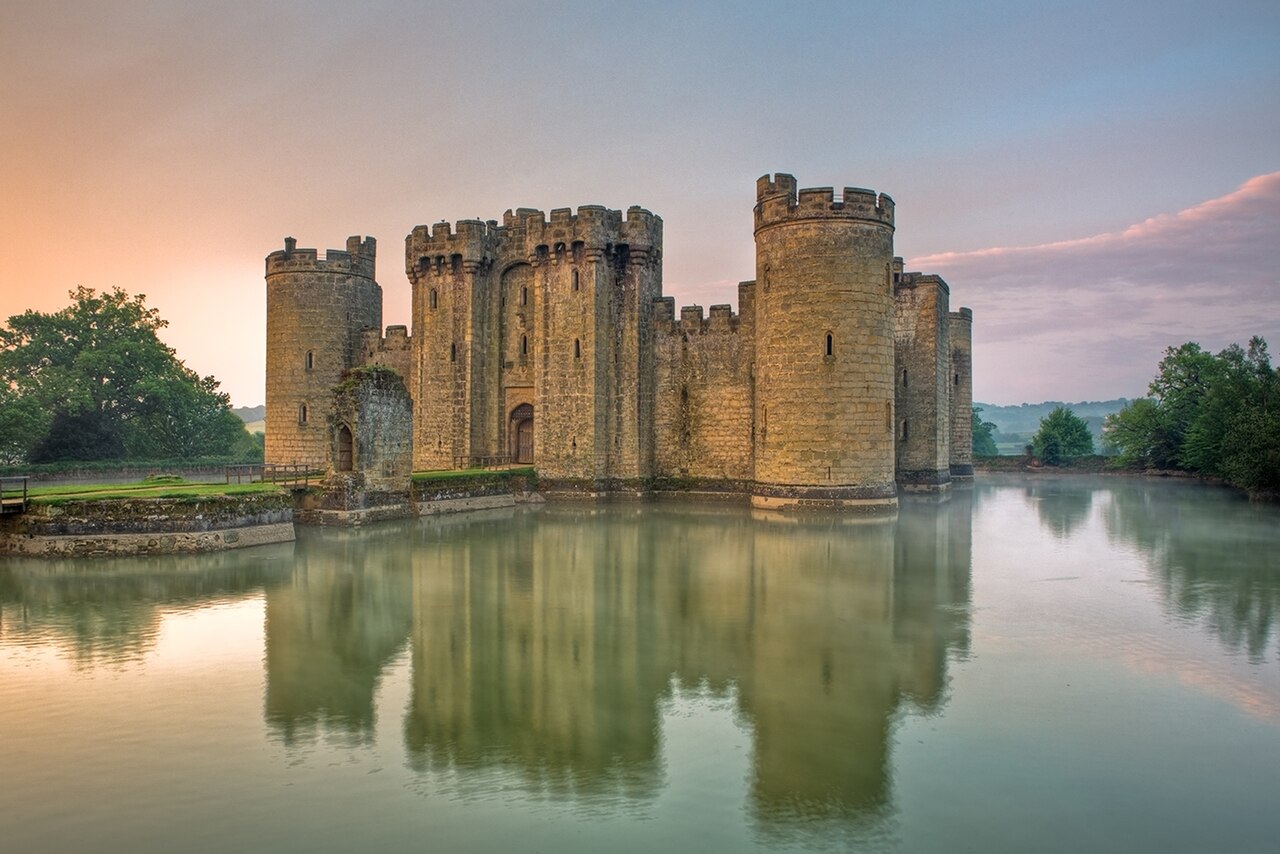
Ask a child to draw a castle and you get something like Neuschwanstein: elegant, picturesque, white, with slender towers ending in conical turrets. Neuschwanstein is a nineteenth-century fantasy, built for a Bavarian king in 1869 as a tribute to Wagner operas. It is not a medieval castle. Most of the buildings people think of as castles, including Disney's logo silhouette, are either Romantic-era reimaginings or Victorian country houses with decorative crenellation. The real medieval castle was smaller, uglier, smellier, and more defensible than anything Disney would design.
Understanding the real castle helps with Building Guessr because the game's Castle filter mixes authentic medieval fortifications with later revivals, and distinguishing them is part of the challenge.
What a castle was for
A castle was not primarily a palace or a museum. It was a private fortified residence that allowed a lord to control territory, collect taxes, and shelter his family and retainers during attack. The castle concept emerged around the tenth century as Carolingian central authority collapsed in Western Europe. Local strongmen needed defensible bases, and they got them by building on any site with natural advantages: a hill, a river bend, a cliff, a headland.
Almost every medieval castle did three things at once. It was a military base, the functional equivalent of a modern police station; an administrative center, where rents were collected and disputes were judged; and a residence for the lord's family, his staff, and the household knights. Rural lords in England, France, and the Holy Roman Empire often ran their entire political lives from within a single castle.
Motte-and-bailey origins
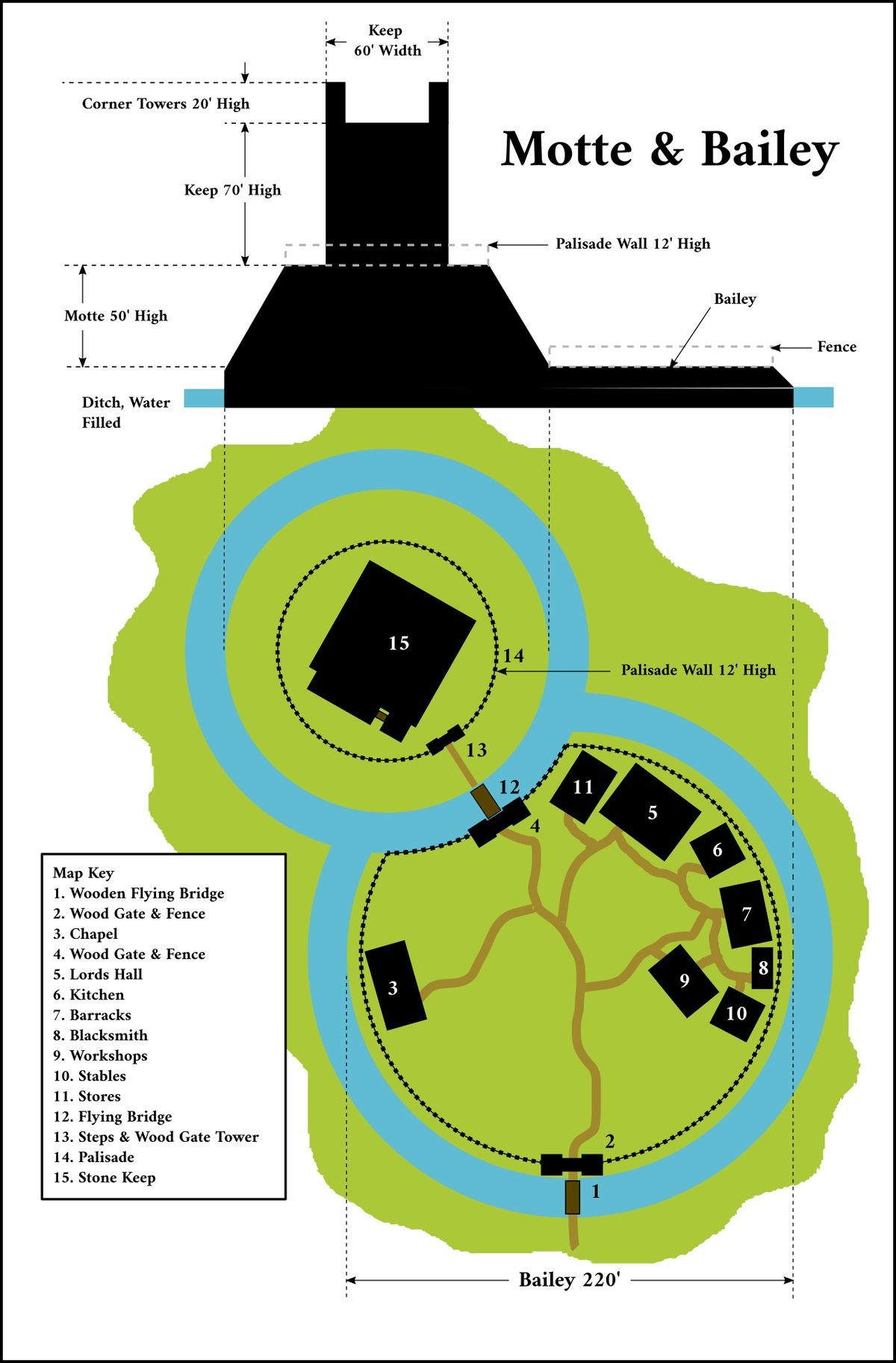
The earliest castles were not stone. After William the Conqueror invaded England in 1066, his Norman followers built hundreds of motte-and-bailey castles across Britain in under a generation. The motte was an artificial earth mound, maybe ten to thirty meters high, with a wooden tower on top. The bailey was a fenced enclosure at the base containing stables, kitchens, and troop quarters. The whole thing could be thrown up in weeks with local forced labor, and it was enough to dominate a village.
Timber castles rotted and burned, so by the twelfth century the richer lords were rebuilding in stone. The motte became a round stone tower (a keep), the bailey became a curtain wall, and the whole arrangement began to look more like the castles in storybooks.
The concentric stone castle
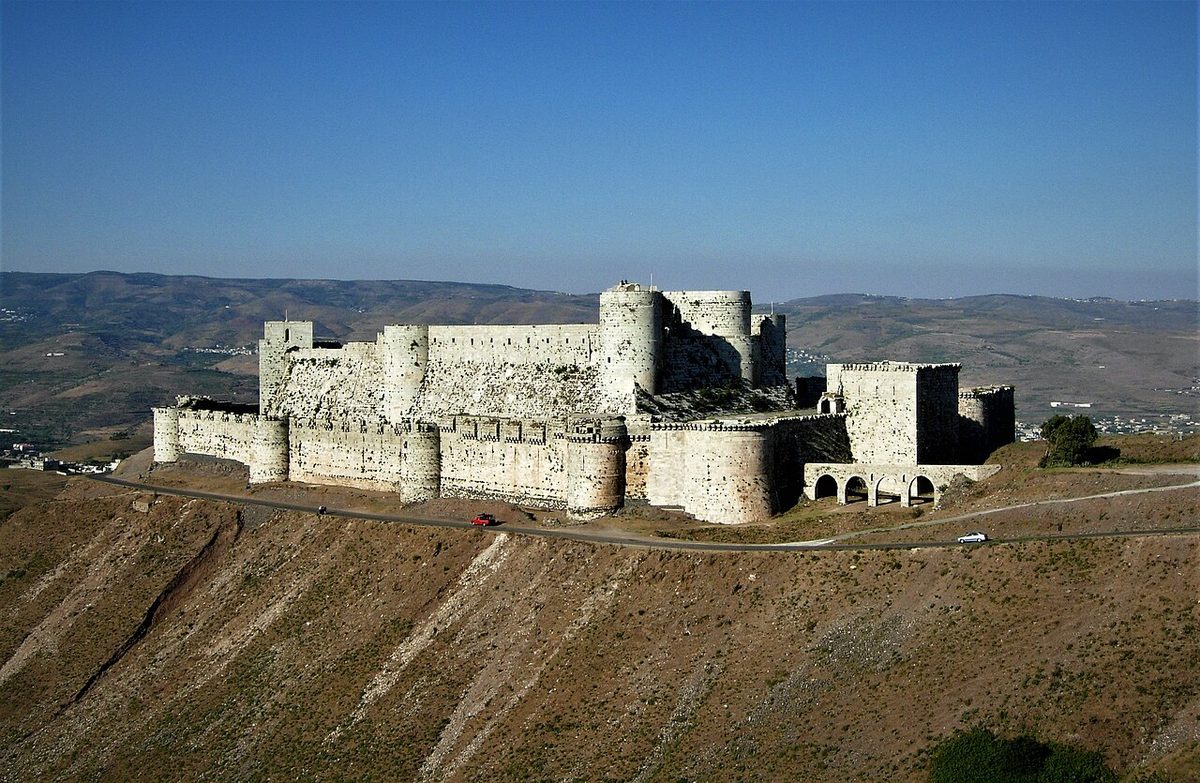
By the thirteenth century, crusader contact with Byzantine and Muslim fortifications had taught European lords about layered defense. The result was the concentric castle: an inner ring of high walls surrounded by a lower outer ring, with the space between them a killing ground. Attackers who breached the outer wall found themselves stuck in a narrow corridor under fire from the higher inner wall. The Welsh castles Edward I built in the 1280s, like Beaumaris and Harlech, are textbook examples; Krak des Chevaliers in Syria is the Middle Eastern prototype.
Key military features you can spot in surviving concentric castles: machicolations, stone projections from the top of a wall with floor openings for dropping things onto attackers; arrow slits, tall narrow openings flared inward so a defender has a wide firing arc through a small external target; barbicans, gatehouse fortifications set forward of the main wall to funnel attackers into a kill zone; and moats, which were more often dry ditches than water-filled, because still water meant mosquitoes and disease.
Inside daily life
A working medieval castle was cramped, smoky, dark, and cold. Most rooms were heated by open hearths; real chimneys did not become common until the fourteenth century, and the great hall in a castle could be so smoke-filled during winter feasts that the upper walls turned black. Windows were small because every window was a defensive weakness and glass was rare. Latrines, called garderobes, were stone chutes that dumped waste into the moat or a pit below the curtain wall.
Food was stored in undercrofts and guarded carefully because a successful siege was won not by breaching walls but by starving defenders out. The population of an ordinary castle was maybe 30 to 100 people in peacetime, swelling to several hundred during war. Most of them slept communally, in hall or barracks, rather than in private chambers. The lord's solar, a small private family room, is often the only space above the ground floor with any reasonable privacy.
Siege and the end of the castle
For three centuries, the defender had the advantage. Walls were thick enough that catapults could batter them for months without breaking through, and hunger worked slowly. The arrival of gunpowder artillery in the fourteenth century changed the equation almost overnight. A well-served cannon could breach a medieval curtain wall in days instead of months. By the sixteenth century, traditional castles were militarily obsolete.
The response was the star fort, a low, angular earth-and-masonry fortification with pointed bastions designed to deflect cannon fire and allow overlapping flanks of defensive gunfire. You can see surviving star forts in Palmanova in Italy, Naarden in the Netherlands, and Fort McHenry in Baltimore. They are technically castles in the sense of fortified defensive architecture, but they look nothing like the medieval version and no one draws them when asked to sketch a castle.
From fortress to residence
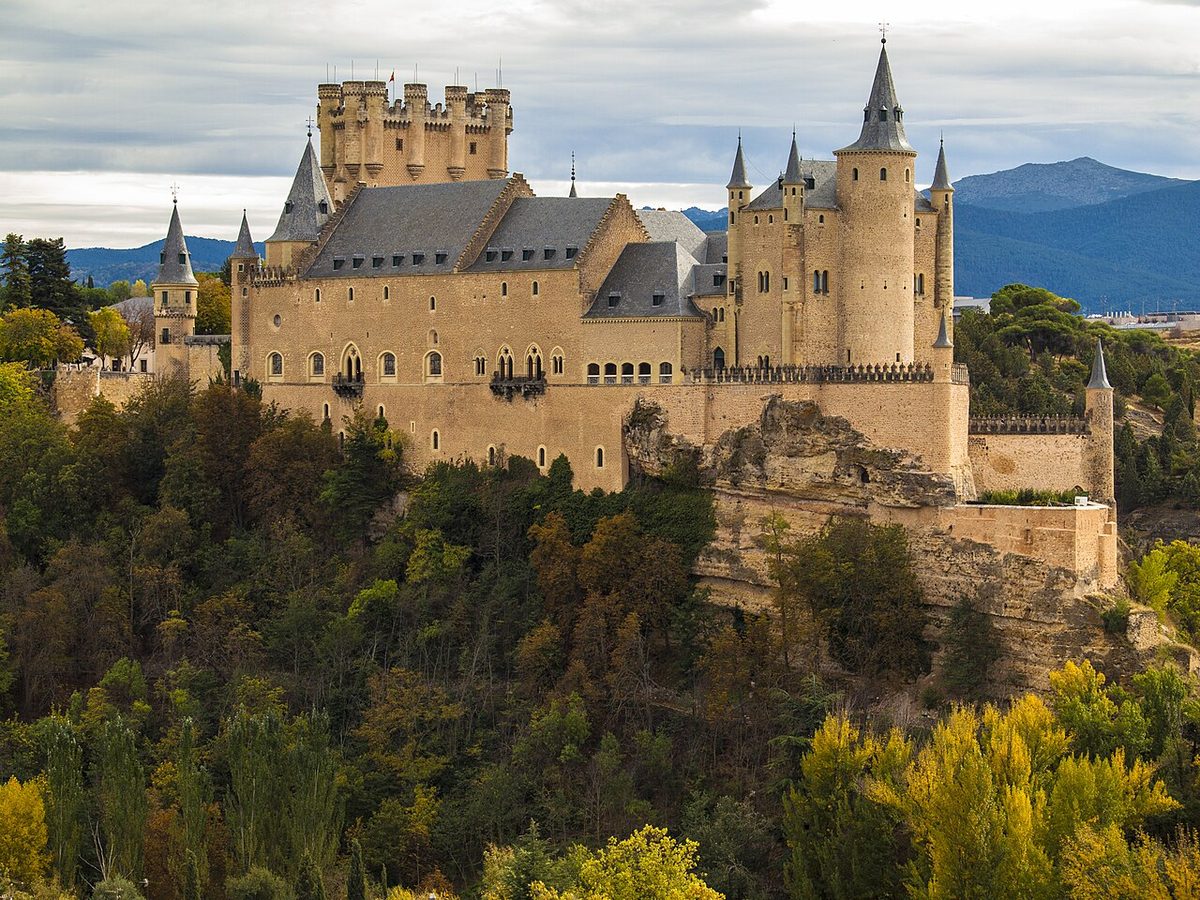
As castles lost their military function, their owners turned them into country houses. Some were demolished during the English Civil War and the French Revolution. Many were modernized, with comfortable wings added, windows enlarged, defensive walls pierced for views, and decorative crenellations added where none had existed before. By the nineteenth century, castle-building was a purely symbolic activity: Neuschwanstein, Balmoral, and hundreds of Gothic Revival country houses were built to look like medieval castles without needing to defend anyone.
The Building Guessr database includes both genuine medieval castles and Romantic revivals; part of the Castle filter's fun is telling them apart. A working rule of thumb: if the castle looks neat, picturesque, and unified in style, it is probably post-1800. If it looks like a jigsaw of additions from five different centuries, with random windows and patched walls, it is almost certainly the real thing.
Seeing castles today
Siege warfare and how it shaped castle design
Every major feature of castle architecture is a direct answer to a specific weapon. The relationship between offense and defense in the medieval period was a continuous arms race, and understanding that race explains the castle's evolution more clearly than any purely aesthetic history can.
The earliest threats were simple: battering rams and scaling ladders. The response was equally simple — build the walls taller. A ram could break a gate, so gates were reinforced with iron-bound doors, portcullises, and murder holes overhead through which defenders could pour boiling water or drop stones. Scaling ladders could carry men over a wall, so towers were added to allow archers to shoot along the wall face and cut down anyone clinging to a ladder. Every tower, every parapet, every extra foot of curtain wall height exists because somebody, somewhere, found a way past the previous version.
The trebuchet, which became the dominant siege engine by the thirteenth century, changed the calculation. A large trebuchet could hurl stones weighing 100 to 150 kilograms with enough accuracy to batter the same section of wall repeatedly until it collapsed. The defensive response was to make walls thicker — some late medieval curtain walls were four to five meters of solid stone — and to keep the wall profile lower and wider rather than tall and elegant, presenting less surface area to a projectile. Towers were spaced more carefully to allow defenders to cover every stretch of wall with flanking fire.
Undermining was a completely different threat. Siege engineers would tunnel under a corner tower, shore the tunnel with timber, fill it with combustible material, and set it alight. When the timber burned away, the tunnel collapsed — and so did the tower above it. The defensive answer to undermining was the round tower. A square tower has four corners, each a potential starting point for a tunnel. A round tower has no corners; the curved base deflects undermining attempts and distributes load differently. This is why you see square towers on early Norman castles and round towers on later thirteenth-century rebuilds: the round form is not decorative, it is a direct tactical response to a specific technique.
The most disruptive development of all was gunpowder artillery, which arrived in European sieges from roughly the fourteenth century onward and became decisively effective by the mid-fifteenth. A cannon firing iron balls did not just break walls — it shattered them into lethal fragments that killed the defenders standing nearby. High masonry became an active liability: the taller the wall, the more rubble rained down on your own garrison when it was hit. By the 1490s, Charles VIII of France demonstrated in Italy that he could reduce fortifications in hours that had previously withstood months of conventional siege. Medieval castle design, as a practical military enterprise, effectively ended within a generation of his Italian campaigns.
What replaced it was the star fort, or bastion fort — a low, wide, angular earthwork faced with stone or masonry, where the pointed triangular bastions eliminated blind spots and allowed cannon to be trained along every approach. The geometry that made star forts look strange to modern eyes was precisely calculated: no section of wall could be approached without being caught in crossfire from two neighboring bastions. Earth absorbed cannonballs far better than stone; even a direct hit produced a dent rather than a cascade of lethal fragments. The logic that built the medieval castle — height and mass — was exactly inverted.
Castles beyond Europe: Japan and India
The castle — a private defensible residence that simultaneously projects military and political authority — is not a uniquely European invention. Wherever local power fragmented and strongmen needed bases to control territory, similar structures appeared. The most significant non-European traditions are those of feudal Japan and medieval India, and both produced castle forms distinctive enough that recognizing them in the game requires separate knowledge.
Japanese castles, known as shiro, developed in a recognizable form during the Sengoku period, the century of near-continuous civil war that ran roughly from the mid-fifteenth to the early seventeenth century. The pressures that produced them were almost identical to those that shaped European castle development: fragmented authority, powerful local lords (daimyo), and the constant threat of military attack. Himeji Castle, completed in 1609 in Hyogo Prefecture, is the finest surviving example and one of the most instructive buildings in the world for understanding Japanese defensive architecture. Its multi-story white-plastered towers rise from a high stone base (the ishigaki), with curved roof tiers at each level that look, from a distance, vaguely like a tiered pagoda. That resemblance is superficial: the flared roof tiers serve the same function as European machicolations, allowing defenders to cover the base of the wall below. The white plaster is fire-resistant render, applied to protect the timber-frame structure from incendiary attack. The plan of Himeji is a maze of switchback paths, dead-end courtyards, and gate sequences designed to disorient attackers who breach the outer perimeter. This is concentric defense by another name.
Indian fortifications present a different set of adaptations, shaped by different terrain and a different political tradition. The great hill forts of Rajasthan — Amber Fort (substantially rebuilt from 1592), Mehrangarh (begun 1459), Chittorgarh (with origins before the seventh century) — exploit rocky outcrops and desert ridgelines in a way that has no direct European parallel. The curtain walls do not form regular geometric plans; they follow the contours of the hillside exactly, making enormous circuits that would require a vast army to besiege effectively. Where Mughal influence is strong, as at Amber, the fortification is integrated with ornate palace apartments, mirrored halls, and formal gardens in a combination of military necessity and courtly display that rivals anything in Western Europe. The red sandstone used throughout Rajasthan gives these structures an instantly recognizable color signature: a deep warm ochre-to-crimson that reads as unlike the grey limestone of French or English castles as it is possible to be.
For the purposes of the game: a white multi-story tiered tower rising from a stone base against a backdrop of Japanese mountain or lowland landscape is almost certainly a Japanese shiro — begin with Himeji as the reference point. A massive wall of red or orange sandstone curving along a rocky ridge, particularly in an arid or semi-arid environment, is almost certainly Rajasthan. Neither looks like what a European child draws when asked to sketch a castle; both are every bit as sophisticated in their defensive logic as anything built by Edward I or Philip II.
Why castles disappeared and what replaced them
The military obsolescence of the castle was swift once gunpowder artillery matured. By the middle of the sixteenth century, no serious military strategist was building the kind of tall-walled, tower-punctuated fortification that had defined European defense for four centuries. The transition was not gradual — it was a decisive break, concentrated in the decades around 1500. What emerged to replace the medieval castle in military terms was the bastion fort, and what emerged to replace it in cultural terms was something far stranger: the Romantic revival castle.
The bastion fort solved the cannon problem through geometry rather than mass. Instead of building higher, engineers built wider and lower, with angular projecting bastions at each corner. The bastions were hollow, mounting cannon of their own, and were angled so that every face of every bastion was covered by fire from the neighboring one. An attacker who battered down one section of wall found himself in a triangular pocket of ground swept by fire from two directions. The trace italienne, as this Italian-originated system was called, spread rapidly through Europe after 1500 and made the medieval castle not just obsolete but actively dangerous to inhabit — the tall walls that once protected defenders now presented a high, fragile target.
The cultural afterlife of the castle is in some ways the more interesting story. The nineteenth century's Romantic movement looked back at the Middle Ages with an idealized nostalgia that had little to do with what medieval life actually involved. Ruins were picturesque; knights were noble; stone towers suggested permanence and lineage. Neuschwanstein, built in Bavaria between 1869 and 1886 for King Ludwig II, is the archetype of this tradition. It has no military purpose whatsoever — its crenellations are decorative, its towers are too narrow to mount meaningful defense, and its hilltop position was chosen for the view rather than for tactical advantage. Ludwig designed it as a stage set for his obsession with Wagnerian opera and medieval romance, and it influenced the aesthetic of fantasy castles so deeply that its silhouette became the Disney logo.
The Romantic revival did not invent fake castles from scratch — it also transformed real ones. Windsor Castle, technically a medieval royal fortress, has been so extensively rebuilt and remodeled since the seventeenth century that much of what visitors see today is Georgian and Victorian work. Alnwick Castle in Northumberland has genuine medieval bones but was refitted with opulent Italian Renaissance-style interiors in the nineteenth century. Identifying a genuine medieval fortification, one where the fabric of the building reflects actual defensive purpose rather than decorative intent, requires looking past the Romantic overlay. The working test is function: do the towers, walls, and gate arrangements make tactical sense? Is the wall profile consistent with pre-gunpowder thinking about height and arrow slits? Are there signs of patching, rebuilding, and functional compromise across different centuries? A building that answers yes to these questions is medieval. A building that looks perfect and unified, especially if the towers are elegant and impractical, is probably telling you a nineteenth-century story.
In the game, this distinction matters. The Castle filter includes both authentic medieval fortifications and Romantic-era revivals, and the visual signatures are different enough to be learnable. Thin towers with decorative turrets and regular, well-preserved stonework belong to a different world than the thick, patched, pragmatic walls of a working medieval garrison. Both are called castles, but only one of them was ever afraid of anything.
A visit to a well-preserved castle like Conwy in Wales, Carcassonne in France, Caerphilly in Wales, or Himeji in Japan gives you a better sense of medieval fortification than any book. Even ruined castles are instructive: the surviving outlines of walls and towers tell you what the defenders were afraid of and where they thought they could win. For related reading, try our essay on leaning towers, which deals with similar stone-and-foundation problems, or the piece on ten famous lost buildings, which includes several destroyed fortifications.
Regional Variations
Castle architecture looks markedly different depending on the region and period. The Norman motte-and-bailey castle, which the Conqueror's followers scattered across England and Normandy after 1066, is the most basic form: an earth mound topped with a wooden tower, a fenced enclosure at the base, the whole thing defensible without skilled stoneworkers or specialist military engineers. These early castles were about speed and territorial control, not permanence. Most were later rebuilt in stone, but their earthwork outlines survive in hundreds of English towns, often visible only as low mounds in a park or churchyard.
The concentric stone castle, perfected in the Crusader states of the Middle East and brought back to Europe by returning knights, represents a conceptual leap. The great Crusader castles, of which Krak des Chevaliers in modern Syria is the finest, were built not by European knights using European methods but by adapting Byzantine fortification principles to the particular landscape of the Levant. Edward I's Welsh castles, built between 1277 and 1295 at Beaumaris, Harlech, Caernarfon, and Conwy, brought the concentric model to its logical conclusion in the British Isles: systematically planned, geometrically rigorous, and funded by the English crown on a scale that no private lord could match. They are, in a sense, military prototypes as much as buildings, each one incorporating lessons from the previous construction. Beaumaris, begun last and never fully completed, is widely considered the most perfect concentric castle plan ever designed.
Japanese castles, or shiro, developed in the Sengoku period from a different set of pressures and arrived at radically different forms. The characteristic multi-story tenshu (keep) tower, rising from a massive sloped stone base called an ishigaki, is the most recognisable element. The white plastered walls, steep roofs with wide upswept eaves, and multiple roof levels stacked above each other give Japanese castles an unmistakable silhouette that is completely unlike anything European. The stone base, irregular and massive, adapts to the natural contours of the site rather than imposing a geometric plan on the landscape. Moorish alcazabas in Iberia, such as the Alcazaba of Málaga, show yet another tradition: fortified enclosures closely integrated with later palatial construction, their irregular walls following ridge lines with a freedom that reflects both the terrain and a different military tradition. Rajput hill forts in India, such as Chittorgarh and Mehrangarh, create enormous circuit walls following rocky outcrops, enclosing not just military garrisons but entire subsidiary towns within their perimeters.
Each regional tradition responds to the same basic problem — how does a relatively small group of people defend itself against a much larger attacking force? — with solutions shaped by local materials, climate, terrain, and the particular weapons the attackers were likely to bring. Understanding these regional variations is the key to recognising castle typology in the game, where a building labeled "castle" might be a Norman keep in Normandy, a Crusader citadel in Lebanon, or a Rajput hill fort in Rajasthan.
Key Identifiers
- Crenellated parapet (alternating merlons and crenels along the top of a wall, also called battlements)
- Round or square towers projecting from the curtain wall to allow flanking fire
- Gatehouse with portcullis slot visible in the arch passage
- Moat or dry ditch encircling the base of the walls
- Curtain wall connecting towers into a continuous defensive perimeter
- Keep (innermost tower), often taller and with thicker walls than the curtain
- Evidence of drawbridge mechanism (corbels, pivot holes, or drawbridge pit)
- Machicolations — stone projections corbelled out from the wall top with floor openings for dropping objects on attackers
- Arrow slits (tall narrow openings, often with splayed interior jambs for a wide firing arc)
- Multiple concentric rings of walls at different heights (concentric castle type)
A Closer Look: Krak des Chevaliers
Krak des Chevaliers, in what is now western Syria near Homs, is one of the best-preserved medieval castles anywhere in the world and arguably the most complete surviving example of concentric castle design. The name combines the Arabic qalat al-Hosn (fortress of the lord) with a Frankish corruption of the Syrian Aramaic krak, meaning fortification. Held by the Knights Hospitaller from 1142 until its fall to the Mamluk sultan Baybars in 1271 — a siege of only a few weeks, ending when the Hospitallers negotiated terms rather than hold out indefinitely — it functioned as a major regional military headquarters for over a century.
The concentric plan solves a specific tactical problem: how do you continue to defend a large fortification even after the attacker has breached the outer wall? At Krak, the outer wall encloses an irregular outer courtyard bounded by a lower set of towers; beyond the outer wall is a massive inner ward at higher elevation, surrounded by a second, taller set of walls with three enormous round towers on the south and west sides. The space between inner and outer walls, the lice or killing ground, is a narrow passage around the base of the inner curtain that an attacker who breaches the outer wall is forced to traverse under fire from both the outer (still partially defended) and inner walls simultaneously. The great round towers of the inner ward — some with walls nine meters thick at the base — house the garrison's living quarters, the great hall, a Gothic chapel, and storage facilities. The entire ensemble covers an area of roughly 3 hectares on a natural spur of rock 650 meters above sea level, visible from enormous distances and controlling the Homs Gap, the only easy route between the Syrian interior and the Mediterranean coast.
What makes Krak particularly instructive is the legibility of its building phases. The earliest Hospitaller work is visible in the inner ward's masonry style; later thirteenth-century additions added the great south tower and the elaborate vaulted aqueduct that supplied the castle's water cisterns. You can read the garrison's growing confidence in their engineering, and their growing nervousness about the military situation, in the sequence of improvements. By the time Baybars took it, Krak was probably the most sophisticated fortification in the world. The fact that it fell not to a direct assault but to a forged letter purportedly ordering the garrison to surrender to safe conduct terms says something about the limits of even the best military architecture when politics and logistics eventually overwhelm it.
Spotting It in Building Guessr
In Building Guessr, the Castle or Military / Fortification filter will surface castles and related defensive structures. The key visual distinction between a genuine medieval castle and a later palace or Romantic revival is the geometry of defense: a castle's towers are positioned to allow flanking fire along the curtain walls (so they project outward from the wall face), its gate is elaborately defended and narrow (not the grand ceremonial entrance of a palace), and its overall form reads as a response to an external military threat rather than as an expression of internal comfort or ceremonial display. Look for the ring of walls with towers at intervals, the elevated position chosen for observation and defense rather than for views, and the absence of large windows at lower levels.
Japanese castles present a different challenge in the game: the tenshu tower and the ishigaki stone base are visually distinctive, but the surrounding landscape is essential for confirmation — Japanese castles sit in Japanese landscapes, with the characteristic quality of light, vegetation, and settlement pattern that distinguishes Japan from any other part of East Asia. Rajput hill forts are distinguished by the color of their stone (deep red or orange sandstone), the scale of the circuit walls following the ridgeline contours, and the characteristic profile of Rajasthan's semi-arid landscape. Getting good at the Castle filter means building a mental library of these regional sub-types so that you can identify not just "castle" but "what kind of castle, from where, and roughly when."
Put the Castle filter on and see which ones you can place.
Play Building GuessrFurther Reading
Sources & further reading
Reference material this page draws on, and where to read further. External links open third-party sites.
- Castle · Wikipedia
- Motte-and-bailey castle · Wikipedia
- Concentric castle · Wikipedia
- Krak des Chevaliers · Wikipedia
- Keep · Wikipedia
- Siege · Wikipedia
- World Heritage listing: Krak des Chevaliers · UNESCO World Heritage Centre