Before skyscrapers: why cities stayed low
For most of human history, cities were low. Load-bearing masonry limits a building to roughly six or seven stories before the walls at the base become too thick to fit useful rooms behind them. Water pressure could not reach higher floors. Nobody wanted to climb ten flights of stairs every day. Fire was a constant threat and ladder-and-bucket firefighting became useless above a certain height. The tallest structures in a pre-industrial city were almost always religious: cathedral spires, minarets, pagodas, bell towers. Everything else was an even plain of four- and five-story housing.
Three nineteenth-century inventions changed the math. The safe elevator, patented by Elisha Otis in 1852, meant people would actually use upper floors. Bessemer steel, produced industrially from 1856 onward, gave builders a material strong enough to carry weight in a skeleton rather than in walls. And improved plumbing and pumping got water to heights that had been impossible a generation earlier. Everything in skyscraper history is built on those three changes.
The Chicago School (1885 to 1910)
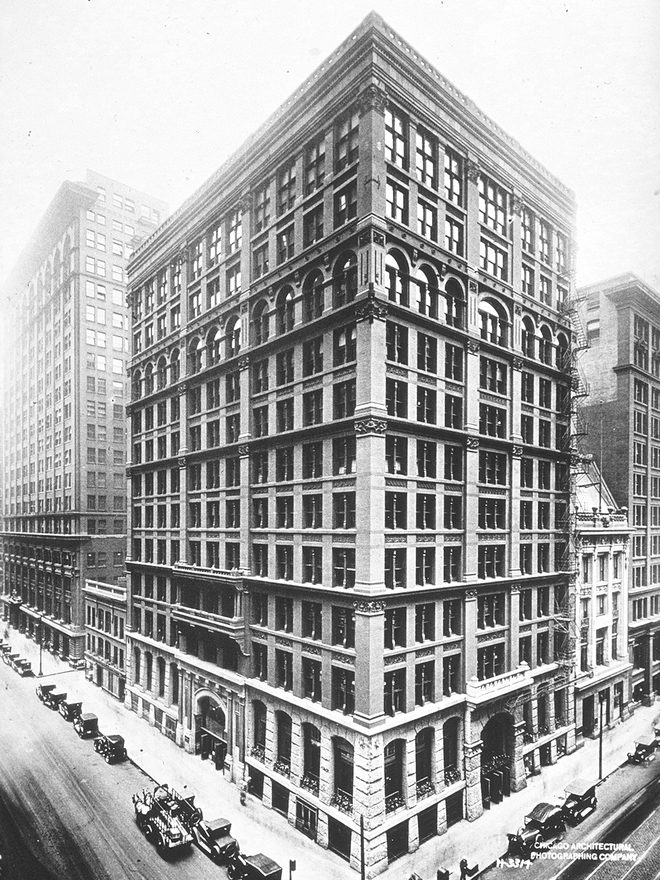
The first true skyscrapers appeared in Chicago after the Great Fire of 1871 cleared huge portions of the downtown. Insurance companies wanted bigger buildings on small lots. The Home Insurance Building, completed in 1885 by William Le Baron Jenney, is usually cited as the first, at ten stories and 42 meters. More important than its height was its skeleton: a steel and iron frame that carried the load, with walls reduced to a weather-proof skin.
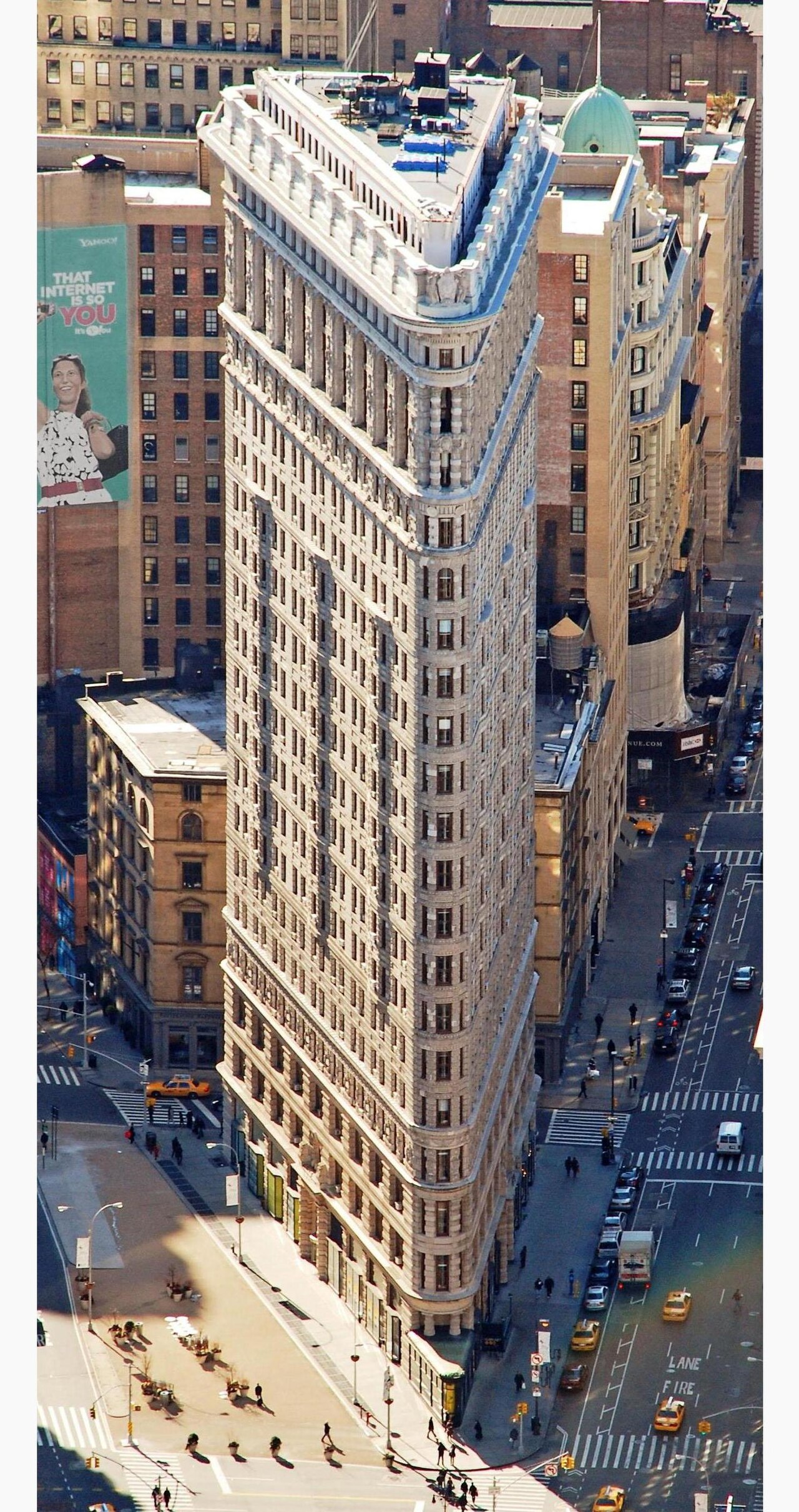
Over the next twenty-five years, Chicago architects like Louis Sullivan, Daniel Burnham, and John Wellborn Root worked out the grammar of the new type: a clear base, a long middle shaft of repeated floors, and a decorative top. Sullivan's maxim "form follows function" dates from this period. New York quickly followed; the Flatiron Building (1902) and the Woolworth Building (1913) announced that the skyscraper was no longer a Chicago specialty.
Art Deco and the race to the sky (1920s and 30s)
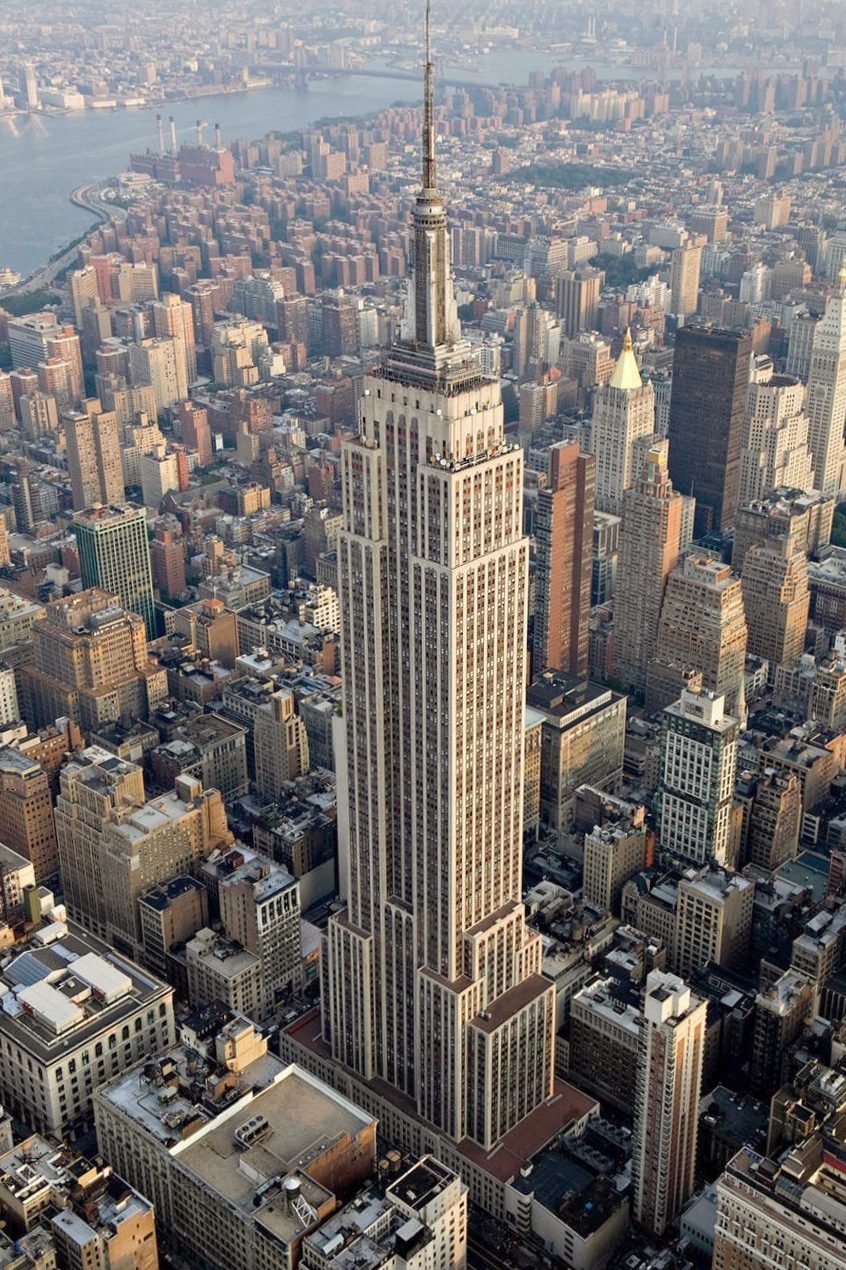
In 1930 and 1931, New York produced three landmarks in eighteen months: the Chrysler Building, 40 Wall Street, and the Empire State Building. All three briefly held the title of world's tallest. The Empire State settled the matter at 381 meters (443 with its later antenna) and held the record for forty years.
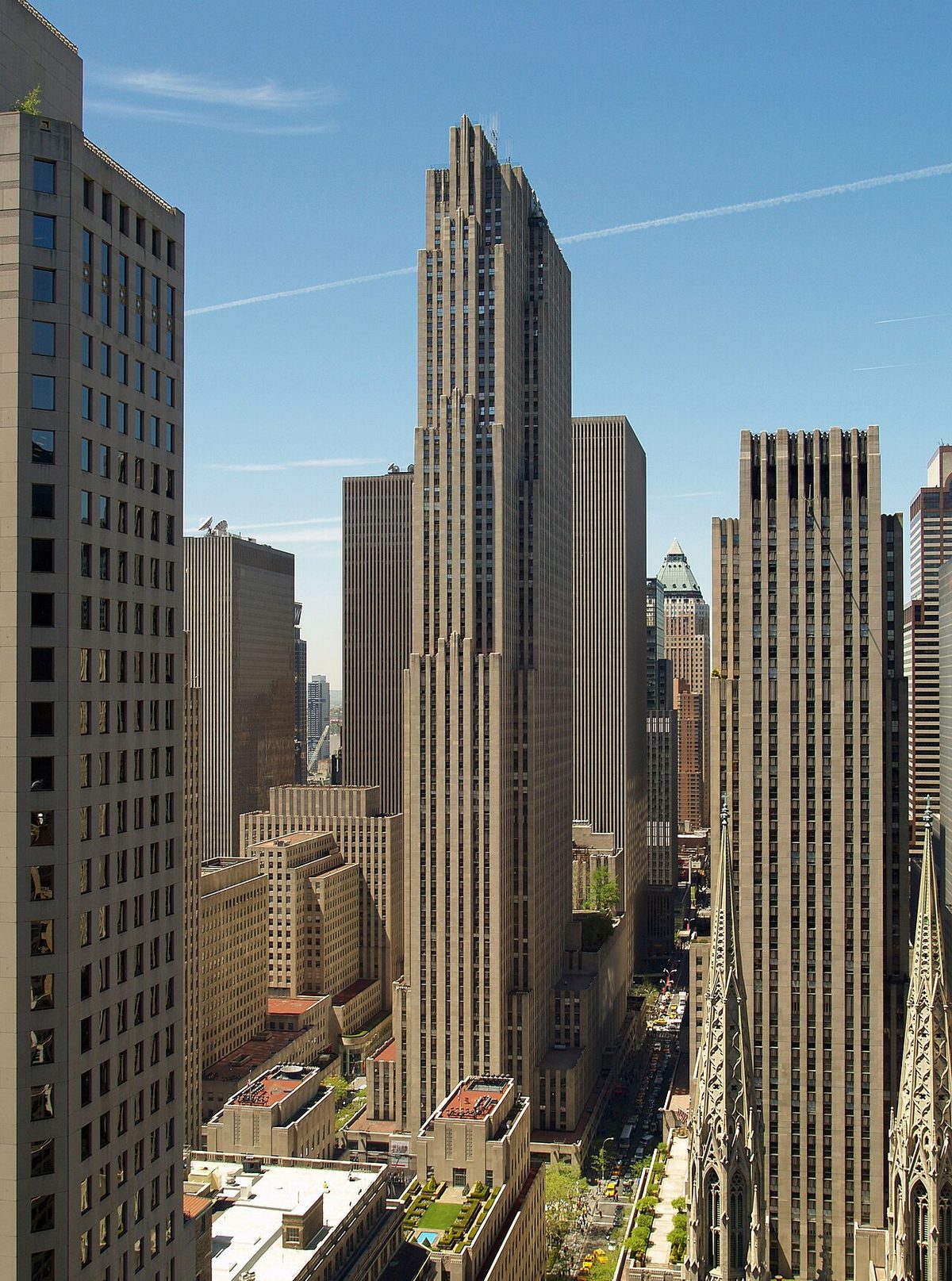
These buildings are the Art Deco skyscrapers most people picture when they hear the word. They are ornamental in a way modernists would later reject: Chrysler's eagle gargoyles and stainless-steel sunburst crown, the Empire State's tiered setbacks and aluminum spandrels. Setbacks were partly aesthetic but mostly legal, a response to New York's 1916 zoning law that required taller buildings to step back so they did not cast their neighborhoods into perpetual shadow. The setback-ziggurat silhouette that became an Art Deco trademark is really a legal document expressed in stone.
International Style: glass boxes (1950s to 1970s)
After World War II, skyscraper design was taken over by European modernism. Mies van der Rohe's Seagram Building (1958) in New York and Lever House (1952) across Park Avenue redefined the type: flat tops, no ornament, curtain walls of glass and aluminum, plinths set back from the street to make a plaza. The ethic was functionalist and universal; a Miesian tower in Chicago looked almost identical to one in Frankfurt or Tokyo.
This era produced the Sears Tower (now Willis Tower, 1973) in Chicago, the original World Trade Center towers (1973) in New York, and dozens of near-identical corporate headquarters in every major city. Critics came to call the style "curtain-wall boredom," but it defined the look of downtown North America for a generation and was widely exported.
Postmodernism and its discontents (1980s and 90s)
By the late 1970s, architects were tired of glass boxes. The postmodern reaction brought ornament back, often ironically. Philip Johnson's AT&T Building (1984), now known as 550 Madison, put a Chippendale pediment on top of a thirty-seven-story tower. Cesar Pelli's Petronas Towers (1998) in Kuala Lumpur crowned a modernist form with Islamic geometric detail and passed the Sears Tower as the world's tallest.
The Petronas record turned out to be important: the tallest building in the world was no longer in North America, and would not be again. Asian cities started building taller than Western ones in the 1990s and the gap has widened since.
Supertalls: the Burj Khalifa era (2010 to today)
A building over 300 meters is called a supertall; over 600 meters is a megatall. In 2010, Dubai's Burj Khalifa opened at 828 meters, by some margin the tallest structure ever built. It is not alone. Shanghai Tower (2015) reached 632 meters. The Merdeka 118 in Kuala Lumpur (2023) hit 679 meters. Saudi Arabia's Jeddah Tower, paused and restarted multiple times, is still officially pursuing 1,000 meters.
The engineering behind supertalls relies on two innovations. The first is the buttressed core: a central concrete core with wings radiating outward, like the Burj Khalifa's Y-shaped footprint, which stiffens the tower against wind. The second is the outrigger system, where horizontal trusses tie the core to the perimeter columns so the whole building resists sway as one unit. Tuned mass dampers at the top, giant pendulums or water tanks that counter-swing during gusts, are now standard above a certain height.
What comes next
The economics of supertalls are shaky. Above roughly 500 meters, each additional floor costs more than it can ever earn in rent. Many recent supertalls are branding exercises paid for by states or state-connected developers, not pure real estate plays. The next frontier is therefore less about raw height and more about sustainability: mass-timber skyscrapers like Mjøstårnet in Norway (2019, 85 meters), structural carbon reduction, and integrated renewable generation.
For a sense of where the current records sit, play the Skyscrapers filter in the game. For related reading, try our piece on brutalism, which shaped mid-century tall buildings, or famous architects to know, which profiles several of the designers mentioned above.
Regional Variations
The skyscraper began as an American type and remained primarily a North American building form for most of its first century. Chicago and New York defined the parameters — the steel frame, the curtain wall, the elevator, the setback-governed silhouette — and every other city's tall buildings were responses to, adaptations of, or reactions against those parameters. This changed definitively in the 1990s when Asian cities began not just matching North American skyscrapers in height but exceeding them with buildings that reflected entirely different cultural, climatic, and economic conditions.
In Asia, the skyscraper became something different from what it was in Chicago. The Petronas Towers in Kuala Lumpur (1998) were the first signal: twin towers designed by Argentine-American architect César Pelli, their stepped profiles and geometric ornament derived from Islamic architectural tradition, topped with steel spires that pushed them past the Sears Tower. The towers were not purely functional office buildings — they were statements of national ambition, designed to announce Malaysia's arrival as a modern Asian nation on a global stage. Shanghai Tower (2015) takes the same logic further: a twisting glass form that wraps a second-skin curtain wall around an inner tower, creating a buffer zone between the interior and exterior that reduces wind loads and heating costs simultaneously. The architectural form and the engineering solution are the same gesture, which is a characteristic of the most sophisticated contemporary supertalls. In Taiwan, the Taipei 101 (2004) used a segmented bamboo-stalk silhouette reference to draw on East Asian architectural tradition while housing within it one of the world's largest and most precisely engineered tuned mass dampers: a 660-metric-ton golden sphere suspended by cables in the upper floors that swings to counteract building sway during typhoons and earthquakes.
The Gulf states — particularly the UAE, Qatar, and Saudi Arabia — approached the supertall as a tool of national branding in the most direct possible way. The Burj Khalifa exists not because Dubai needed office space at 600 meters above street level (it largely doesn't) but because the Sheikh and his advisors understood that the world's tallest building would function as a permanent advertisement for Dubai as a place to invest, to visit, and to move a business to. The engineering cost of the upper floors — where rental rates are low and structural costs per square meter are astronomical — was effectively marketing expenditure, not real estate development. This logic has spread to neighboring states: the Merdeka 118 in Kuala Lumpur and the planned Jeddah Tower in Saudi Arabia both follow the same political economy, in which record height is the point, not a side effect.
European cities have been conspicuously resistant to the supertall. London's tallest building, the Shard (completed 2012), is 310 meters — substantial, but far short of the Gulf and Asian leaders. Frankfurt's Commerzbank Tower (1997, 259 meters) held the European record for decades. The resistance is partly cultural — European cities tend to treat their historic skylines as assets worth protecting — and partly a matter of planning law: height limits, protected view corridors, and strong preservation lobbies make it extremely difficult to build above a certain threshold in most European city centers. The London skyline debate, which has been continuous since the Shard was proposed in the late 1990s, reflects a genuine and unresolved argument between those who see tall buildings as symbols of economic vitality and those who see them as threats to the legibility and human scale of a historically layered city. That argument has no counterpart in Dubai or Shanghai, where height is straightforwardly desirable and planning systems are more accommodating of developer ambition.
Key Identifiers
- Steel or concrete structural frame (not load-bearing masonry walls): the fundamental enabling technology of the skyscraper
- Curtain-wall facade: glass or metal cladding hung from the structural frame, not carrying load
- Repeated floor plates stacked vertically, visible as a regular horizontal rhythm of spandrel panels and window bands
- Mechanical core at center: elevator banks, stairwells, and HVAC ducts grouped in a central shaft visible in floor plans
- Setbacks at upper floors (Art Deco era, pre-1940): the ziggurat silhouette caused by New York's 1916 zoning law
- Flat top with no ornament (International Style, 1950s–70s): the Miesian glass box, curtain-wall boredom
- Pediment, pinnacle, or historicist ornament at top (postmodern, 1980s–90s): the reaction against the glass box
- Twisting, tapering, or organic form (contemporary supertall, 2000s–present): parametric structural optimization
- Diagrid structural skin: triangulated exterior framework visible through the glass, eliminating corner columns
- Tuned mass damper reference in marketing materials or visible internally: characteristic of supertalls in typhoon or earthquake zones
A Closer Look: Willis Tower, Chicago
The Willis Tower (completed 1973, originally Sears Tower, designed by Bruce Graham of Skidmore, Owings & Merrill with structural engineer Fazlur Rahman Khan) held the record as the world's tallest building from its completion until the Petronas Towers surpassed it in 1998 — a reign of 25 years that no subsequent tower has matched. At 442 meters to roof (527 meters to antenna tip), it is still the tallest building in the Western Hemisphere and the eighth-tallest in the world. But its significance in architectural history is not primarily about height. It is about the structural system that made the height possible.
The structural innovation at Willis Tower is what Fazlur Khan called the bundled tube system. The basic idea is simple once stated but was genuinely novel when Khan developed it: instead of a single structural tube (the system used in earlier tall buildings, where the perimeter frame carries lateral wind loads), bundle nine separate steel tubes together, each one strong enough on its own, and allow them to work together as a single composite structure. The nine tubes at Willis Tower are arranged in a three-by-three grid, each 22.9 meters square on plan, and they share walls where they meet — so each shared wall is doing double duty, reducing the total amount of steel required. The bundled tubes are also differentiated in height: two corner tubes rise to the full 110 stories, two others step down at 66 stories, another two at 90 stories, and the remaining three at 50 stories. This stepping produces the distinctive silhouette — a cluster of tubes at different heights, like a fist of uneven fingers — that makes the Willis Tower immediately recognisable from a distance.
The structural efficiency of the bundled tube system meant that Willis Tower used significantly less steel per floor area than the World Trade Center towers built in New York around the same time. The WTC towers used a load-bearing perimeter frame of closely spaced steel columns — dense and visually distinctive — while Willis Tower's perimeter is a more open grid of larger, more widely spaced columns. The difference in visual texture between the two approaches is part of what makes them recognisable despite being contemporary and similarly tall. Khan's bundled tube became one of the foundational ideas of structural engineering for tall buildings; its descendants can be seen in the Petronas Towers' ring-tube structure and in the outrigger-and-core systems that dominate contemporary supertall engineering.
Spotting It in Building Guessr
Very tall buildings in the game almost always appear in urban context — dense, developed city centers rather than isolated suburban or rural settings. The Skyscrapers filter will surface them directly, but you can also encounter them as context in street-level photographs of major city downtowns. The key identification challenge is usually not identifying that a building is a skyscraper but identifying which era and which city or country it belongs to.
For era identification: the setback ziggurat silhouette and masonry or terracotta cladding (Art Deco, New York primarily); the flat-topped glass box with bronze or dark aluminum framing (International Style, 1950s–70s, anywhere from Chicago to Frankfurt); the ornamental top or historically referencing cap (postmodern, 1980s–90s, worldwide); the twisting or parametric form (contemporary, 2000s–present, predominantly Asia and Gulf). For location within era: Art Deco supertalls are almost exclusively North American; contemporary supertalls are predominantly Asian or Gulf. London's Gherkin and Shard have distinctive forms that are learnable on their own. Chicago's bundled-tube silhouette, New York's Art Deco spires, Shanghai's twisting towers, and Dubai's Y-section buttressed-core profile are all recognisable with familiarity. Build the visual library, and the Skyscrapers filter becomes one of the more tractable rounds in the game.
Think you can spot supertalls on the skyline? Try a round.
Play Building GuessrFurther Reading
Sources & further reading
Reference material this page draws on, and where to read further. External links open third-party sites.
- Skyscraper · Wikipedia
- Home Insurance Building · Wikipedia
- Chicago school (architecture) · Wikipedia
- Empire State Building · Wikipedia
- Burj Khalifa · Wikipedia
- Louis Sullivan · Wikipedia
- Curtain wall (architecture) · Wikipedia