Why names matter
Knowing an architect's name is not just cultural trivia. Most prolific architects have a personal vocabulary of shapes, materials, and moves that show up again and again across their work. Once you have that vocabulary in your head, you can often identify an unfamiliar building as "probably a Gehry" or "this has to be Ando" from a photograph alone, and that pins the building to a likely city or region in seconds. This article walks through ten architects whose work you will see over and over in landmark games and in real travel.
Frank Lloyd Wright (1867–1959)
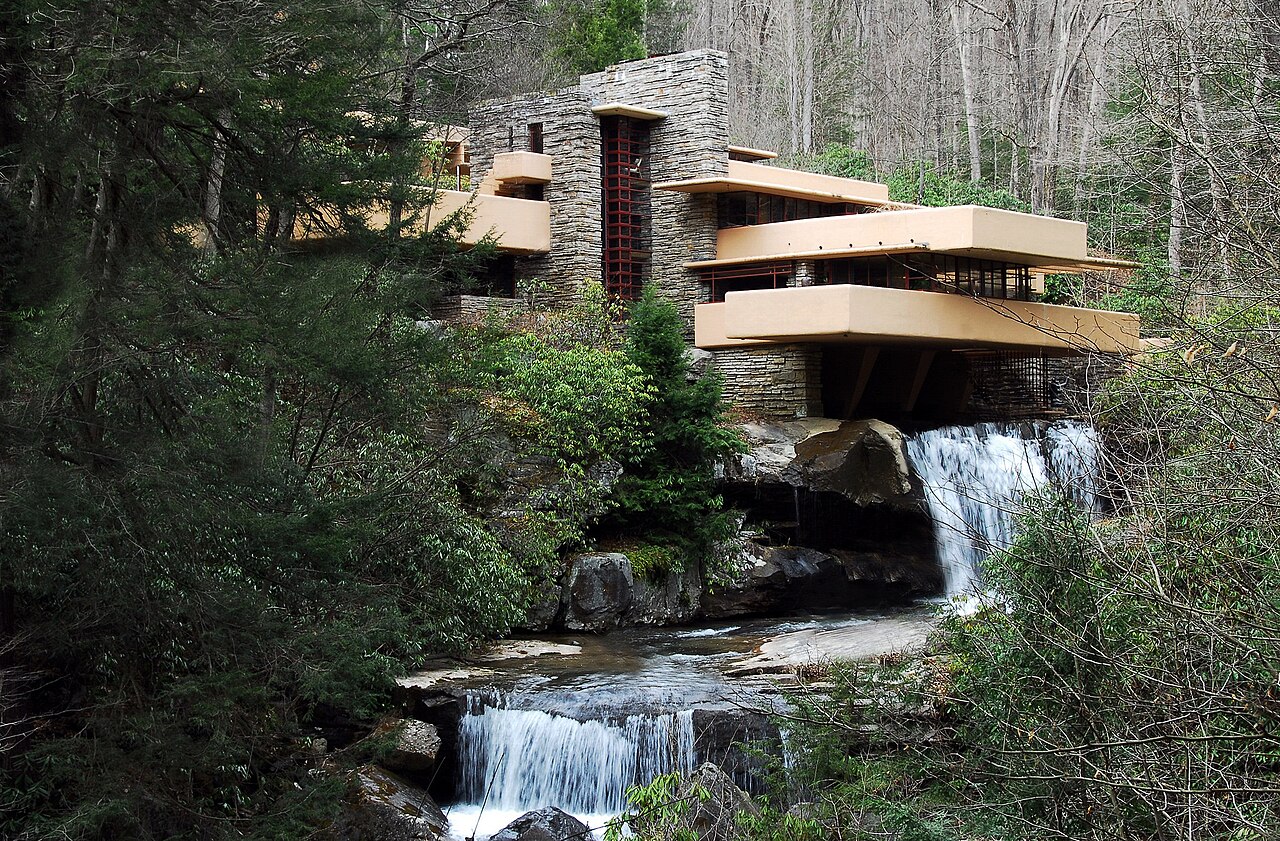
Frank Lloyd Wright spent more than seventy active years reshaping the way Americans thought about domestic space and the relationship between built form and natural landscape. His Prairie Style, developed in the early 1900s across the suburbs of Chicago and the broader Midwest, was a direct repudiation of the Victorian box: rooflines ran low and horizontal, deeply overhanging eaves sheltered broad terraces, and windows were grouped in long ribbons that let the horizon into every room. Materials — brick, limestone, raw timber — were chosen to echo the colours of the surrounding earth rather than impose a foreign palette. Wright believed that a building and its site were inseparable, and his floor plans dissolved internal walls to create what he called the "destroyed box," an open, flowing interior that became the template for most twentieth-century suburban house design. Fallingwater (1939), cantilevered over a waterfall in rural Pennsylvania, is probably the single most recognisable house in American history.
Wright's late career, extending well into his eighties, produced some of his most daring work. The Solomon R. Guggenheim Museum in New York (1959, completed the year of his death) is a continuous concrete spiral ramp that coils upward around a skylit atrium, making the act of moving through the building inseparable from the act of viewing art. Critics argued — and still argue — that the tilted walls make a poor gallery; admirers counter that no other museum interior is as spatially exciting. Beyond individual buildings, Wright's influence on the open-plan house, the carport, the clerestory window, and the integration of kitchen into living space is so pervasive that his ideas are now simply called "the American house." Recognising his work requires learning to look for the ground-hugging silhouette, the abstract ornament, and the sense that the building is exhaling into its site.
Le Corbusier (1887–1965)
Born Charles-Édouard Jeanneret in La Chaux-de-Fonds, Switzerland, Le Corbusier adopted his pen name and became the twentieth century's most consequential — and most contested — architect. In 1927 he codified his ideas into the Five Points of a New Architecture: pilotis (concrete columns that lift a building off the ground, freeing the earth beneath), a roof garden (reclaiming as usable outdoor space what the footprint had taken), a free plan (interior walls positioned independently of the structural grid), ribbon windows (long horizontal glazing that floods rooms with even light), and a free facade (the exterior wall, also freed from load-bearing duty, treated as pure surface). Villa Savoye (1931) in Poissy, near Paris, demonstrates all five points simultaneously and reads almost like a three-dimensional manifesto: a white box on slender pilots, wrapped in horizontal glass, with a roof terrace above. It is one of the most analysed buildings in the world.
The postwar Le Corbusier moved toward a rougher, more sculptural language. The Unité d'Habitation (1952) in Marseille introduced béton brut — raw, board-marked concrete — and stacked 337 apartments into a single self-contained urban block with shops, a gymnasium, and a running track on the roof. The term "brutalism" derives from this work. His late government buildings at Chandigarh, the planned capital of Punjab commissioned by Nehru's India, are vast monumental forms — the Secretariat, the High Court, the Assembly — shaped by climate as much as ideology: deep brise-soleils cast permanent shade over glass walls. Le Corbusier's ideas were seized on by welfare-state housing authorities worldwide and applied with far less skill and far less generosity of space, producing the tower-block estates that blighted mid-century cities. That legacy divides opinion to this day, but the master's own buildings remain among the most powerful of any century.
Mies van der Rohe (1886–1969)
Ludwig Mies van der Rohe distilled modernism to its logical extreme. Where Le Corbusier was polemical and theatrical, Mies was laconic: his guiding motto, "less is more," expressed an entire philosophy in four words. Trained as a stonemason's son in Aachen, he rose to direct the Bauhaus in its final years before emigrating to the United States in 1938, where he remade Chicago's Illinois Institute of Technology campus and then turned his attention to the commercial tower. The Barcelona Pavilion (1929), built for the German national exhibit at the International Exposition, was a horizontal composition of eight steel columns supporting a thin roof plane above planes of marble, onyx, and glass — no rooms, no program, pure architectural experience. It was demolished after the fair and reconstructed in the 1980s; it remains one of the most visited works of architecture in the world despite containing almost nothing.
In New York, Mies produced his definitive tall building: the Seagram Building (1958) on Park Avenue, a bronze-and-glass tower set back from the street on a travertine plaza. Every detail — the non-structural bronze I-beams welded to the curtain wall to articulate its grid, the amber-tinted glass, the consistent interior spacing — was designed with a precision that lesser imitators could not replicate. The Seagram Building spawned thousands of dark-glass corporate towers across every major city, most of them lacking Mies's fastidiousness. The phrase "Miesian curtain wall" became architectural shorthand for a global commercial vernacular that still defines urban skylines from Chicago to Shanghai. Identifying a Mies building is easy; identifying one of his inferior imitators requires knowing what the original actually looks like.
Zaha Hadid (1950–2016)
Zaha Hadid was born in Baghdad, studied mathematics at the American University of Beirut, and trained under Rem Koolhaas at the Architectural Association in London. For much of the 1980s and early 1990s she was better known as a painter of explosive, fragmented architectural drawings than as a builder; her competition wins regularly went unbuilt because contractors could not figure out how to construct what she had drawn. That changed when parametric design software matured sufficiently to allow her studio to translate the fluid, non-Euclidean geometries of her drawings into buildable geometry. In 2004 she became the first woman to win the Pritzker Prize, architecture's highest honour, a recognition that arrived relatively late given the quality of her built work by that point. Her forms — surfaces that curl, fold, and accelerate like frozen fluid dynamics — are unmistakable.
The MAXXI National Museum of 21st Century Arts (2010) in Rome threads a complex of overlapping concrete volumes through a former army barracks site, with circulation ramps that feel more like riverbeds than corridors. The Heydar Aliyev Centre (2012) in Baku, Azerbaijan, is a single continuous surface that lifts off the ground, curves overhead, and settles again, enclosing auditoria, exhibition halls, and a conference centre without a single visible corner. Both buildings demonstrate the construction challenges that characterised Hadid's career: her flowing surfaces required extraordinary precision in formwork, glass cutting, and panel fabrication, and her projects consistently ran over budget and schedule. She died of a heart attack in 2016 at 65; her firm, Zaha Hadid Architects, continues under Patrik Schumacher and remains one of the most influential practices in the world.
Antoni Gaudí (1852–1926)
Antoni Gaudí is the only architect whose entire major output is concentrated in a single city — Barcelona — and whose work has become so identified with that city that it is nearly impossible to separate the two. He trained in Barcelona in the 1870s, initially in a historicist Gothic Revival vein, but rapidly developed a personal language rooted in structural logic and natural observation. The key structural idea behind his apparently chaotic surfaces is the catenary arch: the curve traced by a hanging chain, which, when inverted, is the ideal compression arch because it carries load without bending stress. Gaudí tested his structural systems with hanging chain models, photographed them, and inverted the photographs to produce ceiling and vault profiles that look organic because they follow the same mathematics as trees and bones. This is why his buildings, despite appearing improvised, are structurally among the most sophisticated of their era.
The Sagrada Família basilica has been under construction since 1882, when Gaudí inherited the project from its original architect. He devoted the last fifteen years of his life entirely to it and is buried in its crypt. The building is still under construction and is expected to be completed sometime in the 2030s; it is already the most visited building in Spain. Park Güell, completed in 1914 on a hillside above the city, was commissioned as a garden suburb but only two houses were ever built; it survives as a mosaic-covered public park with serpentine benches, viaducts supported on slanted columns, and a hypostyle market hall. Gaudí belongs to the Catalan Modernisme movement — the local variant of Art Nouveau — but his structural inventions place him closer to the Gothic master builders than to his contemporaries. His work is the easiest of any major architect's to identify: if it looks grown, not built, it is Gaudí.
Tadao Ando (b. 1941)
Tadao Ando is self-taught — he never attended architecture school, instead educating himself through travel, working as a boxer in his youth, and studying the buildings he encountered on trips to Europe and the United States. This unconventional background may account for the singularity of his architectural language, which is stripped to almost nothing: smooth poured-in-place concrete, geometric clarity, and the manipulation of natural light as if it were a material in its own right. His concrete is not the raw, board-marked béton brut of the brutalists; it is cast against carefully prepared formwork to produce surfaces of near-industrial smoothness, marked only by the regular grid of tie-rod holes that become a quiet ornamental rhythm. The walls enclose space but also frame views, direct movement, and control the exact quality of light that falls on floor or water at different hours of the day.
The Church of the Light (1989) in Ibaraki, near Osaka, is one of the most studied small buildings of the twentieth century: a plain concrete box intersected by a freestanding wall at fifteen degrees, with a cross-shaped cut through the east wall behind the altar that floods the interior with a cross of pure white light at morning services. It holds about one hundred people and cost almost nothing to build. The Naoshima Art Museums — the Benesse House Museum (1992), the Chichu Art Museum (2004), and the Lee Ufan Museum (2010) — are largely buried in the hillside of a small island in the Seto Inland Sea, their concrete rooms lit by skylights that frame patches of sky changing through the day. Both the sacred and the secular commissions share the same meditative quality: Ando's buildings ask visitors to slow down, pay attention to light and material, and treat the act of moving through space as something close to ritual.
Norman Foster (b. 1935)
Norman Foster grew up in working-class Manchester, won a scholarship to Yale, and returned to Britain to co-found what became the world's largest architectural practice. His early work with Richard Rogers and their shared enthusiasm for the Californian Case Study Houses defined the High-Tech movement: architecture that celebrates rather than conceals its structural and mechanical systems. Steelwork, tension cables, service ducts, and escalators are treated as expressive elements, not things to be hidden behind plaster. The HSBC Headquarters in Hong Kong (1985) is the canonical early statement: the building hangs from massive mast structures at each corner, leaving the ground floor entirely open to the public and the harbour view, while the services are pushed to the perimeter so interior floors are column-free. The construction cost was extraordinary, but the result established Foster's reputation globally.
30 St Mary Axe, known as the Gherkin (2003, London), is a tapered glass cylinder whose diagrid structural skin eliminates the need for corner columns and allows triangular panels of opening glass to ventilate the building naturally. It transformed the City of London's attitude toward contemporary towers and is now among the most recognisable buildings in the world. Foster's firm, Foster + Partners, has since designed airports in Beijing, Hong Kong, and Chengdu; the Apple Park campus in Cupertino; the Reichstag renovation in Berlin; and hundreds of transport infrastructure projects — stations, bridges, viaducts — that reflect his long-standing conviction that public movement infrastructure deserves the same design investment as prestige cultural buildings. His influence on airport architecture specifically is so pervasive that a Foster terminal has become the aspirational benchmark against which every new airport is measured.
Renzo Piano (b. 1937)
Renzo Piano grew up in a family of builders in Genoa, and that craft sensibility — the pleasure of understanding how things are actually made — runs through his entire career. He is associated with the expressive use of industrial materials: lightweight steel, cast iron, terracotta, glass, and stone, deployed with a transparency that lets you see how the building is put together. His career-defining early commission, the Centre Georges Pompidou (1977, Paris), was co-designed with Richard Rogers and turned the conventional building inside out: all the structure, ducts, escalators, and utility runs were pushed to the exterior and colour-coded by function, leaving the interior floor plates as vast uninterrupted flexible spaces. Paris was scandalised and then charmed; the Pompidou is now the most visited cultural building in Europe.
Piano's later career moved toward more refined, contextually sensitive work, though the materiality and the commitment to transparency remained constant. The Shard (2012, London), an 87-storey glass spire on the south bank of the Thames beside London Bridge station, is drawn from his observation of church spires and masts on the Thames — it is tall and sharp but not blunt, tapering to a jagged apex of open glass. Piano consistently engages with urban context in a way that many star architects ignore: he treats the neighbourhood around a building, the public realm it creates, the sight lines it opens or closes, as part of the brief. His Whitney Museum of American Art in New York (2015) opens to the High Line on one side and the Hudson on another; his Kansai International Airport in Osaka sits on an artificial island and is oriented to make arrivals feel the sea. Piano received the Pritzker Prize in 1998.
I.M. Pei (1917–2019)
Ieoh Ming Pei was born in Canton, educated at MIT and Harvard under Walter Gropius, and built a practice that specialised in something rare: large-scale modernism that historical institutions were willing to accept. Museums, libraries, and government buildings — clients who had spent decades resisting the International Style — commissioned Pei because his work combined geometric clarity with an evident care for material and context. His signature moves are the bold pure geometry — triangles, cubes, cylinders — and the dialogue between his modernist insertions and the historic fabric around them. The East Building of the National Gallery of Art (1978, Washington DC) is a masterclass in this: two interlocking triangles fitted to an awkward trapezoidal site on the Mall, their knife-edge corners and warm Tennessee marble reading as monumental but not aggressive beside John Russell Pope's neoclassical West Building.
The Louvre Pyramid (1989, Paris) is Pei's most controversial and most celebrated work. President Mitterrand commissioned it as part of the Grand Louvre renovation, and when the design was revealed — a 21-metre glass pyramid placed in the Cour Napoléon, the central courtyard of one of the world's great baroque palaces — the reaction from French cultural establishment was ferocious. Pei was accused of desecrating a national monument. The pyramid opened to immediate popular success; the beneath-ground lobby it covers tripled the museum's visitor-handling capacity, and the transparent structure allows light into the entrance hall while remaining visually recessive against the surrounding facades. Within a decade the pyramid had become as emblematic of Paris as the Eiffel Tower itself, a case study in how controversy about architectural change almost always resolves in favour of good design over time. Pei was awarded the Pritzker Prize in 1983.
Carlo Scarpa (1906–1978)
Carlo Scarpa is the least globally famous architect in this list and the one most revered by other architects. He spent almost his entire career in northeastern Italy — Venice, Verona, Vicenza, Treviso — working at a scale and a pace that would have been impossible in a larger practice. His approach was fundamentally craft-based: he drew details obsessively at large scale, worked closely with metalworkers, stonemasons, and glassmakers (his long relationship with Venetian glass manufacturer Venini shaped his entire material sensibility), and treated the joint — the place where two materials meet — as the most expressive moment in a building. Where most architects think in terms of walls and roofs, Scarpa thought in terms of thresholds, edges, and transitions. Water appears in his work as both element and metaphor: channels, pools, rills, and reflecting surfaces recur across his commissions, controlling sound and light simultaneously.
His most widely studied works demonstrate his particular genius for inserting contemporary architecture into historic fabric without violence to either. The Castelvecchio Museum (1964, Verona) is a medieval castle converted into a civic museum over a decade of phased work; Scarpa inserted steel bridges, repositioned the equestrian statue of Cangrande della Scala on a concrete bracket at a counterintuitive angle, and opened apertures between rooms that the original building had sealed for centuries, creating a layered reading of time. The Brion Cemetery (1978, San Vito d'Altivole, near Treviso) is a private funerary complex at the edge of a village cemetery: an arcosolio — a double tomb canopy — interlocking circles cut into concrete walls, a pavilion floating above a reflecting pool, a meditation chapel half-buried in the earth. Scarpa was killed in a construction accident in Japan in 1978, the year the cemetery was completed. His influence on subsequent generations of architects who care about material and making is difficult to overstate.
Honorable mentions
Ten entries cannot contain the field. Louis Kahn (whose monumental use of brick and light at the Salk Institute and Kimbell Art Museum rivals anything here), Alvar Aalto (the humanist Finnish modernist who bent plywood, brick, and light into buildings of extraordinary warmth), Eero Saarinen (the TWA terminal, Dulles Airport, the Gateway Arch), Jørn Utzon (Sydney Opera House), Oscar Niemeyer (Brasília), Santiago Calatrava (transport infrastructure as structural sculpture), and Bjarke Ingels (the current generation's most prolific formal experimenter) all warrant serious study. Earlier periods reward equal attention: Christopher Wren's London churches and St Paul's Cathedral, Andrea Palladio's villas and the Quattro Libri that exported his vocabulary across Europe, Filippo Brunelleschi's dome over Florence Cathedral, and the great Ottoman architect Sinan, whose mosques in Istanbul and Edirne represent the zenith of a structural tradition as sophisticated as anything in the West.
For related reading see the evolution of the skyscraper, which features several of these architects in the context of tall-building history, and brutalism explained, which explores Le Corbusier's raw-concrete legacy and its contested place in architectural culture in more depth.
Regional Variations
The ten architects profiled above are predominantly Western and predominantly male. This reflects the historical reality of which architectural practices attracted global commissions, institutional recognition, and sustained critical documentation — not a judgment on the quality of work produced elsewhere. It is worth acknowledging explicitly that the Western canon represents a fraction of the total world of built architecture, and that some of the most significant contemporary architectural work is being done by non-Western practitioners whose global profile is growing but has historically been lower than their work deserves.
Balkrishna Vithaldas Doshi (1927–2023) trained under Le Corbusier in Chandigarh and under Louis Kahn in Ahmedabad, then spent his entire career developing an approach to low-cost housing, urban planning, and institutional buildings that was rooted in Indian spatial tradition, Indian climate, and Indian social conditions rather than imported Western models. His Aranya Community Housing project in Indore (1989), which provided infrastructure and partial structures for 80,000 lower-income residents who then completed their own homes, was a direct challenge to the top-down modernist housing estate and anticipated ideas that international architecture has only lately begun to discuss seriously. His IIM Bangalore campus and the Amdavad ni Gufa underground art gallery (with artist M.F. Husain) show the range of his formal invention. He was awarded the Pritzker Prize in 2018, becoming the first Indian laureate — an award that arrived nearly forty years after his most significant work was completed. His influence on how architects think about incremental housing, participatory design, and tropical climate response has been quietly enormous.
Wang Shu (born 1963) is the founder, with his partner Lu Wenyu, of Amateur Architecture Studio in Hangzhou, China. He received the Pritzker Prize in 2012, the youngest person ever to win it and the first Chinese citizen. His work is defined by two related obsessions: the collection and reuse of materials salvaged from demolished Chinese villages and historic buildings, and the development of an architectural language that engages seriously with Chinese spatial tradition — courtyard sequences, scholar's garden spatial logic, the relationship between building and landscape — without either copying historical forms or simply applying Western modernism to a Chinese site. The Ningbo History Museum (2008) is faced entirely in tiles and bricks salvaged from demolished villages in the region, creating a surface that carries the material memory of the demolished landscape. The Xiangshan Campus of the China Academy of Art in Hangzhou, built in two phases (2004 and 2007), organises a complex of teaching buildings around a landscape of hills and streams in a way that recalls the spatial experience of a classical Chinese garden far more than any Western campus plan. Wang Shu's work raises fundamental questions about heritage, authenticity, and the relationship between modernism and local tradition that are directly relevant to any part of the world grappling with rapid urbanization.
Diébédo Francis Kéré (born 1965), from Gando in Burkina Faso, trained in Berlin at the Technische Universität and received the Pritzker Prize in 2022, becoming the first African laureate. His work centres on the problem of building in resource-poor contexts: how do you create dignified, functional, climate-responsive buildings when budgets are minimal, skilled labour is scarce, and locally available materials are limited? His Gando Primary School (2001), his first completed building, solved this problem with elegant simplicity. The school could not be air-conditioned; it could not be built from expensive imported materials; and it needed to be constructable with local labour. The solution was a wide-overhanging elevated metal roof that shades the classroom walls and allows hot air to rise and escape between the roof and the walls below, creating a passive cooling chimney effect. The walls are compressed stabilised earth blocks, made from local soil on site. The construction employed and trained local villagers. The building has since been studied by architecture schools worldwide as a model of climate-responsive, low-resource design. Kéré's subsequent work — the Serpentine Pavilion in London (2017), the Léon M'ba School in Libreville, Gabon, and the Olusegun Obasanjo Presidential Library in Nigeria — applies the same principles to larger programs and higher-profile commissions without losing the fundamental commitment to climate logic and community-embedded construction.
Signature Visual Identifiers by Architect
- Gaudí — organic curves and surfaces that appear grown rather than built; ceramic tile mosaic (trencadís) on exterior surfaces; catenary arches and vaulted ceilings; integrated structure and ornament indistinguishable from each other; always in Barcelona
- Le Corbusier — pilotis lifting building off ground; flat roof terrace; ribbon windows (horizontal strips of glazing); white or colored geometric facades; raw board-marked concrete (béton brut) in later work
- Mies van der Rohe — steel-and-glass minimalism; universal floor plan with no fixed internal walls; bronze or dark-aluminum framing; travertine plazas; extreme precision in every detail visible at close range
- Zaha Hadid — flowing, non-orthogonal surfaces; no visible right angles; buildings that appear to lean, curve, or accelerate; white or pale grey concrete and glass; parametric surface complexity
- Renzo Piano — lightweight expressed structure; terracotta, glass, or cast-iron cladding; visible joints and industrial materiality; transparent or translucent roof structures; buildings that explain how they are made
- Norman Foster — diagrid structural skins; high-tech expressed steelwork; sustainability credentials visible in form (natural ventilation stacks, photovoltaic surfaces); large atrium spaces; airport-scale clarity and legibility
- Tadao Ando — perfectly smooth poured-in-place concrete; regular grid of tie-rod holes as quiet ornament; natural light as primary design material; water features (pools, channels, rills); meditative spatial sequences
- Frank Lloyd Wright — low horizontal rooflines; deep overhanging eaves; natural material palette (brick, stone, timber); integration with landscape; organic ornament in art-glass windows
- Balkrishna Doshi — climate-responsive deep shading; integration of landscape and building; incremental and participatory planning approach; Indian spatial tradition adapted to modernist brief
- Diébédo Francis Kéré — elevated wide-overhanging roof creating passive ventilation chimney; compressed earth block walls; locally sourced materials; bright accent colors (typically yellow or orange) against natural earth tones
A Closer Look: The Centre Pompidou
The Centre Georges Pompidou in Paris (opened 1977, designed by Renzo Piano and Richard Rogers with engineer Peter Rice) is the most radical inversion of architectural convention in the twentieth century, and understanding what it did — and why — illuminates both its designers' intentions and the broader High-Tech movement it came to define. The brief was for a cultural centre on a central Paris site covering art, music, industrial design, and a large public library. A conventional architectural response would have produced a building that concealed its structural and mechanical systems behind plaster and cladding, as virtually every building built before 1970 did. Piano and Rogers did the opposite: they moved everything that would normally be hidden to the outside.
The structural steel frame, normally buried in the facade or hidden in a core, is visible on the exterior as a series of gerberettes — cast-steel levers that project from each column to carry the floor beams — and diagonal cross-bracing between columns on the east and west facades. The escalators, which would normally run inside the building, run in transparent tubes up the west facade, giving riders a panoramic view of the piazza and the city as they ascend. The mechanical services — ducts for air conditioning, pipes for sprinkler systems, electrical conduits — run in color-coded tubes on the north facade: blue for air, green for water, yellow for electricity, red for circulation. The floor plates inside are vast, unobstructed, 166 meters long and 48 meters wide, free to be subdivided in any way the museum's curators choose because nothing structural or mechanical interrupts the interior. This is the architectural expression of the utopian modernist idea that the role of the building is to provide maximum flexibility for the activities it houses, not to impose a spatial order on those activities from outside.
The reaction in Paris was ferocious. President Pompidou, who had commissioned the building, died before it opened; his successor, Valéry Giscard d'Estaing, barely concealed his contempt for it. Architectural critics called it an oil refinery and a joke. The Parisian public, characteristically, went anyway — and went in enormous numbers. The building received five million visitors in its first year, far exceeding any projections. By the mid-1980s it was the most visited cultural building in Europe, drawing more visitors than the Eiffel Tower or the Louvre. Paris had not only accepted it; it had adopted it as a symbol of the city's ability to absorb the radical and make it its own. The Pompidou's influence on the subsequent twenty years of architecture, and on the careers of Piano and Rogers individually, cannot be overstated: it established that a building could be both an engineering argument and a cultural event simultaneously, that making construction technique visible could be a form of civic generosity, and that museums could be places of popular entertainment without compromising their scholarly mission. Whether it succeeded in all these aims is still debated; that it changed architecture, permanently, is not.
Spotting It in Building Guessr
Recognising an architect's hand across different buildings is one of the advanced skills that separates experienced geography-game players from beginners. Most players learn to recognise specific famous buildings by direct memorisation; the next level is learning the visual vocabulary of a style or a practitioner well enough to identify an unfamiliar building as belonging to a known tradition. This is significantly harder but also significantly more useful, because the game's harder buildings will often be the less famous works by famous architects or buildings by architects whose single signature building the player knows but whose wider output is less familiar.
The practical approach is to study groups of buildings by the same architect rather than individual landmarks. If you know Fallingwater but have not seen Wright's Unity Temple, his Johnson Wax Headquarters, and his Marin County Civic Center, you will fail to recognise them. If you know the Pompidou but have not studied Piano's Menil Collection in Houston, his Shard in London, and his Whitney Museum in New York, you will not identify them from a photograph. The game rewards this broader study because its harder buildings are specifically selected to require knowledge beyond the canonical top-ten list. Building the visual library means not just knowing the buildings but knowing the vocabulary — the specific combination of material, form, detail, and spatial logic that each architect deploys consistently enough to be a signature.
See how often these names show up when you play.
Play Building GuessrFurther Reading
Sources & further reading
Reference material this page draws on, and where to read further. External links open third-party sites.
- Le Corbusier · Wikipedia
- Frank Lloyd Wright · Wikipedia
- Zaha Hadid · Wikipedia
- Antoni Gaudí · Wikipedia
- Ludwig Mies van der Rohe · Wikipedia
- Oscar Niemeyer · Wikipedia
- Renzo Piano · Wikipedia
- I. M. Pei · Wikipedia