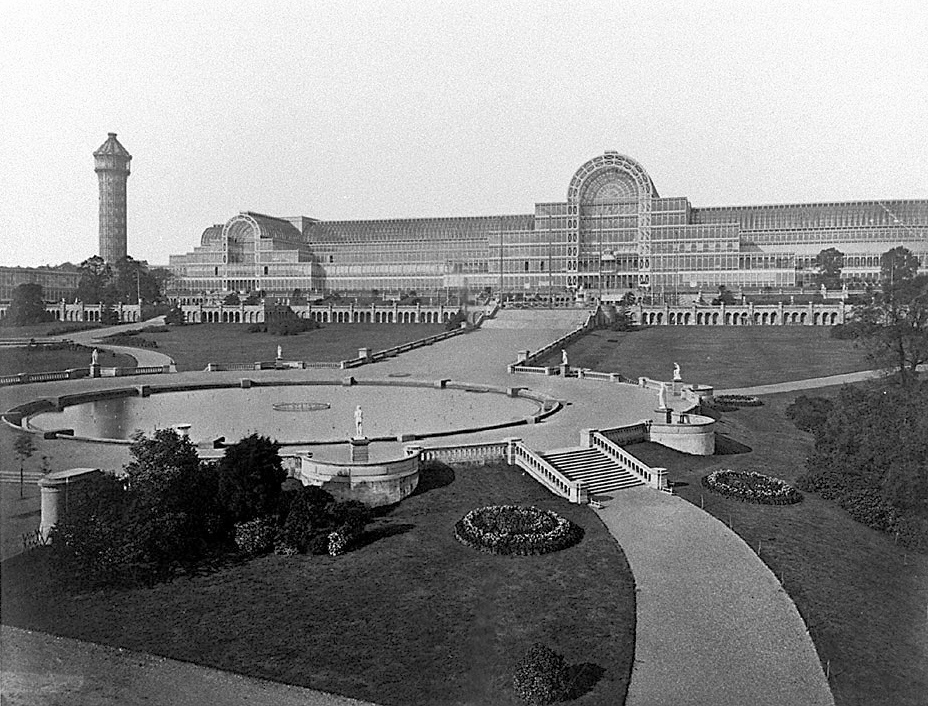
Why buildings disappear
Most buildings do not last. Left alone, a stone structure that took a century to build will crumble within a few hundred years if no one maintains the roof. Add war, earthquakes, fire, political revolution, urban speculation, and the occasional state-led demolition, and it becomes remarkable that any ancient building survives at all. The ones we have are the exceptions.
This article is a short tour of ten buildings that did not make it. Some are almost universally famous, like the Seven Wonders. Others are less known outside their regions but shaped their cultures profoundly. Playing Building Guessr's Lost Buildings mode is more fun if you know why these places mattered.
1. The Lighthouse of Alexandria
Built around 280 BCE on the island of Pharos, the Lighthouse of Alexandria stood for roughly sixteen centuries before a series of earthquakes brought it down between 956 and 1323 CE. At roughly 100 meters tall, it was the tallest human-made structure in the world for much of its existence, and it gave Western languages the word pharos for lighthouse. Divers working in Alexandria's harbor have recovered huge granite blocks that almost certainly came from it, and there is occasional talk of a reconstruction. For now, it exists mostly in coins and descriptions.
2. The Library of Alexandria
More infamous than famous today, the Library was probably not destroyed in a single dramatic fire. The story is messier. Founded in the third century BCE, it declined over centuries through a combination of civil conflict, budget cuts, and physical decay, with Julius Caesar's siege, Christian zealotry, and eventually the Arab conquest all taking credit or blame at different points. The lesson is that famous buildings often die slowly and in stages, not in one burning night.
3. The Temple of Artemis at Ephesus
Another of the Seven Wonders, the Temple of Artemis stood in what is now western Turkey. It was burned by an arsonist in 356 BCE looking for fame, rebuilt, then sacked by Goths in 268 CE, rebuilt again, and finally closed during the Christianization of the Roman Empire. The last fragments were carried off as construction material into nearby buildings, including the Hagia Sophia. What remains today is a single reconstructed column in a field.
4. The Old Summer Palace (Yuanmingyuan)
The Yuanmingyuan in Beijing was a sprawling imperial garden and palace complex that combined Chinese and European styles over more than a century of construction. British and French troops looted and burned it during the Second Opium War in 1860 in an act many Chinese historians still describe as the foundational crime of modern East-West relations. Ruins remain on site and the story is taught in Chinese schools as a warning about foreign intervention; the nearby Summer Palace was built as a replacement.
5. The Buddhas of Bamiyan
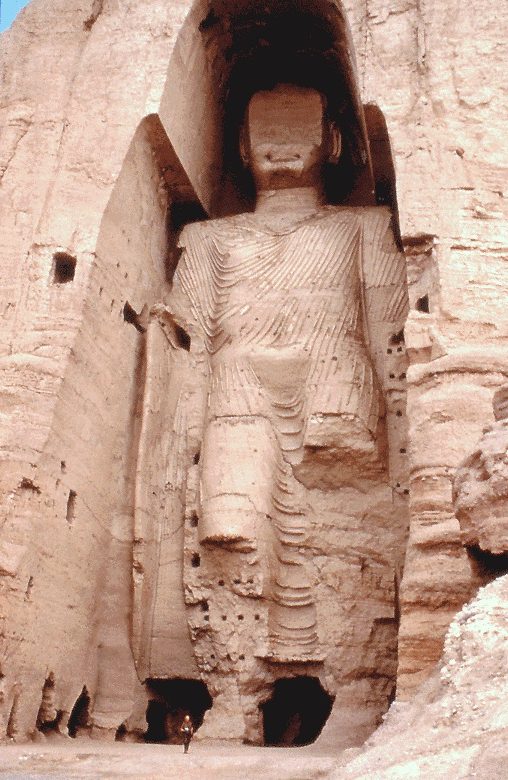
The two giant Buddhas carved into a sandstone cliff in central Afghanistan were among the largest standing Buddha statues in the world, the taller of the two reaching 55 meters. They stood for around 1,500 years before being dynamited by the Taliban in 2001 despite international protests. The niches are empty now, though 3D-projected silhouettes have occasionally been beamed into them. The loss remains a touchstone for debates about cultural heritage in conflict zones.
6. The World Trade Center towers
The destruction of the twin towers on September 11, 2001 is the most recent entry most readers will remember first-hand. Completed in 1973, the towers were not universally loved as architecture; critics called them boring corporate minimalism. But they defined the Lower Manhattan skyline for a generation and their loss reshaped global politics as much as it reshaped New York. The replacement complex, anchored by One World Trade Center, is now a tourism destination in its own right.
7. The Berlin Stadtschloss (mostly)
The Baroque royal palace in the center of Berlin was heavily damaged by Allied bombing during World War II and then deliberately demolished by the East German government in 1950 on ideological grounds. In the 2000s, after decades of debate, Germany decided to rebuild the exterior as a replica called the Humboldt Forum, with a modern museum inside. It is one of the most interesting case studies in what it means to bring a building back: what you get is not the same place that was lost, but a careful, contested memory of it.
8. The Palace of Westminster (the old one)
What tourists photograph as the Palace of Westminster is almost entirely a Victorian Gothic Revival rebuild. The original medieval palace, home to English kings for centuries and the meeting place of Parliament, was destroyed by a fire in 1834 that started with overheated stoves used to burn old tallies. Westminster Hall survived and is embedded in the current complex. The rest is impressive but is not medieval in any meaningful sense.
9. Notre-Dame's spire
Notre-Dame de Paris is not lost, but the world watched its nineteenth-century spire collapse into the nave on April 15, 2019, during a fire whose exact cause remains officially undetermined. The spire was itself a replacement designed by Viollet-le-Duc for an earlier one removed in the late 1700s, so what burned was a Gothic Revival addition, not a medieval original. It was rebuilt in the same form and the cathedral reopened in late 2024.
10. The original St. Peter's Basilica
Before Michelangelo's dome, there was a different St. Peter's: a fourth-century Constantinian basilica that stood for more than a thousand years before being torn down, bit by bit, to make way for the current building during the Renaissance. Almost no one mourns this loss today because the replacement is one of the masterpieces of world architecture. But an entire medieval and early Christian building program disappeared under it.
What preservation really looks like
A working lesson from these stories: buildings rarely disappear for a single reason. Earthquakes weaken structures that fires then finish off. Wars damage what ideological regimes then demolish. Economic booms flatten what neglect had already hollowed out. Preservation is not dramatic at any single moment; it is the slow, unglamorous work of maintaining roofs, stabilizing foundations, and convincing each generation that the building is worth the cost of standing.
If this topic interests you, our piece on medieval castles touches on similar decay-and-repair cycles, and the essay on leaning towers is partly a story about how engineers save buildings from themselves.
Regional Variations: How Loss Is Distributed Across the World
Architectural loss is not evenly distributed in time or geography — it clusters around the forces that have been most destructive in each era and region. The ancient world's losses are concentrated around a small number of catastrophic events that wiped out irreplaceable concentrations of built heritage: the earthquake sequences that destroyed the Lighthouse of Alexandria, the progressive decay and looting of the Seven Wonders as classical civilization contracted, and the fires and sacks that ended the great institutional buildings of the Roman world. What we know of these buildings comes almost entirely from textual description, coins, and surviving fragments — which is itself a reminder of how recently the discipline of archaeological documentation emerged.
Medieval losses have a different character. Old St. Paul's Cathedral in London — a Gothic structure that was larger than the current Christopher Wren building — burned in the Great Fire of 1666. The original mosaics and internal decoration of Hagia Sophia were destroyed or plastered over during Ottoman conversion. Many English monasteries were dissolved under Henry VIII and their buildings quarried for building material within a generation. These are losses produced by religious and political transformation rather than by natural disaster, and they leave a different kind of evidence: accounts, inventories, early drawings, and the empty sites of foundations that subsequent archaeology can trace.
The twentieth century introduced industrialized destruction on a scale that earlier centuries could not match. The Allied strategic bombing campaigns of World War II destroyed or severely damaged Dresden, Cologne, Warsaw, Coventry, and dozens of other historic city centers. The Soviet state systematically demolished Orthodox churches and aristocratic residences across the USSR. China's Cultural Revolution destroyed temples, monasteries, and historic buildings across the country between 1966 and 1976. The deliberate targeting of cultural heritage as a military and political instrument — from the Bamiyan Buddhas to the destruction of Palmyra by ISIS — represents a particular modern form of architectural loss that international law has tried, with limited success, to prevent. Meanwhile, the economic destruction of Penn Station in New York (1963) showed that democratic market economies were capable of their own form of architectural erasure, driven by profit rather than ideology, but equally permanent in its results.
The geography of surviving heritage is therefore not random: it reflects which regions were least subject to war, the most consistent in their building traditions, and the earliest to develop legal frameworks for preservation. This is why Italy, France, and the United Kingdom retain far more of their historic urban fabric than Germany, Poland, or Russia, and why Japanese temple architecture survives in greater quantity than Chinese, even though both traditions were equally sophisticated at their peaks.
Causes of Architectural Loss: What to Know
- Fire: the dominant cause of pre-modern urban building loss; cities built primarily of timber were extraordinarily vulnerable, hence the Great Fire of London (1666) and the Great Chicago Fire (1871)
- War and deliberate destruction: bombing campaigns, siege artillery, and ideological demolition produce sudden, concentrated losses with surviving photographic and documentary evidence
- Economic demolition: profit-driven clearance of older buildings for development; Penn Station (1963) and many Victorian city-center buildings were lost this way
- Natural disaster: earthquakes are the primary structural threat to masonry buildings; floods, volcanic eruption, and landslides have each destroyed specific sites
- Neglect: the slowest form of loss, typically affecting rural and regional buildings that lack the profile to attract restoration funding; roofs fail first, then water destroys the interior
- Religious or political transformation: buildings lose their function when a faith or regime changes; monasteries, temples, and palaces are all at risk when the institution they serve disappears
- Material decay: adobe, timber, and thatch structures have inherent lifespans; vernacular buildings disappear constantly unless actively maintained by living communities
- Reuse: buildings are frequently demolished specifically to provide material for newer construction; Roman temples provided stone for medieval churches; the Colosseum was quarried for Renaissance palaces
A Closer Look: Pennsylvania Station, New York (demolished 1963)
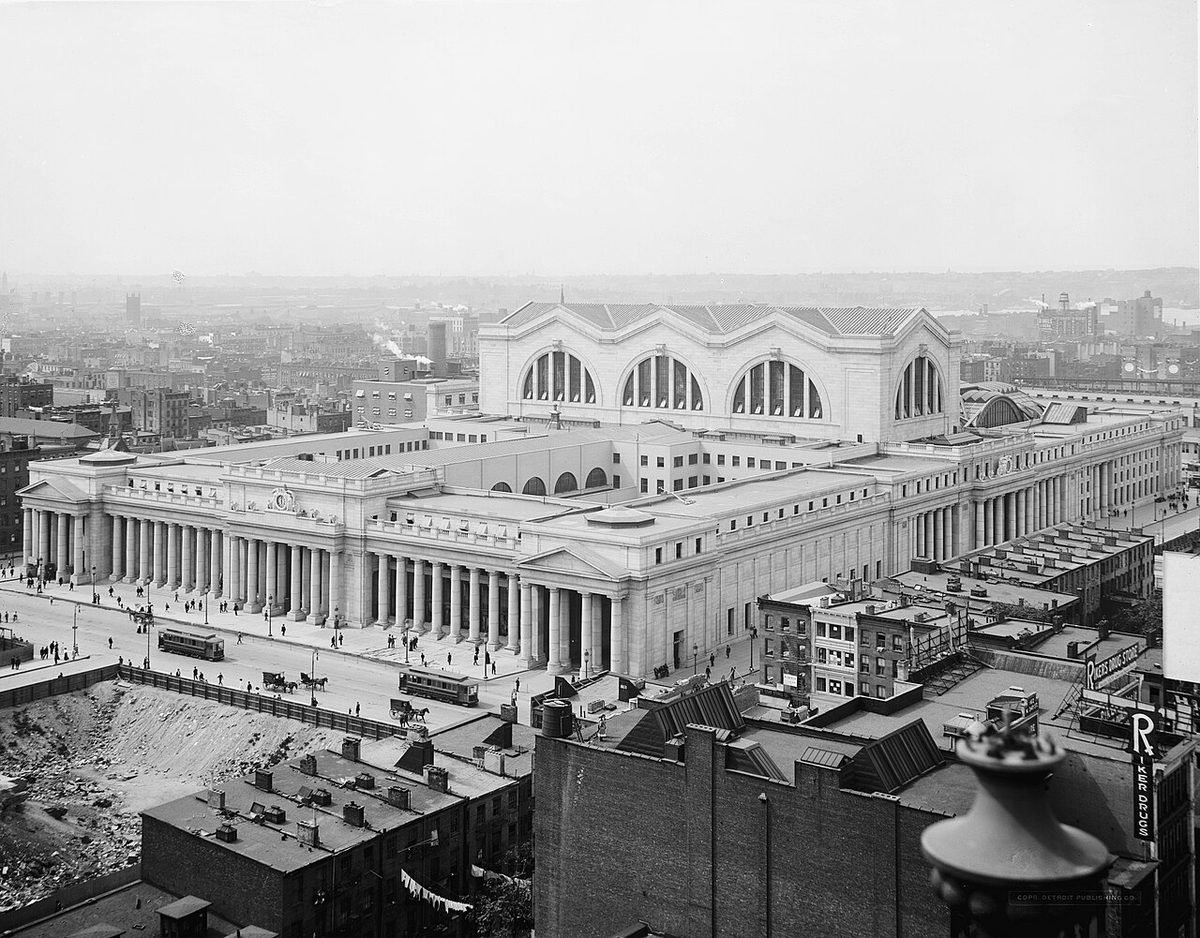
Pennsylvania Station in New York was completed in 1910, designed by the firm McKim, Mead and White in a monumental Beaux-Arts classical style that drew direct inspiration from the Baths of Caracalla in Rome. The main waiting room, a vast vaulted space 150 meters long and 55 meters high, was among the largest interior spaces in the United States. The concourse — a structure of cast iron and glass creating a luminous latticed canopy over the train platforms — was equally extraordinary. The station served as the main gateway into New York from the south and west, and its architecture proclaimed that arrival in New York was a civic event of the highest order.
By the late 1950s, the Pennsylvania Railroad was in financial difficulty. The station's air rights — the space above the tracks — were valuable. In 1961 the railroad announced that the station would be demolished and replaced with a new Madison Square Garden arena and a low-ceiling underground station that would serve the trains. Protests were mounted; the architectural press reacted with outrage. Ada Louise Huxtable wrote in the New York Times that "we will probably be judged not by the monuments we build but by those we have destroyed." The demolition proceeded from 1963 to 1966, and the replacement underground station, still in use today, has been widely described as one of the most unpleasant public spaces in America. The critic Roger Angell wrote that "until the first blow was struck, you never knew what you had."
The destruction of Penn Station was not wasted. The public outrage it generated was the direct cause of New York City's Landmarks Preservation Law, passed in 1965, which created the legal mechanism to protect historic buildings from demolition. The law immediately protected Grand Central Terminal — which had been the subject of similar demolition proposals — and has since protected thousands of buildings across the city. Penn Station's loss was, in the most literal sense, the price paid for the preservation framework that replaced it. The lesson has been widely absorbed: cities across the United States passed comparable legislation in the following decades, and the international heritage movement strengthened significantly in response to the shock of mid-20th century demolitions.
Spotting It in Building Guessr
The Lost Buildings filter in the game shows only structures with partial or lost standing status — ruins, heavily damaged buildings, or sites where only fragments remain. Identifying these requires a different approach from identifying intact buildings. With a complete facade, you read style, proportion, ornament, and materials in combination. With a ruin, you must pattern-match from fragments: the profile of a surviving arch, the coursing of exposed masonry, the geometry of a remaining wall section, or the characteristic stone color of the site. This is harder but often more interesting — ruins reveal structural systems that intact buildings conceal behind their cladding.
The most useful strategy for ruins is to identify the structural system first. Roman concrete vaulting is immediately distinctive: the characteristic hollow sound of opus caementicium, the rough aggregate surface where facing has fallen away, the way the vault springs from massive piers rather than thin columns. Greek temple ruins are identifiable from the profiles of column drums lying in the grass, the entasis (slight swelling) of surviving column shafts, and the flat, precisely cut marble surfaces that have weathered to a warm cream or grey. Gothic ruins, common across Britain and northern Europe, show pointed arch profiles, slender column shafts, and the characteristic radiating rib patterns of vaulted ceilings — often visible even when the vault itself has collapsed and only the springer stones remain embedded in the standing walls. The lean is always in the details that have survived.
Test your knowledge of buildings that still stand and those that do not.
Play Building GuessrFurther Reading
- Why Leaning Towers Don't Fall — the engineering story of buildings that survive against the odds
- Castles: Myth vs Reality — medieval fortifications, their decay cycles, and what survives
- Reading Religious Architecture — many lost buildings were sacred; understanding their original function helps read their ruins
- Neoclassical Architecture — the style that produced many of the civic buildings demolished in the 20th century
Sources & further reading
Reference material this page draws on, and where to read further. External links open third-party sites.
- Lost artworks · Wikipedia
- The Crystal Palace · Wikipedia
- Pennsylvania Station (1910–1963) · Wikipedia
- Buddhas of Bamiyan · Wikipedia
- Great Mosque of Aleppo · Wikipedia
- Temple of Artemis · Wikipedia
- World Heritage listing: Buddhas of Bamiyan · UNESCO World Heritage Centre
- World Heritage listing: Temple of Artemis · UNESCO World Heritage Centre