When tilt becomes disaster
Most buildings that start to lean collapse within a few years. Houses subside, old walls bow outward, factory chimneys tip and fall. The famous leaning towers are famous precisely because they are the exceptions. They have been tilting for centuries and have not, yet, fallen over. Understanding why is partly a structural story and partly a story about geology, time, and human stubbornness.
Building Guessr includes several leaners in its database, and they are often the hardest buildings to guess because their silhouette does not look like anything else. This article walks through what keeps them up and what almost took them down.
The story at Pisa
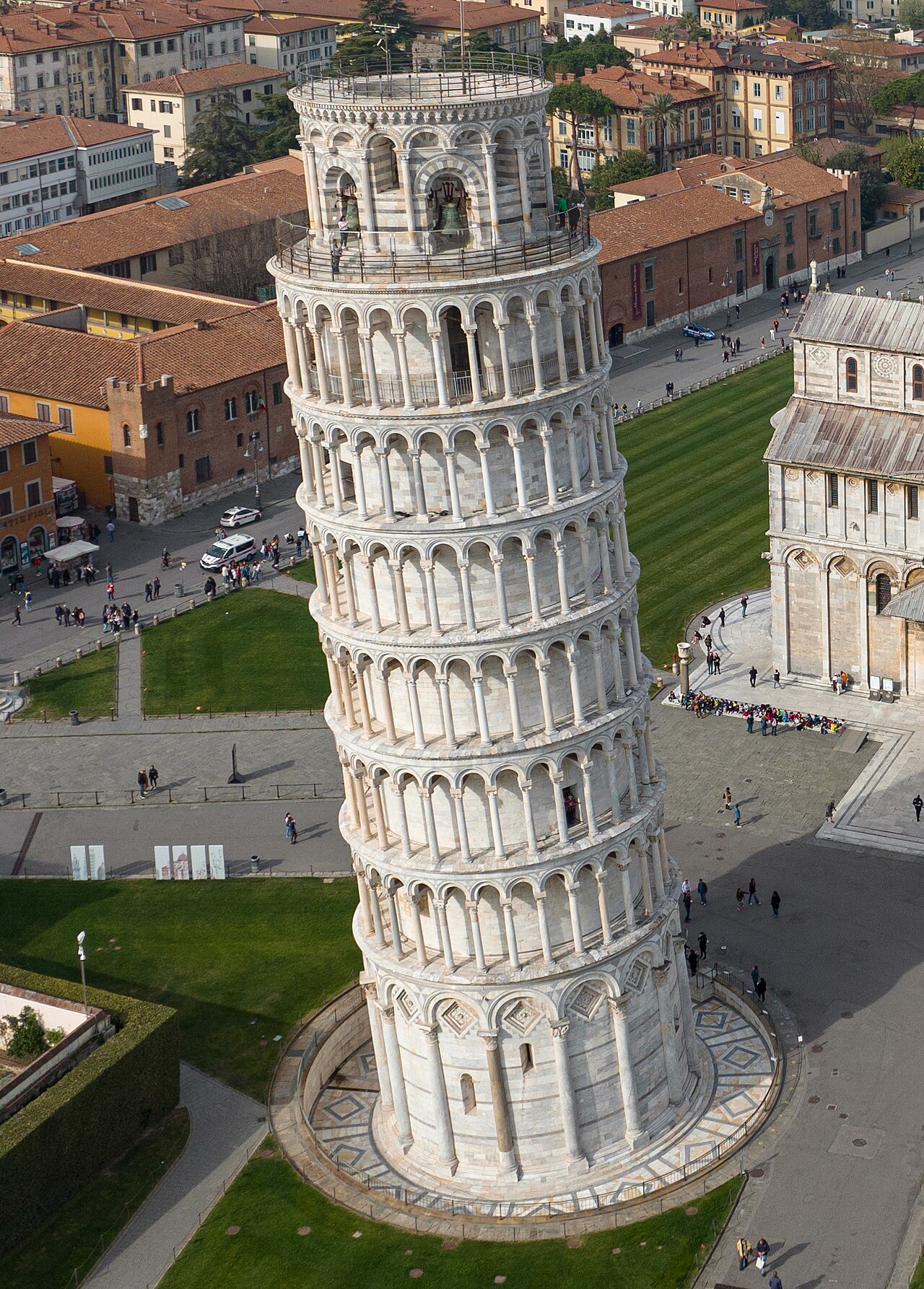
The Leaning Tower of Pisa began settling almost as soon as construction started in 1173. The bell tower for the cathedral next door was planned to stand 60 meters tall on foundations only three meters deep, on soft ground near an ancient estuary. By the time the third of its eight stories was complete, around 1178, the south side had already begun to sink. Work halted; it would not resume until nearly a century later, by which time the soil had compacted enough that construction could continue.
Medieval builders then did something that looks comical until you realize it saved the tower: they built the upper stories with the floors slightly angled to counter the lean, effectively making a banana-shaped building that leans less at the top than at the bottom. If you stand at the base and look up, the tower curves. This accidental compensation kept the center of gravity closer to over the foundations than it would otherwise have been.
The tower was finally completed around 1372. At that point it leaned about one degree. Over the next six centuries, the lean grew to nearly 5.5 degrees, putting the top about 4.5 meters off vertical, and the rate of movement accelerated. By the 1990s, engineers calculated that the tower was months or years from toppling.
Soil: the silent culprit
Pisa's problem was never the stone. The tower itself is well-built marble from the local quarries. The problem was the ground underneath: a complex mix of soft clay, sand, and shell, deposited by the Arno River over thousands of years and unevenly compacted. Pockets of softer material under the south side compressed faster than denser material under the north side. The foundations, only a few meters deep, could not bridge across that difference.
This is the general pattern for leaners. The Suurhusen Church tower in Germany, which officially passed Pisa as the most-tilted tower in the 2000s at 5.19 degrees (Pisa itself has since been corrected downward, but the measurement competition continues), sits on oak foundation beams driven into boggy soil. When the marshland was drained in the nineteenth century for farming, the oak on the drier south side rotted faster than the waterlogged oak on the north. The tower tipped. Two towers in Bologna, the Garisenda and Asinelli, lean because their medieval foundations shifted on the city's alluvial soil; the Garisenda is currently cordoned off and being stabilized because its lean is now accelerating.
The center of gravity test
A leaning building stays up as long as a vertical line dropped from its center of gravity still falls inside its base. That is the entire stability test in one sentence. Pisa survives because its center of gravity, even at 5.5 degrees of tilt, is still over the foundation footprint, though just barely. If the lean kept growing at the rate it was accelerating in the 1980s, the center of gravity would have crossed the base edge sometime in the early 2000s and the tower would have rotated through that axis and fallen.
Wind matters too. Taller leaners have to survive gusts that push the center of gravity further in the direction of tilt, temporarily. Engineers at Pisa had to calculate not just the static stability but the worst-case dynamic stability during storms, and they were cutting it closer than anyone wanted.
Saving Pisa in the 1990s
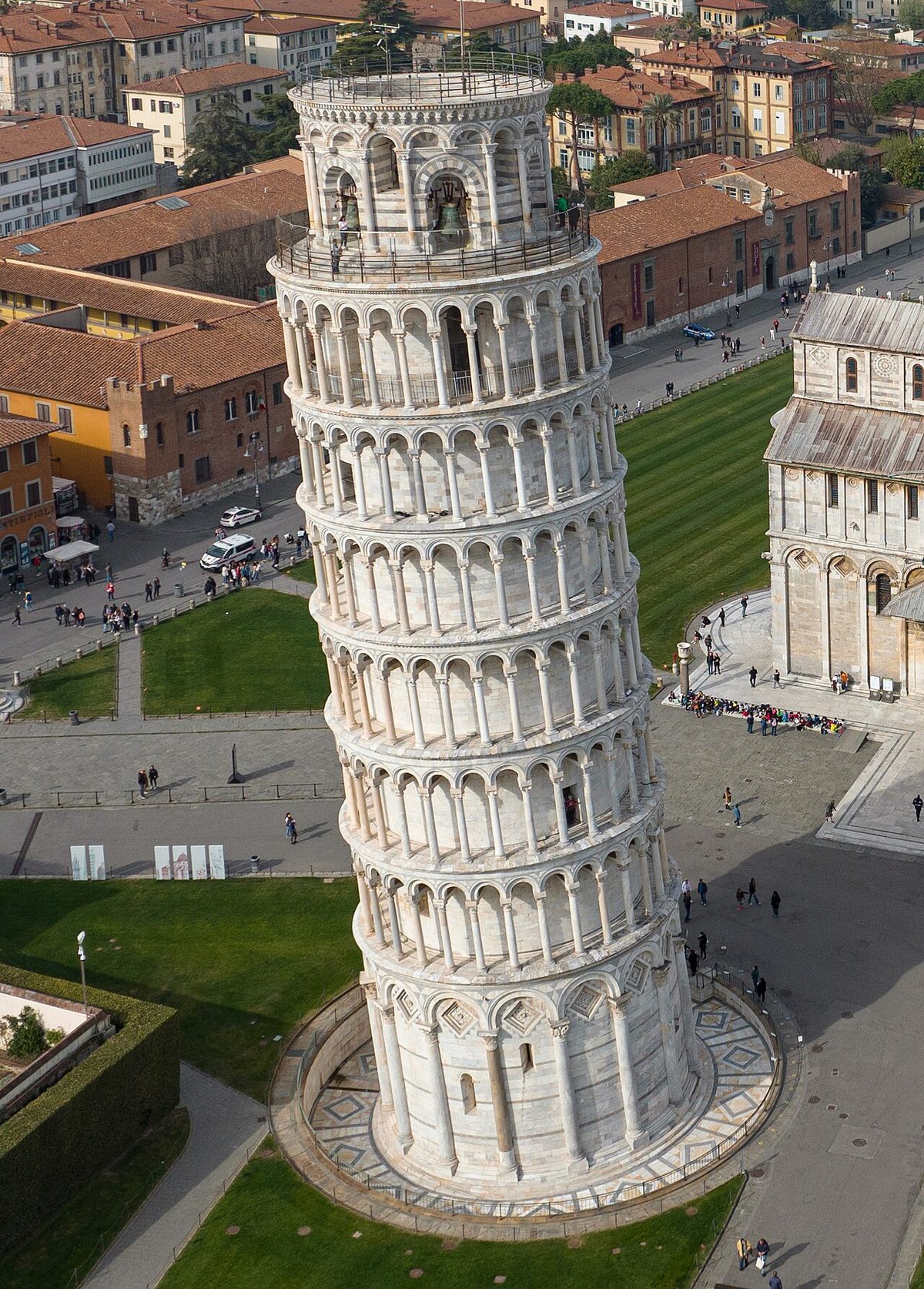
Between 1990 and 2001, the Pisa tower was stabilized in a project led by British engineer John Burland. The approach was counterintuitive: instead of stiffening the ground under the south side (which had been tried in the 1930s with failed results), they removed soil from under the north side. By drilling out small amounts of clay on the high side, they let the tower settle slightly northward, reducing the tilt by about 45 centimeters at the top. The work was done so carefully that the change is invisible to the casual visitor, but it bought the tower at least another two or three centuries of stability.
The tower was reopened to the public in 2001 and continues to be monitored. It moves a few millimeters per year, sometimes forward, sometimes backward, and is now considered stable for the foreseeable future.
Suurhusen and other quiet leaners
Not every leaner gets the Pisa treatment. Suurhusen Church in northwest Germany was saved by concrete reinforcement of its foundations in 1975 after nearly fifty years of being closed for safety. Bologna's Garisenda is currently being wrapped in steel cables as a temporary measure while a long-term plan is developed. The Nevyansk Tower in Russia, which leans at about three degrees, is said to have been built deliberately crooked as an eccentric stylistic choice, though the evidence is mixed and subsidence is the more likely explanation.
Chicago's old Leaning Tower of Niles, a half-scale replica of Pisa built as a water tower in 1934, leans because the builder wanted it to. That one is safe.
Modern engineering and soft soils
You might wonder why modern buildings on soft soil do not lean. The answer is that they do, but by tiny amounts, and the engineering catches it. Mexico City's Metropolitan Cathedral has been gradually sinking into the ancient lake bed beneath it since the sixteenth century, and in recent decades the Mexican government has injected concrete under parts of the foundation to slow uneven settlement. The leaning Santa Maria del Carmine in Naples, the bell tower of Siena Cathedral, and parts of the Tower of London all have monitoring instruments embedded in their walls.
For newer supertall towers in Dubai, Shanghai, and Taipei, engineers design the foundations first and the building second. Burj Khalifa's foundation is a single giant concrete slab over 192 piles driven 50 meters into the ground. Shanghai Tower uses a mat foundation on thousands of piles. The lesson of Pisa has been thoroughly learned: do the ground work before you start stacking stones.
Keep looking up
Leaning towers are worth seeing in person at least once. They give you a visceral sense of how close some old buildings have come to failure and how hard it is to save them once trouble starts. For a related read on buildings that did not survive, see ten famous lost buildings. For more on castles and other stone medieval structures that share the same foundation problems, try castles: myth vs reality.
Regional Variations: Where and Why Towers Tilt
Differential settlement — the dominant cause of most tower leans — is fundamentally a soil mechanics problem, and different soil types around the world produce different patterns of tilt. The soft, clay-rich soils of the Po Valley in northern Italy are responsible for not just the Pisa tower but a significant cluster of other leaning structures across the region. Bologna's two medieval towers, the Garisenda and the Asinelli, both lean; the Garisenda's lean was already famous in Dante's time (he references it in the Inferno). The same alluvial clay soils that made the Po Valley so agriculturally productive also made it structurally treacherous for any building that needed deep foundations, and medieval engineers working with shallow stone foundations on this terrain were fighting a battle they often did not know they were losing until decades after construction was complete.
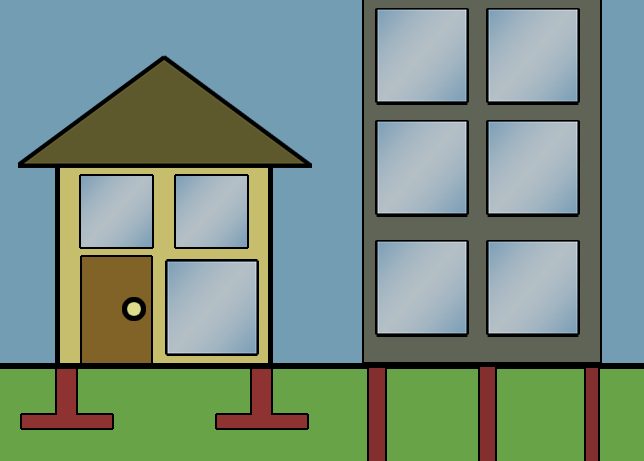
In northern Europe, the problem takes a different form. The boggy, peat-rich soils of coastal Germany, the Netherlands, and Scandinavia compress under load in ways that are not uniform across a single foundation. Timber pile foundations — the standard pre-modern solution to building on soft ground — are vulnerable to differential decay: if part of the foundation is above the permanent water table, those timber piles will rot faster than piles that remain constantly submerged. The result is a slow, differential settlement that produces lean over decades or centuries. Suurhusen is the most famous German example, but the pattern repeats across the North Sea coastal zone wherever medieval masonry buildings were built on timber pile foundations through soft alluvial or peaty ground. The Old Church tower in Delft (Netherlands) leans significantly; so does the tower of the Oude Kerk in Amsterdam.
In the modern world, permafrost thaw has created a new category of leaning buildings across Siberia, northern Canada, and Alaska. Buildings constructed on permanently frozen ground in the 20th century were designed with insulated foundations intended to keep the permafrost frozen under the building — but as Arctic temperatures have risen, permafrost has been thawing beneath existing structures, causing uneven settlement at a rate that is unprecedented in historical experience. Entire neighborhoods in Norilsk and other Siberian cities show the characteristic visual of buildings tilting at multiple angles, doors that no longer close, cracked facades, and displaced pavement. This is the newest form of differential settlement, and unlike the slow medieval examples at Pisa and Suurhusen, it is accelerating rather than slowly stabilizing. Some towers, by contrast, lean by deliberate design. The Puerta de Europa twin towers in Madrid (1996, Burgee and Johnson) lean inward at 15 degrees, mirroring each other across the Paseo de la Castellana. They were the world's first intentionally inclined skyscrapers and demonstrate that what was once an engineering accident can be reclaimed as an architectural statement when the structural engineering is thoroughly worked out in advance.
Earthquake damage produces a fourth category of lean, distinct from slow differential settlement. Sudden seismic events can displace foundations laterally or cause liquefaction of sandy soils that allows a building to tilt rapidly. The 2011 Tōhoku earthquake in Japan produced numerous examples of buildings that tilted within minutes as the ground liquefied beneath them. Unlike the centuries-long settlement at Pisa, earthquake-induced lean is immediate and unpredictable, making it far more dangerous and far less amenable to gradual monitoring and intervention. Buildings that survive seismic tilt are usually either very light and flexible (timber construction) or very heavily founded (modern reinforced concrete on deep piles); heavy unreinforced masonry buildings, like the medieval towers of Europe, are particularly vulnerable because they cannot flex to absorb seismic energy.
Key Identifiers: Leaning Towers and Structural Intervention
- Visible gap between a tower and adjacent structures: if a tower that was clearly built as part of a larger ensemble now stands at an angle to its neighbors, differential settlement is almost certainly the cause
- Tilt axis visible against the horizon: a leaning tower reads most clearly in a photograph where a horizontal reference (the skyline, a roofline, or the ground) is visible for comparison
- Curved profile of a tall structure: the Pisa tower appears slightly banana-shaped because the upper stories were corrected to compensate for the lower story lean; this is visible in close-up photographs
- Steel tie-back cables or external steel collars around the base: visible structural intervention intended to prevent further movement or distribute load away from weak foundation zones
- Lead counterweight blocks on the high side: used at Pisa and other sites to apply a corrective moment opposing the direction of lean
- Extraction bore holes or injection points at foundation level: soil extraction (Pisa method) or concrete injection both leave visible evidence at the base of a tower
- Safety barriers, scaffolding, or closure signage: many leaning towers are periodically closed to the public during stabilization work; this is itself a visual indicator of structural concern
- Monitoring instruments: small sensors embedded in the masonry or attached to the exterior are often visible in close-up photographs of famous leaners
A Closer Look: The Tower of Pisa Intervention (1990–2001)
By 1990, the Tower of Pisa had become a structural emergency. The lean had reached 5.5 degrees, placing the top of the tower 4.5 meters off the vertical. The rate of movement was accelerating — a consequence of the tower's weight continually loading the softer south-side soil and driving progressive settlement. An international Committee of Experts was formed to find a stabilization solution. Previous interventions, including a concrete injection attempt in the 1930s that had actually made the situation worse by adding weight to the already sinking south side, had left engineers cautious about applying any force directly to the tower. The committee closed the tower to visitors in January 1990 and began a systematic program of investigation and intervention that would last eleven years.
The solution developed by British geotechnical engineer John Burland was radical in its simplicity and counterintuitive in its logic: instead of supporting the south side (the side that had sunk), extract soil from the north side (the high side), allowing the tower to settle northward and reduce its lean. Small extraction tubes were drilled diagonally into the clay beneath the north foundation at a shallow angle. As clay was carefully extracted in controlled amounts — 38 cubic meters in total over four years of extraction work — the tower settled millimeters at a time northward. The lean was reduced from 5.5 degrees to 3.97 degrees, moving the top of the tower approximately 45 centimeters closer to vertical. This was precisely enough to return the tower to a stable condition — its center of gravity was moved safely away from the critical threshold — while preserving enough lean to keep the tower visually distinctive and recognizable as the world's most famous leaning structure.
The intervention also included a system of steel tendons wrapped around the third story to prevent the masonry from cracking under the eccentric loading, and a foundation drainage system to stabilize the soil water content. The combined effect was to bring a building that had been months from catastrophic failure to a condition that engineers now estimate will remain stable for at least two to three hundred years. The tower was reopened in December 2001 and continues to be monitored continuously by sensors embedded in the masonry that transmit real-time movement data to the Pisa team. The intervention is widely regarded as one of the most elegant and technically sophisticated structural conservation projects ever carried out, achieving its goal — maximum stability with minimum visible intervention — with exemplary precision.
Spotting It in Building Guessr
Leaning towers in the game are identifiable primarily by their tilt against the horizon or against adjacent buildings. The lean is usually most obvious in photographs where a horizontal reference exists — a skyline, a level roofline, or the flat ground plane — because the human eye is very sensitive to departures from vertical in any structure that is supposed to be upright. Even a two or three degree lean is visible in a well-composed photograph once you are looking for it. The game includes the Pisa tower, the Two Towers of Bologna (both the Garisenda and the Asinelli are recognizable — the Asinelli is taller and straighter, the Garisenda shorter and more dramatically inclined), and other notably tilted structures from the game's database.
Identifying the specific leaner from a cropped or partial photograph requires pattern-matching on the structural details: the Pisa tower has its distinctive arcaded marble exterior with Romanesque blind arches at each gallery level and a white marble surface throughout; the Garisenda is plain brick, medieval in texture, and much shorter than the adjacent Asinelli; Suurhusen is a modest German rural church tower of brick and rough stone, easily confused with dozens of unremarkable German village churches if you do not notice the lean. The lean is always the first thing to look for, but the style, material, and setting of the leaning structure give you the regional context to make a confident identification. For the Pisa tower specifically, the Campo dei Miracoli setting — the cathedral, baptistery, and camposanto visible in the same frame — makes the identification almost certain even from a distant or partial view.
Can you place a leaner on the map from a single photo?
Play Building GuessrFurther Reading
- Ten Famous Lost Buildings — the buildings that ran out of luck before engineers could intervene
- Castles: Myth vs Reality — medieval masonry structures that share the same foundation challenges as leaning towers
- Vernacular Architecture — folk building traditions that often produced structures on difficult ground without formal engineering
- Brutalism Explained — the 20th century's most honest engagement with structure, which produced buildings that never lean because they think about foundations first
Sources & further reading
Reference material this page draws on, and where to read further. External links open third-party sites.
- Leaning Tower of Pisa · Wikipedia
- Leaning Tower of Suurhusen · Wikipedia
- Foundation (engineering) · Wikipedia
- Soil consolidation · Wikipedia
- Settlement (structural) · Wikipedia
- Center of mass · Wikipedia
- World Heritage listing: Leaning Tower of Pisa · UNESCO World Heritage Centre