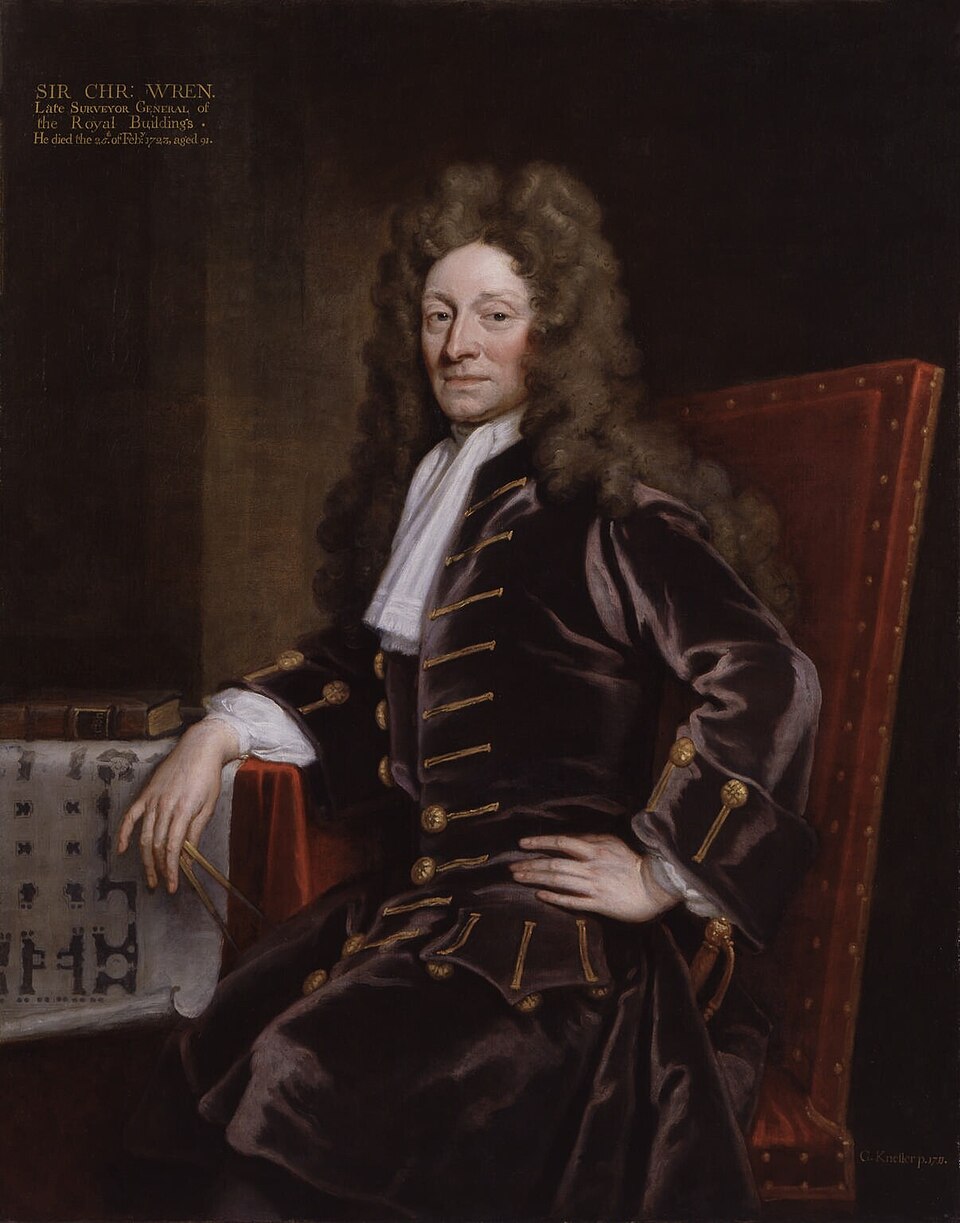
Life and Training
Sir Christopher Wren was born on 20 October 1632 in East Knoyle, Wiltshire, the son of the rector of East Knoyle and nephew of the Bishop of Ely. He was educated at Westminster School and then at Wadham College, Oxford, where he showed extraordinary mathematical and scientific gifts — he was elected a Fellow of All Souls College, Oxford, at twenty-one, and at twenty-eight was appointed Savilian Professor of Astronomy at Oxford. He was a founding member of the Royal Society and was described by Isaac Newton as "one of the greatest geometers of our time." He came to architecture through science rather than through apprenticeship: his early building work in the early 1660s — the Sheldonian Theatre in Oxford (1664–1669), modeled on the Theatre of Marcellus in Rome — was essentially an exercise in applied geometry, exploring how to roof a large space without intermediate supports.
Three years earlier, the Great Fire of London in September 1666 had destroyed eighty-seven churches and approximately thirteen thousand houses — the opportunity of his professional life. He had been appointed Surveyor of the King's Works (the royal building office) in 1669. Wren submitted an ambitious replanning scheme for the city within days of the fire, but it was rejected. When, including the medieval St Paul's Cathedral, and approximately thirteen thousand houses within the city walls. Wren submitted an ambitious replanning scheme for the city — a rational grid of wide avenues and civic spaces — within days of the fire, but the scheme was rejected because it would have required the compulsory purchase and reallocation of existing property rights. Instead, he was tasked with rebuilding the city's churches piecemeal, and in 1675 was commissioned to design the new St Paul's Cathedral. He held the post of Surveyor for nearly fifty years, overseeing one of the most intensive programs of architectural construction in British history. He is buried in St Paul's Cathedral, and his epitaph, composed by his son, reads: Si monumentum requiris, circumspice — "If you seek his monument, look around you."
Architectural Philosophy
Wren was not a theorist in the manner of Italian Renaissance architects who wrote treatises; he was a practitioner and scientist for whom architecture was an extension of his mathematical enquiry. He believed that beauty in architecture arose from what he called "natural causes" — the proportions and forms that the human eye found inherently satisfying, which he identified with Euclidean geometry and with the proportional systems of antiquity. He never traveled to Italy and only briefly visited France, yet he absorbed the lessons of the classical tradition through books, drawings, and his extraordinary spatial imagination.
His mature work — the City churches and St Paul's — is characterized by a combination of classical structural discipline and an inventive, sometimes playful, variation in surface treatment, spire form, and interior spatial arrangement. Each of the fifty-one rebuilt City churches presented a different geometric problem (different site shapes, orientations, and budgets), and Wren solved each with different means: barrel vaults, domical vaults, flat ceilings with elaborate plasterwork, columns placed at unexpected angles. The spires of the City churches — ranging from the simple to the fantastically elaborate — were the first things a visitor saw approaching London by river and constituted a kind of skyline architecture unprecedented in English building.
Key Works
- St Paul's Cathedral, London (1675–1710): Wren's masterwork and England's greatest Baroque building took thirty-five years to complete. The building went through several radically different designs before the "Warrant Design" was approved by King Charles II in 1675, but Wren continued to modify the design substantially as construction proceeded — most significantly in the design of the dome, which in the final version consists of three concentric shells: an inner dome visible from the interior, a brick cone that carries the weight of the stone lantern above, and an outer timber-framed dome clad in lead that forms the exterior silhouette. At the time of its completion, the dome was the second largest in the world after St Peter's in Rome. The building dominated the London skyline for two and a half centuries until the postwar skyscrapers began to surround it.
- City of London Churches (1670–1711): Wren designed fifty-one churches to replace those destroyed in the Great Fire — an unprecedented architectural output for a single architect. Each church was designed to solve a different geometric challenge posed by its irregular site, and Wren resolved each with a different structural and spatial solution. The most celebrated include St Stephen Walbrook (with its central dome anticipating St Paul's), St Mary-le-Bow (with its famous Bow Bells), and St Bride's Fleet Street (whose spire inspired the tiered wedding cake). Together they constitute the most complete expression of Wren's versatility and his mastery of small-scale classical design.
- Royal Hospital Chelsea, London (1682–1692): A residential home for veteran soldiers, commissioned by King Charles II, the Royal Hospital is Wren's most severely classical work: a symmetrical courtyard composition of brick and Portland stone whose proportions and restrained detail reflect the influence of Louis XIV's contemporaneous Les Invalides in Paris. The Figure Court at its center, with a bronze statue of Charles II by Grinling Gibbons, remains one of London's most serene civic spaces and is still in use as a military veterans' home.
- Royal Naval College, Greenwich, London (1696–1712): Built on the site of the old Royal Palace of Greenwich and designed to align with Inigo Jones's Queen's House (1616), the Royal Naval College is Wren's most ambitious civic composition: two matching baroque blocks framing a view of the Thames and the Queen's House behind, creating a theatrical approach by water. The Painted Hall — decorated by James Thornhill — is among the grandest Baroque interiors in England.
- Royal Observatory, Greenwich, London (1675–1676): Designed at the same moment as St Paul's and built in three and a half months at a cost of £520, the Royal Observatory is a modest but precise instrument building designed for the astronomical observations that would eventually allow navigators to determine longitude. The red time ball on its roof, raised each day and dropped at 1 p.m., was for centuries the most widely observed time signal in Britain.
- Hampton Court Palace extensions, East Molesey, Surrey (1689–1700): When William III and Mary II came to the throne in 1689, they commissioned Wren to remodel Hampton Court in a more modern Franco-Dutch style. Wren's new state apartments — the Fountain Court, the King's Staircase, the Queen's Gallery — brought Baroque grandeur to what had been a Tudor palace, integrating painted decorations by Antonio Verrio and ironwork by Jean Tijou into a unified interior scheme of remarkable richness.
Legacy
Wren's influence on British architecture was so pervasive that it lasted for two centuries after his death, through the Georgian Baroque of Hawksmoor and Vanbrugh (both of whom worked under him), the Palladianism of Burlington and Campbell, and the Neoclassical grandeur of Soane and Nash. His particular contribution — the synthesis of mathematical rigor with practical problem-solving and visual invention — established a tradition of architecturally literate engineering that is distinctive in British building culture. St Paul's Cathedral, which survived the Blitz with its dome intact while the surrounding city burned, acquired through that survival an almost mythological status in British national identity: the image of the dome emerging from the smoke of burning London is one of the most reproduced photographs of the twentieth century. No architect in British history has shaped the built environment of a single city more decisively.
Explore Wren's buildings in the game.
Play Building Guessr