A
Ambulatory
A continuous aisle that wraps around the apse or choir of a church, allowing pilgrims to circulate past shrines and relics without disturbing the clergy conducting services at the high altar. Ambulatories became especially important in the great pilgrimage churches of Romanesque France — Santiago de Compostela being the most celebrated example — where radiating chapels opened off the curved walkway, each housing a different relic. The ambulatory plan was widely adopted in Gothic cathedrals throughout the 12th and 13th centuries, giving rise to elaborate arrangements of chapels and allowing the east end of the building to grow into an architecturally rich crown of radiating volumes. See our guide to Gothic, Romanesque, and Byzantine architecture.
Apse
A semicircular or polygonal recess, typically vaulted, that terminates the east end of a Christian church. Originally borrowed from Roman basilicas — where it housed the judge's seat — early Christian builders adopted the apse as the focal point for the altar and bishop's throne. In Romanesque buildings the apse is usually hemispherical and quite thick-walled; in Gothic buildings it may be polygonal and surrounded by a ring of chapels called the chevet. Smaller subsidiary apses, called apsioles or absidioles, frequently appear at the ends of transepts or off the ambulatory. The apse is one of the most consistent and recognizable features of European church architecture across a thousand years of building.
Arcade
A row of arches supported on columns or piers, either freestanding or blind (applied against a wall as decoration). In basilicas and Gothic cathedrals the nave arcade — the lowest of the three horizontal zones — separates the central nave from the side aisles. Blind arcades enliven the exterior surfaces of many Romanesque and Gothic buildings, creating a rhythmic play of light and shadow without opening holes in the wall. In secular architecture, arcades line market streets and public squares throughout southern Europe and Latin America, providing shaded walkways at street level. The 19th century revived the arcade form in covered shopping galleries — the precursor of the modern shopping mall.
Arch
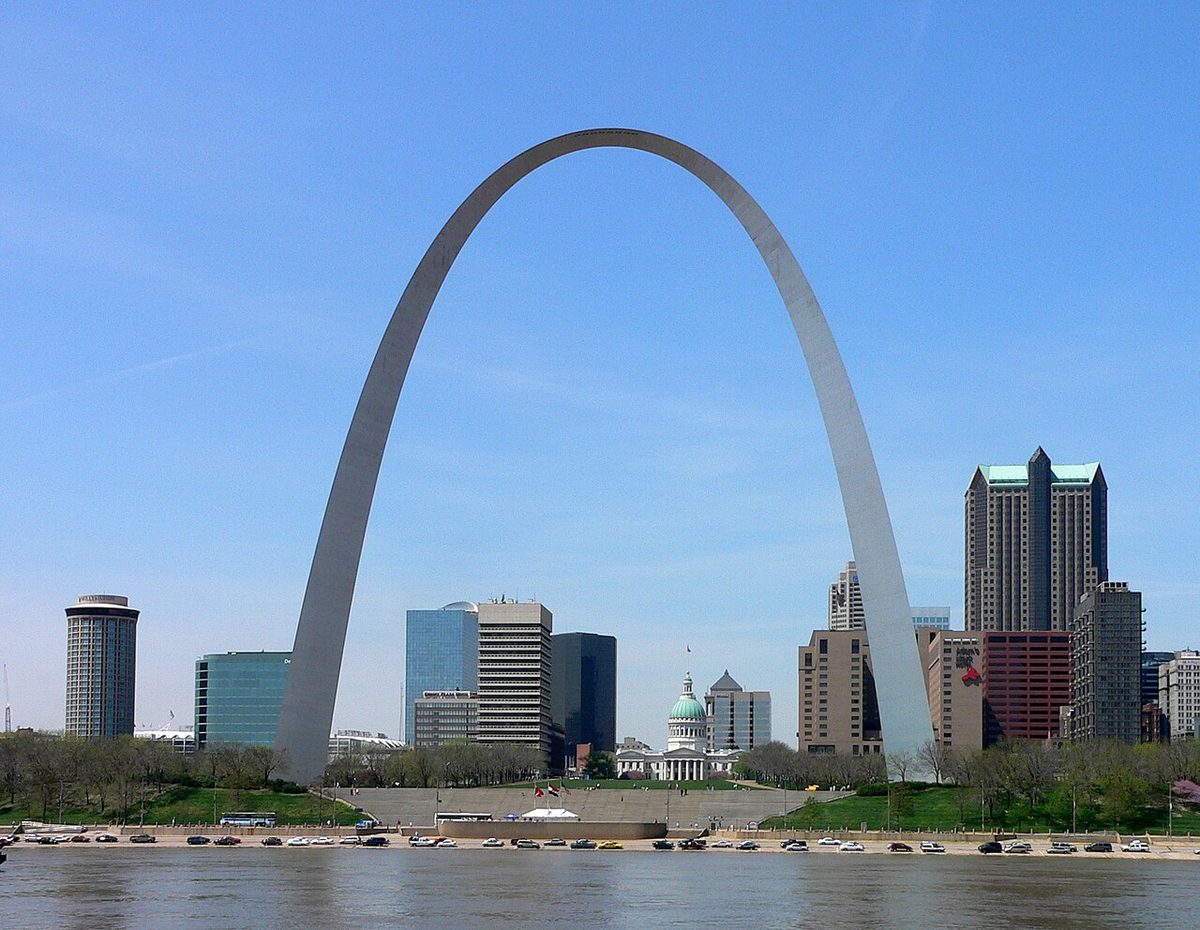
A curved structural form that spans an opening by redirecting compressive forces outward and downward into the supports on either side (the abutments). Arches come in many profiles, each carrying cultural and structural meaning. The round arch — a perfect semicircle — is the hallmark of Roman and Romanesque architecture, conveying solidity and authority. The pointed arch, which rises to a peak rather than a curve, is the defining motif of Gothic architecture; its shape allows height without excessive outward thrust, making tall windows possible. The horseshoe arch extends beyond the semicircle so the opening narrows at the base, a form especially common in Moorish and Islamic buildings from Spain to Persia. The ogee arch is S-shaped in profile — concave at the base, convex at the top — giving a highly decorative silhouette popular in late Gothic and Indo-Islamic architecture. The triumphal arch is not a structural arch at all but a freestanding ceremonial gateway, typically three-bayed, commemorating military victories in ancient Rome and imitated by later European rulers. See also our article on triumphal arches.
Ashlar
Finely cut, squared stone laid in regular horizontal courses with tight joints, as opposed to rubble masonry where stones are irregular. Ashlar work creates smooth, precise wall surfaces that project an image of refinement and permanence. The ancient Greeks used ashlar cut to exacting tolerances in their temple construction; the Romans perfected large-scale ashlar construction in concrete-backed stone veneers. Throughout the Renaissance and neoclassical periods, ashlar became the preferred facing for public buildings and palaces, sometimes combined with rustication at lower levels to suggest both strength and elegance. The precision required for true ashlar work made it significantly more expensive than rougher masonry alternatives.
Atrium
In ancient Roman domestic architecture, the central reception hall of a house, typically with an opening in the roof (the compluvium) above a shallow pool (the impluvium) that collected rainwater. Early Christian basilicas adapted the term to describe the forecourt or courtyard in front of the church entrance, sometimes with a fountain for ritual washing. In modern architecture, the term describes a large glazed interior courtyard — often multi-storey and flooded with natural light — that serves as a social heart for office buildings, hotels, and shopping centres. The atrium hotel, pioneered in the 1960s by architect John Portman, dramatically influenced how large interior public spaces are conceived and experienced.
Attic (architectural)
In classical architecture, the attic is not the space under the roof but rather a low story placed above the main entablature or cornice of a facade, often used to inscribe dedicatory inscriptions or carry sculptural reliefs. Roman triumphal arches typically feature a prominent attic zone above the arch openings, bearing the names of emperors and the victories being commemorated. In Renaissance and Baroque palaces, the attic story is a compressed top floor, smaller in window height than the principal floors below, which helps give the facade a clear hierarchical resolution. The term was later loosely borrowed to describe any storage space directly beneath a pitched roof.
B
Baldachin (Baldacchino)
A permanent canopy of stone, bronze, or wood erected over an altar, throne, or tomb to symbolize sacred or royal authority. The most famous example is Gian Lorenzo Bernini's colossal bronze baldachin inside St. Peter's Basilica in Rome (1623–1634), which rises nearly 29 metres over the papal altar above the tomb of St. Peter. Its spiraling barley-twist columns consciously echo ancient columns believed to have stood in Solomon's Temple. Smaller baldachins appear over the high altars of many medieval churches, serving both a practical purpose — focusing attention on the altar — and a symbolic one, marking the spot as the earthly dwelling place of the divine presence.
Barrel Vault
The simplest form of vault: a continuous semicircular arch extended in depth to cover a rectangular space, producing a tunnel-like ceiling. Barrel vaults were used extensively by the Romans in the substructures of amphitheatres, baths, and aqueducts. Romanesque churches adopted the barrel vault as the standard nave covering, though the form generates considerable lateral thrust that must be absorbed by thick walls or external buttressing. A pointed barrel vault — used in many Cistercian abbeys — reduces the outward thrust slightly. Because barrel vaults are opaque, they limit the size and number of windows that can be cut into the walls beneath them, making the interiors of Romanesque buildings characteristically dim compared to Gothic cathedrals. See Gothic, Romanesque and Byzantine architecture.
Basilica
Originally a large rectangular Roman public hall used for commerce and law, characterized by a central nave flanked by side aisles separated by colonnades, and usually terminating in one or two apses. Early Christians adopted this form wholesale for their new churches because it provided a large, flexible interior that focused movement toward the altar at the east end. The architectural type — nave, aisles, clerestory, apse — became the template for Christian church design throughout Europe and beyond. In Catholic canon law, "basilica" is also an honorific title granted by the Pope to especially important churches regardless of their actual architectural form, which can cause some confusion when visiting, say, a Baroque building officially designated a minor basilica.
Battlement
A parapet with alternating raised sections (merlons) and gaps (crenels or embrasures) running along the top of a castle wall, tower, or gatehouse. Defenders could take cover behind the merlons and fire arrows or drop stones through the crenels. After the medieval period, battlements lost their military function but remained popular as a decorative motif — the so-called "Gothic Revival" style of the 18th and 19th centuries plastered battlements onto country houses, university buildings, and even railway stations to evoke a medieval or chivalric atmosphere. See our detailed guide to military fortifications.
Bay
The fundamental unit of division in a building's structural and spatial rhythm. In a Gothic cathedral, a bay is defined by two adjacent piers and the vaulting compartment above them; the nave of Notre-Dame de Paris is seven bays long. In timber-frame construction, a bay is the space between two transverse frames. In facade design, a bay is typically one vertical unit of windows and wall, repeated across the width of the building. Counting bays is one of the most useful quick tools for understanding a building's proportions and period: a five-bay Georgian house follows different compositional rules than a three-bay Victorian villa, even if both are built of similar brick.
Belfry
The chamber or story of a tower in which bells are hung, or by extension the entire bell tower. A belfry requires large open openings on all sides so the sound of the bells can travel outward — these openings are typically filled with louvred slats rather than glazing, giving belfry stages a distinctive open, latticed appearance. In some traditions the belfry is an entirely separate structure from the church — the Italian campanile being the most prominent example. The word "belfry" comes not from "bell" but from the Old French berfrei, meaning a siege tower, since medieval war towers were later adapted as bell towers as their military use declined.
Bosses (Vault)
Decorative keystones placed at the intersections of vault ribs, typically carved in relief with foliage, heraldic shields, religious scenes, or portrait heads. In simple ribbed vaults, bosses occur only at the four-way crossing of ribs; in complex tierceron and lierne vaults, they multiply across the vault surface, creating constellations of carved imagery overhead. Some of the finest medieval vault bosses survive in English cathedrals — the nave of Norwich Cathedral has over 250 painted and carved bosses illustrating scenes from the Old and New Testaments, forming one of the most complete medieval narrative sequences in stone. Their position high overhead means they are difficult to study without binoculars or mirrors.
Brise-Soleil
French for "sun-break," a brise-soleil is a fixed or adjustable shading system — typically horizontal fins, vertical louvers, or a grid of both — attached to a building's exterior to block direct sunlight from entering windows while still admitting daylight. Le Corbusier popularized the device in his tropical and subtropical buildings of the 1940s and 1950s, most famously the Unite d'Habitation in Marseille and the Chandigarh Secretariat. A well-designed brise-soleil dramatically reduces solar heat gain and cooling loads, making it a fundamentally sustainable device. Modern architects continue to innovate with brise-soleils, incorporating motorized adjustable fins and photovoltaic cells. See also how climate shapes architecture.
Brutalism
An architectural movement of the 1950s–1970s characterized by the expressive use of raw, board-marked concrete (from the French beton brut), heavy massing, bold geometric forms, and an honest display of structure and services. Rooted in the ideas of Le Corbusier, Brutalism was embraced by welfare-state governments for housing blocks, universities, civic centres, and social infrastructure. Its greatest practitioners — Alison and Peter Smithson in Britain, Paul Rudolph in America, Kenzo Tange in Japan — saw it as an ethical architecture that refused cosmetic decoration. Brutalism fell from favour by the 1980s amid charges of coldness and poor weathering, but has undergone serious critical reappraisal in recent years. Read our full guide to Brutalism explained.
Buttress
A mass of masonry built against or projecting from a wall to resist the lateral thrust of a vault or roof. Simple buttresses — solid piers of stone projecting at right angles to the wall — appear in Romanesque architecture to stabilize barrel-vaulted naves. Gothic builders devised the flying buttress, an arched prop that leaps across the aisle roof to press against the nave clerestory wall from outside, allowing the nave walls to be thinned and filled with stained glass. The flying buttress is arguably the most distinctive structural innovation of medieval European architecture, making the soaring, luminous interior of the High Gothic cathedral possible. See Gothic, Romanesque and Byzantine architecture.
C
Campanile
An Italian bell tower, typically freestanding from the church it serves rather than attached to it. The campanile tradition in Italy produced some of the most iconic silhouettes in world architecture: the round campanile of Pisa (begun 1173), famous for its lean caused by unstable subsoil; the tall brick campanile of Venice's Piazza San Marco, which collapsed in 1902 and was rebuilt identically by 1912; and Giotto's Campanile in Florence, clad in polychrome marble panels. The freestanding campanile allowed the bell tower to be positioned for maximum acoustic reach across the town, and its height served as a landmark for travellers arriving from a distance. Many campanili also functioned as watchtowers, with guards stationed to raise alarms against fire or enemy attack.
Cantilever
A structural element — beam, slab, or truss — that projects horizontally beyond its support without any column or brace at its free end, relying entirely on the strength of its connection to the anchor point and the stiffness of the element itself. Frank Lloyd Wright's Fallingwater (1937) is the most celebrated demonstration of the cantilever in domestic architecture, its concrete terraces thrusting dramatically over a waterfall. Modern high-rise buildings use cantilevers to create overhanging upper floors, sky bridges, and transfer structures that allow column grids to shift between floors. The cantilever is a key structural concept behind contemporary architecture's most gravity-defying forms. See the evolution of the skyscraper.
Capital
The crowning member of a column, sitting between the shaft and the entablature or arch above. Capitals are the primary signifier of the classical order being used. The Doric capital is the simplest — a plain circular cushion (echinus) topped by a square slab (abacus) — projecting austere, masculine strength. The Ionic capital introduces the distinctive scroll-shaped volutes on two opposing faces, conveying elegance and refinement. The Corinthian capital, the most elaborate of the three Greek orders, features a basket-like form covered with two or three rows of acanthus leaves from which spiral stalks (caulicoli) rise to support small volutes at the corners; it became the favoured capital of Roman imperial architecture and was extensively revived in neoclassical buildings worldwide. Medieval craftsmen broke free of classical formulae to carve capitals with narrative scenes, interlaced foliage, grotesque faces, and complex geometric patterns, making the carved capital one of the richest sources of Romanesque art.
Caravanserai
A roadside inn built at regular intervals along trade routes across the Islamic world — from Anatolia and Persia to Central Asia and the Silk Road — to provide food, water, shelter, and security for merchants and their caravans of pack animals. A typical caravanserai follows a standardized plan: a large courtyard surrounded by arcaded ranges containing stables at ground level and lodging rooms above, with a single fortified entrance. Some were built by rulers as acts of piety and public benefit, offered free of charge; others were commercial enterprises. At their height, caravanserais were spaced approximately a day's journey (25–35 km) apart, forming a sophisticated network of hospitality infrastructure across the medieval Islamic world.
Caryatid
A sculpted female figure serving as an architectural support in place of a column, with the figure's head carrying the entablature or roof above. The most famous examples are the six Caryatids of the Erechtheion on the Athenian Acropolis (c. 421–406 BC), where the figures stand with their weight shifted elegantly to one leg. The name traditionally derives from the women of Karyai, a Peloponnesian town, though ancient sources vary. One original Erechtheion caryatid was removed by Lord Elgin in the early 19th century and is now in the British Museum; a cast stands in its place. Caryatids appear across subsequent Western architecture wherever a classical reference is desired, including the porch of St. Pancras New Church in London (1822).
Casemate
A fortified chamber in the wall or bastion of a castle or fort, with openings (embrasures) through which artillery or firearms could be directed. Unlike open gun platforms (barbettes), casemates protect their crews from enemy fire by enclosing them in vaulted or arched chambers of thick masonry or concrete. The term also describes armoured compartments on warships. Casemate construction became critical in the 16th century as artillery replaced arrows and the old curtain walls of medieval castles were thickened, lowered, and equipped with projecting bastions from which defenders could deliver flanking fire. See our full guide to military fortifications for more on the evolution of defensive architecture.
Chancel
The eastern arm of a cruciform church, between the crossing and the high altar, reserved for the clergy and choir. The word derives from the Latin cancelli, referring to the screen or lattice that traditionally separated this liturgically privileged space from the nave where the lay congregation stood. In medieval parish churches the chancel was often physically distinct — narrower, lower, and separately roofed — reflecting the fact that it was the responsibility of the rector to maintain, while the nave was the responsibility of the parishioners. The chancel typically contains the choir stalls, the bishop's throne (cathedra, in a cathedral), the sedilia (seats for officiating clergy), and the piscina (basin for rinsing sacred vessels).
Chevron (Ornament)
A zigzag or V-shaped decorative motif carved in continuous bands around arches, doorways, and window openings — one of the most characteristic decorative signatures of Romanesque architecture, particularly in Britain and Normandy. Chevron mouldings appear in multiple overlapping bands, creating a dazzling visual effect that is sometimes described as almost Op Art in its intensity. Durham Cathedral's nave piers are incised with giant spiral, chevron, and lozenge patterns that are among the most powerful ornamental treatments in medieval architecture. The chevron's precise regularity required skilled stone carving but was faster and less expensive than figurative sculpture, making it widespread across 12th-century building. See Gothic, Romanesque and Byzantine architecture.
Clerestory
The upper zone of a church wall, rising above the roofline of the flanking aisles, pierced with windows to admit light into the nave. The term (pronounced "clear-story") describes any upper story of windows in a multi-level building. In Roman basilicas the clerestory windows were relatively small round-headed openings; Gothic builders, freed by flying buttresses from the structural constraints of thick walls, expanded the clerestory into vast sheets of stained glass divided by stone tracery. In hot climates, clerestory openings are used for natural ventilation — the thermal stack effect draws hot air up and out through the high-level openings. Clerestory windows are found in secular buildings too: great railway stations, factories, and warehouses use them to light deep floor plans without side windows.
Cloister
A covered walkway forming a square or rectangular courtyard, open on the inner side to a garden (the garth), typically attached to a cathedral, monastery, or college. The cloister served as the organizing spine of monastic life — the place where monks walked, read, meditated, washed at the lavatorium before meals, and carried out everyday tasks sheltered from the weather. The covered walk was usually vaulted and its open arcade looked out over the garden through tracery or coupled columns. The finest medieval cloisters — at Mont Saint-Michel, Westminster Abbey, or the Cistercian abbeys of southern France — combine architectural refinement with a profound sense of enclosed peace. Many secular colleges, particularly in Oxford and Cambridge, adopted the cloister form as a dignified organizing device for their courts.
Colonnade
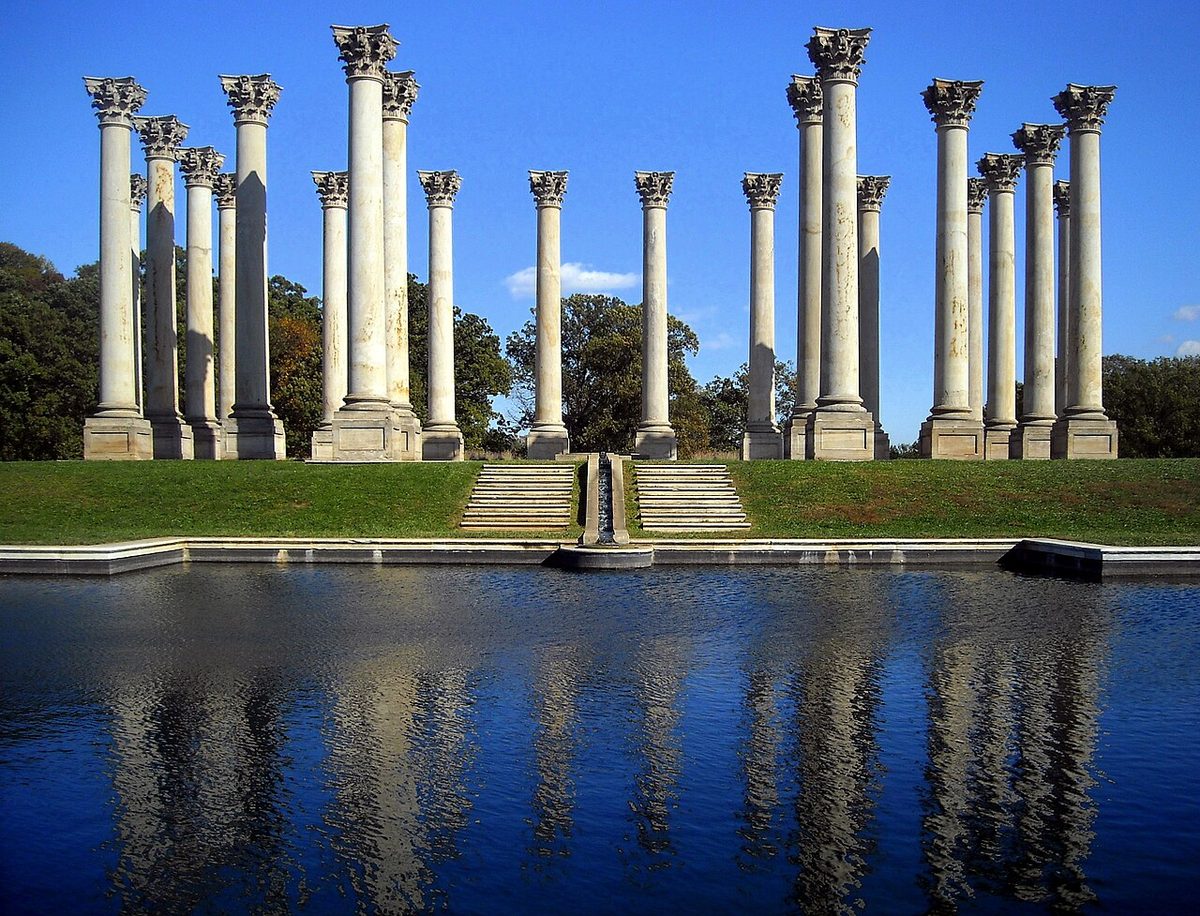
A row of evenly spaced columns supporting an entablature or arcade, typically forming a covered walkway or defining the perimeter of a space. The colonnade is one of the fundamental instruments of classical architecture, used to create shaded outdoor galleries (stoas in Greek cities), define the fronts of temples, and provide dignified public space. Among the grandest colonnades in Western architecture is Gian Lorenzo Bernini's elliptical colonnade encircling the piazza in front of St. Peter's in Rome (1656–67), its sweeping arms described by Bernini as the motherly arms of the Church embracing the faithful. The neoclassical revival of the 18th and 19th centuries deployed colonnades extensively for museums, libraries, and government buildings worldwide. See neoclassical architecture.
Column
A vertical structural element, typically cylindrical or slightly tapered, consisting of a base, a shaft, and a capital. In classical architecture, columns are the primary expression of order and proportion — the diameter and height of the column, and the details of base and capital, define the character of the entire building. Greek Doric columns have no base and taper more dramatically; Ionic and Corinthian columns stand on molded bases and have more slender proportions. Columns in Greek temples are slightly swelled in the middle (entasis) to counteract the optical illusion of concavity that would appear in perfectly straight shafts. In Gothic architecture, the equivalent element — the pier — is typically a cluster of shafts that fan out into vault ribs above, making the boundary between support and vault intentionally ambiguous. See neoclassical architecture.
Corbel
A projecting block of stone, brick, or timber built into a wall to support a weight above — a beam, arch, vault, or parapet. Corbels are essentially cantilevered supports, projecting further with each successive course as more stone is laid above, until the corbelled elements from opposite sides of a space can meet to form a corbelled arch or vault — a primitive structural form (requiring no mortar) used in Neolithic and Bronze Age structures long before the true arch was developed. In medieval buildings, corbels frequently carry wall ribs, timber floor beams, and parapet walkways; the carved faces of people and animals that serve as decorative corbels in English parish churches are known as grotesques or green men.
Crenellation
The pattern of alternating raised merlons and open crenels (or embrasures) cut into the top of a wall, forming the characteristic jagged skyline of a castle parapet. Crenellation served a defensive purpose: archers could shelter behind the merlons and shoot through the crenels. In medieval England, permission to crenellate — a formal royal licence — was required before a lord could fortify his house with battlements, since fortification implied military power that the Crown wished to regulate. After the medieval period, crenellation retained purely decorative status; the "castellated" style of 18th and 19th century architecture — all turrets and battlements — applied crenellation to manor houses, bridges, follies, and even garden walls as a picturesque historical reference. See military fortifications.
Crossing (Church)
The square or rectangular space at the intersection of the nave and transepts of a cruciform church, typically marked above by a crossing tower, dome, or lantern that floods the interior with light from a central point. The crossing is structurally demanding because four arches (the crossing arches) meet here from four directions, generating complex forces that must be carefully managed. In Norman and Romanesque cathedrals the crossing tower is a heavy, solid form; in Gothic cathedrals the crossing may be surmounted by a soaring spire or an open lantern tower of stone tracery. The crossing is architecturally the heart of the church — the point where the longitudinal processional axis intersects the transverse axis, creating the plan of the cross in three dimensions.
Curtain Wall
The term has two distinct meanings in architectural history. In medieval fortification, a curtain wall is the main defensive perimeter wall linking towers and gatehouses of a castle or city — it is literally a "curtain" of masonry hanging between the stronger vertical elements of the fortification system. In modern architecture, a curtain wall is a non-structural exterior skin of glass and metal panels hung from the building's structural frame, providing weather protection and appearance without carrying any floor or roof loads. The modern glass curtain wall, developed in the 1950s in buildings like Skidmore Owings & Merrill's Lever House in New York, transformed the appearance of commercial architecture worldwide. See military fortifications and the evolution of the skyscraper.
D
Deconstructivism
An architectural movement that emerged in the late 1980s characterized by fragmentation, non-rectilinear forms, distorted geometries, and a deliberate disruption of conventional ideas about structure, enclosure, and surface. Influenced by the philosophical writings of Jacques Derrida and the formal experiments of Constructivist artists, Deconstructivism was identified as a movement by the landmark 1988 exhibition at the Museum of Modern Art in New York, curated by Philip Johnson and Mark Wigley. Key practitioners — Frank Gehry, Zaha Hadid, Daniel Libeskind, Peter Eisenman, Bernard Tschumi — produced buildings that seem to challenge gravity, logic, and spatial clarity, creating powerful emotional environments through deliberate architectural dissonance. The Guggenheim Museum Bilbao (1997) brought Deconstructivism to global celebrity. See also Soviet Constructivism, one of its precursors.
Dome
A hemispherical, parabolic, or pointed shell structure that covers a circular, square, or polygonal space by redirecting forces in compression around its curved surface toward a ring of abutments at the base. The dome has carried powerful symbolic meaning across cultures — it represents the sky, the cosmos, and divine protection in traditions from ancient Mesopotamia to the Renaissance papacy. The Romans mastered concrete dome construction, most spectacularly in the Pantheon (c. AD 125) with its 43-metre diameter open oculus. Byzantine architects developed the pendentive to set a circular dome over a square room. The great Renaissance domes of Florence (Brunelleschi, 1436) and Rome (Michelangelo, 1590) established the dome as the supreme symbol of Western institutional authority. See our detailed guide to the great domes of the world.
Dormer
A window set vertically into the sloping surface of a pitched roof, with its own small roof and side walls (cheeks), which projects outward to admit light and ventilation to the space within. Dormers range in scale from tiny roof lights in modest cottages to large, elaborately decorated projecting structures in French chateaux and mansions — the French coined the term from dormir (to sleep), since the upper rooms they served were typically bedchambers. A dormer can take many forms: a flat-topped "blind" dormer for visual effect, a triangular pediment dormer in a classicizing scheme, or the stepped and curved baroque forms that enliven the rooflines of 17th-century Parisian buildings. Dormers are an important clue in reading the age and status of historic houses.
Drum (Architectural)
The cylindrical or polygonal wall that supports a dome, raising it above the roofline of the building below and typically pierced with windows to admit light to the interior. The drum is both a structural and a compositional element: structurally, it distributes the dome's thrust outward and downward to the walls and piers beneath; compositionally, it provides a vertical transition between the rectangular mass of the building and the curved form of the dome. The drum of Brunelleschi's Florence Cathedral dome is polygonal and relatively short; Michelangelo's drum for St. Peter's in Rome is taller and articulated with paired columns. In Baroque churches, drums are often generously glazed so that the dome appears to float in a ring of brilliant light. See the great domes of the world.
E
Entablature
In classical architecture, the horizontal band of structure carried by columns, consisting of three superimposed horizontal members: the architrave (the lowest, which spans directly from column to column), the frieze (the middle zone, often decorated with continuous relief sculpture or alternating triglyphs and metopes in the Doric order), and the cornice (the projecting topmost member that throws rainwater clear of the wall below). The proportions and detail of the entablature are as defining as the capital in distinguishing the different classical orders — Doric entablatures are heavier and more austere; Corinthian entablatures are more richly ornamented. Virtually every neoclassical and Renaissance building incorporates an entablature or its parts at key compositional moments. See neoclassical architecture.
Expressionism (Architectural)
A movement in early 20th-century European architecture — primarily German, Dutch, and Scandinavian — that sought to express powerful emotional states through extreme, often organic or crystalline forms in concrete, brick, and glass. Architectural Expressionism overlapped with but was distinct from the Expressionist movement in painting and film, sharing an interest in the subjective and the visionary. Key works include Erich Mendelsohn's Einstein Tower in Potsdam (1921), Hans Poelzig's Grosses Schauspielhaus in Berlin (1919), and Bruno Taut's Glass Pavilion at Cologne (1914). The movement produced some of the most architecturally inventive buildings of the century, and its influence persists in later architects such as Jorn Utzon (Sydney Opera House) and the entire Expressionist tradition in contemporary architecture.
F
Fan Vault
The most decorative and technically demanding form of Gothic vaulting, developed in England in the late 14th century and reaching its spectacular apex in the Tudor period. A fan vault consists of conical half-vaults — looking like the spread of a hand-held fan — that spring from the walls or piers and meet at the centre of the ceiling, covered with a dense tracery of ribs that are in fact carved from solid stone panels rather than individually constructed ribs. The fan vault is unique to English Gothic architecture; the supreme examples are King's College Chapel, Cambridge (completed 1515) and the Henry VII Chapel at Westminster Abbey (begun 1503), where pendant bosses hang seemingly impossibly from the vault centre. See Gothic, Romanesque and Byzantine architecture.
Fenestration
The arrangement, proportion, and design of windows in a building's facade. Fenestration is one of the primary tools through which architects control the relationship between interior and exterior, between solid and void, between light and dark. The fenestration pattern is also one of the most reliable indicators of a building's period and style: the small, deeply-set windows of Romanesque buildings differ fundamentally from the vast glazed surfaces of Gothic cathedrals; the regular sash windows of Georgian townhouses follow entirely different compositional rules from the ribbon windows of International Style modernism or the complex punched openings of contemporary architecture. Reading a building's fenestration carefully — its rhythm, hierarchy, and detail — is essential to understanding it as a whole.
Finial
A decorative terminating ornament placed at the apex of a gable, spire, pinnacle, canopy, or roof. Finials serve to visually complete a pointed or tapered architectural element, giving it a definitive stopping point. In Gothic architecture, pinnacle finials are typically carved as stylized foliage (crockets and the foliated ball called a fleur-de-lis or pommel); in Islamic architecture, a crescent moon finial crowns the tip of every minaret; in Hindu temple architecture, the amalaka (ribbed stone disk) and kalasha (pot-shaped ornament) form the ritual finial that crowns the shikhara. In domestic architecture, cast-iron finials were mass-produced in the Victorian era for ridge tiles, gates, and ironwork, allowing even modest houses to sport decorative punctuation along the roofline.
Flying Buttress
An arched prop that transfers the lateral thrust of a vault across the open space of an aisle and down into a freestanding pier or wall, allowing the nave walls above the aisle roofline to be thinned and pierced with large windows. The flying buttress is the enabling technology of High Gothic architecture — without it, the soaring windows of Chartres, Notre-Dame, and Amiens would be structurally impossible. Developed through trial and error in the 12th century (the choir of Notre-Dame de Paris, begun 1163, is the canonical early example), the flying buttress was refined over two centuries into increasingly elegant and daring forms. From outside, the forest of stone arches leaping over the aisle roofs of a great Gothic cathedral is one of architecture's most dramatic spectacles. See Gothic, Romanesque and Byzantine architecture.
Frieze
The middle horizontal band of the classical entablature, between the architrave below and the cornice above. In the Doric order, the frieze is divided into alternating triglyphs (three vertical channels carved in stone) and metopes (flat or sculptured panels between the triglyphs); the Parthenon's famous carved metopes depict mythological battles. In Ionic and Corinthian buildings, the frieze is typically a continuous flat or slightly projecting band used for relief sculpture — the 160-metre Ionic frieze of the Parthenon, now largely in the British Museum, depicts the Panathenaic procession in continuous narrative. The term "frieze" is used loosely in modern architecture and interior design for any decorative horizontal band near the top of a wall.
G
Garbhagriha
Sanskrit for "womb chamber," the innermost sanctuary of a Hindu temple — a small, dark, stone-walled room where the principal deity's image (murti) is enshrined. Unlike the nave of a Christian church, the garbhagriha is not a space for congregational gathering; it is the home of the god, entered only by priests. The smallness and darkness of the room are deliberate: they replicate the sacred cave or mountain grotto where the divine is thought to dwell, and the darkness intensifies the power of ritual encounter with the deity's image illuminated by lamps and lamplight. The garbhagriha sits directly below the tower (shikhara in north Indian temples), which marks its presence on the exterior skyline and channels cosmic energy down toward the deity within. See ancient temples explained.
Glacis
A long, gentle slope of earth or masonry that descends away from the outer defences of a fortification, designed to expose attackers to flanking fire from the fortress while preventing them from taking cover. The glacis was a key feature of the trace italienne fortification system developed in Italy in the 16th century in response to the devastating power of cannon, and was refined by the French military engineer Vauban into a science of almost mathematical precision. Unlike a medieval wall, a glacis presents no vertical surface that enemy artillery can breach — cannonballs simply roll off the slope. The glacis also served to deflect shells upward away from the main defensive walls. See military fortifications.
Gothic (Architectural)
The dominant style of European ecclesiastical architecture from the mid-12th through the 16th century, characterized by pointed arches, ribbed vaults, flying buttresses, and large windows filled with stained glass. Gothic architecture originated in the Ile-de-France with Abbot Suger's reconstruction of the choir of Saint-Denis (begun 1137), spread rapidly across France, England, Germany, and Spain, and generated distinct regional schools with their own distinctive characters. English Gothic evolved through Early English, Decorated, and Perpendicular phases; French Gothic peaked with the High Gothic cathedrals of the 13th century; German Gothic produced tall hall churches with dramatic unified interiors. Gothic was revived with scholarly rigour in the 19th century by architects including Viollet-le-Duc and Pugin. See our full guide to Gothic, Romanesque and Byzantine architecture.
Groin Vault
A vault formed by the intersection of two barrel vaults at right angles, producing a structure with four curved triangular sections (webs or cells) meeting at a sharp ridge (the groin) along the diagonal. The groin vault concentrates structural forces at four corner points rather than along the entire length of the walls, allowing the walls between the corners to be opened up with windows or arcade arches. Romans used groin vaults in the vast halls of their baths; Romanesque builders adopted them for side aisles and crypt spaces. The development of the ribbed vault — which adds stone ribs along the groin lines — is the structural innovation that bridges Romanesque and Gothic architecture, making vaulting more precise, flexible, and potentially thinner. See Gothic, Romanesque and Byzantine architecture.
H
Hall Church (Hallenkirche)
A church type in which nave and aisles are built to the same height, creating a single unified interior volume without a clerestory. Unlike the three-tiered elevation of a French Gothic cathedral, the hall church has no visual hierarchy between the different zones of the wall — all is uniform height and light. The type was developed particularly in Germany and its neighbours, with notable examples in Westphalia, Bavaria, and Bohemia; the Wiesenkirche at Soest and St. Barbara's Cathedral at Kutna Hora are among the finest. Hall churches often achieve a powerfully atmospheric interior because the light enters from windows in all three aisles at the same level, creating an even wash of illumination and a sensation of great spatial breadth. The type influenced later central European and Spanish Gothic buildings significantly.
Hypostyle Hall
A large interior space with a flat roof supported by a dense forest of columns, with no clearstory or windows above the main column level. The hypostyle hall was a defining spatial type in ancient Egyptian temple architecture — the Great Hypostyle Hall at Karnak (c. 1250 BC), with 134 columns in 16 rows covering an area of some 5,000 square metres, is one of the most awe-inspiring interiors ever built. The word comes from the Greek for "under pillars." Similar column-forest spaces appear in Persian palatial architecture at Persepolis and in many Islamic mosques, where the prayer hall is structured as a hypostyle space with rows of columns supporting a flat or slightly vaulted roof. See ancient temples explained.
I
Iwan
A barrel-vaulted hall or recess, open at one end through a large pointed arch, that serves as a monumental gateway or reception room in Islamic architecture. The iwan is one of the most important spatial types in the Islamic world, used in mosques, madrasas (theological schools), caravanserais, and palaces across an enormous geographical range from Egypt to Central Asia. In the four-iwan madrasa plan — adopted widely from the 11th century onward — four iwans open off a central courtyard on each of its four sides, creating a powerful axial cross arrangement. The soaring vaulted interior of an iwan, typically covered with brilliant tilework and muqarnas, creates a spatially dramatic yet sheltered transition between the open courtyard and the enclosed interior. See the Islamic architecture guide.
K
Keystone
The central, wedge-shaped stone at the crown of an arch, which locks all the other voussoirs in place and completes the structural transfer of load. Before the keystone is inserted, an arch under construction is supported by temporary wooden centering; once the keystone is set, the arch becomes self-supporting and the centering can be removed. Because of its critical structural role and its central, visually prominent position, the keystone became a favourite location for decorative carving — faces, heraldic devices, and masks are common keystones in Renaissance and Baroque architecture. The metaphorical usage of "keystone" — as the thing that holds everything together — derives directly from its architectural function.
L
Lancet Window
A tall, narrow window with a sharply pointed arch at the top and no tracery — the simplest and earliest form of Gothic window, associated with the Early English Gothic style of the late 12th and early 13th centuries. Named for its resemblance to a surgeon's lance, the lancet window typically appears in groups of three, five, or seven, set close together or separated by slender wall shafts. The famous Five Sisters window at York Minster (c. 1250) consists of five lancet windows of exceptional height filled with grisaille (grey-toned patterned) glass. As Gothic progressed into the Geometric and Decorated phases, individual lancets were combined under a larger arch and the space between them cut into tracery patterns. See Gothic, Romanesque and Byzantine architecture.
Lantern (Dome)
A small windowed turret or tower placed at the apex of a dome to admit light to the interior and to provide the dome's visual termination from outside. The lantern serves both a functional purpose — cutting a hole at the dome's crown to admit natural light without fully opening it to the elements — and an expressive one, giving the dome a pointed or crowned silhouette. The lantern atop Brunelleschi's Florence Cathedral dome (designed 1436, completed 1467) is particularly elegant, with a conical marble top and flanking flying buttresses that help contain the dome's outward thrust. St. Paul's Cathedral in London has a triple lantern structure — an inner light dome, an outer masonry cone, and the visible outer dome — producing a complex piece of structural engineering. See the great domes of the world.
Lintel
A horizontal beam spanning an opening — a doorway, window, or fireplace — and carrying the weight of the structure above. The lintel is the simplest structural device for bridging an opening, requiring only that the spanning material be strong enough in bending (tension at the bottom, compression at the top) to carry the load. Stone is relatively poor in tension, so stone lintels must be thick and spans kept short; timber and steel are far stronger in bending and can span greater distances. Post-and-lintel construction — vertical supports topped by horizontal beams — is the most ancient and universal structural system, used in Stonehenge, in Greek temples, and in virtually every timber-framed building in the world. The arch and vault were developed partly to overcome the span limitations of the stone lintel.
Loggia
A gallery or room open on one or more sides to the exterior, typically through an arcade or colonnade, used for shade, outdoor activity, or ceremonial display. The loggia occupies an intermediate position between indoors and outdoors, providing shelter from sun and rain while maintaining a close relationship with the street, garden, or piazza beyond. In Italian Renaissance architecture, loggias were prominent features of public buildings (Loggia dei Lanzi in Florence, 1382) and private palaces alike. The Vatican Loggia, painted by Raphael's workshop with grotesque ornament and biblical scenes, became one of the most influential decorative programmes in Western art. In vernacular architecture across the Mediterranean and tropics, the shaded loggia or veranda is a climatically rational response to intense heat and sunlight. See also how climate shapes cities.
M
Mandapa
The columned hall or porch of a Hindu temple that serves as the assembly space for worshippers, dancers, and musicians — the public counterpart to the private, priestly garbhagriha. Mandapas vary enormously in scale: small temples may have a single small porch; major temple complexes like Madurai Meenakshi or Ranakpur have multiple successive mandapas of increasing size, the largest capable of housing hundreds. The columns of South Indian mandapas are typically carved with elaborate figural programmes — horses, elephants, mythological scenes — making them effectively galleries of narrative sculpture. The thousand-columned halls (sahasra-stambha mandapas) of some South Indian temples are among the most visually complex interior spaces in world architecture. See ancient temples explained.
Mashrabiya
A projecting enclosed balcony or oriel window with elaborately carved wooden lattice screens — a defining feature of traditional domestic architecture throughout the Arab world, from Egypt and the Levant to North Africa and the Arabian Peninsula. The mashrabiya screen filters the harsh desert sunlight while allowing air to circulate (the wooden members wet the passing air through evaporation), and provides privacy for women within the house while allowing them to see onto the street below without being observed. The lattice patterns, often geometrically intricate, are works of great craft and beauty in their own right. Contemporary architects have reinterpreted the mashrabiya in perforated metal panels and laser-cut facades as a culturally resonant sustainable shading device. See the Islamic architecture guide.
Merlon
The raised, solid section of a battlement parapet between two open crenels (gaps). Merlons provide cover for defenders standing behind the parapet who wish to fire arrows, crossbow bolts, or later firearms through the crenels at attackers below. The top of a merlon is sometimes cut with a small vertical slot (called an arrow loop or oillet) through which a bowman could fire while remaining entirely shielded by the solid stone on either side. The relative proportions of merlons and crenels — how tall and wide each element is — varied by region and period, giving battlements their distinctive silhouettes. In decorative post-medieval applications, merlon profiles range from simple rectangular blocks to pointed or rounded crowns. See military fortifications.
Mihrab
A niche set into the qibla wall of a mosque — the wall oriented toward Mecca — indicating the direction of prayer. All Muslims pray facing Mecca, and the mihrab gives this orientation visible, permanent form within the mosque's architecture. Mihrabs range from simple semicircular recesses in modest village mosques to elaborate multi-lobed niches encrusted with tilework, carved stone, or stucco that constitute some of the finest examples of Islamic decorative art. The mihrab of the Great Mosque of Cordoba (c. 965), with its double horseshoe arch framed by Byzantine mosaic panels, is among the most celebrated in the world. Because of its symbolic importance, the mihrab and the wall surrounding it receive the finest available craftwork. See the Islamic architecture guide.
Minaret
The tall tower from which the muezzin calls the faithful to prayer five times daily — one of the most universally recognizable forms in Islamic architecture and a key element in identifying mosques from a distance. Minarets vary enormously in form across different regional traditions: the squat, square-plan minarets of North Africa contrast with the elegant round pencil minarets of Ottoman Turkey; the spiral external-ramp minaret of the Great Mosque of Samarra (ninth century) is unique in world architecture. Most mosques have one minaret; major imperial mosques may have four or six. Modern sound amplification systems have reduced the functional need for height, but minarets continue to be built as the essential vertical accent that identifies a mosque on the cityscape. See the Islamic architecture guide.
Minbar
The raised pulpit in a mosque from which the imam delivers the Friday sermon (khutba). A minbar typically consists of a flight of stairs — often six to twelve steps — leading to a small platform or seat near the top, with a decorative gate or arch at the bottom of the stairs. The imam traditionally stops one step below the highest platform, which is symbolically reserved for the Prophet. Minbars are among the finest examples of Islamic woodwork and stone carving — the 12th-century minbar originally made for the Kutubiyya Mosque in Marrakech and later moved to the Koutoubia Mosque is considered one of the masterpieces of medieval Islamic craftsmanship, its lattice panels of inlaid wood of extraordinary refinement. See the Islamic architecture guide.
Muqarnas
A distinctively Islamic form of decorative three-dimensional surface articulation consisting of tiers of small corbelled niches, brackets, and projections assembled into stalactite-like compositions that fill vaults, domes, apse heads, cornices, and capitals. Muqarnas function structurally to make the transition between a flat wall or square room and a curved ceiling or dome, but their primary impact is visual and symbolic — they dissolve the solid surface of the vault into an infinitely complex celestial canopy that suggests the plurality and endlessness of creation. The muqarnas of the Alhambra's Hall of the Two Sisters (1354) in Granada are among the most celebrated in existence, with more than 5,000 individual plaster cells arranged in a dizzying composition that catches and fragments the light. See the Islamic architecture guide.
N
Narthex
A vestibule or entrance hall at the western end of a church, before the nave proper, where catechumens (those preparing for baptism) and penitents would wait during services they were not yet admitted to attend. The narthex acts as a transitional zone between the secular exterior and the sacred interior, a space for gathering, preparation, and contemplation before entering the liturgical space. Some churches have an outer narthex (exonarthex) in the open air and an inner narthex (esonarthex) within the building envelope. In Byzantine churches, the narthex was elaborately decorated with mosaics as part of the symbolic programme of spiritual preparation. In modern churches, the narthex functions as a welcoming foyer, bookshop, or social gathering space — its transitional role continues even without the liturgical formalities.
Nave
The central longitudinal space of a church, stretching from the entrance (or narthex) to the crossing or chancel, where the lay congregation gathers for worship. The word comes from the Latin navis (ship), perhaps because the vaulted nave resembled an overturned hull, or because the Church was metaphorically the ship of salvation. In a basilica plan, the nave is flanked by lower side aisles separated by colonnades or arcade piers; in a hall church, nave and aisles are the same height. The nave is typically the longest and widest element of the church and receives the most care in its architectural treatment. The proportions of the nave — its height-to-width ratio and the number and design of its bays — are among the most important variables distinguishing national and period styles within Gothic architecture.
O
Oculus
A circular opening at the crown of a dome or in a wall, admitting light and sometimes — as in the Pantheon — sky, rain, and the full theatre of natural weather. The Pantheon's oculus (9 metres in diameter) is the most famous in the world: it is the sole source of light for the entire interior, and the shaft of sunlight that passes through it sweeps slowly around the interior walls as the day progresses, creating one of architecture's most powerful spatial effects. The word comes from the Latin for "eye." In medieval architecture, small circular windows in gable ends are called oculi; in Gothic churches, the rose window is a vastly elaborated oculus transformed into a wheel of stone tracery and stained glass. See the great domes of the world.
Ogee
An S-shaped double curve — concave at the base, convex above — used in arch profiles, moulding profiles, and roof shapes. The ogee arch (two ogee curves meeting at a point) is highly decorative rather than structurally efficient, generating complex thrust patterns; it appears extensively in the Decorated Gothic architecture of 14th-century England and in the Indo-Islamic architecture of the Mughal period. The ogee is also widely used in classical moulding profiles — the cyma reversa and cyma recta are ogee-profiled mouldings that appear in cornices and bases. In roof construction, an ogee profile produces the distinctive concave-then-convex outline of a Mansard roof or of some East Asian eave profiles. The double curve makes the ogee simultaneously elegant and visually restless — it seems to rise, pause, and continue.
Orders (Architectural)
A system for organizing the design of a classical column and the entablature it carries, each order constituting a complete and internally consistent set of proportional relationships and decorative details. The three Greek orders are the Doric (simplest and most massive: no base, plain capital, triglyphs-and-metopes frieze), the Ionic (more slender, with scroll volutes on the capital and a continuous sculptural frieze), and the Corinthian (most elaborate, with acanthus-leaf capital and rich entablature ornamentation). The Romans added two further orders: the Tuscan (a simplified, unfluted Doric with a plain base, considered the most rustic and severe) and the Composite (which combines the Ionic volute with the Corinthian acanthus leaves, the most ornate of all). Renaissance theorists codified all five orders into treatises — notably Vignola's Regola delli cinque ordini d'architettura (1562) — which became the grammar books of classical design for architects worldwide. See neoclassical architecture.
P
Parapet
A low wall along the edge of a roof, terrace, bridge, or balcony, providing a safety barrier and often constituting the main visible skyline element of the building's elevation. In classical architecture, parapets are typically solid and may be decorated with balustrades, urns, or statuary. In medieval fortification, the parapet is the defensive wall atop the ramparts, equipped with battlements for the protection of defenders. In 20th-century modernism, the flat-roofed parapet became a compositional tool for creating buildings with crisp, pure silhouettes unburdened by historic decorative profiles — the flat or slightly sloped parapet is one of the signature elements of the International Style. Parapets also perform crucial practical functions: concealing rooftop plant and equipment, managing rainwater drainage, and providing structural edge stiffening.
Pediment
The low triangular gable formed by the sloping roof of a classical Greek or Roman temple, framed by the raking cornice above and the horizontal cornice below. The triangular tympanum of the pediment was the primary location for large-scale figure sculpture in Greek temple architecture — the two pediments of the Parthenon contained some of the finest sculpture of the ancient world, depicting the birth of Athena and her contest with Poseidon for Athens. In post-antique architecture, pediments were applied as decorative features over doors, windows, and aedicules, and proliferated into triangular, segmental (curved), broken (with a gap at the apex), and swan-neck variations. The pediment remains one of the most widely used decorative elements in Western architecture. See neoclassical architecture.
Pendentive
A concave triangular surface that makes the transition between a circular dome and the square or polygonal space beneath it, effectively "squeezing" a circle into the corners of a square by curving inward from the four arches below. Pendentives were the Byzantine solution to the fundamental geometric problem of placing a round dome over a rectangular room, and the Hagia Sophia in Constantinople (537 AD) is their supreme demonstration — the enormous dome seems to float above the nave on a ring of windows, its weight actually transferred invisibly through the pendentives to four massive piers. Pendentives became the universal solution for dome construction in Byzantine, Islamic, Renaissance, and Baroque architecture. The alternative solution — the squinch — fills the corner with a small arch or corbelled niche rather than a smooth curved triangle. See the great domes of the world.
Piano Nobile
Italian for "noble floor," the principal reception floor of an Italian Renaissance or Baroque palace, typically the first floor above the ground level (which was usually given over to service functions, storage, and commercial use). The piano nobile is identified from the exterior by its taller windows, more elaborate mouldings, and greater ceiling heights — a hierarchy that is visibly expressed in the facade's vertical proportions. The term, and the spatial hierarchy it describes, was codified in Italian Renaissance theory and spread across Europe wherever Italian architectural influence was felt. The concept persists in Georgian and Regency British townhouses, where the first-floor drawing room with its tall sash windows and generous proportions is the social and compositional focus of the elevation.
Pilaster
A shallow, flat column applied against a wall surface, projecting only slightly from it, with a capital, shaft, and base consistent with a classical order. Unlike a true column, a pilaster carries no structural load — it is a purely decorative element that articulates the wall surface, establishes vertical rhythm, and signals the use of a classical order. Pilasters were used extensively in Renaissance and Baroque architecture to organize facade compositions, to provide visual support for pediments and entablatures, and to create a sense of classical order without the physical presence (and cost) of full free-standing columns. Giant pilasters — running two or more full stories — were introduced by Michelangelo and became a powerful compositional device in Baroque and neoclassical architecture. See neoclassical architecture.
Pilotis
Slender concrete or steel columns that raise a building off the ground, creating an open space at ground level through which air, people, and visual space can flow freely. Pilotis are most strongly associated with Le Corbusier, who included them as one of his "Five Points of a New Architecture" (1926), arguing that raising the building on stilts freed the ground plane for garden and movement, allowed the floor plan to be independent of structural constraints, and liberated the facade from load-bearing limitations. The Unite d'Habitation in Marseille (1952) stands on massive brutalist pilotis; the Villa Savoye floats delicately on slender round ones. Pilotis became a cliche of mid-century modernism, appearing under housing blocks and office buildings across the world with varying degrees of success. See Brutalism explained.
Portico
A porch or entrance vestibule defined by columns supporting a roof or pediment, forming a covered transitional space between exterior and interior. The Greek temple portico — typically a row of columns carrying a triangular pediment — became one of the most enduring images in Western architecture, signifying civic authority, cultural aspiration, and institutional permanence. Porticos are classified by the number of columns across the front: tetrastyle (four), hexastyle (six), octastyle (eight). In Greco-Roman temple architecture, the portico might be in antis (columns set between projecting walls), prostyle (columns free in front of the wall), or amphiprostyle (columns on both front and back). Neoclassical architecture applied porticos to courthouses, churches, museums, and country houses across the Western world and its colonial territories. See neoclassical architecture.
Post-and-Beam
The most fundamental structural system in architecture: vertical posts (or columns) support horizontal beams (or lintels) that span the space between them, carrying the floor or roof above. Post-and-beam construction is found in the earliest known human structures — the timber frames of Neolithic longhouses, the megalithic trilithons of Stonehenge — and remains the structural basis for most timber-frame buildings today. Its principal limitation is the spanning capacity of the beam: stone beams are weak in tension and can only span short distances; timber beams span further; steel and reinforced concrete span furthest of all. Post-and-beam construction contrasts with the arch-and-vault system (which uses curved elements to transfer loads in compression), the shell (which uses the form of the surface itself), and the truss (which distributes loads through triangulated members).
R
Rationalism (Architectural)
A broad term applied to several distinct but related architectural movements that foreground logic, structural truth, and systematic organization over decoration and historical imitation. Italian Rationalism (Razionalismo) of the 1920s–1940s sought to reconcile modernist principles with classical order and Mediterranean clarity, producing the severe but refined buildings of architects like Giuseppe Terragni and Giovanni Michelucci. More broadly, rationalism describes any approach in which the visible form of a building is determined primarily by structural and functional requirements rather than aesthetic preferences — the position that beautiful buildings are those in which every element has a rational justification. Viollet-le-Duc's structural reading of Gothic architecture as a perfectly logical engineering system was one of the foundational rationalisms of 19th-century theory.
Ravelin
A triangular outwork positioned in the ditch in front of a curtain wall or gate, designed to deflect enemy cannon fire and prevent attackers from approaching the main wall directly. The ravelin's angled faces deflect cannonballs to either side, protecting the main wall behind it, while its flanks are protected by fire from adjacent bastions. The ravelin was a key element in the mature star-fort system developed in the 16th and 17th centuries and codified by the French military engineer Sebastien Le Prestre de Vauban, who systematized defensive architecture into three distinct systems of increasing complexity. Together, bastions, ravelins, and glacis created interlocking fields of fire that could hold off besieging armies for months or years. See military fortifications.
Ribbed Vault
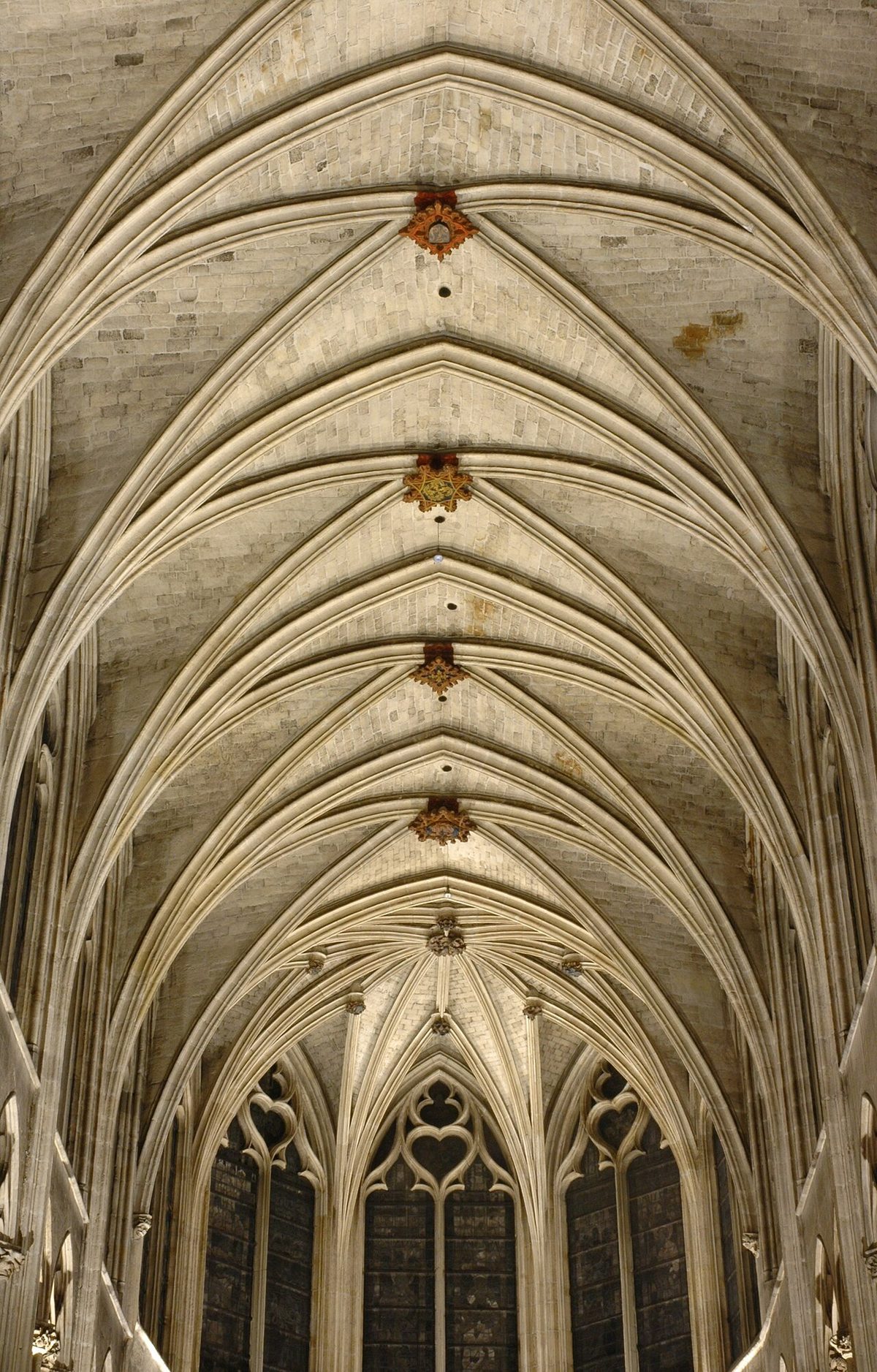
A vault in which the structural load is carried by a skeleton of stone arches (ribs) that intersect at the crown and spring from piers or corbels at the walls, with thinner stone panels (webs) infilling the spaces between. The ribbed vault was the crucial structural and aesthetic invention that bridged Romanesque and Gothic architecture: by concentrating forces along the ribs, builders could make the web panels thinner and construct the overall vault more economically, while the visible rib framework created a powerful decorative rhythm across the ceiling. As Gothic developed, additional ribs — tiercerons and liernes — were added to produce ever more elaborate patterns, culminating in the fan vaults of English Perpendicular Gothic. See Gothic, Romanesque and Byzantine architecture.
Rose Window
A large, circular window filled with stained glass and divided by stone tracery into a radial pattern resembling a flower — one of the most magnificent and iconic creations of Gothic architecture. Rose windows typically appear at the western facade above the main portal and at the end walls of the transepts. The enormous scale to which they were taken — the north transept rose of Notre-Dame de Paris measures 13 metres in diameter — required complex engineering to prevent the stone tracery from buckling under its own weight. The imagery in rose windows often relates to the Virgin Mary (west and north roses) and the Last Judgement or Christ in glory (south and east roses). The Chartres Cathedral roses, with their original 12th and 13th-century glass largely intact, are among the most precious objects in world architecture. See Gothic, Romanesque and Byzantine architecture.
Rustication
A treatment of masonry in which the joints between stones are deeply recessed or the stone faces are left rough-hewn and projecting, creating a bold, textured surface that conveys strength, antiquity, and natural power. Rustication was used by ancient Romans in the substructures of buildings and was revived systematically in Italian Renaissance palace architecture — the massive rusticated bases of Florentine palaces like the Palazzo Pitti convey the financial and social power of the families within. There are many varieties: vermiculated rustication (the surface carved with worm-like channels), diamond-point rustication (each stone face cut to a four-sided pyramid), and banded rustication (alternating courses of smooth and rough stone). Rustication is often combined with smooth ashlar in the upper stories, creating a graduated hierarchy of texture from base to top. See neoclassical architecture.
S
Shikhara
The tower that rises above the garbhagriha (sanctuary) of a North Indian Hindu temple, tapering upward in a curved or straight profile to the crowning disk (amalaka) and pot (kalasha) at its apex. The shikhara is the temple's most important exterior element, marking the presence of the deity inside and channeling cosmic energy downward through the building. North Indian (Nagara) shikhara styles are categorized into three main groups: the curvilinear latina shikhara, the tiered phamsana, and the stepped valabhi; regional schools evolved distinct proportional systems and decorative vocabularies. The great shikharas of Khajuraho, Bhubaneswar, and Puri — covered with dense sculptural programmes and rising from tiers of projecting horizontal mouldings — are among the most complex architectural forms ever devised. See ancient temples explained.
Soffit
The underside of any horizontal architectural element — the underside of an arch, beam, stair, overhang, or cornice. The soffit of an arch is the curved inner surface seen when looking up into the arch opening; the soffit of a cornice is the horizontal surface visible on the underside of the projecting moulding. Soffits are important both structurally (they must be detailed to prevent water penetration and condensation) and decoratively — the coffers (sunken square panels) that articulate the soffit of the Pantheon's porch ceiling, or the painted and gilded soffits of Baroque churches, are among the most impressive overhead surfaces in architecture. In everyday construction, the term is applied to the boxed-in surfaces under stairs, beneath eaves, and in roof overhangs.
Spandrel
The roughly triangular area of wall between the outer curve of an arch and the rectangular frame (pier, column, or wall) that contains it. In a row of arches (an arcade), the spandrel is the wall area between adjacent arch curves. Spandrels are frequently treated decoratively in medieval, Renaissance, and Baroque architecture — filled with sculptured roundels, painted figures, heraldic devices, or ornamental foliage. In Gothic cathedrals, the spandrels of the nave arcade are often pierced with small roundels or filled with carved foliage. In modern steel or concrete construction, "spandrel panels" are the opaque elements of a curtain-wall facade that conceal the floor slabs and structural members between the transparent windows of successive stories, typically in glass, metal, or stone panels.
Squinch
A small arch, corbelling, or lintelled niche placed across the corner of a square room to provide a polygonal base upon which a round dome can rest. The squinch is one of the two main solutions (the other being the pendentive) to the geometric problem of placing a circular dome over a square or rectangular space. While pendentives create smooth, uninterrupted curved triangles, squinches create a stepped octagonal (or more) transition by cutting each corner of the square with a small arch. Squinches appear widely in late Roman, Persian, and early Islamic architecture; the elaborate muqarnas stalactite vaults that fill corners in Islamic buildings are a direct development of the squinch principle, multiplied into dozens of tiny corbelled niches. See the great domes of the world.
Stoa
In ancient Greek civic architecture, a long colonnaded building open along its length, providing shaded covered walkway and space for public activities — the Greek equivalent of a shopping arcade, law court waiting room, philosophical school, and social gathering place all in one. The Stoa Poikile (Painted Stoa) in the Athenian Agora, decorated with famous battle paintings, gave its name to Stoic philosophy, since the philosopher Zeno lectured there in the late 4th century BC. The Stoa of Attalos in Athens (built c. 150 BC, reconstructed 1956) is the best-surviving example: two stories of colonnaded galleries with a row of shops behind, forming one side of the Agora. The stoa form influenced later Roman basilicas, medieval cloisters, and Renaissance loggias — the covered walkway as social infrastructure is one of architecture's most enduring inventions.
Stringcourse
A continuous horizontal band of moulding projecting slightly from a wall surface, running across the facade at the floor levels or at other compositionally significant heights. Stringcourses serve both practical and decorative purposes: they can shed water from the wall surface, mark the transition between floors or building phases, and provide horizontal visual rhythm to a facade that might otherwise read as an undifferentiated vertical surface. In Gothic architecture, a stringcourse may run beneath the windowsills, linking the windows across the width of the building. In classical architecture, the equivalent element is part of the entablature system. In brick buildings, a stringcourse is often a projecting course of brick laid differently from the wall, or a band of stone or terracotta in contrast to the brick of the main wall surface.
T
Tensile Structure
A structure that works primarily in tension — cables, membranes, or nets pulled taut between anchor points — rather than in compression like traditional masonry. Because steel cables are extraordinarily strong in tension (far stronger per unit weight than any masonry element in compression), tensile structures can achieve dramatic spans with minimal material. Major types include cable-stayed roofs (where cables hang from masts to support the roof), suspension structures (where the roof itself hangs like a bridge deck), and membrane or tent structures (where a flexible surface is stretched between supports). Frei Otto pioneered lightweight tensile canopies for the 1972 Munich Olympics; the tent roofs of airports, stadiums, and transport hubs worldwide demonstrate the structural efficiency and spatial drama that tensile forms can achieve. See the evolution of the skyscraper.
Torii
The gateway that marks the entrance to a Shinto shrine in Japan, forming the boundary between the profane world outside and the sacred space within. A torii consists of two upright posts (hashira) topped by two horizontal beams — the straight lower lintel (nuki) and the curved upper beam (kasagi) — often with a central plaque bearing the shrine's name. Torii come in many styles (there are at least eight main types, classified by the shape and configuration of the beams), and they are traditionally painted red, though some are natural wood or stone. The most famous torii image in the world is the "floating" torii of Itsukushima Shrine on Miyajima island, which stands in the sea and appears to float at high tide. See our guide to Japanese architecture.
Tracery
The ornamental framework of interlaced ribs of stone that fills the upper portions of Gothic windows and sometimes covers wall surfaces in blind panels. Tracery evolved from early plate tracery — in which openings were cut through a solid stone tympanum — into bar tracery, where slender stone bars are assembled into geometric, curvilinear, or flowing patterns of great sophistication. The main tracery types are: geometric (circles, trefoils, and quatrefoils, dominant in the 13th century), curvilinear or flowing (sinuous curves and ogee forms, dominant in the 14th century Decorated style), rectilinear or Perpendicular (straight vertical bars, dominant in late 14th–16th century English Gothic), and the extreme German and Spanish flamboyant style (flame-like forms). Reading tracery patterns is one of the most reliable methods for dating a Gothic building. See Gothic, Romanesque and Byzantine architecture.
Transept
The transverse arm or arms of a cruciform church plan, projecting at right angles to the main nave-to-chancel axis. A church with transepts has a cross-shaped plan when viewed from above, which carries obvious religious symbolism. The transepts typically rise to the same height as the nave, creating a crossing space at their intersection with the nave and chancel. In many medieval cathedrals the transepts had their own entrance portals from the outside, creating secondary processional axes. Great French Gothic cathedrals like Chartres and Reims have transepts of nearly equal importance to the nave, with towering rose windows filling their end walls. English cathedrals often feature double transepts — an inner and outer pair — creating very long east-west plans with multiple crossing spaces. The transept form also appears in secular plan types — the cross-shaped hospital, prison, or railway terminus.
Tribune Gallery
An upper gallery or second-story aisle within a church, opening into the nave through an arcade above the main nave arcade — the second of the three horizontal zones of a classic Romanesque or early Gothic interior elevation. Unlike the clerestory (third zone, with direct external windows), the tribune gallery has its windows facing into the aisle below and only receives indirect light. It served both structural and liturgical functions: structurally, the tribune's roof helped brace the nave walls against vault thrust; liturgically, it provided additional space for overflow congregation, singers, or the royal party at coronations and great ceremonies. As Gothic builders refined the flying buttress and reduced the need for the tribune's structural contribution, the form was often replaced by the smaller triforium in the High Gothic period.
Triforium
The narrow, arcaded passage or gallery in the wall thickness of a Gothic church between the main nave arcade below and the clerestory above — the middle zone of the three-part elevation typical of French Gothic cathedrals. Unlike the tribune gallery (which has a full floor level and is accessible), the triforium is shallow and essentially decorative in High Gothic buildings — a row of small arched openings in the wall between the main arcade and the clerestory windows. In some High Gothic buildings (notably Amiens and the Sainte-Chapelle in Paris) the triforium level is glazed, so that the entire wall from floor to vault crown is one continuous field of stained glass, with only the narrow horizontal band of the triforium arcade interrupting the transparent zone of the clerestory. The word's etymology is unclear but may refer to the three-opening bays typical of the zone.
Truss
A structural framework of members arranged in triangles — typically in a flat or pitched configuration — that distributes loads through a combination of members in tension and compression, enabling large spans with relatively light material. Because the triangle is the only inherently stable polygon (it cannot change shape without changing the length of its sides), a well-designed truss can span far greater distances than a simple beam of equal weight. The Howe truss, Pratt truss, Warren truss, and king-post and queen-post trusses are historical forms, each named for their inventor or their geometric configuration. The Victorian railway boom produced enormous iron and later steel trusses spanning the trainsheds of major stations. In domestic timber framing, the roof truss — often a simple king-post or queen-post form — has supported pitched roofs for centuries.
Tympanum
The triangular recessed area enclosed by the raking and horizontal cornices of a classical pediment, or the typically semicircular panel above a medieval doorway enclosed by the arch and the lintel below. In Greek and Roman temples, the triangular tympanum was filled with large-scale sculptural compositions — the tympana of the Parthenon contained some of the finest sculpture of antiquity. In Romanesque and Gothic churches, the semicircular tympanum above the main west portal is typically the most important location for monumental sculptural programmes in the entire building — Last Judgement scenes, Christ in Majesty, the Virgin and Child — often with extraordinary complexity and refinement. The great Romanesque tympanum at Autun Cathedral by Master Gislebertus (c. 1130) and the Gothic portals of Chartres and Reims represent peak achievements of medieval architectural sculpture.
V
Vernacular Architecture
The traditional buildings of a given place and culture, built without the involvement of professional architects using locally available materials and techniques passed down through generations of craft practice. Vernacular architecture includes everything from the mud-brick houses of the Saharan villages to the timber-framed halls of medieval England, the stone-stacked trulli of Puglia, and the rammed-earth compounds of rural China. Because vernacular buildings are the direct product of long local experience, they often display remarkable climatic intelligence — thick walls for thermal mass in hot dry regions, steep roofs for snow shedding in cold wet ones, raised floors for flood protection in waterlogged delta landscapes. See our full guide to vernacular architecture.
Voussoir
One of the wedge-shaped stones that make up an arch, cut so that its faces converge toward the centre of the arch (the intrados and extrados are not parallel but angled toward a central point called the centre of curvature). Voussoirs lock together under the weight of the structure above, each pressing against its neighbors to create a system of mutual compression — the arch is only stable as a complete ring of voussoirs; remove one and the whole collapses. The precise cutting of voussoirs requires considerable skill and geometric knowledge, since each stone must be cut to a slightly different angle depending on its position in the arch. Dressed voussoirs in contrasting materials — alternating light and dark stone — are used decoratively in Islamic, Moorish, and Romanesque architecture, most famously in the double-coloured striped arches of the Great Mosque of Cordoba.
W
Wind Tower (Barjeel)
A traditional passive cooling device found throughout the Persian Gulf region, Iran, and parts of South Asia — a tower projecting above the roofline with open scoops or vanes oriented to catch the prevailing wind and direct it downward into the interior of the building below. The wind tower (called barjeel in the Gulf, badgir in Persian) cools interiors through a combination of direct air movement and evaporative cooling: in sophisticated examples, air passes over a pool of water before entering the rooms below. Wind towers are architectural responses of extraordinary ingenuity to extreme summer heat: before mechanical air conditioning, they made habitation possible in cities like Dubai, Yazd, and Hyderabad during temperatures that regularly exceed 45°C. Today they are experiencing a major revival in sustainable architecture as architects seek passive cooling alternatives to energy-intensive HVAC systems. See how climate shapes cities.
Z
Ziggurat
A massive stepped pyramid of sun-dried or kiln-fired brick built in ancient Mesopotamia (modern Iraq and adjacent areas) as the physical base of a temple to a city's patron deity, typically rising in three to seven receding tiers to a small sanctuary at the top. Ziggurats were not tombs (unlike Egyptian pyramids) but working religious monuments — the great stepped platform raised the temple above the flood plain and brought it physically closer to the realm of the gods. The ziggurat of Ur (c. 2100 BC), dedicated to the moon god Nanna, survives in remarkable condition; the legendary Tower of Babel described in the Book of Genesis was almost certainly based on the ziggurat of Babylon. The ziggurat form influenced later stepped pyramids across the ancient world, from Mesoamerica to Southeast Asia, raising the question of independent invention versus cultural transmission. See pyramids beyond Egypt.
Sources & further reading
Reference material this page draws on, and where to read further. External links open third-party sites.
- Glossary of architecture · Wikipedia
- Column · Wikipedia
- Vault (architecture) · Wikipedia
- Arch · Wikipedia
- Pediment · Wikipedia
- Buttress · Wikipedia