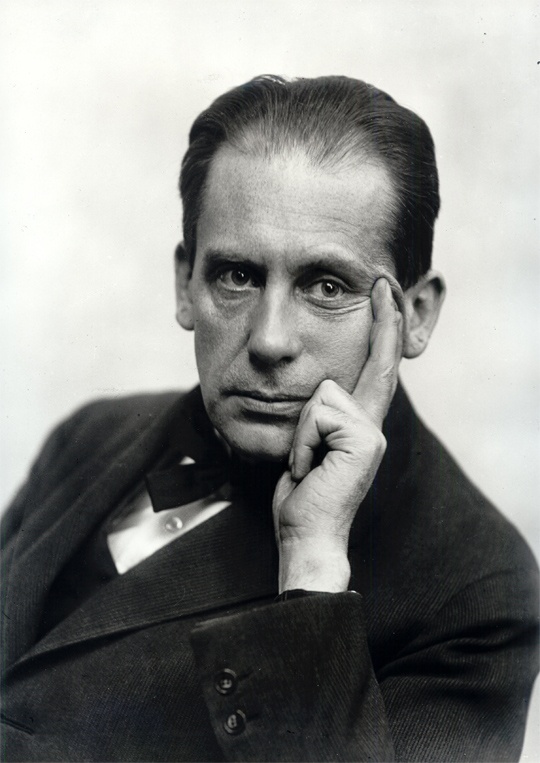
Life and Training
Walter Adolph Georg Gropius was born on 18 May 1883 in Berlin into an architectural family — his great-uncle was the neoclassical architect Martin Gropius, and his father was a city architect. He studied architecture in Munich and Berlin, then joined the prestigious office of Peter Behrens in 1907, working alongside Ludwig Mies van der Rohe and Le Corbusier in what became, in retrospect, the most consequential studio of the early twentieth century. Behrens was developing an entirely new visual language for industrial production, and Gropius absorbed his conviction that design, craft, and industry needed to be unified rather than treated as separate disciplines.
After founding his own practice in 1910 and completing the landmark Fagus Factory, Gropius was drafted in the First World War. He emerged from the trenches radicalized, convinced that a new world required a completely new approach to building and design education. In 1919 he was appointed director of two art schools in Weimar that he merged into the Staatliches Bauhaus — the State House of Building — an institution whose influence on twentieth-century design, typography, furniture, and architecture would prove almost without parallel. Political pressure from conservatives forced the Bauhaus to move to Dessau in 1925 and Berlin in 1932; in 1933 the Nazis forced it to close. Gropius fled to Britain, then in 1937 emigrated to the United States, where he joined the faculty of Harvard's Graduate School of Design and remained until 1952. He became an American citizen in 1944 and died in Boston in 1969 at the age of eighty-six.
His two marriages included one to Alma Mahler — widow of the composer — during the turbulent Bauhaus years, a relationship that became legendary in European cultural history.
Architectural Philosophy
Gropius believed that the division between fine art and applied craft was socially and aesthetically destructive. The Bauhaus curriculum he designed was radical: students spent their first year in a foundational course that stripped away all preconceptions about materials, form, color, and space. They then studied simultaneously under a "master of form" (an artist) and a "master of craft" (a skilled craftsperson), so that aesthetic thinking and technical making were learned together. The ultimate goal was a Gesamtkunstwerk of industrial production — a total artwork where buildings, furniture, textiles, typography, and ceramics formed an integrated whole designed for mass manufacture.
In his buildings, Gropius pursued clarity and rationality: flat roofs, large expanses of glass curtain wall, open plans, and the honest expression of structure. He rejected historical ornament as dishonest and insisted that beauty could emerge from function alone, provided the designer understood materials deeply and resolved the program with rigor. This position — which he articulated in lectures, manifestos, and exhibitions throughout his career — became one of the defining tenets of what critics would later call the International Style. At the same time, Gropius resisted the charge that Modernism was dehumanizing; he consistently argued that the design of light, air, and space in a building was as much a social act as an aesthetic one, and that good housing was a fundamental right, not a luxury.
Key Works
- Fagus Factory, Alfeld an der Leine, Germany (1911–1913): Gropius's first major commission, designed with Adolf Meyer for a shoe-last manufacturer, is one of the first buildings in history to use a fully glazed curtain wall — the glass skin wrapping around the structural corners with no visible support. This single gesture declared that a building's envelope could be separated from its structure, a principle that would define Modernist architecture for a century. The factory is now a UNESCO World Heritage Site.
- Bauhaus Dessau, Dessau, Germany (1925–1926): Gropius designed the school's own building when the Bauhaus moved from Weimar, and the result became one of the canonical works of twentieth-century architecture. The complex groups workshops, studios, classrooms, and student dormitories into an asymmetric pinwheel composition best understood from the air. The workshop wing — a three-story curtain-wall glass box — became the image most associated with the Bauhaus aesthetic worldwide and remains a UNESCO World Heritage Site.
- Masters' Houses, Dessau, Germany (1925–1926): A series of semi-detached prefabricated houses for Bauhaus masters including Paul Klee, Wassily Kandinsky, and László Moholy-Nagy, built alongside the school building. The houses applied the same principles of flat roofs, geometric volumes, and large windows to domestic architecture on a modest scale, demonstrating that Modernism was not a style reserved for public buildings.
- Harvard Graduate Center, Cambridge, Massachusetts (1949–1950): Gropius's principal American building, designed with his firm The Architects Collaborative (TAC), is a campus of dormitories and a dining hall organized around connected courtyards. The project demonstrated that Bauhaus principles — rational structure, clear plan organization, integration of murals by artists including Joan Miró — could be applied to institutional American construction.
- Pan Am Building (now MetLife Building), New York City (1963): Designed with Pietro Belluschi and Emery Roth & Sons, the Pan Am Building rose above Grand Central Terminal as one of the largest commercial office buildings of its era. The commission was controversial among Modernists for its bulk and its obstruction of Park Avenue's visual corridor, and Gropius himself later expressed ambivalence about the project — a reminder that even the most principled architect operates within the constraints of client ambition and commercial pressure.
- Gropius House, Lincoln, Massachusetts (1938): Gropius's own home, now preserved by Historic New England, is a precise demonstration of how he adapted European Modernism to the American context. The white-painted wood frame and screened porch acknowledge New England vernacular traditions while the flat roof, open plan, and ribbon windows announce the Bauhaus sensibility. The house became a touchstone for American Modernist domestic architecture.
Legacy
Gropius's legacy operates on two levels: the buildings and the school. As a builder he produced a handful of masterworks — above all the Fagus Factory and the Dessau Bauhaus — that remain touchstones of Modernist design. But his influence as an educator was larger still. Through the Bauhaus and through Harvard, where he taught a generation of American architects including Philip Johnson, Paul Rudolph, and I.M. Pei, he propagated a pedagogy of design that reshaped art and architecture schools across the world. The Bauhaus model — foundational course, workshop-based learning, integration of fine and applied arts — is so thoroughly absorbed into contemporary design education that most students today encounter it without knowing its origin. His insistence that architecture was a social practice, not merely an aesthetic one, remains a live argument in every debate about affordable housing, urban planning, and the ethics of building.
Explore Gropius's buildings in the game.
Play Building Guessr