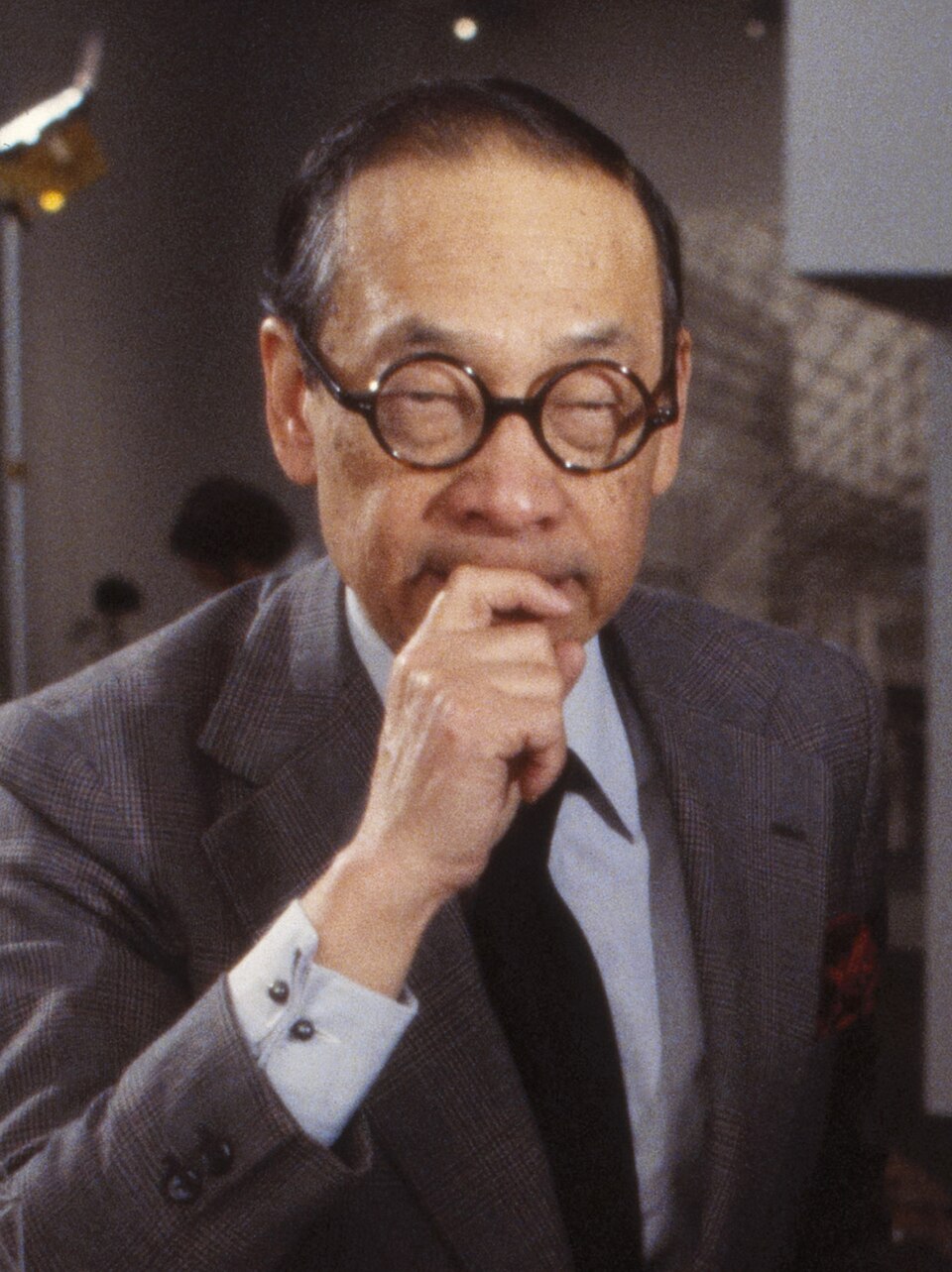
Life and Training
Ieoh Ming Pei was born on 26 April 1917 in Guangzhou, China, into a prominent banking family. His father was the head of the Bank of China, and the family moved to Shanghai when Pei was a child. He grew up between two worlds: the traditional garden culture of Suzhou, where he spent summers, and the modernizing cosmopolitan energy of 1920s Shanghai, where he watched the construction of the city's International Settlement buildings with fascination. He traveled to the United States in 1935 to study architecture at MIT and later at Harvard's Graduate School of Design under Walter Gropius, where he absorbed Bauhaus principles of structural clarity and functional honesty.
After graduating from Harvard in 1946, Pei spent several years working for a developer, building a practice in large-scale urban real estate development — an unusual beginning for a career that would end with some of the most culturally significant institutions in the world. He established his own firm, I.M. Pei & Associates (later Pei Cobb Freed & Partners), in 1955. His first major cultural commission, the National Center for Atmospheric Research in Boulder, Colorado (1967), established his commitment to geometric purity and contextual sensitivity — the NCAR building's mesa-colored concrete blended with the Colorado Rocky Mountains backdrop. He became an American citizen in 1954. He received the Pritzker Architecture Prize in 1983, the American Institute of Architects Gold Medal in 1979, and the Presidential Medal of Freedom in 1992. He died on 16 May 2019, aged 102.
Architectural Philosophy
Pei built his career on the proposition that geometry — specifically the triangle, the square, and the circle — contains an inexhaustible richness of formal and spatial possibility. Unlike architects who turned to historical ornament or organic form as a counterweight to Modernist austerity, Pei remained committed to pure geometric language while demonstrating, through his exceptional spatial intelligence, that this language could produce buildings of warmth, dignity, and celebration. His buildings are never cold; their geometry is deployed in the service of human scale, natural light, and the experience of movement through space.
His other signal contribution was the resolution of what seemed to many architects an irresolvable tension: how can a contemporary building stand in relation to a historic one without either imitating it or ignoring it? Pei's answer — worked out most powerfully at the Louvre — was to find an abstract geometric form that could be simultaneously of its time and respectful of its context: transparent where the Louvre is solid, lightweight where it is massive, contemporary where it is historic, and yet in dialogue with the courtyard's proportions rather than at war with them. This approach to contextual Modernism influenced a generation of museum architects who came after him.
Key Works
- East Building, National Gallery of Art, Washington, DC (1978): Pei's masterpiece of geometric invention, the East Building occupies a trapezoidal site on the National Mall and resolves the problem of the awkward plot by dividing it into two triangles — an isosceles triangle housing the main galleries and a right-angle triangle containing the study center — joined along their hypotenuse. The knife-edge corner of the main triangle, where two façades meet at an acute angle, has been rubbed smooth by millions of visitors' hands. The skylighted central atrium, bridged by walkways and animated by Alexander Calder's last mobile, is one of the great interior spaces of twentieth-century American architecture.
- Louvre Pyramid, Paris, France (1984–1989): When President François Mitterrand chose Pei to redesign the Louvre's public access for the Grand Louvre project, the decision was met in France with outrage: why had a Chinese-American been chosen over a French architect, and why a glass pyramid in the courtyard of a Renaissance palace? Pei's answer to both objections was the pyramid itself: a form rooted in ancient geometry, transparent enough to reveal the existing façades through its glass planes, and at 21.65 meters — precisely calibrated to avoid overtopping the surrounding palace wings while remaining visible from the street. It is now one of the most beloved buildings in Paris.
- Bank of China Tower, Hong Kong (1982–1990): At 367 meters, the Bank of China Tower was the tallest building in Asia outside Japan at its completion and the first supertall building outside the United States to exceed 305 meters. Its structural system — four triangulated steel trusses that transfer loads from the sloping façade to four corner columns — expresses the building's geometry with an unusual directness, and the prismatic form produces a silhouette that changes dramatically from different viewpoints around Hong Kong. The building is simultaneously a symbol of China's growing economic presence and of Pei's long engagement with his birth country.
- John F. Kennedy Presidential Library, Boston, Massachusetts (1979): After winning the commission in 1964, Pei spent fifteen years working through multiple schemes as the original site in Cambridge attracted opposition. The final building on Columbia Point — a white concrete pavilion anchored by a glass pavilion facing the Boston Harbor — is a quieter, more contemplative work than its long gestation might suggest, organized around the relationship between the archive of a presidency and the water that Kennedy loved.
- Rock and Roll Hall of Fame and Museum, Cleveland, Ohio (1995): Pei's commission for a museum dedicated to popular music — a medium entirely remote from his usual institutional clients — produced one of his most playful late works: a sequence of geometric volumes including a large glass tent-like structure, a tower, and cylindrical elements clustered on the Lake Erie waterfront. The building's exuberance reflects Pei's engagement with a client culture that prized energy and spectacle alongside historical documentation.
- Museum of Islamic Art, Doha, Qatar (2008): Pei's final major work, completed when he was ninety-one, is located on an artificial peninsula in Doha Harbor. He spent months studying Islamic architecture before arriving at a design that distills its geometric principles — particularly the muqarnas stalactite vault and the geometric window mashrabiyya — into a contemporary concrete form. The building is organized around a central atrium of extraordinary spatial complexity, lit from a pyramidal lantern above. It is the summation of his lifelong enquiry into the relationship between geometry and light.
Legacy
I.M. Pei's career spanned seven decades and produced buildings on six continents — a range matched by almost no one in the profession. His influence operated on multiple levels: his demonstration that geometric Modernism could produce architecture of warmth and civic dignity was a counterweight to the more austere strands of the International Style; his resolution of the historic-contemporary tension at the Louvre established a model that many museum additions since have followed; and his success as a Chinese-American architect in postwar America — navigating the cultural barriers of his era with elegance — made him a significant figure beyond architecture. He died aged 102, his last major building, the Museum of Islamic Art, standing as evidence that architectural creativity can persist to the very end of a long life.
Explore I.M. Pei's buildings in the game.
Play Building Guessr