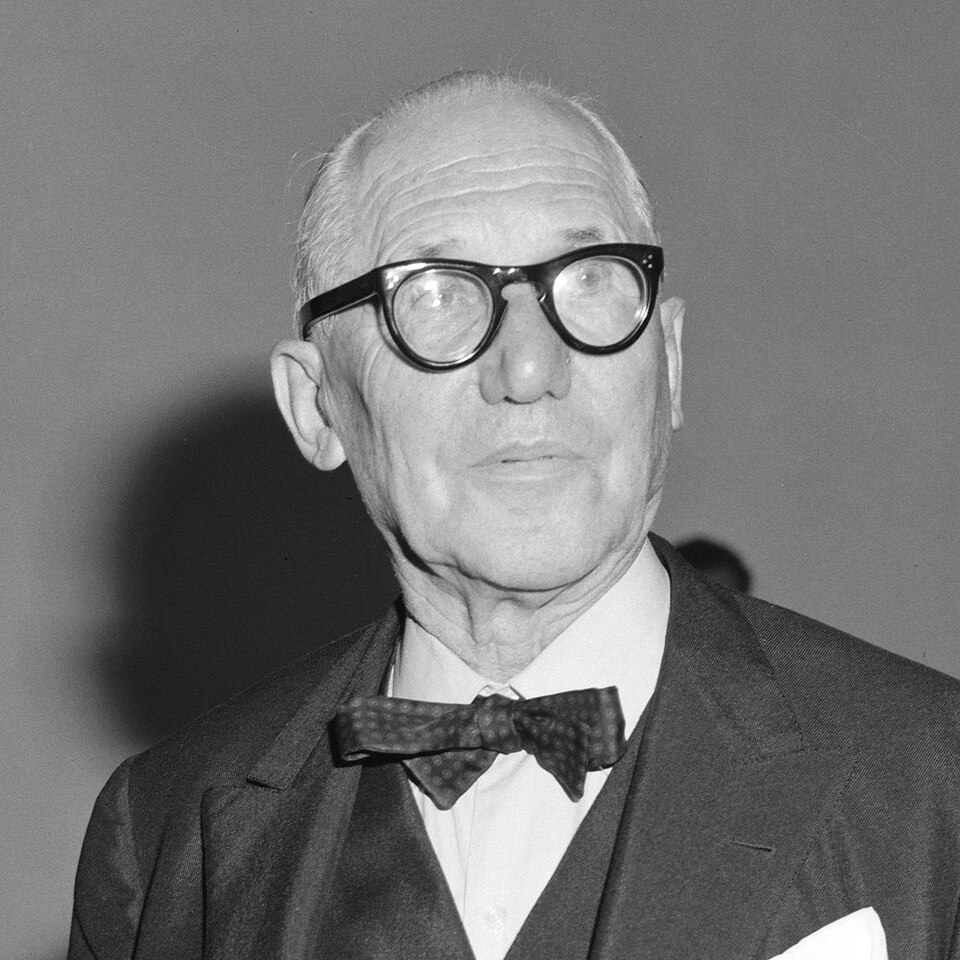
Life and Training
Le Corbusier was born Charles-Édouard Jeanneret-Gris on 6 October 1887 in La Chaux-de-Fonds, a Swiss watchmaking town in the Jura mountains. He trained initially as an engraver and decorative artist at the local art school, where a teacher recognized his spatial aptitude and encouraged him toward architecture. He was largely self-taught as an architect — he never attended a formal school of architecture — but made up for it through an extraordinary program of independent study and travel.
Between 1907 and 1911 he undertook what he called his "education sentimental": extended study trips through Italy, Vienna, Paris, Berlin, and ultimately a five-month journey on foot and by train through the Balkans, Greece, and Turkey, culminating in Athens. The Acropolis made a profound impression on him; he sketched it obsessively and returned to it throughout his writing as a paradigm of pure form in light. He worked briefly with Auguste Perret in Paris — the master of reinforced concrete — and with Peter Behrens in Berlin, in whose office he overlapped briefly with Walter Gropius and Mies van der Rohe. In 1917 he moved permanently to Paris and adopted the pseudonym Le Corbusier — an anagram-derived version of a maternal grandfather's name — for his architectural practice.
He co-founded the Purist movement with the painter Amédée Ozenfant and published the journal L'Esprit Nouveau, which became a platform for his ideas about architecture and urban form. His 1923 book Vers une architecture (translated into English as Towards a New Architecture) was the most influential architectural manifesto of the century, introducing to an international audience his assertion that "a house is a machine for living in."
Architectural Philosophy
Le Corbusier's earliest and most structured theoretical contribution was the Five Points of Architecture, published in 1927: pilotis (slender concrete columns lifting the building off the ground), the free plan (load-bearing structure moved to the columns, freeing the interior walls from structural duty), the free facade (exterior walls no longer structural, free to be designed independently), the horizontal window (the ribbon window running the full width of each floor, maximizing light), and the roof garden (reclaiming the building's footprint from the ground above). These five points were not aesthetic preferences but a logical consequence of reinforced concrete construction, and they provided a systematic framework for a new architecture independent of historical style.
His urban thinking was equally radical and considerably more controversial. He proposed replacing dense urban fabric with widely spaced towers set in parkland — most notoriously in his 1925 Plan Voisin, which proposed demolishing most of central Paris north of the Seine and replacing it with a grid of uniform cruciform towers. The plan was never adopted, but its logic — towers in a park, urban clearance as progressive — influenced postwar housing policy across Britain, France, and America with consequences that are still debated.
His later work showed a decisive shift from the white geometric purism of his early villas toward raw concrete — béton brut — and sculptural plasticity. The Ronchamp chapel, the Chandigarh buildings, and the Unité d'Habitation all belong to this later phase, characterized by massive, heavy, expressive forms rather than the lightweight transparency of his 1920s work. This shift is the root of what later became called Brutalism, though Le Corbusier himself would not have used the term.
Key Works
- Villa Savoye, Poissy, France (1928–1931): The purest statement of the Five Points. The white cubic volume floats on slender pilotis above a meadow outside Paris; a ribbon window wraps each floor; the roof is a garden terrace with a curved solarium. Inside, a ramp rather than a staircase connects the levels — the promenade architecturale, a route through the building designed to unfold the space in time rather than presenting it all at once. The house was briefly used as a barn during the Second World War. It is now a national monument and one of the most visited modern buildings in France.
- Unité d'Habitation, Marseille, France (1947–1952): A vertical city of 337 apartments in a single massive concrete block lifted on massive pilotis and embedded with shops, a hotel, a gymnasium, and a rooftop crèche and running track. Le Corbusier designed it as a prototype for postwar housing that would combine the density of the city with the green space of the country. The raw concrete surface — board-marked during casting — gave the building its immediate textural character and became the template for Brutalism worldwide.
- Chandigarh Capitol Complex, Chandigarh, India (1950s–1960s): When India's first prime minister Nehru asked Le Corbusier to design the new capital of Punjab after the partition displaced Lahore, the commission became his greatest urban opportunity. The Capitol sector contains the High Court, the Secretariat, and the Parliament (Assembly) building — massive concrete sculptures organized around an open plaza at the city's northern edge. The buildings are extraordinary inventions of form, scale, and tropical light-management, and they remain in active use as government buildings.
- Notre-Dame-du-Haut, Ronchamp, France (1950–1955): The chapel at Ronchamp shocked architects who expected Le Corbusier to produce rational geometry. Instead, he designed a building of pure sculptural intuition: a curved roof like a concrete boat hull balanced on a thick wall pierced with small, irregularly placed windows of colored glass. The interior is dim, mysterious, and intensely emotional. It remains one of the most admired buildings of the 20th century precisely because it refutes the idea that modernism could only produce rectilinear rationalism.
Legacy
Le Corbusier's influence on 20th-century architecture is without parallel in its breadth, though it is equally without parallel in the controversy it has attracted. The towers-in-a-park housing model he theorized was adopted across the world as social housing policy, with results that ranged from dignified to catastrophic depending on the quality of execution and the social investment around it. The criticism of his urban ideas has been intense, particularly from Jane Jacobs, who identified the destruction of urban street life as the key pathology of modernist planning. His buildings, by contrast, have aged remarkably well as individual objects. Seventeen of them were inscribed on the UNESCO World Heritage List in 2016 — one of the largest single-architect entries in UNESCO history. His personal politics, particularly his collaboration with the Vichy regime in France between 1940 and 1942, remain a serious subject of critical debate.
Explore Le Corbusier's buildings in the game.
Play Building Guessr