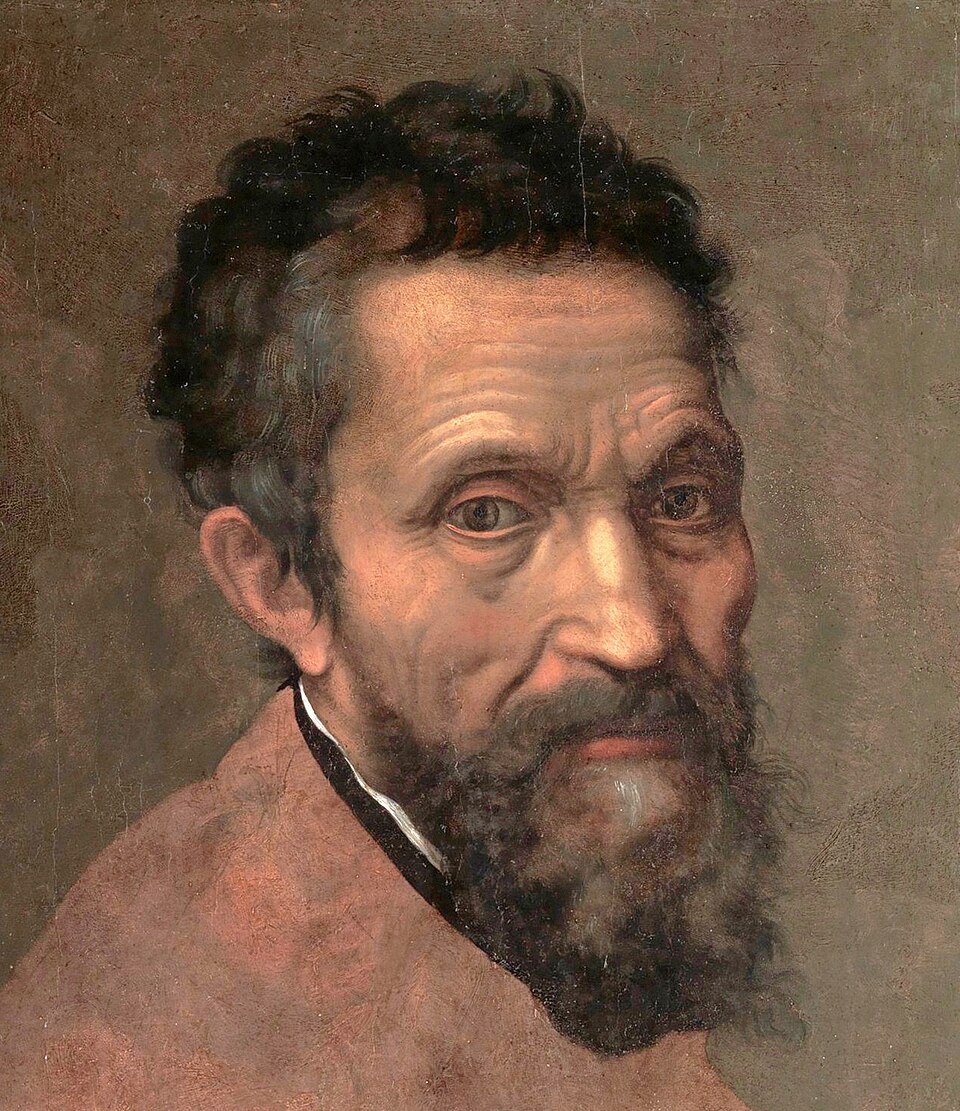
Life and Training
Michelangelo di Lodovico Buonarroti Simoni was born on 6 March 1475 in Caprese, a small village in the Tuscan Apennines where his father was briefly serving as a local magistrate. The family returned to Florence shortly after his birth, and it was in Florence — under the Medici — that Michelangelo received the extraordinary formation that would make him the most complete artist of the Renaissance. At thirteen he entered the workshop of the painter Domenico Ghirlandaio, but his gifts were so apparent that Lorenzo de' Medici brought him into the Medici household, where he absorbed the humanist culture — Neoplatonism, classical antiquity, poetry — that would shape his intellectual life permanently.
His architectural career developed relatively late in his life, after decades of supremacy in sculpture and fresco. His first architectural commission came in 1516, when Pope Leo X commissioned him to design the new façade of San Lorenzo in Florence — a project that was never executed but consumed years of his life. The Medici Chapel and the Laurentian Library vestibule, both begun in the 1520s, were his first completed architectural works and immediately established that he would not be bound by the classical rules that Brunelleschi and Alberti had established as the foundations of Renaissance architecture. He was appointed chief architect of St Peter's Basilica by Pope Paul III in 1546, at the age of seventy-one, and worked on the project until his death eighteen years later, at eighty-eight. He never married and spent his final decades in Rome, intensely devout and increasingly reclusive, pouring his remaining energy into the dome that he would not live to see completed.
Architectural Philosophy
Michelangelo came to architecture as a sculptor, and his buildings have the quality of sculpture writ large: they are concerned with the body, with tension and release, with the expression of internal force through external surface. Where Brunelleschi organized architecture through mathematical proportion and where Alberti articulated it through the systematic application of classical orders, Michelangelo treated the classical orders as a vocabulary he could bend and distort — pilasters that taper downward instead of upward, windows that press against frames that are too small for them, vestibule walls organized in a rhythm that appears about to break its own rules. This deliberate tension — classical elements deployed to produce unclassical effects — is what art historians mean when they call his architecture Mannerist.
He described his own method as working by eye and judgment rather than by rule, and his disdain for architectural theory was explicit: he said that he who follows others will never advance ahead of them. Yet this iconoclasm was not willfulness for its own sake; it was in service of expressive power. His buildings convey an almost muscular energy — walls that seem to press outward, pilasters that seem to strain under load — that is inseparable from his sculptural imagination. The concept of the human body as the measure and source of architectural form, which runs through Renaissance theory from Vitruvius to Leonardo, was, in Michelangelo's hands, not a metaphor but a deeply felt way of thinking about space.
Key Works
- Medici Chapel (New Sacristy), San Lorenzo, Florence (1519–1534): Built to house the tombs of Giuliano and Lorenzo de' Medici, the Medici Chapel is Michelangelo's most integrated architectural and sculptural work. The architecture — pilasters, blind arches, and attic zone — creates a spatial tension that is inseparable from the reclining sculptural figures of Day, Night, Dusk, and Dawn that inhabit the tomb structures. The dome above is coffered in diminishing squares that create a perspective acceleration toward the oculus, and the grey pietra serena against white plaster anticipates the color language of Brunelleschi while bending its rules.
- Laurentian Library (Biblioteca Medicea Laurenziana), Florence (begun 1524): The vestibule of the Laurentian Library — designed to receive visitors ascending from the cloister below — is one of the most original and puzzling spaces in Western architecture. Columns are recessed into the wall rather than projecting from it (an apparent reversal of their structural logic); pilasters are narrow and tall relative to their capitals; a staircase fills the space with a triple cascade of steps that seems to flow downward. The effect is of a space under intense, barely contained pressure. Michelangelo left Florence in 1534 and the library was completed by Bartolommeo Ammannati and Giorgio Vasari from his models and drawings.
- Campidoglio (Capitoline Hill), Rome (designed 1536, executed 1564–1655): When Pope Paul III asked Michelangelo to redesign the Capitoline Hill for the ceremonial visit of Holy Roman Emperor Charles V in 1536, the hill was a disordered space dominated by two medieval buildings oriented at an awkward eighty-degree angle to each other. Michelangelo's solution was to accept the angle and make it the organizing principle of a new trapezoidal piazza, which he framed with a third palace (the Palazzo Nuovo) placed symmetrically opposite one of the existing buildings. The paving pattern — an oval star design in white and dark stone radiating from an ancient equestrian statue of Marcus Aurelius — unified the whole. The piazza was not completed until a century after his design, but it is executed faithfully from his drawings and is one of the great civic spaces in the world.
- St Peter's Basilica Dome, Vatican City (designed from 1546, completed 1590): When Michelangelo took over the St Peter's project from Antonio da Sangallo the Younger in 1546, construction had been underway for decades and the design had passed through many architects' hands since Bramante's original conception. Michelangelo simplified the plan, thickened the piers, and designed the drum and dome that would crown the building. His dome design — executed after his death by Giacomo della Porta, who raised the profile somewhat — is the direct ancestor of virtually every major dome in Western architecture built in the following three centuries: the dome of the Pantheon in Paris, the dome of St Paul's, the Capitol in Washington, and dozens of others all trace their formal language to Michelangelo's unprecedented synthesis of engineering power and visual grandeur.
- Porta Pia, Rome (1561–1565): Commissioned by Pope Pius IV to create a new city gate at the terminus of the newly straightened Via Nomentana, the Porta Pia is Michelangelo's most purely architectural and least structural work — a triumphal gateway of compressed ornamental complexity. The gate's façade plays deliberately with ambiguity between structural and decorative elements, a late summation of his lifelong engagement with the boundaries of classical rule. It was the last major commission of his life.
Legacy
Michelangelo's influence on architecture is incalculable, operating through three distinct channels: his dome of St Peter's established a formal type — the tall drum dome on a colonnaded drum — that dominated European civic and religious architecture for three centuries; his Mannerist distortion of classical rules licensed later architects to treat the vocabulary of antiquity as a resource for expressive invention rather than a set of laws to be followed; and his integration of architectural surface with sculptural and pictorial thinking introduced a conception of the building as a total sensory experience — space, material, light, and image unified by a single imagination — that prefigures the Baroque and remains a live aspiration for architects today. Giorgio Vasari, who wrote the first biography of living artists and placed Michelangelo at its apex, described him as il divino — the divine one. The designation has proved durable.
Explore Michelangelo's buildings in the game.
Play Building Guessr