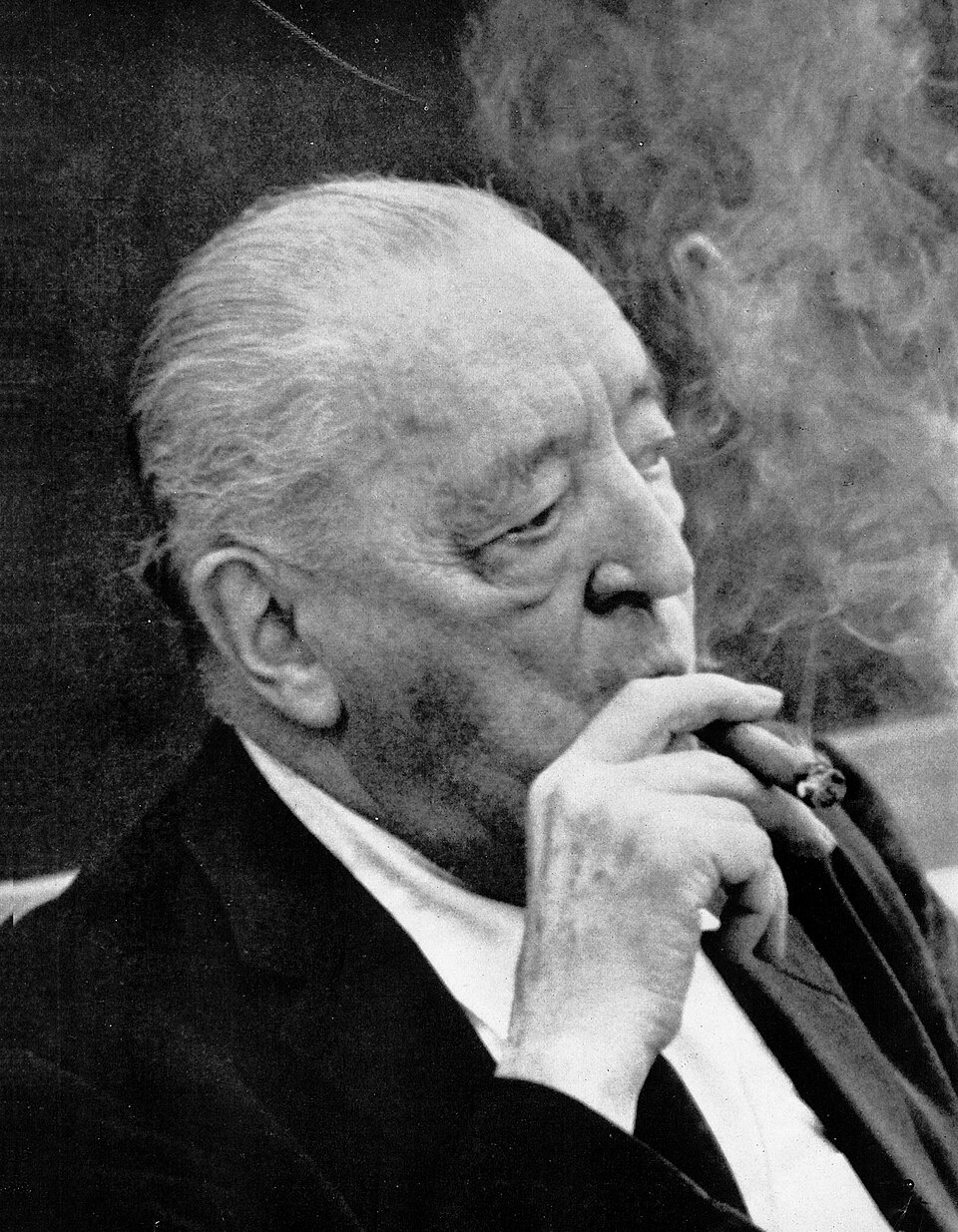
Life and Training
Ludwig Mies — he added "van der Rohe" (his mother's name) to his surname for professional purposes — was born on 27 March 1886 in Aachen, Germany, the son of a stonemason. He had no formal architectural education. He left school at fifteen and worked in his father's workshop, learning to handle stone and to read buildings through their material logic. He then worked for a furniture designer in Aachen before moving to Berlin in 1905, where he found work in the office of Bruno Paul, a master furniture designer, and then — crucially — entered the office of Peter Behrens in 1908.
Behrens's office was the most intellectually charged architectural practice in Europe at the time: it was there simultaneously that Walter Gropius was working, and Le Corbusier would arrive the following year. Behrens himself was developing the idea of industrial design as a complete cultural project, and his office was exposed to the full range of European modernist thinking — Jugendstil giving way to a harder, more geometric classicism. Mies absorbed all of it, and his early projects show a sophisticated wrestling with Schinkel's Prussian neoclassicism, which he admired enormously. He set up his own practice in 1913.
After the First World War, Mies threw himself into the Berlin avant-garde — the G Group, the Novembergruppe, and the experimental culture of Weimar Germany. His two glass skyscraper projects of 1921–1922, never built, proposed towers of pure curtain-wall glass articulated by curved and angular floor-plate edges: they were visionary projections of a technology that did not yet fully exist and anticipated buildings that would not be built for thirty years. In 1930, after the departure of Hannes Meyer, he was appointed director of the Dessau Bauhaus — the most famous art school in the world — which he led until pressure from the Nazi municipal authorities forced him to close it in 1933. In 1938 he emigrated to the United States, settling in Chicago as director of the architecture school at the Illinois Institute of Technology, which he led until 1958.
Architectural Philosophy
Mies's governing aesthetic principle was captured in two aphorisms, both of which he consistently claimed as his own: "Less is more" and "God is in the details." Together they describe a position of extreme formal reduction combined with extraordinary material and constructional precision. Where Le Corbusier's spaces unfold in complexity through the promenade architecturale, Mies's ideal space was unified, open, and uninterrupted — a volume defined by planar surfaces, typically of steel, glass, and marble, in which space flows rather than being divided.
His mature work is organized around the concept of the universal space: a large, column-free floor plate capable of accommodating any program without structural modification. The columns — always expressed externally as perfect cruciform or I-section steel members, never hidden in the wall — carry the structure, while the interior is free for occupation. This concept, developed in the IIT campus buildings and brought to its commercial conclusion in the Seagram Building, became the template for the glass office tower worldwide.
Mies was obsessive about proportion and material. His steel sections were often non-structural — welded to the glass curtain wall to express the structural logic even where the building's actual structure was hidden by fireproofing — a decision that drew criticism but that he defended as expressing the spirit rather than the fact of the construction. The marble he selected for the Barcelona Pavilion — Roman travertine, green Tinos marble, golden onyx, and dark green Verd Antique — was sourced with the attention of a jeweler. His buildings are among the most expensive per square meter of any 20th-century architect precisely because the quality of their materials and the precision of their detailing were non-negotiable.
Key Works
- Barcelona Pavilion, Barcelona, Spain (1929; reconstructed 1986): Designed as the German national pavilion for the 1929 International Exposition in Barcelona, this small building contained no exhibition — it was itself the exhibit. Eight cruciform chrome-plated steel columns carry a thin roof slab above a composition of marble and glass planes that glide past each other without meeting, creating a continuous open space that flows between interior and exterior. A shallow pool reflects the interior planes from outside. The original was demolished in 1930; a meticulous reconstruction opened in 1986 on the original site and is one of the most studied buildings in architectural history.
- Seagram Building, New York, USA (1954–1958): Co-designed with Philip Johnson, the Seagram Building is the definitive glass skyscraper — thirty-eight floors of amber-tinted glass curtain wall set back from Park Avenue on a raised travertine plaza with two symmetrical reflecting pools. The bronze I-sections welded to the glass express a structural logic that is in fact partially fictitious (the steel frame inside is encased in concrete for fire protection), but they give the building a taut precision that has never been matched by its many imitators. The building redefined the commercial tower as a work of art and is widely credited with establishing the language of the mid-century American skyscraper.
- Farnsworth House, Plano, Illinois, USA (1945–1951): A weekend house for the physician Edith Farnsworth, conceived as the ultimate expression of universal space: a single glass-and-steel box lifted on eight white-painted steel columns above the Fox River floodplain, containing one undivided living space. The building is transparent on all four sides; the only internal partitions are a bathroom core. Farnsworth sued Mies over cost overruns, and their relationship was deeply bitter, but the house became one of the most analyzed buildings of the century.
- Crown Hall, Illinois Institute of Technology, Chicago (1950–1956): The architecture school Mies designed for his own department at IIT. A single column-free hall 67 metres long, 37 metres wide, and 6 metres high, its steel roof structure is suspended from external plate girders — allowing the entire interior to be uninterrupted by columns. The glass curtain walls are divided by the expressed structure of the exterior, giving the building a gridded, precise quality that made it the paradigm of the IIT campus.
Legacy
Mies van der Rohe is perhaps the most imitated architect of the 20th century and — because the imitations are rarely executed with his precision — also one of the most maligned. The glass box office tower that covers city centres worldwide descends from his Seagram Building and Lever House precedents, though nearly all such towers lack his obsessive attention to proportion and material quality. His insistence that the curtain wall is a system demanding precise thought about module, surface texture, and reflection has been largely ignored by commercial practice, producing exactly the mediocrity he feared. Within the discipline, however, his reputation remains immense: his concept of universal space, his structural expression, and his material minimalism are reference points for architects including SOM, I.M. Pei, and a generation of minimalist practitioners in Japan and Europe. The Pritzker Prize — architecture's Nobel — was, appropriately, first awarded in 1979 to Philip Johnson, his collaborator on the Seagram Building.
Explore Mies van der Rohe's buildings in the game.
Play Building Guessr