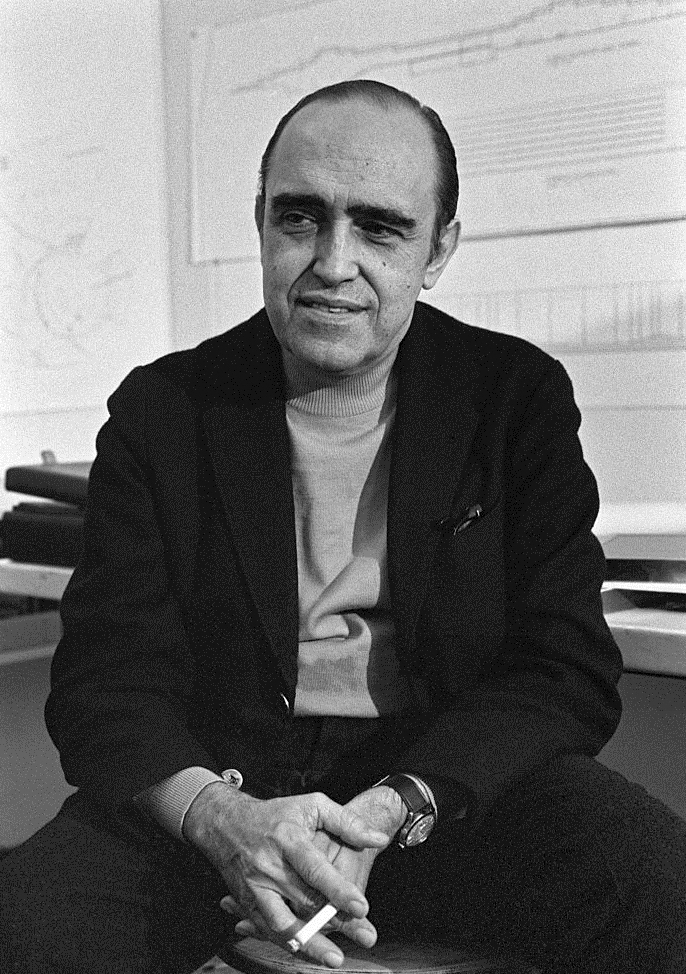
Life and Training
Oscar Ribeiro de Almeida Niemeyer Soares Filho was born on 15 December 1907 in Rio de Janeiro into a middle-class family of German and Portuguese descent. He studied at the National School of Fine Arts in Rio, graduating in architecture in 1934, and immediately joined the studio of Lúcio Costa — the urbanist who would later become his collaborator on Brasília. The defining encounter of his early career came in 1936, when Le Corbusier traveled to Rio as a consultant on the proposed Ministry of Education and Health building. Niemeyer worked directly with the Swiss-French master, absorbing his principles of structural liberation and free-plan design. But where Le Corbusier remained committed to rectilinear geometry, the young Niemeyer was already being drawn toward something more fluid.
His breakthrough came with the Brazilian Pavilion at the 1939 New York World's Fair, co-designed with Lúcio Costa, and the resort complex at Pampulha (1940–1943), commissioned by a young mayor of Belo Horizonte named Jusçelino Kubitschek. When Kubitschek became president of Brazil in 1955, he recruited Niemeyer and Costa to design an entirely new national capital from scratch. Brasília was inaugurated in 1960 and remains the greatest single commission of Niemeyer's life. He was a lifelong communist and close friend of Fidel Castro, which led to his self-imposed exile in France during Brazil's military dictatorship (1964–1985). He returned to Brazil after the restoration of democracy and continued practicing with extraordinary energy until his death in December 2012, just ten days short of his 105th birthday — making him one of the longest-lived architects in history.
Architectural Philosophy
Niemeyer's philosophy begins with a rejection of the right angle. He famously wrote: "It is not the right angle that attracts me, nor the straight line, hard and inflexible, created by man. What attracts me is the free and sensual curve — the curve that I see in the mountains of my country, in the sinuous course of its rivers, in the waves of the sea, in the body of the beloved woman." This was not mere romanticism; it was a structural program. Niemeyer understood that reinforced concrete, unlike stone or brick, has genuine tensile strength and can carry loads in ways that defy Newtonian intuition. A thin shell dome can span enormous distances; an inverted parabola can stand on a single point; a cantilevered slab can reach into space without visible support.
He exploited these structural possibilities to create a Brazilian architecture that was unmistakably its own: modern in technique, tropical in sensibility, theatrical in ambition. His buildings are almost always experienced as sculptural objects set against landscape — against the cerrado plateau of Brasília, against the blue of Guanabara Bay, against the sky. He worked closely with structural engineer Joaquim Cardozo, who made his most technically daring forms achievable. The result is an architecture that feels simultaneously effortless and monumental — light despite its concrete mass, joyful despite its governmental formality.
Key Works
- Pampulha Complex, Belo Horizonte, Brazil (1940–1943): Commissioned by the future president Kubitschek when he was still the local mayor, this lakeside resort and civic complex — comprising a casino, dance hall, yacht club, and the Church of São Francisco de Assis — announced Niemeyer's mature style at a single stroke. The church's sequence of parabolic vaults and its ceramic tile murals by Portinari caused a scandal among local Catholic authorities, but the complex is now a UNESCO World Heritage Site and the moment that Brazilian Modernism found its voice.
- National Congress, Brasília, Brazil (1958–1960): The compositional centerpiece of Brasília's governmental axis, the National Congress pairs two identical towers — the tallest buildings on the Monumental Axis — with two contrasting domes: the convex dome of the Senate and the concave bowl of the Chamber of Deputies. The formal wit of this pairing — one dome up, one down, one branch of government checked by its mirror image — is Niemeyer operating at the height of his symbolic and spatial powers.
- Brasília Cathedral (Cathedral of Our Lady of Aparecida), Brasília, Brazil (1958–1970): Sixteen identical curved concrete columns sweep outward from a circular plan and then curve back inward to meet at the crown, forming a hyperboloid structure that reads as a crown of thorns. Visitors descend via an underground ramp through a dark passage and emerge into the interior lit entirely through stained glass between the columns — a theatrical manipulation of light and sequence that few religious buildings of the twentieth century surpass.
- Palácio do Planalto (Presidential Palace), Brasília, Brazil (1958–1960): The seat of the Brazilian executive is raised on slender inverted parabolic columns — a structural form Niemeyer used across Brasília's governmental buildings — that give the building an appearance of floating above its reflecting pool. The colonnade, repeated with variations at the Supreme Court and other Brasília buildings, became the defining visual vocabulary of the new capital.
- Niterói Contemporary Art Museum, Niterói, Brazil (1991–1996): Built when Niemeyer was eighty-three, this flying-saucer museum on a clifftop overlooking Guanabara Bay demonstrates that his formal invention never diminished. The circular gallery floor is supported on a single cylindrical stem and accessed via a curved ramp that spirals up from the cliffside. The building is almost purely sculptural — its primary purpose as an object to be seen from across the bay rivals its purpose as an interior gallery space.
- Communist Party of France Headquarters, Paris, France (1965–1980): Designed during Niemeyer's French exile, the PCF headquarters in Place du Colonel Fabien is his most significant European work. A five-story dome, half-buried below street level, sits alongside a glass-curtain-wall tower, demonstrating Niemeyer's capacity to bring his Brazilian formal language into dialogue with a dense urban European context.
Legacy
Niemeyer received the Pritzker Architecture Prize in 1988 — the same year as Gordon Bunshaft, in the Prize's only dual award — though many critics felt the recognition was overdue for a career that had already produced Brasília. He influenced the global interest in expressive concrete form that runs from Eero Saarinen to Zaha Hadid, and his work on Brasília helped establish the idea that a planned city could be a work of art — an idea both celebrated and contested ever since. The city itself was designated a UNESCO World Heritage Site in 1987, the only twentieth-century city to be so recognized. Niemeyer remained productive until his final years, his office issuing projects until he was past a hundred, a testament to an architectural vitality matched by almost no one in the history of the profession.
Explore Niemeyer's buildings in the game.
Play Building Guessr