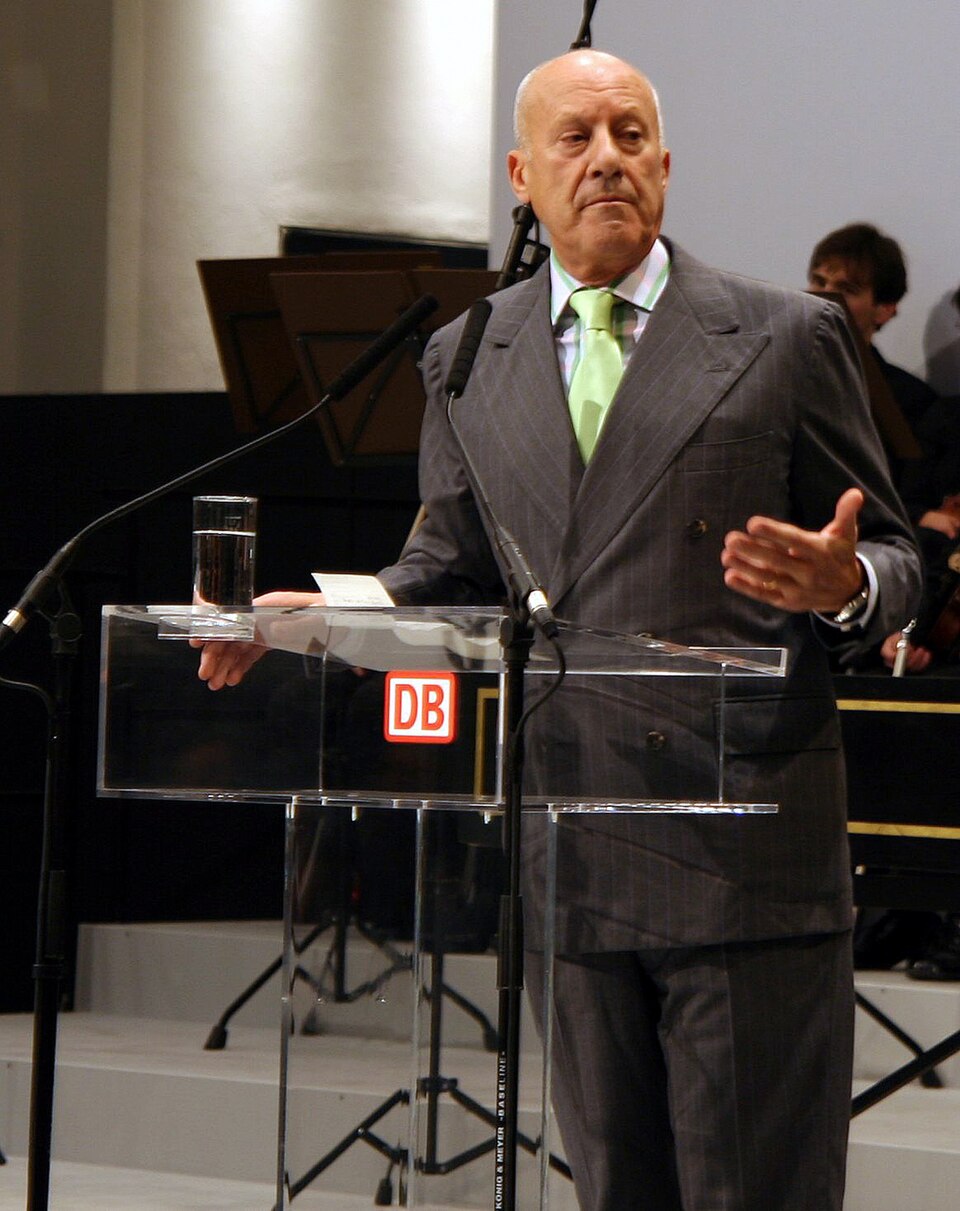
Life and Training
Norman Robert Foster was born on 1 June 1935 in Reddish, Stockport, on the outskirts of Manchester, the son of a factory worker and a domestic servant. He left school at sixteen and worked in the Manchester City Treasurer's Department, then did National Service in the Royal Air Force, an experience that left him with a lifelong fascination with aircraft and aerospace engineering. He then studied architecture at the University of Manchester School of Architecture, graduating in 1961, before winning a Henry Fellowship to Yale University, where he met Richard Rogers. The two became close friends and later, briefly, professional partners.
After Yale, Foster returned to Britain and in 1963 co-founded Team 4 with Rogers and their respective partners. Team 4 dissolved in 1967, and Foster founded Foster Associates (now Foster + Partners). His early commissions were small industrial buildings, but each was executed with a rigour and material precision that attracted attention from industry and the press. The Willis Faber & Dumas building in Ipswich (1975) and the Sainsbury Centre for Visual Arts at the University of East Anglia (1978) established his reputation internationally. A series of landmark commissions followed — the HSBC headquarters in Hong Kong, Stansted Airport, the Reichstag renovation — culminating in the Pritzker Prize in 1999. Foster was appointed to the House of Lords in 1999 as Baron Foster of Thames Bank.
Architectural Philosophy
Foster's architecture is organized around the premise that technology, when handled with precision and elegance, is intrinsically beautiful. He has cited Buckminster Fuller, the American engineer and systems thinker, as a fundamental influence — particularly Fuller's conviction that doing more with less is the highest form of design intelligence. This "more for less" ethic translates into buildings that achieve extraordinary spatial generosity and environmental performance from minimal material means: large-span roofs that seem to float, curtain walls of barely visible glass, structures whose slenderness appears almost implausible.
Foster is also one of the architects who most seriously engaged with environmental sustainability before it became a mainstream architectural concern. His German Commerzbank tower in Frankfurt (1997) was the world's first ecological skyscraper, organized around sky gardens that provide natural ventilation. His interest in the integration of building systems — structure, services, climate control, and enclosure — as a unified design problem rather than a series of separate engineering challenges has made Foster + Partners one of the most technically sophisticated practices in the world. In his own words, architecture should be "a celebration of life" in which the quality of the environment — its light, air, spaciousness, and material refinement — is a direct expression of social values.
Key Works
- HSBC Main Building, Hong Kong (1979–1986): One of the most expensive buildings ever constructed at the time of its completion, the HSBC headquarters in the heart of Hong Kong's Central district is organized around a structural system of eight masts from which floor trusses are suspended, leaving the entire ground level open as a public space. The building is prefabricated to extraordinary precision, and its double-skin facade provides natural ventilation. At its opening it was hailed as the most technically advanced building on earth.
- Stansted Airport, Essex, UK (1981–1991): Foster inverted the conventional airport section: instead of routing passengers through a labyrinth of underground services, he placed all mechanical systems below ground and expressed only the roof — a forest of structural "trees" supporting domed roof lights — above. The result is a single, column-free concourse of extraordinary clarity and calm, flooded with daylight. Stansted remains a benchmark of airport design despite its subsequent expansion.
- Reichstag New Dome, Berlin, Germany (1992–1999): Commissioned to renovate the historic German parliament building after reunification, Foster wrapped the existing neoclassical shell in a new glass dome that is both a public space — visitors can ascend via twin spiral ramps to a viewing platform — and a functional light reflector that directs daylight into the debating chamber below. The dome became an immediate symbol of the reunified Germany: transparent government, accessible democracy.
- Great Court, British Museum, London, UK (1994–2000): Foster's addition of a glass roof to the British Museum's central courtyard — long inaccessible as it housed the library's reading room — created the largest covered public square in Europe. The roof is a gridshell of 3,312 unique triangular glass panels, shaped by a complex geometry that distributes the load evenly while following the curved plan of the round reading room at the centre. The Great Court became one of London's most popular public spaces.
- 30 St Mary Axe (The Gherkin), London, UK (1997–2003): Foster's tapering glass tower in the City of London is aerodynamically shaped to reduce wind loads at street level, and its double-skin spiraling facade incorporates ventilation shafts that reduce air-conditioning demand by forty percent compared to a conventional curtain-wall tower. Its distinctive silhouette — circular plan, tapering profile, diamond-pattern glazing — made it the most recognizable building added to the London skyline in a generation.
- Millau Viaduct (with Michel Virlogeux), Millau, France (1993–2004): The world's tallest bridge at the time of its completion, the Millau Viaduct carries the A75 motorway across the Tarn valley in southern France on seven concrete piers, one of which is taller than the Eiffel Tower. Foster's role was to give the bridge's structural logic an elegance and refinement that pure engineering would not have reached — particularly in the tapering profile of the piers and the precise geometry of the cable stays. The viaduct is now widely regarded as one of the great civil engineering achievements of the twenty-first century.
Legacy
Norman Foster has practiced architecture for more than six decades, and Foster + Partners remains among the largest and most globally active architectural firms in the world, with offices on five continents and a portfolio that spans airports, skyscrapers, museums, campuses, and urban masterplans. His influence on the language of high-tech architecture has been immense, establishing an aesthetic of precision, lightness, and transparency that dominated corporate and institutional architecture from the 1980s onward. His engagement with sustainability, and his insistence that environmental performance and architectural quality are not in opposition, anticipated a debate that the profession as a whole only fully engaged with decades later. He received a life peerage in 1999, making him — alongside Richard Rogers — one of the very few architects to be elevated to the British House of Lords.
Explore Norman Foster's buildings in the game.
Play Building Guessr