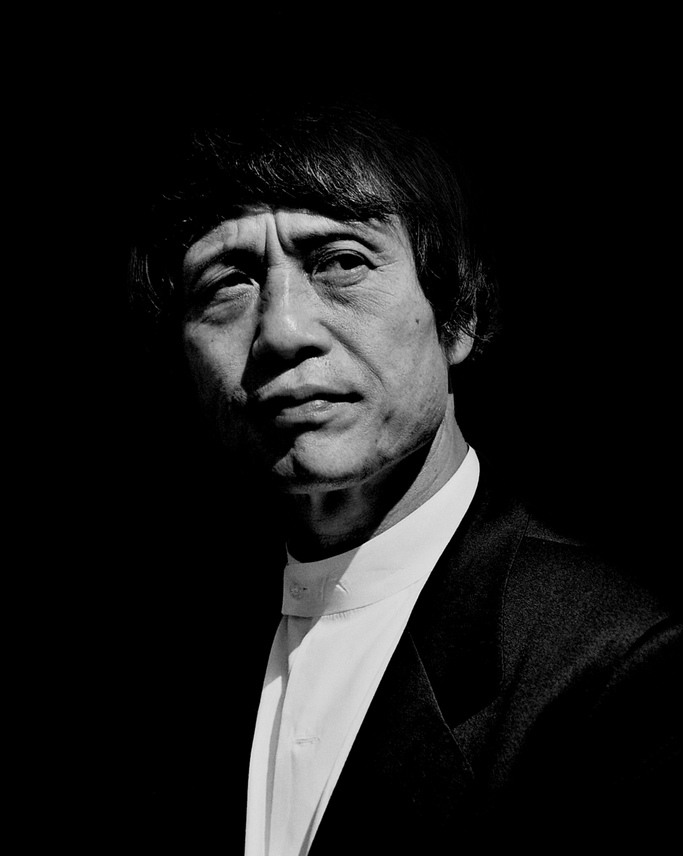
Life and Training
Tadao Ando was born on 13 September 1941 in Osaka, Japan, the son of a factory worker. He grew up with his grandmother and twin brother in a small wooden row house — the typical Osaka nagaya — and spent much of his childhood observing carpenters and craftsmen at work in the adjacent workshops. He received no formal architectural education; instead, he taught himself by reading extensively, studying the drawings of Le Corbusier, and — crucially — by traveling. Working as a professional boxer in his early twenties to fund himself, he traveled through Japan, Europe, Africa, and the United States, visiting buildings directly and learning from observation and immersion rather than from a classroom.
He opened his own practice in Osaka in 1969 with no completed buildings and no professional credentials beyond determination and an extraordinary capacity for self-directed learning. His early commissions were tiny urban houses squeezed into narrow Osaka lots, where the challenge of making habitable space from almost nothing forced him to develop the spatial intensity that would characterize all his later work. The Azuma House (Row House in Sumiyoshi) of 1976 brought him to international attention: a concrete box inserted into a traditional Osaka row house, with an open courtyard at its center that exposes the interior to rain and weather. The jury that awarded it the Annual Prize of the Architectural Institute of Japan noted that it forced residents to confront nature as an intrinsic part of domestic life.
Architectural Philosophy
Ando's philosophy is rooted in the conviction that architecture is primarily a medium for the human experience of nature — particularly light, shadow, wind, water, and the passage of time. Where Western Modernism tended to treat nature as something to be excluded and controlled (through sealed glass envelopes and mechanical air-conditioning), Ando insists on admitting it. His buildings are full of gaps, slots, and apertures that allow light to enter as a moving, seasonal, time-of-day phenomenon rather than a fixed illumination level. The cross of light in the Church of the Light, cut through a concrete wall, changes throughout the day and across the seasons: at dawn in winter it is almost horizontal; at noon in summer, nearly vertical. The building changes in time.
His material of choice is exposed concrete — but not raw or industrial concrete. Ando's concrete is cast to extraordinary precision, with carefully controlled aggregate and finish, so that its surface achieves a refinement approaching that of polished stone. He has described this as a paradox: concrete is the most industrial of materials, yet in his hands it achieves the warmth and tactility of a natural material. He is also deeply influenced by traditional Japanese spatial ideas — the ma (interval, negative space), the engawa (transitional threshold), and the Zen garden's cultivation of emptiness as a positive presence — which he translates into the language of modern concrete construction.
Key Works
- Church of the Light, Ibaraki, Osaka, Japan (1989): Built on a minimal budget for a small Protestant congregation, the Church of the Light is a concrete box bisected by a freestanding wall at fifteen degrees to the main volume. The altar wall is cut by a cruciform slit that allows direct sunlight to form a cross of light on the interior — a cross that moves, changes color through the day, and disappears at night. The congregation sits on reclaimed timber pew-benches. It is a building of almost elemental simplicity that has become one of the most studied religious spaces of the twentieth century.
- Chichu Art Museum, Naoshima Island, Japan (2004): Buried almost entirely underground to avoid dominating Naoshima's coastal landscape, the Chichu Art Museum is organized around a series of skylighted concrete courts and galleries designed specifically for three artists: Claude Monet's large Water Lily paintings, James Turrell's light installations, and Walter De Maria's time-based sculptures. Every spatial decision — the angle of the skylights, the texture of the walls, the sequence of the route — was calibrated to the specific work each room contains.
- Benesse House Museum, Naoshima Island, Japan (1992): Part of the Benesse Art Site Naoshima — an extraordinary concentration of art and architecture on a small island in the Seto Inland Sea — Benesse House is simultaneously a hotel, a museum, and a landscape intervention. Ando's concrete pavilions are embedded in the island's topography, offering rooms that open to views of the sea and galleries that integrate with the outdoor landscape. The project established Naoshima as one of the world's most significant destinations for the intersection of art and architecture.
- 4×4 House, Kobe, Japan (2003): A residential tower of just four meters square, rising four stories on a narrow seaside plot — a test of Ando's ability to make habitable space from an almost impossible program. Each floor contains a single room; the top floor is a living room with panoramic windows facing the water. The project is a concentrated demonstration that spatial intensity can substitute for spatial quantity.
- Church on the Water, Hokkaido, Japan (1988): Complementing the Church of the Light, the Church on the Water at the Tomamu ski resort in Hokkaido is organized around a reflecting pool facing a forested hillside. The altar wall opens — mechanically, in a dramatic moment during services — to allow the congregation to be directly in the presence of the landscape, with a freestanding cross standing in the water. The two churches together are Ando's fullest statement on the relationship between spiritual experience and the direct encounter with nature.
- Pulitzer Arts Foundation, St. Louis, Missouri, USA (2001): Ando's first completed building in the United States, designed for collectors Emily Rauh Pulitzer and Joseph Pulitzer Jr., is a compact sequence of concrete galleries organized around a shallow reflecting pool. The building demonstrates that his spatial vocabulary — exposed concrete, carefully controlled natural light, strong geometric organization — translates intact into the American context, where the qualities of light and material are entirely different from Japan.
Legacy
Tadao Ando received the Pritzker Architecture Prize in 1995, the jury citing his ability to create architecture of great power and beauty from the most limited means. His influence has been enormous particularly on the design of museums, cultural institutions, and residential architecture where experiential quality is prioritized over programmatic complexity. His story — self-taught, beginning with tiny urban houses, achieving global recognition without institutional backing — is also a powerful argument that architecture can be learned through direct encounter with buildings rather than solely through academic instruction. He has taught at Harvard, Columbia, and Yale, sharing his autodidactic methods with students who have gone through the formal education he never received.
Explore Tadao Ando's buildings in the game.
Play Building Guessr