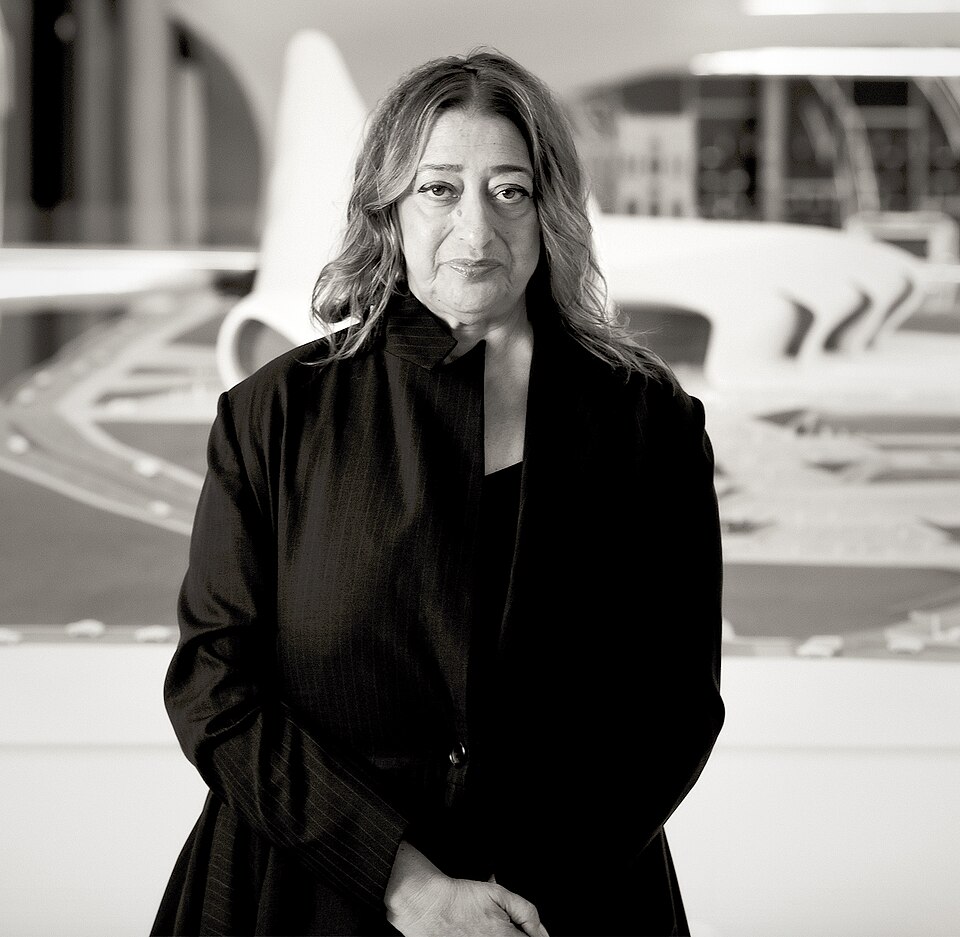
Life and Training
Zaha Hadid was born on 31 October 1950 in Baghdad, Iraq, into an educated and progressive family. Her father, Mohammed Hadid, was a prominent politician and co-founder of the Iraqi National Democratic Party; her mother was an artist. She grew up in a household where intellectual ambition was unremarkable, and she later credited this environment with making it possible for her to conceive of a career for which there was, at the time, essentially no precedent: a woman leading one of the world's most demanding architectural practices.
She studied mathematics at the American University of Beirut before moving to London in 1972 to study at the Architectural Association. At the AA, she encountered Rem Koolhaas and Elia Zenghelis, who became mentors, and she joined their practice OMA (Office for Metropolitan Architecture) in Rotterdam after graduating in 1977. She quickly proved exceptional: her student project, a reimagining of Malevich's Tektonik as a hotel on the Hungerford Bridge in London, was so radical that the school purchased it. She set up her own practice in London in 1979.
The following decade was a period of near-total professional frustration. Hadid won competitions — most notably the 1983 Hong Kong Peak competition, which brought her international attention — but built almost nothing. Her designs were widely reproduced in architecture journals and regarded as visionary, but contractors, clients, and planning authorities consistently found them too technically complex, too expensive, or too unconventional to execute. The architectural world debated whether her work was buildable at all. The turning point came in 1993 with the Vitra Fire Station in Weil am Rhein, Germany — her first completed major building, a slicing exercise in angular concrete planes that demonstrated her formal ideas could indeed be constructed.
Architectural Philosophy
Hadid described her guiding ambition as the investigation of fluid, dynamic space — architecture that captures movement, energy, and change rather than settling into static geometry. Where conventional modernism worked from the right angle and the grid, she worked from the diagonal, the curve, the fragmented shard, and the continuous surface that transitions smoothly from floor to wall to ceiling without conventional joints. Her formal vocabulary was influenced by Russian Suprematism and Constructivism — particularly Malevich's painted geometries — which she absorbed and then drove into three-dimensional space.
The technological precondition for her built work arriving was the development of parametric design software in the 1990s and 2000s. Tools like CATIA (originally developed for designing aircraft fuselages) and Rhino allowed her team to design the complex double-curved geometries that her drawings had always proposed. Once geometry could be computed and communicated to fabricators digitally, the contractor's objection that "it can't be built" lost its force. The practice became one of the earliest architectural offices to fully integrate computational design — not merely using software to draw but using it to generate and optimize form.
Her relationship with landscape was distinctive. Rather than treating the ground as a neutral datum from which a building rises, she frequently designed buildings that seemed to emerge from the ground or continue its topography — a geological upwelling rather than an object placed on a site. The Heydar Aliyev Centre in Baku is the clearest example: its white GRC (glass-reinforced concrete) skin peels up from the surrounding plaza with no visible joint between pavement and facade, as though the ground itself had been lifted and folded.
Key Works
- MAXXI — National Museum of 21st Century Arts, Rome, Italy (1998–2010): The building that, more than any other, made Hadid's critical reputation as a practitioner rather than a theorist. The MAXXI is organized as a bundle of overlapping galleries — concrete tubes that intersect, overlap, and flow through a city block — connected by bridges and overlooked by continuous concrete-edged staircases. The interior circulation is simultaneously disorienting and exhilarating, with views across multiple levels at every turn. It won the RIBA Stirling Prize in 2010.
- Heydar Aliyev Centre, Baku, Azerbaijan (2007–2012): A cultural centre comprising a conference hall, museum, and library whose exterior is a single continuous white surface folding up from the surrounding plaza. The building has no visible corners and no conventional facade/roof distinction. Structurally it is a steel space frame clad in GRC panels, each individually shaped to the compound curves of the design. It received the Design of the Year award from the Design Museum in London in 2014.
- London Aquatics Centre, London, UK (2005–2011): Designed for the 2012 Olympic Games, the Aquatics Centre is covered by a massive sweeping wave roof — a concrete shell 160 metres long and 80 metres wide at its widest — supported on just three concrete pads. The undulating interior ceiling follows the roof's curves, giving the pools below a sense of being sheltered by a living landscape. The temporary wings added for Olympic capacity were removed after the games, revealing the building's intended silhouette.
- Guangzhou Opera House, Guangzhou, China (2003–2010): A twin-stone composition — two boulders "eroded" into asymmetric forms by imaginary rivers — set on the Zhujiang New Town waterfront. The larger boulder contains the 1,800-seat opera house; the smaller contains a multi-function theatre. The angular faceted exterior is translated inside into a series of irregular faceted surfaces in the main auditorium, creating superb acoustics while avoiding the circular symmetry conventional in opera house design.
Legacy
Zaha Hadid died of cardiac arrest on 31 March 2016 in a Miami hospital while being treated for bronchitis. She was 65. At the time of her death she had become the most famous architect in the world — a figure whose celebrity extended far beyond the architectural profession, whose work was constantly exhibited and published, and whose practice employed 400 people on projects across five continents. She was the first woman to win the Pritzker Architecture Prize (2004) and the first to be awarded the Royal Gold Medal of the Royal Institute of British Architects (2016). Zaha Hadid Architects, led by her longtime partner Patrik Schumacher, continues to operate at the same scale. The practice has completed significant projects since her death, including the Beijing Daxing International Airport (2019). Her most debated legacy is parametricism — the formal movement Schumacher has systematized from her practice's work — which remains both influential and contested in architectural culture.
Explore Zaha Hadid's buildings in the game.
Play Building Guessr