The engineering problem of the dome
A dome looks simple — a hemisphere placed over a circular plan — but the engineering problem it solves is anything but. The fundamental challenge is that a dome generates strong outward thrust at its base. Each ring of masonry pushes not just downward under gravity but outward horizontally, like a stack of interlocking arches trying to straighten themselves out. If nothing resists that horizontal thrust, the base of the dome will spread and the structure will crack or collapse. Every great dome in history is, at its core, an answer to this one structural question: how do you contain the base thrust without making the building impossibly heavy or narrow?
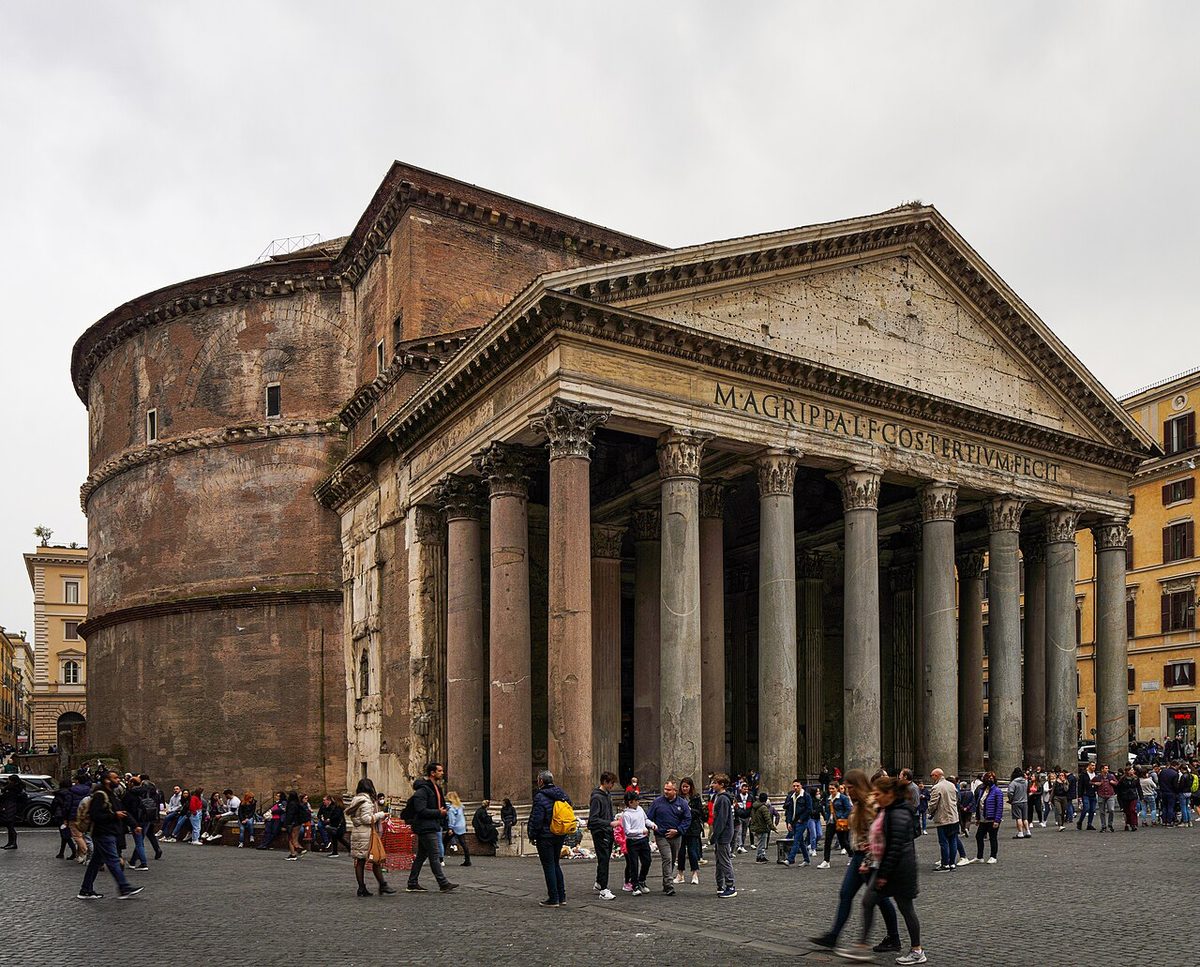
The Romans answered it with mass. The walls of the Pantheon in Rome (completed around 125 AD, during the reign of Hadrian) are approximately six meters thick at the drum, and the exterior is stepped in a series of receding rings that add weight over the springing line of the dome while reducing weight higher up. Roman engineers also made the concrete of the dome progressively lighter as it rose — pumice aggregate near the top, heavier travertine and brick at the base — creating a structure that is both self-regulating and visually unified.
At the very apex of the dome sits the oculus, an open circular eye nine meters in diameter that has no glass and is simply open to the sky. Rain falls through it onto a slightly domed and drained floor. The oculus serves two purposes: it reduces weight at the point where outward thrust is greatest, and it admits a column of light that moves across the interior surfaces throughout the day, transforming the interior into a kind of sundial. The Pantheon's dome is 43.3 meters in internal diameter — it held the record for the largest unreinforced concrete dome in the world for more than 1,300 years, until Brunelleschi's Florence Cathedral dome surpassed it in the fifteenth century.
The Byzantine pendentive
The pendentive was one of the most consequential inventions in the history of architecture. The problem it solved sounds technical but its implications were enormous: how do you place a circular dome on top of a square room? A dome rests naturally on a circular base. A room with four walls has a square base. The gap between the two — the corner zones between the four arches that span the walls and the circular base of the dome — is a concave triangular surface that curves inward in both directions at once. That surface is the pendentive.
By constructing these four curved triangular surfaces, Byzantine architects could build the dome's circular base above a square plan, with the pendentives smoothly bridging the geometry. This was not merely an elegant trick: it opened up the entire floor plan of a church or mosque from the confined aisles of the Roman basilica to a unified, centralized interior space under a floating dome. The plan could now be organized around a central open area rather than a long nave — a spatial and liturgical transformation of the first importance.
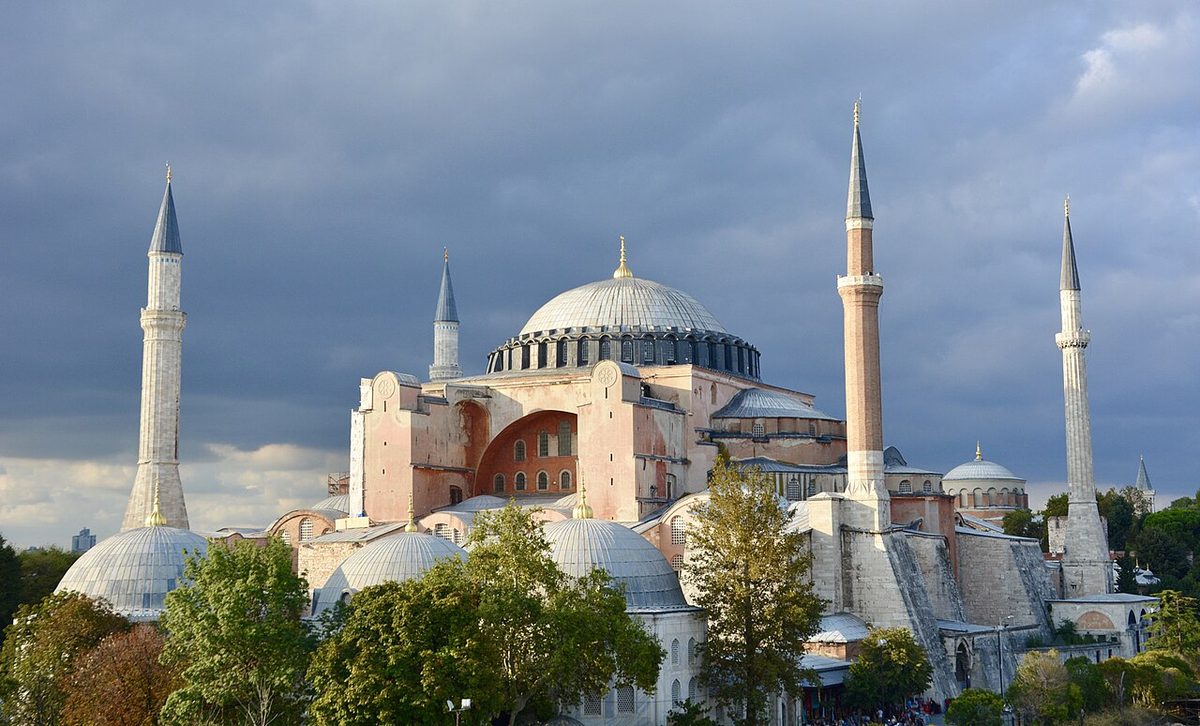
Hagia Sophia in Constantinople (completed 537 AD under the emperor Justinian) is the supreme demonstration of the system. Its central dome is 31 meters in diameter, pierced at its base by a ring of forty windows that flood the interior with light and create the famous illusion — described by contemporary witnesses — that the dome is suspended from heaven by a golden chain rather than resting on earthly supports. The dome collapsed twice in earthquakes (in 558 and 989) and was rebuilt each time, with its profile steepened slightly after the second collapse to reduce outward thrust. In its rebuilt form the pendentive system has now been in continuous structural use for over 1,500 years.
The Renaissance dome: Brunelleschi and Michelangelo
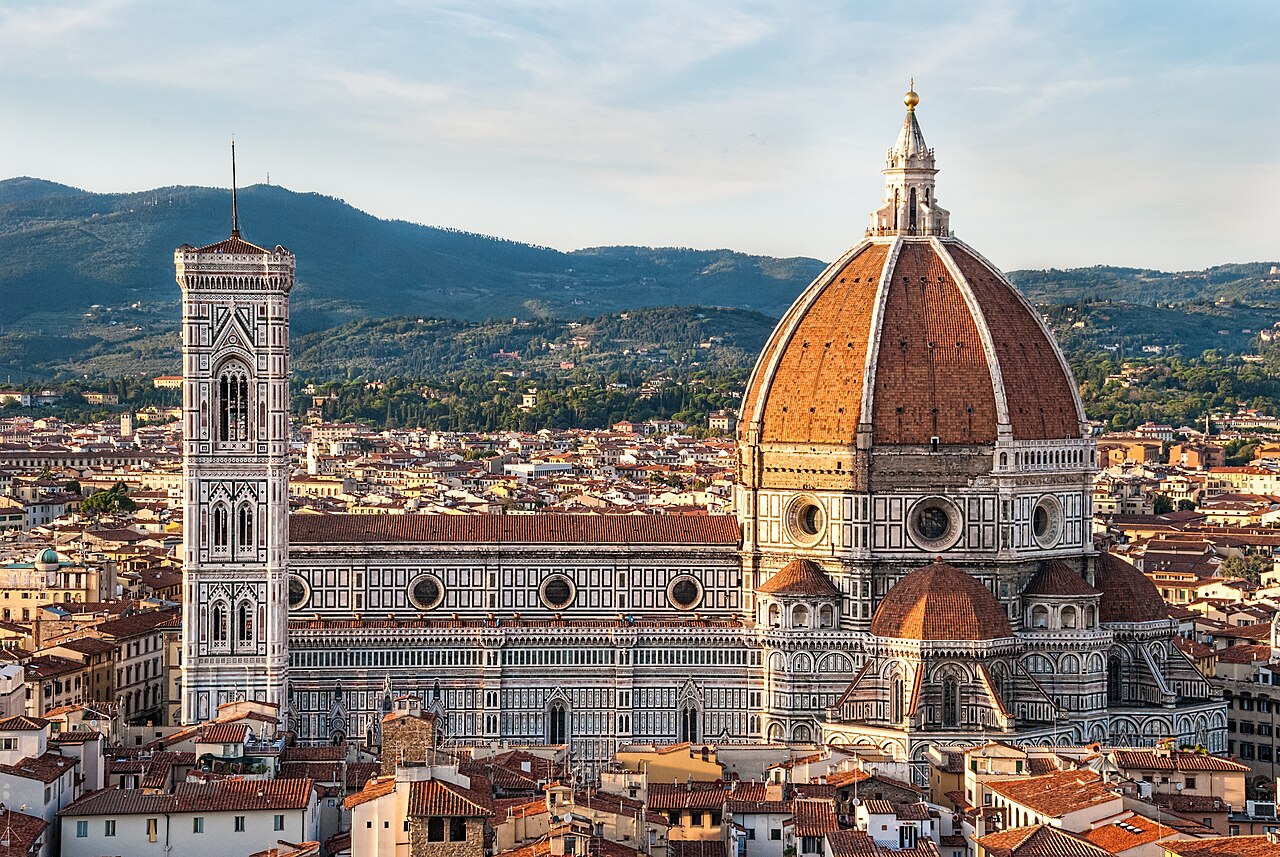
When the Florence Cathedral crossing was finally closed with a dome in the fifteenth century, the solution was one of the most audacious engineering achievements in history. The cathedral had been under construction since 1296; the crossing had been left open since 1380 because no one knew how to build the dome that the original design required — a dome 42 meters in diameter, higher than any dome yet built in medieval Europe, and too wide for any centering (temporary wooden framework) that could be constructed at the time.
Filippo Brunelleschi solved the problem between 1420 and 1436 without centering, using a combination of innovations that he refused to fully explain to competitors. His solution had three key elements: a double shell (an outer shell for appearance and an inner shell for structural integrity, with a cavity between them used as a construction walkway); a system of herringbone brickwork in which each row of bricks locked the previous row in place without needing external support; and a series of hidden horizontal stone chains embedded in the masonry like hoops around a barrel, resisting the outward thrust that would otherwise cause the shell to spread. The result rises 114 meters above the cathedral floor and dominates the Florence skyline from every direction, setting the standard for Renaissance civic domes that followed.
Michelangelo's design for the dome of St. Peter's Basilica in Rome (begun 1546, completed posthumously by Giacomo della Porta in 1590) took Brunelleschi's precedent and pushed it further. Michelangelo steepened the profile to a more pointed curve — reducing horizontal thrust while increasing visual height — and surrounded the drum with paired columns that gave the exterior strong vertical emphasis. The combination of elevated drum, paired column articulation, and prominent lantern became the template for civic domes across the Western world: the Capitol in Washington, the Panthéon in Paris, St. Paul's in London — all are variations on the grammar established at St. Peter's.

The Ottoman dome: Sinan's engineering
Mimar Sinan, the chief court architect of the Ottoman Empire under Süleyman the Magnificent, viewed Hagia Sophia not as an unsurpassable model but as a challenge to be met and exceeded. Over a career spanning six decades in the sixteenth century, he built more than three hundred structures across the empire, refining his understanding of dome engineering with each commission. His masterpiece, the Selimiye Mosque in Edirne (completed 1575), is his explicit answer to Hagia Sophia — and by his own account, his greatest achievement.
The Selimiye's central dome is 31.3 meters in diameter at the base — marginally but measurably larger than Hagia Sophia's. What is more remarkable than the slight dimensional increase is how Sinan achieved it. Rather than relying on thick external buttresses or half-domes to absorb the outward thrust (as Hagia Sophia does), Sinan transferred all the dome's load to just eight slender piers arranged in an octagonal pattern. These piers are embedded within the interior space rather than buried in walls, leaving the perimeter almost entirely open. The result is a ring of almost continuous windows at every level — muqarnas-capped recesses, arched galleries, and the drum's arcade — that fill the interior with a luminosity Sinan described as superior to Hagia Sophia. Where Hagia Sophia achieves its light effect by making solid structure appear to dissolve, Selimiye achieves it by making structure genuinely minimal.
Sinan's achievement was recognized even by contemporaries in hostile political relationships with the Ottoman Empire. The structural audacity of transferring a dome of that scale to eight freestanding piers, while simultaneously maintaining the geometric clarity of a centralized plan, represents a solution to the dome problem that had no precedent in either Roman or Byzantine engineering. The four slender minarets at the corners, the lowest of which rises higher than any minaret in Istanbul, amplify the vertical drama of the composition and make the Selimiye one of the most recognizable silhouettes in Ottoman architecture.
Steel and iron: the Crystal Palace and its children
The Industrial Revolution made available two new structural materials — cast iron and wrought iron, later steel — that transformed the dome problem entirely. Iron could carry far greater tension than masonry, which meant that outward thrust could now be resisted by iron tie-rods and tension rings rather than by massive buttressing walls. The material also allowed very thin ribs to carry enormous spans, and prefabrication meant that large structures could be assembled quickly from standardized components shipped to site.
The demonstration moment came with Joseph Paxton's Crystal Palace, built for the Great Exhibition of 1851 in Hyde Park, London. Though not a dome, it established the fundamental idea: a vast clear-span enclosure built entirely from prefabricated cast-iron columns and beams and standard panes of plate glass, erected in just nine months by a largely unskilled workforce following simple assembly instructions. The Crystal Palace taught the architectural world that large, light, column-free interior spaces were now within reach of any building type.
The Reading Room of the British Museum (1857, designed by Sydney Smirke) applied the lesson directly to a dome. Its 42-meter diameter cast-iron dome, slightly larger than the Pantheon's, appears from the interior as a solid plaster vault — white and smooth, suggesting Roman concrete. From above or in section, the reality is a web of slender iron ribs, technically a more advanced structure than the Pantheon but visually a deliberate homage to it. This duality — structural modernity presenting itself as historical continuity — characterizes the Victorian period's uneasy relationship with the new possibilities that iron and steel had opened up, possibilities that twentieth-century architects would eventually embrace rather than disguise.
Geodesic domes: Buckminster Fuller
Buckminster Fuller's geodesic dome, for which he received a US patent in 1954, approached the dome problem from a completely different theoretical starting point. Rather than thinking about a dome as a curved surface supported by ribs or rings, Fuller thought about it as a three-dimensional network of triangles mapped onto the surface of a sphere. When a sphere's surface is divided into triangular elements — each triangle approximating the curve of the sphere — the result is a structure in which every member is approximately in pure tension or pure compression, with no bending. A structure without bending is maximally efficient: every unit of material is working as hard as it can.
The practical consequence is that geodesic domes can cover very large areas with very little material. The structural weight per unit of enclosed volume decreases as the dome gets larger, meaning that beyond a certain scale a geodesic dome is lighter per unit area than almost any other structural form. Fuller believed that very large geodesic domes could in principle cover entire city districts, controlling their internal climates. The most famous surviving large-scale example is the Montreal Biosphère, originally constructed as the United States Pavilion for Expo 67. Its steel geodesic sphere, 76 meters in diameter, is now an environmental museum; its original acrylic skin burned away in a 1976 fire, leaving the bare structural frame exposed.
The Eden Project in Cornwall (opened 2001), designed by Nicholas Grimshaw, applies the geodesic principle to enclosures for tropical and temperate biomes. Its interlocking hexagonal and pentagonal ETFE (ethylene tetrafluoroethylene) cushion panels are organized on a geodesic structural grid, creating the largest greenhouse structures in the world. The visual effect — clusters of silver-white domes nestled in a former china clay quarry — is immediately recognizable and represents the most architecturally successful large-scale use of the geodesic principle yet built. Geodesic structures remain difficult to seal and weatherproof at large scales, which is why the Eden Project's use of inflated ETFE cushion panels rather than rigid glazing was a significant technical advance.
Modern long-span roofs: ETFE and tensegrity
The final frontier of dome engineering is the long-span enclosure that covers enormous areas — sports arenas, exhibition halls, transport termini — without internal columns and without the traditional dome silhouette. Cable-net and tensegrity structures achieve this by replacing rigid compression elements with a network of cables in tension, held in equilibrium by a minimal number of compression masts. The result is a structure that can be both enormously large and visually almost weightless.
The Millennium Dome (now the O2 Arena) in Greenwich, London, completed in 2000 and designed by Richard Rogers Partnership, is the largest structure of its type ever built. Its 365-meter diameter PTFE-coated glass fibre fabric roof is supported by a cable net hung from twelve bright yellow steel masts, each 100 meters tall. The cables run from the mast heads down to a perimeter compression ring, holding the fabric in tension. The structure encloses more than 100,000 square meters of floor area under a single roof without a single internal column. Seen from above or at distance, its flat, circular profile is unlike any traditional dome; the twelve masts give it the appearance of a tent city at extraordinary scale.
The Beijing National Aquatics Centre, known as the Water Cube (2008, by PTW Architects and ARUP), applies an entirely different non-traditional geometry to the enclosure problem. Its structural system is derived from the Weaire-Phelan foam model — the theoretical arrangement of cells that most efficiently packs equal volumes of space using the minimum of surface area, first proposed by two physicists studying soap bubble geometry. The result is a facade of irregular, multi-sided ETFE cushion panels that gives the building its distinctive blue cellular appearance: simultaneously biological and industrial. In the context of a geography game, the complete absence of traditional structural expression — no columns, no arches, no ribs — combined with an unusual material surface (translucent cushions, fabric membranes, apparent weightlessness) is the primary visual tell for modern long-span tensegrity and cable-net structures.
Interested in how these structural ideas connect to broader architectural history? See our guides to the evolution of the skyscraper and reading religious architecture.
Regional Variations in Dome Design
The dome is one of the few architectural forms that appears independently across multiple unconnected traditions, which makes tracing regional variation particularly instructive. The Roman concrete dome — best exemplified by the Pantheon — uses a single continuous shell without visible ribs, relying on the mass and composition of the concrete itself to manage thrust. The hemispherical profile is very shallow relative to the span, which keeps the center of gravity low but increases outward thrust at the base. The heavy coffers visible in the Pantheon's interior serve a structural purpose as much as a decorative one: they reduce material volume at the thinnest upper zones while maintaining the geometry.
The Byzantine pendentive dome represents a fundamentally different spatial logic. Rather than spanning a circular plan like the Pantheon, it spans a square plan, which the pendentives transform smoothly into a circular base. This seemingly small innovation had enormous consequences: it allowed the entire floor plan of a basilica or mosque to be reorganized around a central open space rather than a long colonnaded nave. The Hagia Sophia's shallow saucer profile was common in early Byzantine work; later regional variants in Russia and the Balkans developed taller, more vertical drum proportions that gave churches a more vertical silhouette from the exterior.
Islamic domes developed in several distinct regional traditions. Persian and Central Asian domes tend toward a pointed profile — structurally advantageous because a pointed curve reduces horizontal thrust compared to a hemispherical one — with exterior surfaces covered in glazed tile in blues, greens, and gold. The Timurid blue domes of Samarkand and Bukhara are among the most immediately recognizable in the world. Ottoman domes follow Byzantine structural precedent (pendentives, heavy drum) but with a distinctly flatter, more restrained profile than Persian work, surrounded by cascading half-domes and clusters of smaller domes that make the exterior silhouette complex. Mughal domes develop the onion or bulbous profile — swelling outward at the shoulders before narrowing to a pointed finial — influenced by Central Asian Timurid precedents but combined with local Indian materials and decorative sensibilities. The white marble domes of Mughal funerary architecture, most famously the Taj Mahal, are immediately distinctive for their smooth surface, prominent finial, and chhatri (small decorative pavilion) clusters at the drum base.
Renaissance and Baroque domes differ from all of the above in their use of the elevated drum — a cylindrical base story that raises the dome well above the roof level and gives it visual dominance over the surrounding structure. Brunelleschi's Florence dome uses a pointed octagonal profile without a drum; Michelangelo's St. Peter's adds a tall drum with paired columns; Wren's St. Paul's in London adds a further visual trick — a decorative outer dome in a different profile from the structural inner dome, with a brick cone supporting the lantern hidden between them. This three-shell system (outer dome, inner dome, hidden cone) allowed the exterior silhouette to be dramatically tall and pointed while the interior space remained proportional and intimate.
Key Dome Identifiers
- Drum: the cylindrical base story raising the dome above the roofline — strongly associated with Renaissance and Baroque domes
- Lantern: a small windowed tower at the apex of the dome, admitting light and capping the composition — absent from the Pantheon type (oculus instead)
- Pendentive: the curved triangular surface bridging a square plan to the circular base of a dome — the defining structural innovation of Byzantine and Ottoman architecture
- Squinch: an arch or corbelled niche bridging the corners of a square room to support a dome — an alternative to the pendentive, common in Persian and early Islamic work
- Muqarnas: stalactite-like decorative vaulting beneath domes in Islamic interiors — purely ornamental, applied over the structural shell
- Oculus: the open circular eye at the apex of the Pantheon dome — admits light and reduces material at the point of greatest structural efficiency
- Onion dome: a bulbous profile swelling beyond the drum diameter before tapering — associated with Mughal, Russian Orthodox, and some Central Asian traditions
- Hemispherical profile: the simple half-sphere — associated with Roman concrete work and early Byzantine domes; minimizes visual drama but maximizes structural efficiency
- Pointed profile: a dome taller than a hemisphere — reduces outward thrust; common in Persian, Ottoman, and Gothic-influenced dome traditions
A Closer Look: Hagia Sophia
Hagia Sophia in Constantinople, completed in 537 AD under the Emperor Justinian and the architects Anthemius of Tralles and Isidore of Miletus, posed and solved the fundamental problem of Byzantine dome engineering at an unprecedented scale. The building's core challenge was to place a large circular dome — roughly 31 meters in diameter — over a rectangular nave. A nave is organized along a longitudinal axis; a dome, by its geometry, implies a centralized space. Reconciling the two required a structural solution that had no precedent at that scale.
The pendentives handled the transition from square to circle: four enormous curved triangular surfaces spanned the angles between the four great arches, creating a smooth circular ring at the level from which the dome sprang. But a single dome of that diameter and height would exert enormous lateral thrust on its supports. The solution was to introduce two half-domes of similar diameter on the main axis, east and west, each supported by smaller exedra half-domes in turn. The result is a cascade of structural volumes diminishing in size toward the ends of the nave, each transferring the main dome's thrust laterally and downward rather than allowing it to concentrate in the four great piers. On the north and south sides, the thrust is taken by massive solid buttress walls, largely invisible from the interior but essential to the structure's stability.
Contemporary witnesses at the dedication described the dome as appearing to float, suspended from heaven by a golden chain — a perception created by the ring of forty windows at the dome's base. These windows, inserted where structural forces are relatively low (the dome generates most of its outward thrust lower, where it meets the pendentives), admit a band of light around the entire base of the dome that effectively dissolves the visual connection between the dome and its supports. The floating effect is not an illusion but a precisely calculated architectural experience. After the dome's collapse in 558 and its reconstruction (with a slightly steepened profile) in 562, the same visual program was re-established, and it has now been in continuous use for nearly fifteen hundred years — first as a Christian church, then as an Ottoman mosque, and today as a mosque again after a period as a museum.
Spotting It in Building Guessr
Domed buildings appear across all regions of the game, and distinguishing a Byzantine church dome from an Ottoman mosque dome from a Renaissance cathedral dome from a Mughal mausoleum dome is one of the most valuable skills a player can develop. The process starts with the base: does the dome sit directly on the building's walls (suggesting Byzantine or Roman origin), or does it sit on a drum (suggesting Renaissance, Baroque, or Ottoman influence)? A prominent drum with windows almost certainly means post-fifteenth-century European or Ottoman work. A flat hemispherical dome emerging directly from pendentives suggests Byzantine or early Islamic.
Profile is the next discriminator. An onion-shaped dome that swells beyond its drum before tapering to a finial points to Mughal work (India, Pakistan) or Russian Orthodox work — the two traditions are visually distinct in their context and supporting structure but share the bulbous profile. A pointed dome with a glazed tile exterior in blues and greens is almost certainly Persian or Central Asian. A smooth white marble dome with chhatri clusters at the drum corners is Mughal. A dome surrounded by minarets narrows to Islamic traditions generally; the minaret type then identifies Ottoman (pencil-thin cylindrical) versus Mughal (octagonal with canopied balconies) versus Persian (square with tile facing). A dome ringed by flying buttresses or accompanied by Gothic tracery windows is a Renaissance or Gothic Revival hybrid typical of Western European ecclesiastical architecture.
Think you can spot these dome traditions from a single photo?
Play Building GuessrFurther Reading
Sources & further reading
Reference material this page draws on, and where to read further. External links open third-party sites.
- Dome · Wikipedia
- Pantheon, Rome · Wikipedia
- Florence Cathedral · Wikipedia
- Hagia Sophia · Wikipedia
- Filippo Brunelleschi · Wikipedia
- Coffer · Wikipedia
- Pendentive · Wikipedia
- World Heritage listing: Hagia Sophia · UNESCO World Heritage Centre