What it is
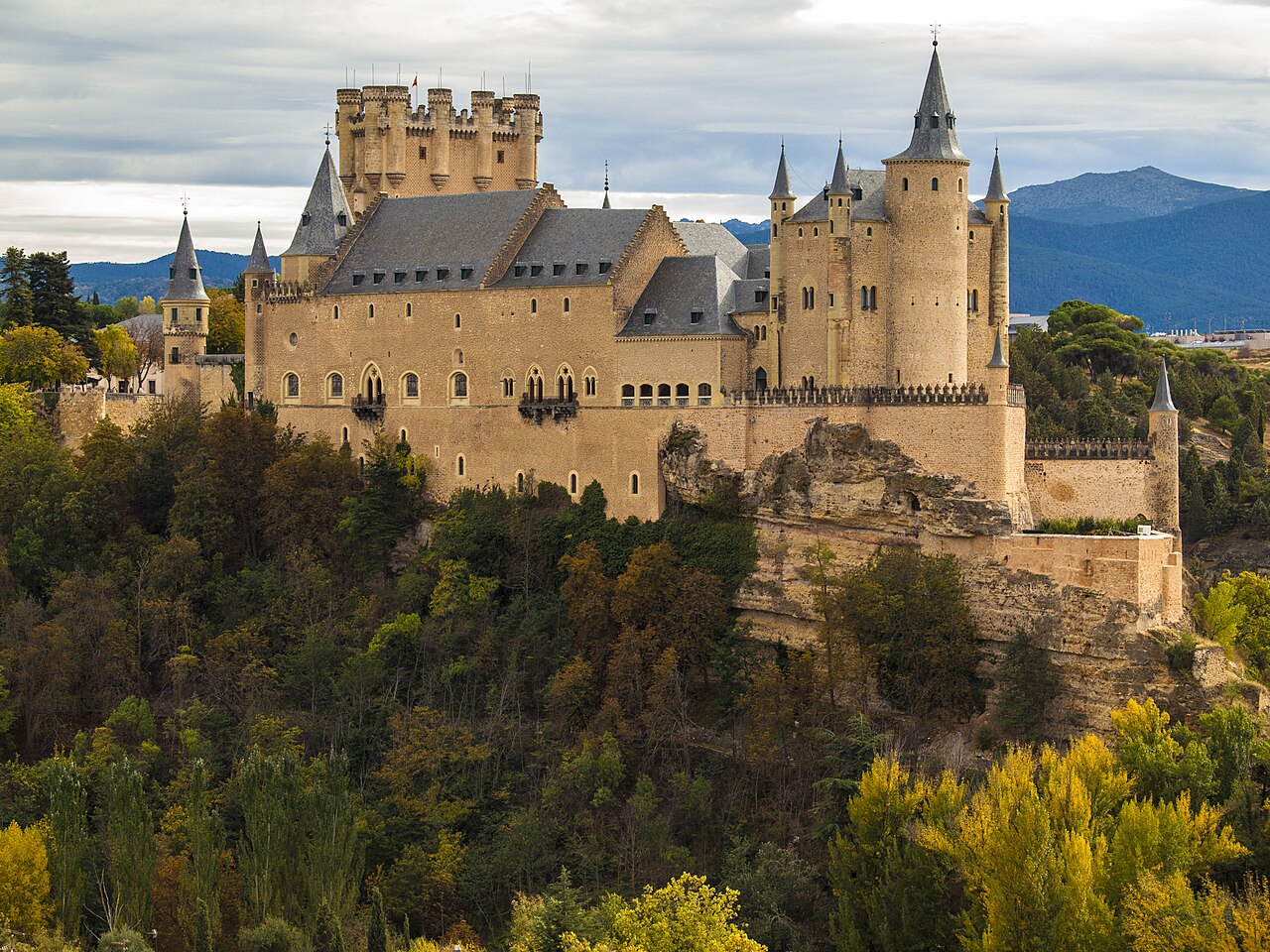
The Alcázar of Segovia is a medieval castle-palace that rises dramatically from the tip of a rocky promontory at the confluence of the Eresma and Clamores rivers in the Castilian city of Segovia, about 90 kilometres northwest of Madrid. It is one of the most distinctive castle silhouettes in Europe — a long, narrow body of stone terminated at its western end in a sharp point, like the prow of a ship forcing its way through the rock below. This ship's-prow shape is not merely a poetic description but a genuine architectural peculiarity, the result of the castle being built on the exact footprint of the promontory, which narrows to a pointed wedge where the two river valleys meet. From the air, the structure really does read as a vessel moored in stone, its towers rising like masts from the hull.
The origins of the Alcázar go back at least to the early 11th century, possibly earlier. There are suggestions of a Roman fort on the site, and the Moors held a fortified position here during their occupation of Castile. After the Christian reconquest of Segovia in the late 11th century, the castle was developed under the Castilian kings. Alfonso VIII, who reigned from 1158 to 1214, is the first monarch firmly associated with significant construction at the site, and from his time onward the Alcázar served as a royal palace for successive Castilian monarchs: Alfonso X the Wise, who conducted court here and wrote some of his famous astronomical treatises within its walls; Enrique IV; and eventually Ferdinand and Isabella, the Catholic Monarchs, who used it as a principal residence in the latter decades of the 15th century.
The most historically resonant moment in the Alcázar's royal history came in December 1474, when Isabella I of Castile departed from this fortress for her coronation in the Plaza Mayor of Segovia following the death of her half-brother Enrique IV. She had been sheltering within the Alcázar's walls and it was from here that she rode to claim the Castilian throne — making this building the literal starting point of the unified Spain that Isabella and Ferdinand would forge through their marriage, their conquest of Granada, and their sponsorship of Columbus's westward voyage. The chain of consequences flowing from that departure is arguably without equal in the history of any single building on earth.
Architectural character
The Alcázar as it stands today is the product of centuries of construction, modification, destruction, and reconstruction, layered in ways that make architectural dating complex. The basic fabric of the structure — the towers, the curtain walls, the principal rooms of state — dates from the 12th to 14th centuries, with the Romanesque ground floor preserved beneath later Gothic superstructure. The interior rooms of the palace include the Throne Room, the Hall of the Galley (a spectacular wood-panelled chamber with a coffered ceiling), the Hall of the Kings with its frieze of 52 polychrome statues of Castilian monarchs, and the Hall of the Cordón — each successive room richer and more ornate than the last as the visitor penetrates deeper into the palace's ceremonial core.
The most visually memorable feature of the Alcázar's exterior is its slate-capped towers: tall, steep conical spires capped in dark grey slate that give the silhouette its fairy-tale quality. These towers were not part of the medieval castle. They were added under Philip II in the second half of the 16th century, in a style imported directly from the Rhineland and the Low Countries — the same Germanic Rhenish influence that produced the steep rooflines and pointed spires of northern European medieval architecture. Philip II had spent time in the Habsburg territories of central Europe and brought back craftsmen and design ideas; the result was a distinctly un-Castilian skyline grafted onto a thoroughly Castilian castle. The contrast between the rough limestone walls below and the slate spires above is part of what makes the Alcázar's profile so arresting from the valley below.
The Alcázar also served functions quite different from royal residence at various points in its history. Philip II converted part of it into a state prison, and it held high-profile inmates — most notably Antonio Pérez, Philip II's own secretary of state, who was imprisoned here in 1585 after becoming embroiled in a scandal involving the murder of a royal messenger and an affair with the Princess of Éboli. Pérez eventually escaped from the Alcázar in 1590, fled to Aragon, and later to France and England, where he became a celebrated exile whose memoirs were widely read across Protestant Europe as anti-Spanish propaganda. From 1762 to 1862, the Alcázar served as the Real Colegio de Artillería — the Royal Artillery School — and was substantially modified to serve military and educational functions. It was during this period that a catastrophic fire in 1862, apparently started accidentally by artillery students, destroyed much of the interior, including irreplaceable tapestries, furniture, and painted ceilings. The subsequent restoration, completed in the 1880s and 1890s, recreated the exterior appearance with considerable fidelity but produced interiors that are partly historical recreation rather than survival.
The fairy-tale question
The Alcázar of Segovia appears regularly in popular accounts as the inspiration for Cinderella's Castle at Disneyland, opened in 1955. Disney's official position on this has varied over the years; the studio has also cited the Neuschwanstein Castle in Bavaria and various other sources. Art historians and architecture critics generally note that the resemblance between Disneyland's central castle and several real European castles is generic rather than specific — the pointed towers, the pale walls, the dramatic promontory are all common elements of the fairy-tale castle trope that Disney was drawing on, not a direct copy of any one building. What is certain is that the Alcázar's profile — its ship's prow, its slate spires, its setting above two river valleys — is visually extraordinary enough that it has genuinely shaped the cultural imagination of what a castle should look like, regardless of whether Walt Disney's designers were consciously referencing it.
The deeper truth is that the Alcázar's silhouette entered popular visual culture through a different route: the romantic landscape paintings and engravings of the 19th century, which circulated widely across Europe and America and established a repertoire of fairy-tale castle imagery. The Alcázar appeared frequently in this visual tradition, and it is likely that Disney's designers absorbed it as part of the same romantic visual vocabulary that produced Neuschwanstein and dozens of other 19th-century castle fantasies. The real-world building and the fantasy castle share a common visual ancestor more than a direct line of influence.
UNESCO and contemporary significance
The Alcázar of Segovia is part of the UNESCO World Heritage Site designated in 1985 for the Old Town of Segovia and its Aqueduct. The inscription recognises the ensemble of the Roman aqueduct (1st–2nd century CE, still largely intact), the medieval walled city, and the Gothic Cathedral — a remarkable concentration of architectural history in a single small city. The Alcázar is administered by the Patronato of the Alcázar of Segovia and functions today as a museum, military archive, and one of Spain's most-visited monuments. The interior contains a substantial collection of armour, weaponry, and historical artefacts, and the tower of Juan II offers panoramic views over the Castilian plateau that give some sense of why the promontory was so strategically valuable to every power that held it.
Think you can place this building on the map?
Play Building Guessr