What it is
Baalbek is a Roman imperial temple complex situated in the Bekaa Valley of what is now Lebanon, roughly 85 kilometres northeast of Beirut. It is, by most measures, the largest and most ambitious Roman temple complex ever built — a statement of imperial power and religious intent so extreme in its physical dimensions that it remained virtually unmatched in stone construction until the industrial era. The site is dominated by the Temple of Jupiter Heliopolitanus, once a peristyle temple surrounded by 54 columns, each 20 metres tall and 2.2 metres in diameter, weighing approximately 100 tonnes apiece. Of these 54 columns only six are still standing, but even those six survivors are sufficient to convey the original scale: they rise above the surrounding landscape like an astronomical monument, visible from kilometres away across the flat valley floor.
The name Baalbek combines the Semitic "Baal" (lord) with "Bek," believed to refer to the Bekaa Valley itself — so "Lord of the Bekaa." The settlement is ancient: evidence of Phoenician occupation goes back to at least the 2nd millennium BCE, and the site was a major sanctuary to the Canaanite deity Baal long before the Romans arrived. When Alexander the Great's successors — the Seleucid Greeks — took control of the region in the 3rd century BCE, they renamed the city Heliopolis, "City of the Sun," mapping their sun god Helios onto the indigenous Baal worship. The Romans, arriving in the 1st century BCE, continued the same process of religious accommodation, identifying the local deity with their own Jupiter and embarking on a construction programme of extraordinary scale that would continue for nearly three centuries.
Construction of the main temple platform began under Augustus in the late 1st century BCE and continued through the reigns of Nero, Domitian, Trajan, Antoninus Pius, and Caracalla. The Romans were building not merely a temple but a statement: Baalbek was a major pilgrimage destination for the eastern Roman world, drawing worshippers from across the Levant, Anatolia, and beyond. The investment in stone — in cutting, transporting, and lifting blocks of a size that strains modern comprehension — reflects the religious and political importance the site held at its peak.
The stones of Baalbek
The most astonishing feature of Baalbek is not the standing columns but the Trilithon — three massive limestone blocks incorporated into the western retaining wall of the temple platform. Each of the three Trilithon blocks is approximately 19 to 20 metres long, 4 metres high, and 3.6 metres deep, and each weighs an estimated 800 tonnes. They sit about 6 to 7 metres above the ground, incorporated into a wall course that also includes other blocks of 300 to 400 tonnes — themselves among the largest stones ever moved. How the Romans quarried, transported, and lifted these stones remains a question that has not been fully answered by engineering analysis. The quarry from which they were cut has been identified about 800 metres from the site; the blocks were presumably moved on sledges and rollers, possibly on temporary earthen ramps, using human and animal labour in quantities that would have required extraordinary organisational and logistical capacity.
Even more extreme is the Stone of the Pregnant Woman (Hajar al-Hibla in Arabic), which lies in the quarry, never moved from its original position. This block is approximately 21 metres long, 4.2 metres wide, and 4.8 metres deep, and is estimated to weigh around 1,000 tonnes — making it the largest known quarried stone in human history. A fourth large stone discovered nearby in 2014 may be even heavier. The Pregnant Woman stone was abandoned in the quarry, presumably because the effort of moving it proved beyond even Roman capacity, or because the temple complex was complete by the time it was cut. It lies at a slight angle in its cutting, still attached at one end to the bedrock below, a monument to the outer limit of ancient ambition.
These dimensions have attracted fringe speculation about non-human construction techniques, speculation that mainstream archaeology and engineering reject. The Romans had sophisticated lifting equipment — cranes, compound pulleys (polyspastos), and capstans — and ample slave and conscripted labour. The Trilithon stones, while extraordinary, are not physically impossible by Roman engineering standards when sufficient manpower and time are assumed. What is genuinely remarkable is not the mystery of their construction but the certainty of Roman will: the decision to move 800-tonne stones at all, when 100-tonne stones would have been more than adequate for structural purposes, reflects a deliberate statement of power that no subsequent civilisation has matched in pre-industrial stone construction.
The Temple of Bacchus
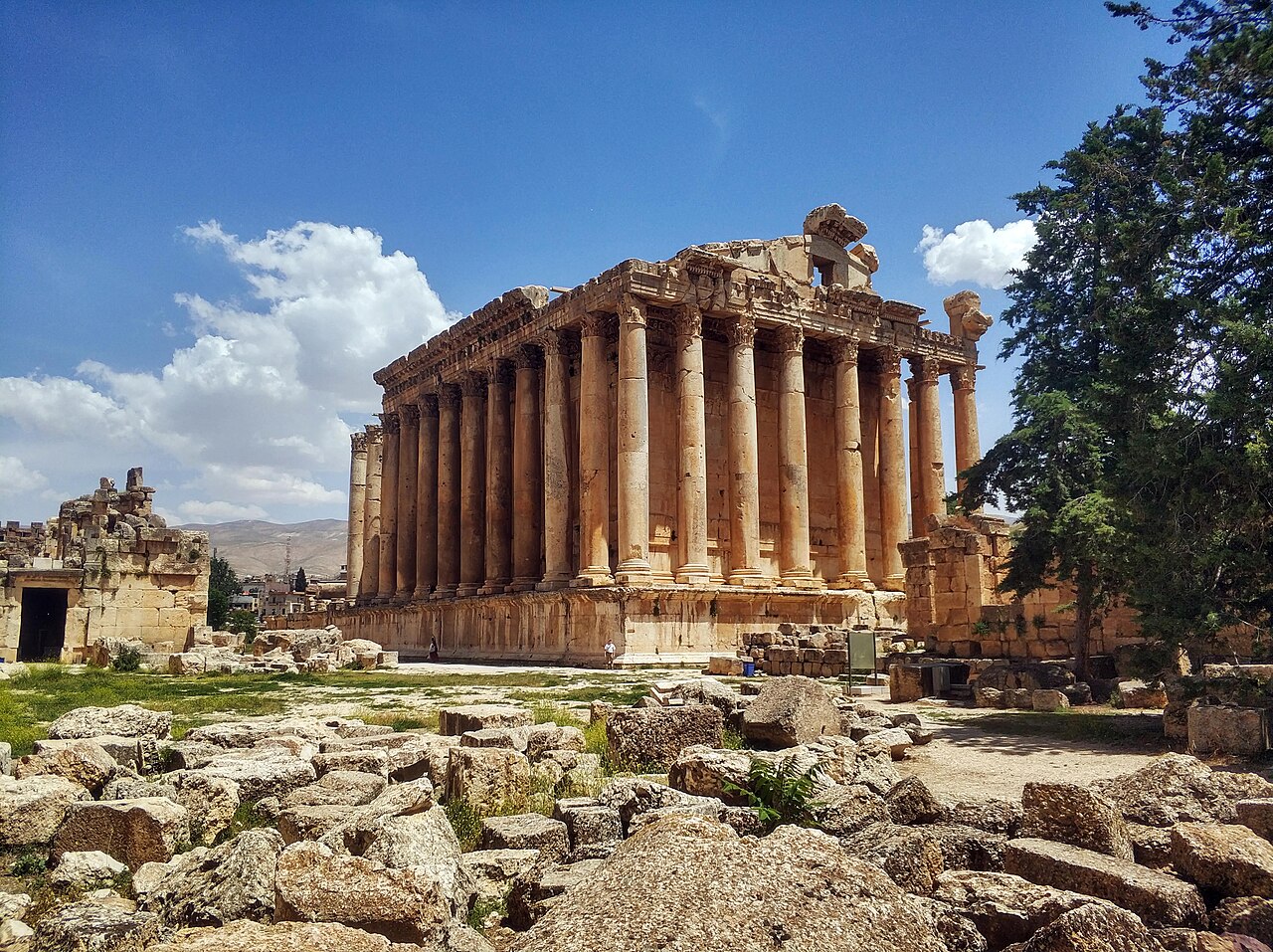
Adjacent to the ruined Temple of Jupiter stands the Temple of Bacchus, built in the 2nd century CE under Antoninus Pius or Marcus Aurelius. Despite being slightly smaller than the Jupiter temple, it is one of the best-preserved Roman temples anywhere in the world. Its inner sanctum (cella) retains much of its original roof structure, its 42 surviving peristyle columns still carry sections of their entablature, and the sculptural decoration — carved reliefs of Bacchus, Ganymede, Nike, the seasons, and other mythological figures — is still legible in considerable detail. The carved portal doorway, at approximately 13 metres high, is among the largest and most elaborately decorated doorways surviving from antiquity. The Temple of Bacchus has been continuously studied since European travellers began documenting Baalbek in the 17th century, and it remains a primary reference for the study of Roman decorative stonework and temple design.
A smaller Temple of Venus (sometimes attributed to Mercury) stands near the main complex entrance. It is circular in plan with a scalloped cella wall — an unusual form in Roman temple design — and preserves substantial portions of its original structure. Together with the Temple of Jupiter and the Temple of Bacchus, it completes a triad of Roman religious buildings at Baalbek that represents an unparalleled concentration of Roman imperial architecture outside Italy.
History and preservation
The site has been occupied, repurposed, and damaged across its long post-Roman history. The Byzantine emperor Theodosius I converted the Jupiter temple into a Christian basilica in the late 4th century. The Arab conquest in the 7th century transformed it into a fortress. Crusaders briefly held it. A series of earthquakes — most devastatingly in 1158, 1203, 1664, and 1759 — toppled columns, shattered walls, and buried ruins under debris. The site was plundered repeatedly for building materials by successive rulers of the Bekaa Valley. European travellers — Robert Wood and James Dawkins in 1751, published in a landmark engraved survey — brought Baalbek to widespread scholarly attention and ignited a wave of 18th and 19th-century study. German archaeological missions conducted major excavations between 1898 and 1905 under imperial sponsorship. Baalbek was inscribed as a UNESCO World Heritage Site in 1984. Ongoing damage from conflict, particularly in the context of Lebanese civil and regional wars, and from continued seismic activity, has kept the site on UNESCO's list of properties in need of international attention. International restoration efforts coordinated by UNESCO, the German Archaeological Institute, and the Lebanese Directorate General of Antiquities are ongoing.
Think you can place this building on the map?
Play Building Guessr