What it is
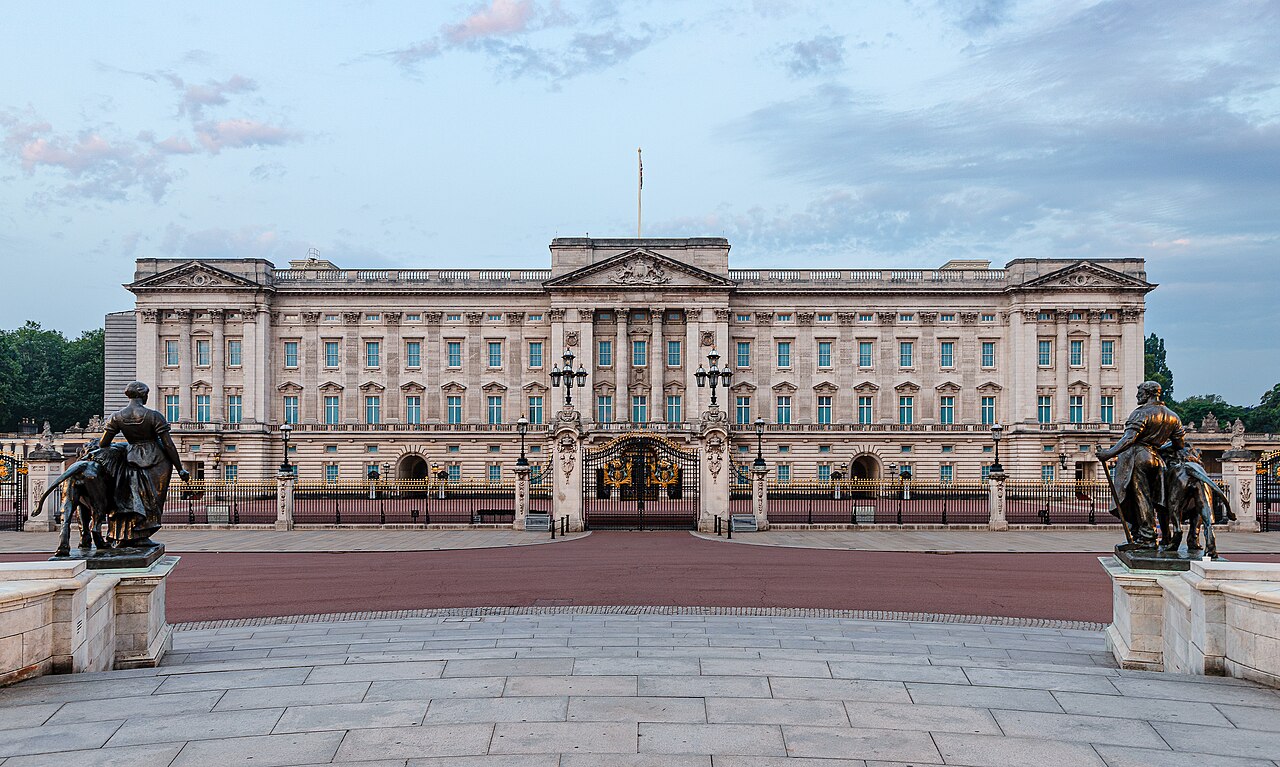
Buckingham Palace is the official London residence and principal working palace of the British monarch, located at the western end of St James's Park in the City of Westminster. The building that stands today is the product of more than three centuries of incremental construction, demolition, expansion, and refacing — a palimpsest of Georgian ambition, Victorian practicality, and Edwardian restraint that presents a reassuringly unified Portland stone facade to the traffic of The Mall while concealing a more complex architectural history behind it.
The site's history as a significant building begins in 1703, when John Sheffield, the first Duke of Buckingham and Normanby, completed a substantial town house here — "Buckingham House" — on the edge of the royal park. Sheffield's house was a solid brick mansion with a garden front looking out over the park and a courtyard entrance on the London side, a structure respectable by aristocratic standards but nothing approaching a palace. George III purchased the house in 1761 as a family residence for his new wife Queen Charlotte, to serve as a more private alternative to the formal ceremonial apartments at St James's Palace nearby. Known as the Queen's House during George III's reign, it became the principal dwelling of the royal family and the birthplace of fourteen of their fifteen children, but it was not yet a state palace in either name or architectural ambition.
John Nash and the conversion to a palace
The transformation of Buckingham House into Buckingham Palace was the work of John Nash, the most fashionable architect in Regency England, commissioned by King George IV in 1826 to create a proper palace from the existing house. George IV was a man of consuming architectural ambitions — he had already transformed Windsor Castle and was midway through creating the Brighton Pavilion — and he instructed Nash to create something worthy of the most powerful monarchy in the world. Nash largely demolished Sheffield's original house and constructed in its place an enlarged U-shaped building in a French Classical style, faced in Bath stone, with a grand triumphal arch at the entrance on the Mall side.
The project was troubled from the beginning. Nash's budget overruns were enormous — costs rose from an initial estimate of £252,690 to over £700,000 — and his architectural decisions attracted fierce criticism from Parliament, which was increasingly irritated by royal extravagance during a period of economic hardship following the Napoleonic Wars. Nash was dismissed from the project in 1830, the same year George IV died, and the work was handed to Edward Blore, a more cost-conscious architect who completed the main palace and enclosed the forecourt with a new east wing in 1847, using the stone intended for Nash's triumphal arch. The arch — Nash's most impressive single element — was relocated to the northeast corner of Hyde Park, where it stands today as Marble Arch, an object lesson in architectural repurposing.
Queen Victoria and the modern palace
Queen Victoria was the first monarch to use Buckingham Palace as the primary London residence, moving in upon her accession in 1837. She immediately identified two major problems: the palace was too small for a growing royal family and a working government, and the ventilation and heating were dangerously inadequate. Edward Blore's east wing addition in 1847, which enclosed the forecourt and provided additional rooms, partly addressed the space problem but created a new one: it removed Nash's spectacular arched entrance, leaving the palace with a rather blank face to the public. Victoria commissioned the balcony above the central portico that has since become the site of the iconic appearances of the Royal Family at moments of national celebration — a feature not present in the original design and added specifically to provide a public-facing platform for monarchical display.
The Portland stone facade that most Londoners and visitors know today is not Victorian but Edwardian — and not even early Edwardian. In 1913, Sir Aston Webb refaced the entire east wing in Portland stone, replacing Blore's deteriorating Caen limestone facing. The work was completed in just 13 weeks, an astonishing pace achieved by extensive prefabrication and around-the-clock working, to coincide with the unveiling of the Queen Victoria Memorial in front of the palace. The Memorial — the large white marble monument with its gilded Victory figure visible from across St James's Park — was also Webb's design, and the forecourt railings and the ceremonial layout of the Mall approaching the palace were remodelled at the same time to create the grand processional approach that exists today.
Rooms, gardens, and the State Rooms
The palace contains 775 rooms: 188 staff bedrooms, 92 offices, 78 bathrooms, 52 royal and guest bedrooms, 19 state rooms, and various kitchens, storerooms, and service spaces. It employs approximately 800 staff and receives around 50,000 guests at banquets, lunches, dinners, receptions, and garden parties each year. The garden behind the palace — hidden from the public except during the summer opening season — covers approximately 16 hectares (40 acres), making it the largest private garden in London. It contains a lake, a helicopter landing pad, a tennis court, and garden party lawns that can accommodate 8,000 standing guests at the Queen's (now King's) garden parties held each summer.
The State Rooms, used for official entertaining, contain one of the finest collections of art and decorative objects in Britain — part of the Royal Collection, one of the largest and most important art collections in the world. The Ballroom, the largest room in the palace at 36 metres long and 18 metres wide, was added in 1855 and serves as the venue for state banquets, investitures, and the largest receptions. The Throne Room, with its ornate gilded ceiling and twin thrones, is used for formal portrait photographs and certain ceremonial occasions. The Picture Gallery, a top-lit gallery 47 metres long running along the central axis of the garden front, houses paintings from the Royal Collection including works by Rembrandt, Rubens, Van Dyck, and Canaletto. The State Rooms have been open to visitors each summer, for approximately eight weeks while the monarch is at Balmoral in Scotland, since 1993 — a partial opening that allows public access to buildings that are otherwise genuinely in daily use as a working residence and government venue.
Ceremonial life and public presence
Buckingham Palace's relationship with the British public is conducted primarily through ceremony and spectacle. The Changing of the Guard — the formal handover of responsibility for the palace's security from one group of Foot Guards to another, accompanied by a military band — takes place in the palace forecourt and is one of the most-watched tourist ceremonies in London. The balcony appearances, in which the Royal Family appears above the central portico of the east front to acknowledge crowds on occasions of national celebration — coronations, royal weddings, Trooping the Colour, VE Day — have become one of the most reproduced images in British public life. The Privy Purse Door, on the south side of the palace facing Buckingham Palace Road, is the informal entrance used by those with appointments but not full state reception: a detail that speaks to the palace's dual nature as both a seat of government and a family home.
The palace was a focus of national grief and public confrontation during the week following the death of Princess Diana in 1997, when the absence of a flag at half-mast above the palace — at that point incorrect protocol, since the Royal Standard flies only when the monarch is in residence and is never lowered — became the target of intense public criticism. The controversy led to a change in practice: a Union Flag now flies above the palace and is lowered to half-mast on the death of a member of the Royal Family or other national figures of significance, marking the end of a century-long convention and demonstrating the continuing capacity of this 320-year-old building to be at the centre of Britain's evolving national life.
Think you can place this building on the map?
Play Building Guessr