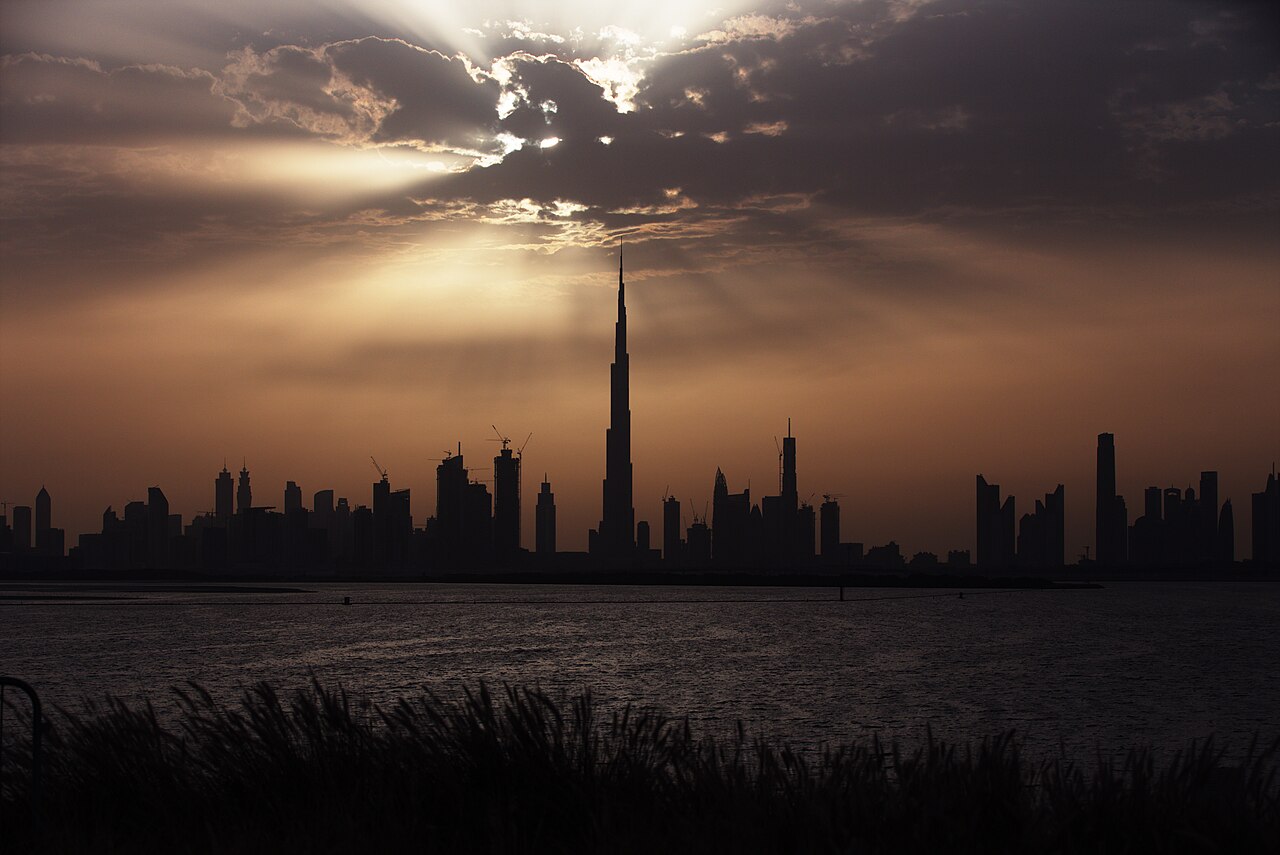
What it is
The Burj Khalifa is the world's tallest structure, standing at 828 meters from ground level to the tip of its spire — a record it has held since its opening on January 4, 2010. Designed by Adrian Smith at Skidmore, Owings & Merrill (SOM) and developed by Emaar Properties, it contains 163 occupied floors plus mechanical and observation floors, with uses that include residential apartments (Armani Residences, floors 9–16 and 19–39), the Armani Hotel (floors 1–8), corporate offices (floors 45–108), and the At the Top observation decks on floors 124, 125, and 148. The building required approximately 330,000 cubic meters of concrete, 39,000 metric tons of steel rebar, and 103,000 square meters of glass for its cladding — materials that arrived from 21 countries and were assembled by a workforce of up to 12,000 on site at peak construction.
The project was conceived during Dubai's early 2000s construction boom as a flagship for the Downtown Dubai development district. The building was originally known as Burj Dubai (Dubai Tower), but was renamed at its opening in honor of Sheikh Khalifa bin Zayed Al Nahyan, the president of the UAE and ruler of Abu Dhabi, whose government provided a financial rescue package when Dubai's property market collapsed in 2008–2009. The economic context matters architecturally: the building was designed during one financial era and completed in another, which is part of why it remains the tallest building in the world far longer than its developers originally anticipated — several planned rivals in Dubai and elsewhere have been indefinitely deferred.
Architectural significance
The Burj Khalifa's structural achievement is the Y-shaped buttressed core system, developed by SOM's structural engineering team. The plan consists of three equal wings radiating at 120 degrees from a central hexagonal concrete core, with each wing acting as a buttress to its neighbors against lateral wind loads. This is a fundamentally different approach from the rectangular tube or bundled tube systems used in earlier supertall buildings like the World Trade Center or the Sears Tower. In the Y-plan, lateral forces in any direction are always resisted by at least two of the three wings acting together, which allowed the engineers to achieve the required stiffness with less material than a rectangular plan of equivalent height would require. The building's structural system can be described as a tripod — stable in three dimensions because each leg braces the others.
The building also uses a stepped setback profile, reducing its cross-section at 27 mechanical floor levels as it rises. This is not merely decorative: wind tunnel testing at Rowan Williams Davies & Irwin (RWDI) in Guelph, Canada demonstrated that the spiral setback pattern causes the building's vortex-shedding frequency to change as wind speed varies — preventing the dangerous resonance that occurs when a structure's natural frequency coincides with the shedding frequency of the wind. The building essentially "confuses" the wind by presenting a constantly changing cross-section. This principle, used in a more advanced form than in earlier supertalls, allowed the engineers to design for Dubai's wind conditions without the massive structural penalty that a uniform-section tower of equivalent height would require. The total steel and concrete quantities per square meter of floor area are significantly lower than in earlier generation supertall buildings.
Key features
- Y-shaped plan: Three equal wings at 120-degree intervals around a central hexagonal core, most clearly visible in aerial photographs. The plan is inspired, according to the design team, by the flower of the Hymenocallis (desert lily) native to the region.
- Stepped setbacks at mechanical floors: The building's silhouette shows a spiral staircase of setbacks as it rises, each step corresponding to a mechanical floor where structural transitions occur. The setbacks follow a counter-clockwise spiral pattern when viewed from above.
- Silver aluminum and textured glass cladding: The exterior skin consists of 28,261 glass panels, 142,000 square meters of high-performance glazing, and 75,000 square meters of stainless steel spandrel panels. The reflective metallic surface changes appearance dramatically with light conditions and viewing angle.
- At the Top observation decks: Floor 124 (452m) and floor 125 (456m) form the main public observation level, At the Top; floor 148 (555m) is the higher At the Top SKY experience, the world's highest observation deck at its opening. Both feature floor-to-ceiling glass panels and outdoor terraces.
- 200-meter pinnacle spire: The spire extends from floor 163 (roof level, 585m) to the tip at 828m, nearly doubling the building's height at the top. It contains the broadcast antenna and acts as the building's primary communications mast.
- Condensate collection system: The building collects approximately 15 million liters of condensation per year from the exterior glazing — a significant water resource in Dubai's arid climate — using a dedicated drainage system that delivers water to the surrounding landscape irrigation.
- 40,000-sensor building management system: The BMS monitors structural health, HVAC performance, elevator systems (57 elevators and 8 escalators), and fire safety systems continuously, with dedicated monitoring teams working around the clock.
Preservation status
The Burj Khalifa is an active, fully occupied building in excellent condition. It is maintained under an intensive building management program operated by Emaar and monitored by a continuous sensor network. The primary long-term maintenance challenges are the cladding system — cleaning the 142,000 square meters of glass requires a permanent team of 36 window washers working in custom-designed cradles — and the mechanical systems, which must handle the extreme temperature differential between the desert ground level and the building's upper floors.
The building sits in a complex geological context: Dubai's substrate is coastal sedimentary rock and sandy fill, requiring 192 bored concrete piles driven 50 meters deep to support the tower's 500,000-metric-ton load on ground with relatively low bearing capacity. Ongoing geotechnical monitoring confirms that settlement rates are within design parameters. As the building approaches its second decade of operation, it serves as a real-world laboratory for supertall building operations — informing the engineering of taller projects currently under design, including the planned Jeddah Tower in Saudi Arabia, which targets a height above 1,000 meters.
Think you can place this building on the map?
Play Building Guessr