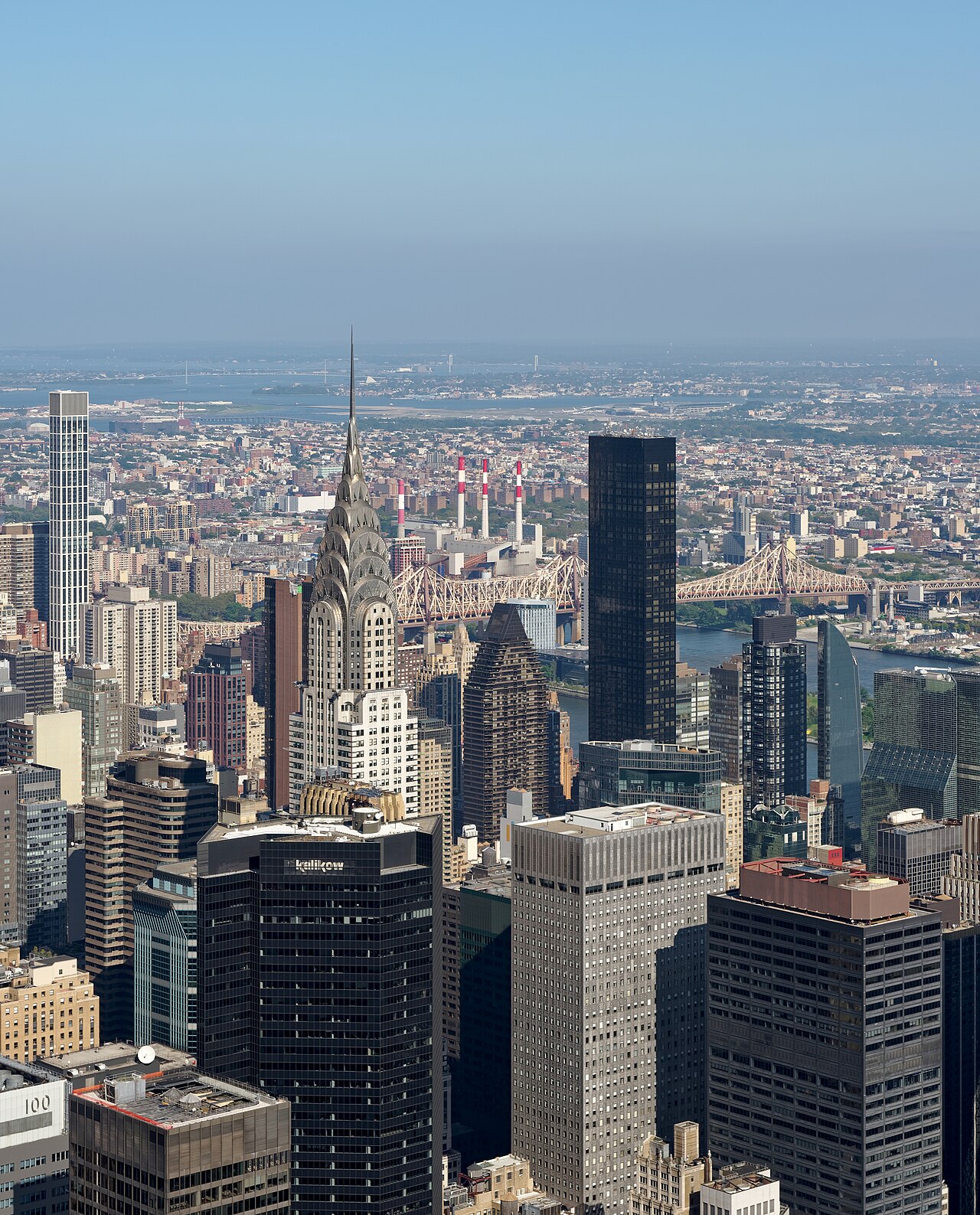
What it is
The Chrysler Building stands at 405 Lexington Avenue in Midtown Manhattan, rising 319 meters to the tip of its spire across 77 floors. It was designed by architect William Van Alen for the automobile magnate Walter P. Chrysler, who wanted a building that would bear his name and express the dynamism of the American automobile industry in architectural form. Construction began in 1928 and was completed in 1930. For 77 days in 1930, between its topping-out and the completion of the Empire State Building, the Chrysler Building was the tallest building in the world — and, by the prevailing consensus of architectural historians and the general public, remains the most beautiful skyscraper ever built in New York, perhaps in the world. That combination of momentary supremacy and enduring beauty has given it a peculiar resonance that purely functional records cannot produce.
The building's financing and client relationship were unconventional. Walter Chrysler paid for the building personally — not through the Chrysler Corporation — with the explicit aim of creating a lasting monument to his name. He and Van Alen had a falling out over fees shortly after completion; Van Alen sued for his commission and won. The building was sold after Chrysler's death and has changed hands several times since. It spent much of the late twentieth century in poor condition before a major restoration in 1978, when it was designated a New York City landmark, renewed attention to its extraordinary craftsmanship. The Chrysler Building represents the moment when Art Deco, in New York, reached its fullest and most exuberant expression.
Architectural significance
The episode that defines the Chrysler Building's place in architectural history is the secret assembly and raising of its stainless-steel spire. In late 1929, the building at 40 Wall Street, designed by H. Craig Severance, was being constructed to a height intended to make it the world's tallest building. Van Alen, knowing that 40 Wall Street's height was 282 meters, had the seven-story Nirosta stainless-steel crown — the sunburst spire — assembled secretly inside the building's fire shaft. On 23 October 1929 (the same week as the stock market crash that began the Great Depression), the assembled spire was raised through the roof in 90 minutes and bolted into position, adding 38 meters to the building's height and ensuring its primacy over 40 Wall Street. The operation was a publicity stunt and a feat of engineering planning simultaneously, and it succeeded entirely: it was weeks before 40 Wall Street's builders understood what had happened.
The eagle gargoyles that project from the corners of the building at the 31st and 61st floors are the most immediately recognizable detail of the Chrysler Building's exterior after the spire itself. The eagles at the 61st floor are enlarged three-dimensional replicas of the eagle hood ornament from the 1929 Chrysler Plymouth automobile — the building's ornamental program is, throughout, a translation of automobile design elements into architectural form. Hubcap friezes run around the building at the 26th floor; abstract eagle forms appear at the setbacks below; the whole building reads as a celebration of the American industrial moment. The Nirosta steel of the spire — a brand name for a type of stainless steel produced by Krupp in Germany — has required no painting, no treatment, and no structural intervention since its installation in 1929.
Key features
- Stainless-steel tiered sunburst spire: Seven radiating arcs of triangular windows arranged in a stepped crown, clad in Nirosta stainless steel that has weathered without corrosion since 1929, forming the building's unmistakable silhouette visible from across Manhattan and from both rivers.
- Eagle gargoyle corner details: Giant stainless-steel eagle heads project from the building's corners at the 61st floor, modeled on the Chrysler Plymouth's 1929 hood ornament and serving as both decorative elements and symbolic links between the building and the automobile industry that paid for it.
- Automotive motifs in the frieze: A band of stylized hubcaps and wheel covers in white brick runs around the building at the 26th floor, directly referencing automobile design in architectural ornament — an unusual and entirely specific form of corporate branding built into the structure.
- Brick facade with setbacks: The main body of the building is clad in white and dark brick with setbacks governed by New York's 1916 zoning resolution, the stepped profile giving the building its pyramidal form and creating the terraced appearance characteristic of late 1920s New York skyscrapers.
- Lobby with Red African marble: The lobby features walls and floor of rich Red African marble from Morocco, inlaid metal elevator doors in a feather or leaf pattern, and a large coffered ceiling mural by Edward Trumbull depicting transportation and human industry — one of the finest Art Deco interior spaces in New York.
- Cloud Club observation level: The building originally housed the Cloud Club, an exclusive private dining and business club on floors 66 and 67, accessible only to members; the spaces, though no longer operating as a club, retain their original Art Deco interiors.
Preservation status
The Chrysler Building was designated a New York City landmark in 1978 and listed on the National Register of Historic Places in 1976. It is privately owned; as of 2019, it was purchased by a real estate consortium for a reported $150 million — substantially below its peak valuation — reflecting the challenges faced by pre-war office buildings competing in a market dominated by modern, larger-floored towers. The Nirosta stainless-steel spire and cladding on the upper floors are in excellent condition and have required no painting or structural treatment since installation. The lobby, while no longer publicly accessible to casual visitors as it once was, has been maintained in good condition and retains its original material fabric. The building remains a working office building with a mix of tenants across its floors.
Think you can place this building on the map?
Play Building Guessr