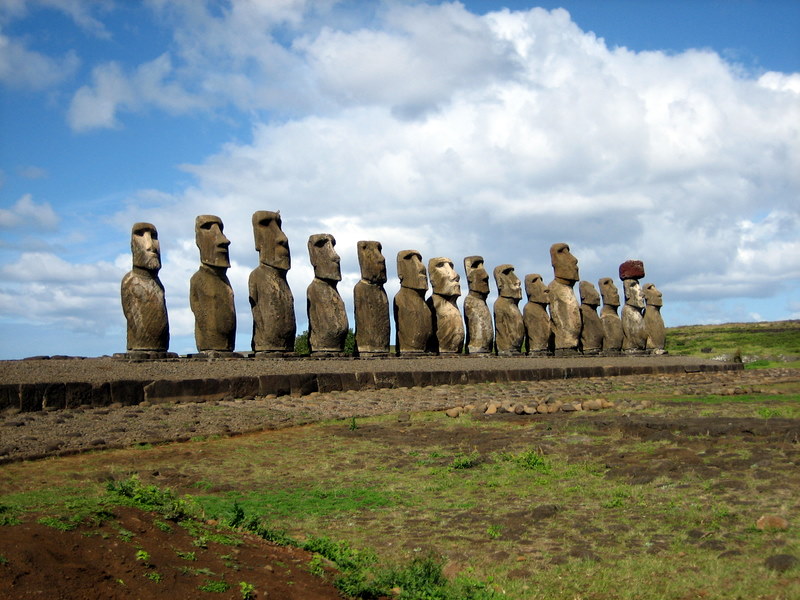
What they are
The moai of Easter Island — Rapa Nui in the language of the Polynesian people who carved them — are a collection of more than 1,000 monolithic stone statues distributed around the perimeter and interior of a small, remote island in the southeastern Pacific Ocean, approximately 3,500 kilometres west of Chile and 2,000 kilometres from the nearest inhabited island. They were carved by the Rapa Nui people between approximately 1250 and 1500 CE, though precise dating of individual statues remains difficult. The average moai stands about 4 metres tall and weighs around 14 tonnes, though individual statues vary enormously: the smallest standing moai are about 1.5 metres; the largest erected statue — Paro, on the Ahu Te Pito Kura platform — stood 10 metres tall and weighed an estimated 82 tonnes before it was toppled. The largest moai ever begun, known as El Gigante, still lies in the quarry at Rano Raraku unfinished: it is 21.6 metres long and would have weighed approximately 270 tonnes had it been completed and stood upright.
Easter Island itself is a volcanic island of about 163 square kilometres, formed from three overlapping shield volcanoes. The smallest inhabited island in the world to develop an independent civilisation, it is often held up as a case study in both human ingenuity and environmental overreach. The Rapa Nui people arrived by canoe from somewhere in eastern Polynesia — probably the Marquesas Islands or the Gambier Islands — most likely between 700 and 1200 CE. They found an island covered in a dense subtropical forest of giant palm trees (subsequently identified as Paschalococos disperta, a species now extinct), land birds, and marine resources. Within a few centuries, the population had grown, the forest had been cleared, and a culture of extraordinary monumental ambition had emerged from the small, isolated community of several thousand people.
Form and meaning
All moai share the same basic form: a large head with prominent, elongated features — a strong brow ridge, a long straight nose, thin compressed lips, a jutting rectangular chin, and deep-set eye sockets. The ears are elongated, a stylistic feature common to Polynesian art that may reflect the practice of ear elongation among high-status individuals. The torso is typically represented to about the navel, with arms at the sides, hands extended to rest on the abdomen with long fingers pointing inward. There are no legs: the moai end at the waist, giving them the appearance of colossal busts. What most visitors do not realise is that roughly half of all moai are still buried to the waist in the earth of Rano Raraku quarry, where they were abandoned mid-transport. Excavations have revealed that the buried portions include complete lower torsos, some with detailed carvings of tattoo patterns on their backs — designs invisible since the statues sank into the soil centuries ago.
The moai were not intended as decorative sculptures. They were aringa ora — "living faces" — representations of ariki (chiefs and ancestors of high status) who had been deified after death. Each moai channelled the mana (spiritual power) of the ancestor it represented and directed that power inward, toward the community it guarded. This explains why moai on their platforms (ahu) face inland, away from the sea: they are watching over the living, not greeting arrivals by boat. The ahu — the ceremonial stone platforms on which moai were erected — were also burial sites; the moai literally stood guard over the bones of the ancestors they embodied.
Many moai originally wore pukao — cylindrical topknots of red scoria (volcanic rock from a separate quarry at Puna Pau, distinct from the grey tuff of Rano Raraku) placed on top of the head like a crown or a top-knot of hair. The largest surviving pukao weighs about 12 tonnes. How these heavy cylinders were placed on top of already-enormous standing statues without mechanical cranes is an engineering puzzle that has generated competing hypotheses involving ramps, levers, and incremental lifting techniques. The combination of grey statue and red topknot would have made the moai visually striking across considerable distances, and the red of the pukao may have held specific symbolic meanings related to social status and divine power.
Quarrying and transport
Almost all moai were carved from the yellowish-grey volcanic tuff of the Rano Raraku crater, an extinct volcano in the eastern part of the island. The quarry face still shows hundreds of unfinished moai in various stages of completion — lying on their backs in the slope, carved on three sides but still attached by an uncut spine of rock to the cliff behind them. Finishing a moai in the quarry would then have involved undercutting the spine and lowering the statue down the slope to where it could be stood upright and its back and base finished. Rano Raraku is one of the most extraordinary archaeological sites on earth: a place where time appears to have stopped mid-project, hundreds of half-finished statues staring up at a sky they never left to face.
How moai were transported from the quarry — in some cases across 10 to 15 kilometres of rough terrain — to their coastal platforms is the most debated question in Rapa Nui archaeology. The Rapa Nui oral tradition holds that the moai walked to their destinations — a claim that modern experimental archaeology has shown to be both a metaphor and a structural description. In 2012, archaeologists Terry Hunt and Carl Lipo demonstrated experimentally that a moai can be "walked" upright in a rocking motion, held by ropes, with relatively small teams of people working in coordination. This technique — moving the statue by alternating tilts from side to side while pulling it forward — requires no sledges, no rollers, and no tracks, and leaves the kind of ground disturbance consistent with what has been found along known transport routes. The "walking moai" hypothesis is now one of the leading explanations in the field, though it remains actively debated; other researchers favour horizontal sledge-and-roller transport methods championed by different research teams. What is agreed is that the movement required the felling of enormous numbers of palm trees — for rollers, ropes, sledges, or as levers — and that this deforestation had catastrophic ecological consequences.
The fall of the statues
By the time European ships began arriving at Rapa Nui in the 18th and 19th centuries, the island was largely deforested and many of the moai had already been toppled. The Dutch explorer Jacob Roggeveen, who arrived on Easter Sunday 1722 — giving the island its European name — was among the first outsiders to see the statues. Later European visitors noted with increasing frequency that moai were lying prostrate on their platforms. By the mid-19th century, all the moai on their ahu had been toppled. This destruction was the result of inter-clan warfare that intensified during the 17th and 18th centuries as the island's resources — food, timber, land — declined. Rival clans deliberately toppled each other's ancestral moai as acts of symbolic desecration: destroying the mana of an enemy by destroying the physical vessel that contained it. Toppling a moai face-down was the most complete annihilation — erasing the ancestor's gaze and severing the connection between the living and the dead.
The environmental history of Rapa Nui has become a widely cited parable of ecological collapse. Jared Diamond's 2005 book Collapse used Easter Island as its most dramatic example of a society that destroyed itself by exhausting its natural resources. More recent scholarship — particularly by Hunt and Lipo — has complicated this narrative considerably, arguing that the primary drivers of the population collapse were not indigenous deforestation alone but the introduction of Polynesian rats (who ate palm seeds and prevented forest regeneration), and above all the catastrophic effects of European contact: introduced diseases that killed the majority of the population, slave raids by Peruvian ships in the 1860s that kidnapped hundreds of islanders (including most of the remaining literate elite), and the subsequent conversion of the island into a sheep ranch that restricted the surviving Rapa Nui people to a small area around Hanga Roa for over a century.
Ahu Tongariki and UNESCO
The largest ahu on the island — Ahu Tongariki — holds 15 moai re-erected in a restoration project carried out between 1992 and 1996 with the support of a Chilean university and a Japanese crane company. The platform had been devastated by a 1960 tsunami triggered by the massive Valdivia earthquake, which scattered the statues hundreds of metres inland. The restoration of the 15 moai, ranging in height from about 4 to 9 metres, created the most visually dramatic group of standing moai on the island and has become the defining image of Easter Island in contemporary photography. Rapa Nui National Park, which encompasses most of the island and all the major archaeological sites, was inscribed as a UNESCO World Heritage Site in 1995. The island is administered by Chile but has a degree of autonomy, and the question of cultural sovereignty — including calls for the return of moai held in museums abroad, notably the British Museum's moai "Hoa Hakananai'a" — remains an active political issue.
Think you can place this building on the map?
Play Building Guessr