What it is
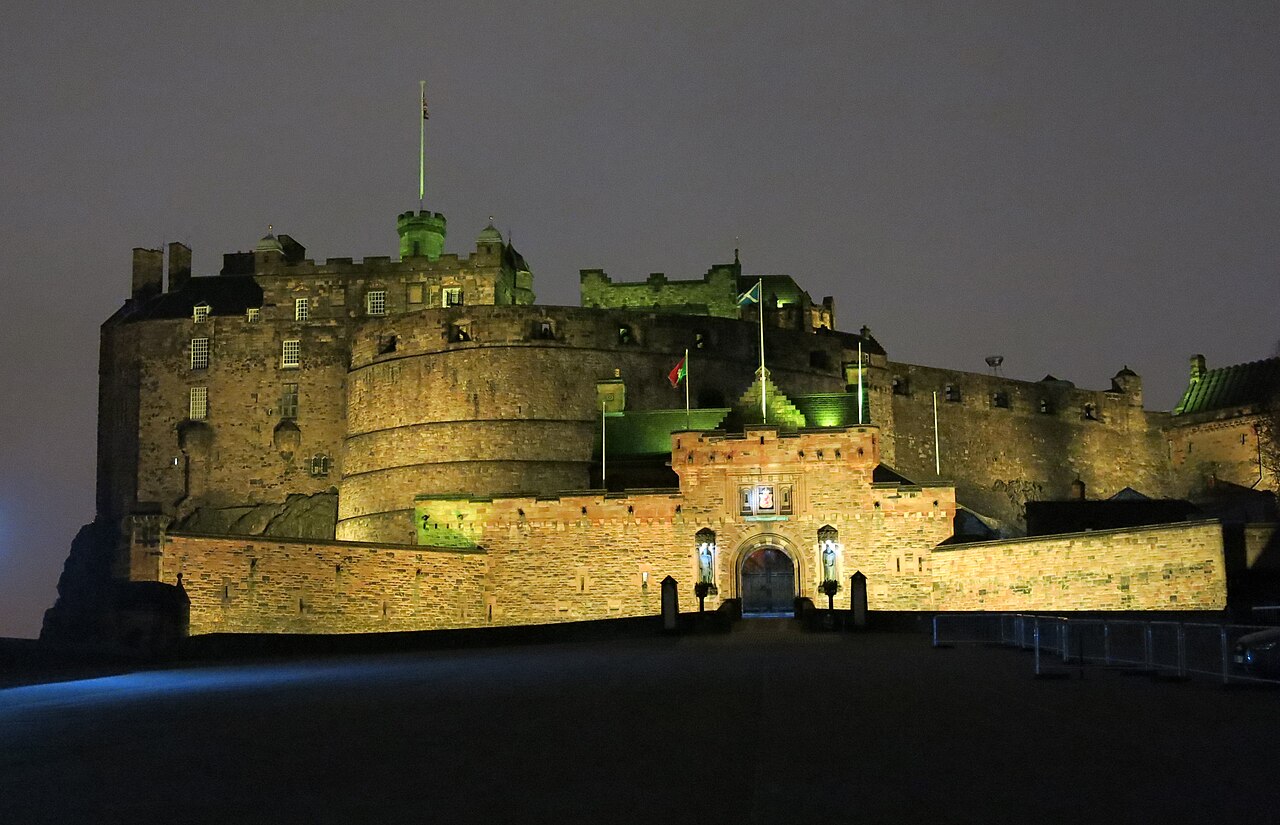
Edinburgh Castle is a historic fortress occupying the summit of Castle Rock, a craggy volcanic plug rising 80 metres above the old town of Edinburgh in Scotland. It is one of the most visited paid tourist attractions in Scotland, welcoming over two million visitors annually, and one of the most besieged fortifications in the British Isles — records and archaeological evidence suggest it has been besieged at least 26 times over more than eight centuries of documented military history. The castle is not a single building but a complex of structures from different periods accumulated on the summit and slopes of Castle Rock, ranging from the tiny Norman chapel of St Margaret (c.1130), the oldest surviving building in Edinburgh, to the Scottish National War Memorial, completed in 1927.
Castle Rock is a volcanic plug — the solidified magma core of a volcano that erupted approximately 350 million years ago. When glaciers ground across Scotland during the last Ice Age, they eroded the softer rock around the volcanic core but could not dislodge the hard basalt, leaving the craggy, steep-sided crag that now underlies the castle. The same glacial action created the characteristic Edinburgh topography: the Royal Mile stretches eastward from the castle along a ridge of rock deposited by glacial debris behind the volcanic plug, a geological "tail" behind the "crag" that gives the Castle Rock its dramatic visual relationship to the old town below.
Architectural significance
Edinburgh Castle's architectural significance derives less from any single building than from the ensemble's demonstration of defensive architecture adapted to an extreme natural site. Castle Rock's natural defences — sheer cliffs on three sides, with the only practicable approach from the east along the ridge — made it one of the most naturally defensible sites in northern Britain, and the buildings of the castle were designed, expanded, and rebuilt over centuries in response to changing military technology and political circumstance. The result is a layered complex where successive building campaigns are visible in the fabric: Romanesque stone from the 12th century, late medieval great halls from the early 16th century, artillery batteries from the late 16th and 17th centuries, and 19th-century barracks and administrative buildings occupying the upper wards.
The most architecturally significant individual building is the Great Hall, built by James IV around 1503–1511 and still used for ceremonial state occasions. It is a hammer-beam roofed great hall of considerable sophistication — the roof, reconstructed in the 19th century but based on the original structure, is supported by hammer-beam trusses that span the full width of the hall without intermediate columns, creating an unobstructed interior space that was a technical achievement of Scottish late-medieval carpentry. The hall's window tracery, fireplaces, and corbelling reflect the confident mature style of James IV's court, one of the most culturally sophisticated in Scottish history before the Reformation. The Half Moon Battery, built between 1573 and 1588 on the east face of the rock, is equally significant — a great artillery platform that replaced an earlier round tower, its curved face designed to deflect rather than absorb artillery fire, an early example of post-medieval defensive engineering applied to a site previously designed for medieval siege warfare.
Key features
- St Margaret's Chapel: Built around 1130 by King David I in memory of his mother, Queen Margaret, St Margaret's Chapel is the oldest surviving building in Edinburgh and one of the oldest in Scotland. It is a tiny Romanesque structure — approximately 9 metres long — with a simple apse, thick stone walls, and a decorated chancel arch of Norman workmanship. It survived the repeated destructions that swept the rest of the medieval castle because it was used as a storehouse and gunpowder magazine and was therefore maintained structurally even when not in religious use. It was restored to use as a chapel in the 1850s and is the oldest functioning church in Scotland.
- The Honours of Scotland: The Scottish Crown Jewels — known as the Honours of Scotland — comprise the crown, the sceptre, and the sword of state, and are the oldest surviving royal regalia in the British Isles, predating the English Crown Jewels (which were melted down during the Interregnum and replaced under Charles II). The crown was refashioned in 1540 and is believed to incorporate gold from an earlier crown used at the coronation of Robert the Bruce in 1306. The regalia were hidden under the floor of Kinneff Church during the English occupation under Cromwell to prevent their seizure, and recovered after the Restoration in 1660.
- The Stone of Destiny: The Stone of Destiny — also known as the Stone of Scone — is a block of sandstone used in the coronation of Scottish, and later English and British, monarchs. Seized by Edward I of England in 1296 and kept at Westminster Abbey (built into the Coronation Chair) for 700 years, it was returned to Scotland in 1996 under a political agreement and is now on display in Edinburgh Castle alongside the Honours. It is returned to Westminster for coronations: it was transported to London for the coronation of King Charles III in May 2023.
- The One O'Clock Gun: Since 1861, a time-signal gun has been fired at 1:00 pm daily from the Mills Mount Battery (except Sundays, Christmas Day, and Good Friday). The original purpose was to provide an accurate time signal visible and audible across Edinburgh and the Firth of Forth to ships setting their chronometers. The gun is now fired by an electronic signal from the Royal Observatory on Calton Hill, though a Gunner in uniform still presides. It remains one of only three daily time-signal guns fired worldwide.
- Scottish National War Memorial: Designed by Sir Robert Lorimer and completed in 1927, the National War Memorial occupies the former Crown Square barracks on the castle's highest point. It commemorates the Scottish dead of World War I and all subsequent conflicts. The interior, by a team of Scottish artists and craftspeople, is considered a masterwork of the Scottish Arts and Crafts movement — fine stone carving, stained glass, bronze sculpture, and wrought ironwork of exceptional quality.
Construction and history
Human habitation of Castle Rock dates back to at least the Iron Age, and there is evidence of a hillfort on the summit during the late Bronze Age. The earliest medieval reference to the castle as a royal residence dates from the reign of Malcolm III (1058–1093), and it is during the reign of his son David I that the first stone structure, St Margaret's Chapel, was built. The castle grew rapidly in strategic importance during the 12th and 13th centuries as Edinburgh developed as Scotland's principal city. It changed hands repeatedly during the Wars of Scottish Independence (1296–1357): seized by Edward I of England in 1296, recaptured by the Scots under Thomas Randolph in a midnight raid in 1314, and subsequently demolished on the orders of Robert the Bruce to prevent its future use against him.
The castle as it substantially exists today was built from the 14th century onward, with major construction phases under David II, James IV, and James VI. The arrival of effective artillery in the late 15th century fundamentally changed the castle's military significance: it was no longer impregnable by medieval siege methods, and each subsequent improvement to the artillery fortifications was overtaken within decades by advances in siege technology. The last serious military siege was in 1745, when Jacobite forces under Prince Charles Edward Stuart briefly held Edinburgh but failed to take the castle. After 1745 the castle transitioned gradually from an active military installation to a ceremonial and heritage site, a process completed by the 20th century.
Preservation and status
Edinburgh Castle is managed by Historic Environment Scotland and is Scotland's most visited paid attraction. The castle is maintained in active use — it houses the Scottish National War Memorial, the Honours of Scotland, military regimental museums, and a garrison of the Royal Regiment of Scotland. Stone conservation work is continuous on the various historic structures. The Half Moon Battery was extensively conserved in 2016–2019. The castle hosts the Royal Edinburgh Military Tattoo annually in August — a spectacular display of military music, massed pipe bands, and theatrical performance on the castle esplanade that runs for three weeks and is watched by roughly 220,000 spectators in person and by television audiences across the world.
Think you can place this building on the map?
Play Building Guessr