What it is
The Cathedral of Santa Maria del Fiore in Florence presents one of architecture's most remarkable discontinuities: a building whose nave was designed and largely built in the Gothic style, and whose dome was designed and built in a style that helped define the Renaissance and effectively ended the Gothic tradition's authority over Italian architecture. The nave was begun in 1296 under the direction of Arnolfo di Cambio, Florence's leading architect at the time, and construction continued through the fourteenth century. By the time the nave was substantially complete, the octagonal drum at its eastern end — the platform on which a dome was always intended to sit — had been built to a diameter of 42 meters and raised to a height of 55 meters above the floor. And there it stopped. The engineering problem of constructing a dome to span that opening, at that height, without the traditional timber centering (which would have required more wood than existed in all of Tuscany) was considered effectively unsolvable. The drum sat open to the sky for 125 years.
The solution came from Filippo Brunelleschi, a goldsmith and clockmaker turned architect who had spent years studying the Pantheon in Rome and thinking about dome construction. In 1418, the Opera del Duomo — the committee overseeing the cathedral — held a competition for the dome's design. Brunelleschi won, though he refused to explain his method in detail until he had secured the commission. The dome was built between 1420 and 1436 and consecrated by Pope Eugenius IV in March of that year. It remains the largest masonry dome ever built — larger in diameter than the Pantheon, larger than Michelangelo's dome over St. Peter's in Rome, and almost certainly the most consequential single work of architecture in the history of the Western tradition.
Architectural significance
Brunelleschi's dome solved the centering problem through a combination of structural innovations, each of which required the others to work. The fundamental insight was the herringbone brick pattern (known in Italian as spina pesce — "fish spine"): bricks laid in alternating vertical and diagonal courses that allowed each horizontal ring of brickwork to be self-supporting as it was laid, without needing a temporary wooden form to hold it in place until the mortar set. The dome has two shells — an outer shell that handles weatherproofing and an inner shell that provides the primary structure — connected by a system of stone and brick ribs: eight large ribs visible on the exterior and sixteen smaller hidden ribs between them. Horizontal sandstone chains embedded in the masonry at intervals act as iron hoops to resist the outward thrust that a dome of this diameter generates. The result is a structural system of extraordinary ingenuity that distributes loads through the masonry in ways that Brunelleschi understood intuitively, even without the mathematical framework that later structural engineers would develop to explain them.
The dome's influence on subsequent architecture is almost impossible to overstate. Michelangelo, when asked about his design for the dome of St. Peter's in Rome, allegedly said "I will build your sister, but she will not be more beautiful." Every subsequent Renaissance and Baroque dome — St. Paul's in London, Les Invalides in Paris, the Capitol in Washington D.C. — is in dialogue with what Brunelleschi achieved in Florence. The lantern at the dome's summit, also designed by Brunelleschi (installed after his death in 1446), resolves the outward thrust at the top of the dome and provides a vertical accent that makes the dome legible from across the city and from the surrounding hills for many kilometers in every direction.
Key features
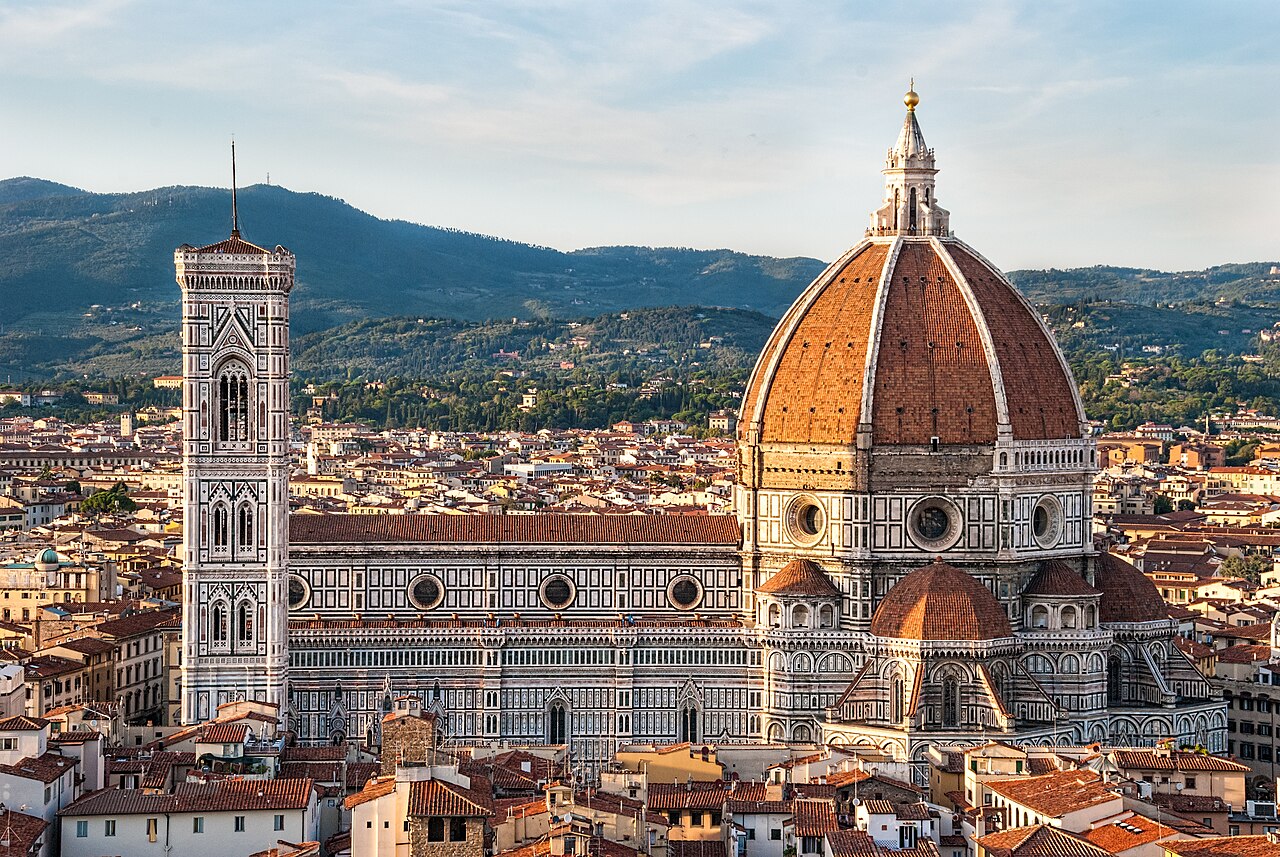
- White, green, and pink marble cladding: The nave's exterior is clad in Florentine Gothic polychrome marble — white Carrara marble, green Prato marble, and pink marble from the Maremma — in geometric patterns designed before the Renaissance, creating a building whose skin and skeleton were conceived in entirely different architectural worlds.
- Octagonal drum with oculi: The broad octagonal drum supporting the dome is pierced by oculi (round windows) at its base, admitting light to the transition zone between nave and dome and visually marking the structural hand-off between the Gothic nave and Brunelleschi's Renaissance crown.
- Brunelleschi's double-shell dome: The dome's outer surface is divided by eight white marble ribs into eight red brick panels, creating the alternating white-and-red striped profile that defines the Florentine skyline; the double shell and self-supporting herringbone brickwork are invisible but constitute the building's most significant engineering achievement.
- Giotto's campanile: The freestanding bell tower alongside the cathedral, begun by Giotto di Bondone in 1334 and completed by Francesco Talenti in 1359, is clad in the same polychrome marble as the nave; its relief carvings of the arts, sciences, and planets constitute a program of humanist learning in stone.
- Baptistery of San Giovanni: The separate octagonal baptistery facing the cathedral's west facade — one of the oldest buildings in Florence, dating from the eleventh century — is the destination for Ghiberti's two sets of bronze doors, including the Gates of Paradise (east doors, 1452), which Michelangelo reportedly said deserved to be the gates of heaven.
- Vasari's Last Judgment fresco: The interior of the dome is covered by Giorgio Vasari's enormous fresco of the Last Judgment, begun in 1572 and completed by Federico Zuccari — 3,600 square meters of painted surface that are visible from the nave floor below but best seen from the walkway between the two dome shells.
Preservation status
Florence Cathedral is an active place of worship managed by the Opera di Santa Maria del Fiore, the same institution — under different names — that has overseen its construction and maintenance since the fourteenth century. The dome is continuously monitored by a network of sensors that measure structural movement, crack widths, and environmental conditions; given the dome's age, its unique structural logic, and the seismic activity of the Italian peninsula, this monitoring program is essential. The Ghiberti baptistery doors — the originals, replaced by replicas in situ in the 1990s — are housed and displayed in the Museo dell'Opera del Duomo, a few steps from the baptistery itself, where they can be examined at close range in controlled conditions. The dome's exterior masonry is maintained through ongoing inspection and targeted repair, with particular attention to the lantern and to the junctions between the marble ribs and the brick panels.
Think you can place this building on the map?
Play Building Guessr