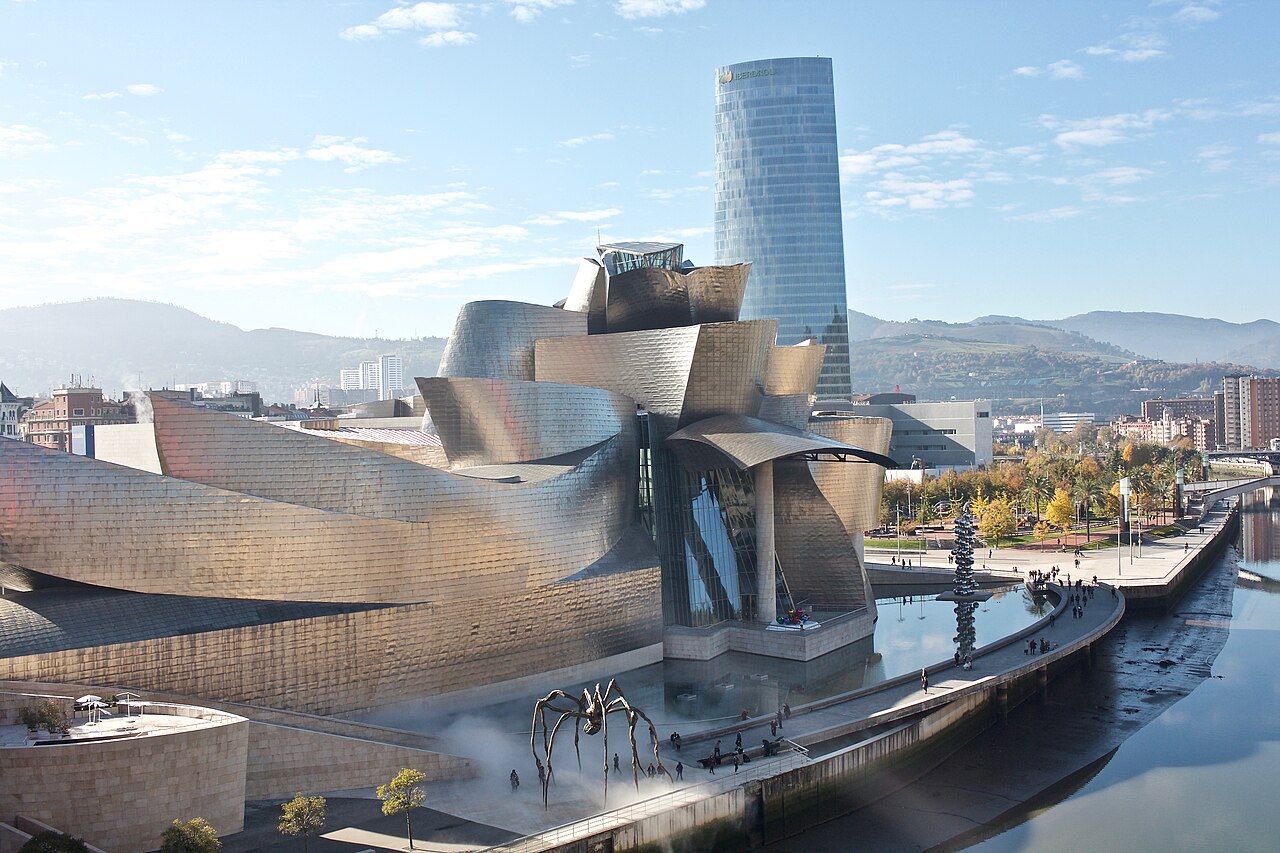
What it is
The Guggenheim Museum Bilbao is a contemporary art museum designed by the Canadian-American architect Frank Gehry and opened on October 18, 1997. It was commissioned by the Basque regional government in partnership with the Solomon R. Guggenheim Foundation as part of a deliberate strategy to revitalize the city of Bilbao, which had suffered severe economic decline following the collapse of its traditional steel and shipbuilding industries in the 1980s. The Guggenheim Foundation was seeking to expand its international presence through a network of satellite museums; the Basque government was seeking a transformational cultural institution that could redefine the city's identity. The combination produced one of the most influential buildings of the late twentieth century.
Gehry was selected from a competition that also included Arata Isozaki and Coop Himmelblau. His design — a cluster of interconnected volumes clad in titanium, limestone, and glass, arranged along the south bank of the Nervión River — was radical enough that Guggenheim director Thomas Krens initially had reservations about whether it could be built. It could, and on time and within budget: the final cost was approximately 84 million US dollars, and the building opened as scheduled. The "Bilbao Effect" — the term now used in urban planning and cultural economics to describe the phenomenon of a single iconic cultural building catalyzing citywide economic regeneration — was coined in the years immediately following the museum's opening, as Bilbao's visitor numbers, hotel beds, airport traffic, and tax revenues all rose dramatically. The term has since been applied (and misapplied) to cultural building projects around the world, though subsequent research has shown that the Bilbao case was unusually successful and that the effect does not reliably replicate elsewhere.
Architectural significance
The Guggenheim Bilbao was the first major building to be designed using CATIA — a software package originally developed for aerospace engineering by Dassault Systèmes that allowed complex three-dimensional curved surfaces to be modeled digitally, tested structurally, and then directly translated into fabrication drawings for the steel frame and cladding panels. Before CATIA, a building with this degree of surface complexity would have been impossible to coordinate across the engineering, fabrication, and construction teams: the geometry could not have been fully described by conventional technical drawings. With CATIA, each of the 110,000 individual titanium panels could be precisely dimensioned and positioned in a shared digital model. The Guggenheim Bilbao is therefore a pivotal moment in the history of parametric and computational design — the point at which digital tools first enabled formal complexity at an architectural scale that would have been previously buildable only through extraordinary handcraft or pure accident.
The titanium cladding itself is a story of accident turned to advantage. Gehry's original intention was to clad the building in lead, a material he admired for its matte surface that would read differently in different light conditions. Lead was ruled out on environmental and structural grounds. Titanium was suggested as an alternative, and Gehry's team sourced extremely thin panels — 0.38 millimeters thick, thinner than a credit card — that would be light enough to be cost-effective. At this thickness, the titanium panels are flexible: they move and flex slightly with temperature changes, creating a constantly shifting texture across the facade as the panels respond independently to thermal expansion and contraction. The result, entirely unforeseen in the original design intent, is a surface that appears alive — shimmering and shifting as the sun moves, the light changes, or the viewer moves. The building's visual character is inseparable from this material accident. Gehry has said in subsequent interviews that he would never have specified titanium intentionally, and that the building would not have been as good had he done so.
Key features
- Titanium-clad curved volumes: The dominant formal gesture of the building — a series of billowing, boat-like volumes clad in 110,000 individual titanium panels, no two of which are exactly the same shape. The titanium was selected partly because it is extremely resistant to corrosion, and the Bilbao climate (humid, near the coast) would have quickly degraded most metals.
- Limestone rectilinear gallery wing: The most conventional-looking part of the building, a rectangular block clad in honey-colored limestone that houses the more traditional rectangular gallery spaces and anchors the building's relationship to the urban street grid. The contrast between the flowing titanium forms and the orthogonal limestone block is deliberate.
- Glass curtain-wall atrium: The central atrium — which Gehry called "the flower" — is a soaring glass-walled space that serves as the organizational hub of the museum, with sculptural steel staircases and glass elevator towers distributing visitors to the various gallery wings.
- River-facing boat form: The building's most celebrated volume, the curved titanium form facing the Nervión River, is widely described as resembling a ship's hull or a fish — a reference that Gehry, who has a recurring interest in fish forms, has neither confirmed nor denied.
- Jeff Koons' "Puppy": The 12-meter-tall West Highland Terrier sculpture covered in flowering plants, positioned at the museum's main entrance, has become as much a symbol of the Guggenheim Bilbao as the building itself. Originally conceived as a temporary installation for the museum's opening, "Puppy" was acquired permanently after public response made its removal unthinkable.
- Richard Serra's "The Matter of Time": The 130-meter-long Fish Gallery — one of the largest gallery spaces in Europe — was designed specifically to house large-scale sculpture, and is now the permanent home of Richard Serra's eight weathered steel sculptures, which visitors walk through. The gallery's dimensions were designed in consultation with Serra before the building was complete.
Preservation status
The Guggenheim Bilbao is in good condition. The titanium facade panels require periodic inspection and cleaning, and the Guggenheim Foundation and the Basque government, which jointly own and operate the building, have ongoing maintenance programs in place. The titanium's extreme thinness means individual panels can be dented or deformed and require replacement, but the material's resistance to corrosion means that structural degradation of the cladding has not been a significant issue. The building's unconventional geometry creates some practical maintenance challenges — accessing and inspecting the complex curved surfaces requires specialized equipment — but the building was designed with long-term maintenance access in mind.
The Guggenheim Foundation manages the building as a landmark cultural institution and an ongoing commercial asset: the museum itself generates sufficient revenue to be financially self-sustaining, unlike many institutions of its size. Its status as a global architectural icon is reflected in the fact that architectural tourism — visiting the building for its own sake, regardless of the exhibitions inside — accounts for a significant portion of the museum's visitors. The building is expected to remain in active use indefinitely; no conservation status beyond standard building maintenance is required, as it is a living institution rather than a protected historic monument.
Think you can place this building on the map?
Play Building Guessr