What it is
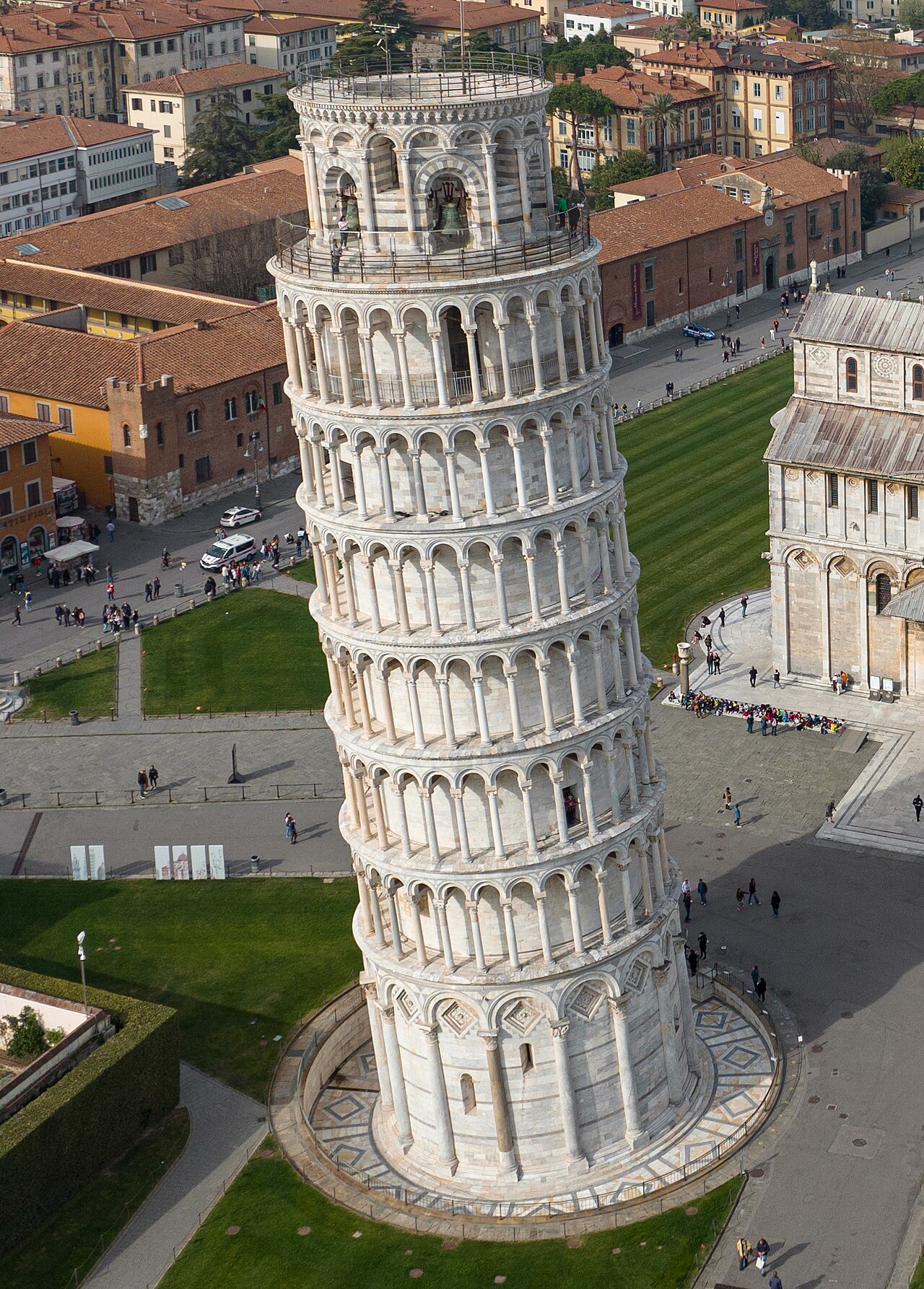
The Leaning Tower of Pisa is the freestanding campanile — bell tower — of the Cathedral of Pisa, located in the Piazza dei Miracoli (Square of Miracles) alongside the cathedral, the baptistery, and the monumental cemetery. It is one of the most visited buildings in Italy and, by a wide margin, the world's most famous structural anomaly: a tower that has been leaning since the first years of its construction and that, despite centuries of worry, periodic engineering intervention, and the passage of more than eight hundred years, has never fallen. The lean is caused by soft alluvial subsoil on the southern side of the foundation, which compresses more than the northern side under the tower's weight, tilting the entire structure.
The tower stands 56 metres tall on the low side and 56.7 metres on the high side, and is built in eight storeys of white Carrara marble in the Pisan Romanesque style — a regional variant of Romanesque architecture characterised by arcaded galleries of small columns encircling each storey, blind arcading at the base, and an openwork belfry at the top. There are 294 steps in the staircase that spirals up through the hollow interior of the wall. The tower's lean, after 1990–2001 stabilisation works, now stands at approximately 3.97 degrees from vertical — still visible and dramatic but reduced from the 5.5 degrees it had reached before intervention.
Architectural significance
The Leaning Tower of Pisa is a masterwork of Pisan Romanesque architecture — a style developed in the 11th and 12th centuries by the Republic of Pisa, a maritime power that grew wealthy on Mediterranean trade and expressed that wealth in some of the most refined stone buildings of medieval Italy. The Piazza dei Miracoli ensemble — cathedral, baptistery, campanile, and camposanto — was conceived as a unified religious and civic monument, the cathedral begun in 1064 following Pisa's naval victory over the Saracens at Palermo. The tower was designed to match the cathedral's aesthetic: both use the same white Carrara marble, the same arcaded gallery system, and the same layered horizontal banding that gives Pisan Romanesque its distinctive striped character.
What makes the tower architecturally unusual beyond its lean is its cylindrical form. Most campanili of the period were square in plan; Pisa's is round, each storey ringed by a gallery of colonnettes that creates the impression of a series of stacked loggias rather than a solid tower. The colonnettes are not purely decorative: they form part of the load-bearing perimeter and create the visual rhythm that makes the building legible from a distance despite its relatively modest height. The builders attempted to compensate for the developing lean during construction: the upper storeys were built with a slight counter-lean, so that the tower curves gently as it rises, each later addition tilting back toward the vertical. This compensatory curvature gives the tower its characteristic banana-shaped profile, visible in careful measured drawings, and is evidence that medieval builders were far more aware of — and troubled by — the lean than a casual reading of the historical record might suggest.
Key features
- Eight storeys of arcaded galleries: Each storey is ringed by a gallery of blind and open colonnettes in white marble, creating the characteristic horizontal banding that defines the Pisan Romanesque style. The galleries are not merely decorative: they distribute the structure's weight around the perimeter and give the tower its visual lightness despite the mass of marble involved.
- The lean and its correction: Before the 1990–2001 stabilisation project led by Professor John Burland, the tower was leaning at 5.5 degrees and accelerating — an increase of about one millimetre per year. Engineers extracted soil from the north side using angled drilling, allowing the north foundation to settle and pulling the tower back by 44 centimetres. The lean is now stable at 3.97 degrees and is expected to remain so for at least 300 years.
- Seven bells: The belfry at the top holds seven bells tuned to the major scale. The largest, the Assunta, was cast in 1654 and weighs nearly 3.5 tonnes. For much of the 20th century the bells were not rung, since the vibration was considered a threat to structural stability; they have been carefully rung again since the completion of the stabilisation works.
- Galileo's experiments: According to Pisan tradition, Galileo Galilei dropped two cannonballs of different masses from the tower to demonstrate that objects fall at the same rate regardless of their weight — a challenge to Aristotelian physics. Most historians consider this story a legend; Galileo's own writings describe his experiments with inclined planes rather than the tower. Nevertheless, the association between the tower and Galileo's falling-body work has been a staple of popular science writing for four centuries.
- UNESCO World Heritage Site: The Piazza dei Miracoli was designated a World Heritage Site in 1987, recognised for the outstanding universal value of the architectural ensemble. Visitor numbers approach four million per year, making it one of the most intensively visited historic sites in Italy.
Construction and history
Construction of the tower began on 9 August 1173, under a designer whose identity remains disputed — the name Bonanno Pisano appears in medieval sources but is not confirmed by documentary evidence. Within five years, the south side had already begun to sink into the soft alluvial soil, and construction was halted after completion of the third storey, probably around 1178. The pause lasted nearly a century, coinciding with a period of continuous warfare between Pisa and its rivals Genoa, Florence, and Lucca. This long interruption proved accidentally beneficial: it allowed the subsoil to consolidate partially under the weight already placed on it, which may have prevented the tower from simply toppling during construction.
Work resumed around 1272 under Giovanni di Simone, who added four more storeys, continuing to compensate for the lean by building each storey slightly more vertical than the last. Construction halted again in 1284 after Pisa's catastrophic naval defeat at the Battle of Meloria. The belfry — the top storey — was finally added around 1319–1372, completing a project that had occupied nearly two centuries and spanned at least three architects. The tower survived the medieval period, the Renaissance, and the modern era, though the 20th century saw its lean accelerating to the point where international concern mounted and a restoration committee was formed in 1990.
Preservation and status
The 1990–2001 stabilisation project, overseen by an international committee of engineers, geotechnical specialists, and conservators, is now regarded as a landmark achievement in historic conservation engineering. The extracted-soil technique was chosen over more drastic alternatives — including anchoring the tower with steel cables, which would have been highly visible and damaging to the fabric — and proved effective beyond initial expectations. The tower was reopened to visitors in 2001, and ongoing monitoring confirms that the lean is stable. The Piazza dei Miracoli remains in excellent condition; the main conservation challenges are visitor management and the general environmental pressures — acid rain, particulate pollution — that affect white marble facades across Italy.
Think you can place this building on the map?
Play Building Guessr