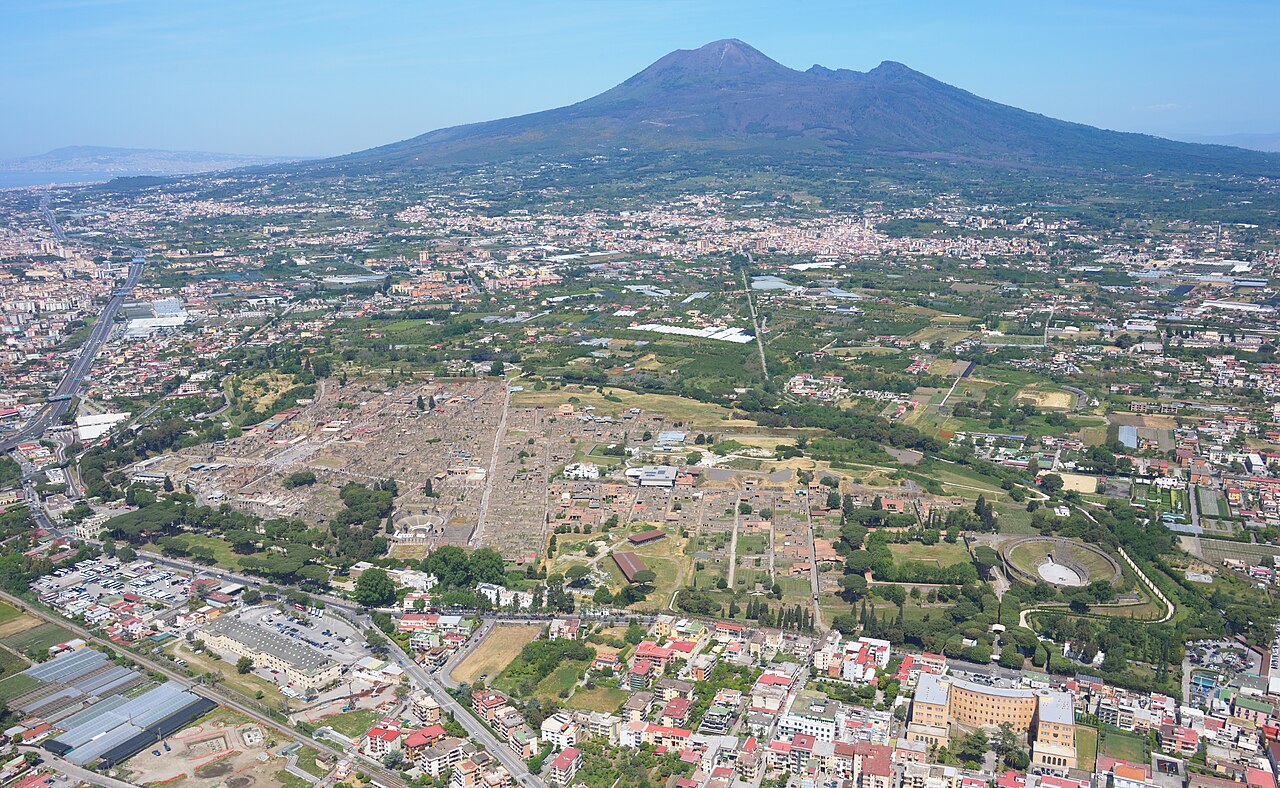
What it is
Pompeii is a Roman city in the Campania region of southern Italy, located approximately 23 kilometres southeast of Naples at the foot of Mount Vesuvius. Founded no later than the 6th century BCE — with archaeological evidence of settlement extending back further — the city grew into a prosperous Roman municipium with a population of approximately 11,000 to 20,000 people at the time of its destruction. On the morning of 24 August 79 CE (though some scholars now argue for an October date, based on evidence from fruit, wine stores, and the clothing of victims), Vesuvius erupted with catastrophic violence, burying Pompeii — along with the neighbouring cities of Herculaneum, Oplontis, and Stabiae — under 4 to 6 metres of volcanic ash and pumice. This catastrophic burial preserved the city in extraordinary detail, creating one of the most significant archaeological time capsules ever discovered.
Pompeii was rediscovered in 1748 by the Spanish military engineer Rocque Joaquín de Alcubierre, working under contract for the Bourbon King of Naples. Systematic excavation began almost immediately, though the methods of the early period were more interested in recovering portable antiquities — statues, paintings, mosaics — than in understanding the urban context. Scientific excavation, beginning in the 19th century, transformed understanding of the site and of Roman urban life more broadly. Today, approximately two-thirds of the 66-hectare site has been excavated; the remaining third is deliberately left unexcavated, both to preserve it and to reserve it for future generations with better technologies.
The eruption of 79 CE
The eruption of Vesuvius was described by Pliny the Younger in two letters to the historian Tacitus — letters that represent the oldest detailed eyewitness account of a volcanic eruption and that gave science the term "Plinian eruption" (a high-column, gas-propelled eruption of extreme force). Pliny was at Misenum, approximately 30 kilometres from Vesuvius, where he observed the eruption with his mother while his uncle, Pliny the Elder — the naturalist and naval commander — sailed toward the eruption to assist in rescue operations and subsequently died, almost certainly from toxic gases near Stabiae.
The eruption produced two distinct lethal mechanisms. The first phase, lasting through the afternoon and night of 24 August, produced a rain of pumice and lapilli (small volcanic rock fragments) that accumulated on roofs, collapsing them and burying streets. Many residents fled during this phase. Those who sheltered in buildings were at risk of roof collapse; those who fled along roads were pelted by falling pumice. The second and ultimately lethal phase, beginning in the early morning hours, produced a series of pyroclastic surges and flows — superheated mixtures of gas, ash, and rock fragments that travel at speeds of 100–300 kilometres per hour and at temperatures of several hundred degrees Celsius. It was these surges that killed those who had survived the pumice fall, including in Herculaneum where the toll appears to have been almost total. The ash that followed then sealed the pyroclastic deposits, preserving everything beneath it with unusual completeness.
City layout and urban life
Pompeii reveals the anatomy of a prosperous Roman city with a clarity that written sources alone could never provide. Its urban grid — modified from an earlier irregular layout — is organised around major streets (decumanus and cardo) intersecting at right angles, with stepping stones at intersections to allow pedestrians to cross the wheel-rutted streets without stepping in the sewage-laced runoff. The Forum, the city's political and commercial heart, is surrounded by the Temple of Jupiter, the basilica (law court and commercial exchange), and administrative buildings. The Amphitheatre (c.70 BCE), the oldest surviving stone amphitheatre in the Roman world, seated approximately 20,000 spectators.
Among the most revealing structures are the thermopolia — the ancient equivalent of fast-food counters, of which over 80 have been identified. These are characterised by L-shaped counters with large ceramic dolia (storage jars) embedded in the masonry, keeping food warm. A recently excavated thermopolium (the Thermopolium of Regio V, excavated 2019–2021) was found complete with food remains in its containers, painted decoration on its counter, and a fresco of a duck — possibly advertising the menu — still visible on its facade. The city's brothels (lupanare), marked by explicit relief carvings above the doorways, its public and private baths, its insulae (apartment blocks), and its wealthy peristyle villas all document a social spectrum from the very poor to the prosperous merchant class in unprecedented detail.
The graffiti corpus
One of Pompeii's most extraordinary legacies is its graffiti — over 11,000 inscriptions scratched or painted on walls throughout the city, constituting the largest corpus of Latin popular writing from the ancient world. These inscriptions cover every aspect of daily life: election endorsements ("Vote for Gaius Julius Polybius for aedile — he provides good bread"), love declarations, insults, prices of goods, records of gladiatorial fight results, business announcements, literary quotations, crude jokes, and protests. They reveal the texture of Roman popular culture with an immediacy that formal literature cannot match. Particularly significant is the evidence they provide for widespread literacy across social classes — many graffiti appear to have been written by people of low social status, including slaves.
The plaster casts
The most emotionally powerful aspect of Pompeii's archaeology is the plaster casts of victims. When the volcanic ash that buried the city hardened around the bodies of the dead, it preserved their exact shapes as hollow cavities in the deposit. Beginning in the 1860s, the archaeologist Giuseppe Fiorelli developed the technique of injecting liquid plaster into these cavities, creating casts that preserve the precise posture, facial expressions, and even clothing of people who died nearly 2,000 years ago. Dozens of casts have been made, including a man covering his face with his cloak, a woman lying face-down, and a dog chained and unable to flee. They constitute one of the most haunting intersections of archaeology and human emotion in the entire historical record.
Herculaneum and ongoing excavation
Pompeii's companion site, Herculaneum, was also destroyed by the 79 CE eruption but was buried under a different type of deposit — a thick layer of volcanic material that solidified into rock rather than loose ash. This has made excavation more difficult but preservation in some respects even better: at Herculaneum, wooden structures, furniture, food, and organic materials have survived in conditions that Pompeii's loose ash could not match. The two sites together provide complementary evidence for Roman urban life of the 1st century CE.
The Great Pompeii Project, funded by the European Union and the Italian government, has since 2012 overseen a major programme of restoration, structural consolidation, and renewed excavation at the site. New discoveries continue to be made: the Regio V excavations of 2018–2021 uncovered several new rooms including a ceremonial banquet room with intact frescoes, a stable with a harnessed horse preserved in plaster, a ceremonial chariot, and the thermopolium described above. The fact that Pompeii continues to yield major new discoveries from its still-unexcavated third is one of the most compelling arguments for the cautious, technology-assisted approach to archaeological excavation that modern practice demands.
Think you can place this building on the map?
Play Building Guessr