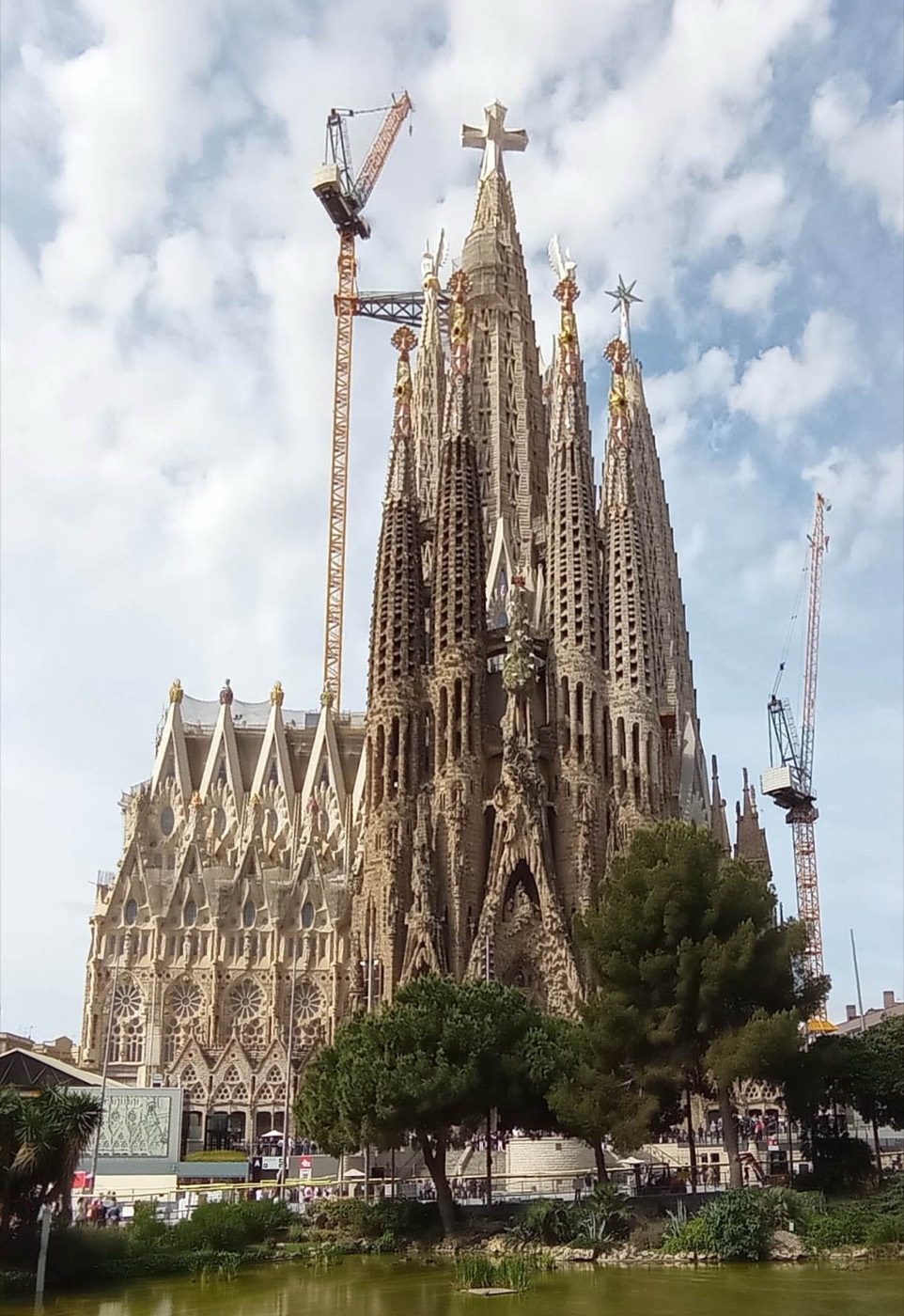
What it is
The Basílica de la Sagrada Família is the largest unfinished church in the world, and arguably the most extraordinary architectural project of the last two centuries. Ground was broken in 1882 under architect Francisco de Paula del Villar, who conceived a conventional neo-Gothic church. He resigned after a year, and in 1883 the commission passed to a thirty-one-year-old Antoni Gaudí — who proceeded to abandon every conventional design decision and spend the remaining forty-three years of his life transforming it into something entirely without precedent. When Gaudí died in 1926 — struck by a tram, and initially unrecognized by passersby because of his worn clothing — less than a quarter of the building was complete. He had deliberately designed a project too large and too complex for any single lifetime, reasoning that future generations' participation was itself part of the work's spiritual meaning.
Construction has continued without interruption since Gaudí's death, funded entirely by admission tickets rather than public money or Church funds — a fact that has profound architectural consequences: the construction team must balance historical fidelity with practical buildability and visitor revenue. Gaudí's original plaster models were largely destroyed by anarchists in 1936 who burned the workshop; much of the post-war reconstruction has relied on photogrammetric reconstruction of surviving fragments and Gaudí's published drawings. The central tower of Jesus Christ, at 172.5 meters, was topped out in 2021 and a star lantern added; the remaining towers are expected to be completed in the mid-2020s, finally fulfilling a project now entering its third century.
Architectural significance
The Sagrada Família is significant for achieving something that had been attempted but never fully realized in Gothic architecture: a complete structural system without flying buttresses. Gothic cathedrals counteract the outward thrust of stone vaults with elaborate external buttressing systems that are both costly and visually dominant. Gaudí's solution was to route all structural forces downward through inclined branching columns — the same logic by which a tree distributes the weight of its canopy through progressively thickening limbs to a central trunk. Each column leans at a calculated angle, branches at a specific height, and terminates in hyperboloid knuckle joints that distribute vault loads smoothly across the ceiling plane. The result is a forest interior: no flying buttresses interrupt the exterior silhouette, and the interior reads as an organic canopy rather than a stone cage.
Gaudí developed this structural logic using hanging chain models (funicular models) — suspending weighted strings from a frame and photographing the inverted result, which gives the precise catenary curves that carry compression loads efficiently in stone. These models, some with thousands of strings, covered the workshop ceiling. The method was centuries old (Hooke had described the principle in 1675), but Gaudí's scale of application and integration with decorative form was entirely new. The facades are equally complex: each of the three principal facades — Nativity (1894–1930, completed in Gaudí's lifetime), Passion (designed by Gaudí, built 1954–2018 by Josep Maria Subirachs), and Glory (still under construction) — is a dense sculptural program encoding theological narrative in stone, bronze, and ceramic.
Key features
- Three facades: Nativity facade (eastern, organic and encrusted with plant and animal forms celebrating Creation), Passion facade (western, angular and austere, depicting the suffering and death of Christ), Glory facade (southern, the main entrance, still under construction).
- 18 towers: Twelve apostle towers (four per facade, representing the twelve apostles), four evangelist towers flanking the transept crossing, one tower dedicated to the Virgin Mary above the apse, and the central tower of Jesus Christ — at 172.5 meters, intentionally one meter shorter than Montjuïc hill so that human creation does not surpass God's creation.
- Hyperboloid branching columns: Interior columns of inclined stone and granite fork repeatedly as they rise, distributing vault loads without any external buttressing. The branching geometry is precisely hyperboloidal — a mathematically ruled surface Gaudí favored for its structural efficiency and light-catching faceted surface.
- Stained glass color scheme: The nave windows are designed to cast warm reds and oranges on the western side (representing the passion, sunset, and death) and cool greens and blues on the eastern side (representing nature, dawn, and resurrection), flooding the interior with shifting colored light throughout the day.
- Inverted catenary vaulting: The vaulted ceiling surfaces follow catenary curves derived from Gaudí's hanging chain models, so every curve is structurally optimal — the vault carries its load in pure compression, with no bending forces and minimal material.
- Dense sculptural programs: Every surface of the Nativity facade is covered with naturalistic carving — salamanders, turtles, herons, cypress trees, and hundreds of human figures. The iconographic program reads from bottom (earthly creation) to top (the divine).
- UNESCO World Heritage Site: The Nativity facade and crypt were inscribed in 2005 as part of the Works of Antoni Gaudí World Heritage property, even while the building remains unfinished.
Preservation status
As an active construction site, the Sagrada Família presents unusual preservation challenges. The primary tension is between the fidelity of post-Gaudí construction to his original intentions and the practical realities of building with twenty-first-century materials and methods. Gaudí used natural stone exclusively; later construction phases have incorporated reinforced concrete for speed and economy, a choice that architectural purists have criticized. The construction board has attempted to address this by specifying that any concrete elements be clad in stone, but the structural logic differs from Gaudí's.
A secondary controversy involves the tunnel constructed beneath the building in 1997 for Barcelona's high-speed rail link. Geotechnical monitoring has detected minor foundation settlement, and the construction team continues to monitor the structure for any stress changes. The building's funding model — entirely dependent on the approximately 4.5 million visitors who pay admission annually — means that any prolonged disruption to tourism would halt construction. The COVID-19 pandemic demonstrated this vulnerability: the site was temporarily closed in 2020 and construction slowed significantly for over a year.
Think you can place this building on the map?
Play Building Guessr