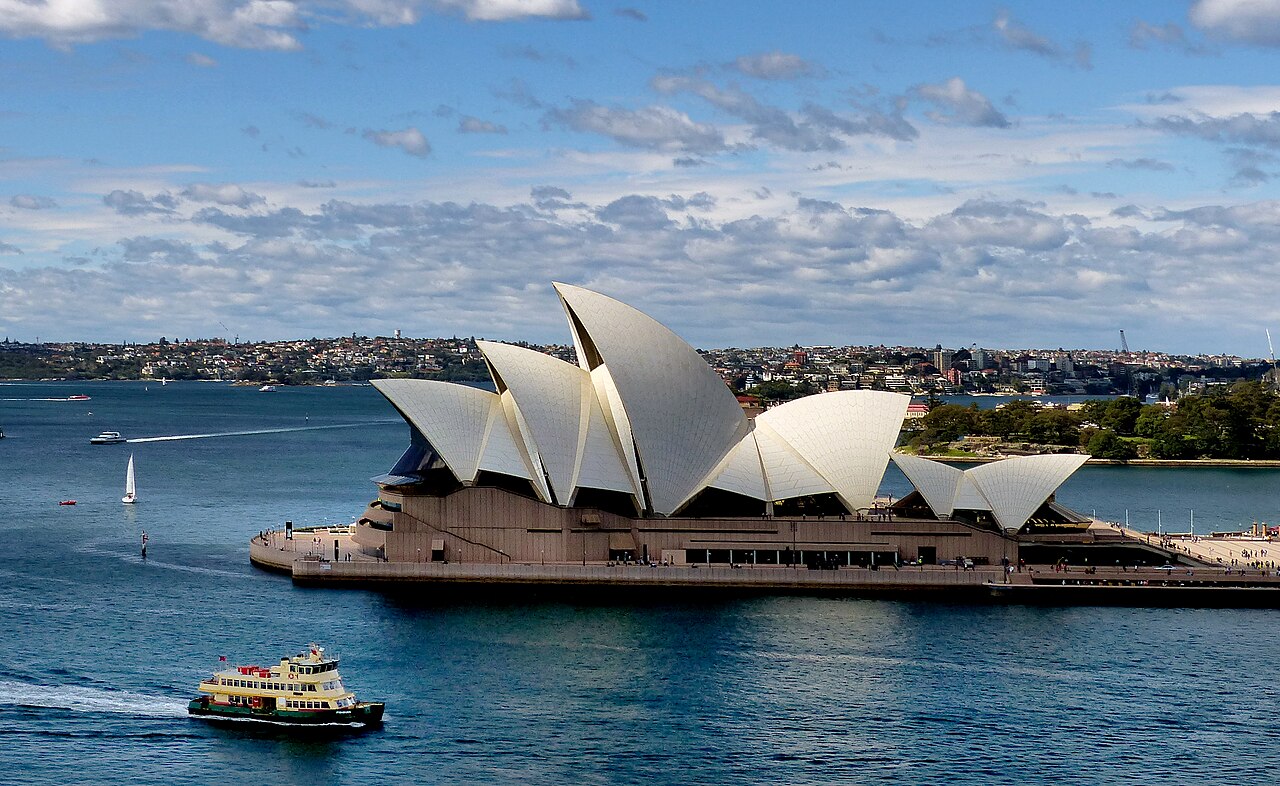
What it is
The Sydney Opera House is simultaneously one of the most recognizable buildings in the world and one of the most fraught architectural stories of the twentieth century. Danish architect Jørn Utzon won the 1957 international design competition from 233 entries with a set of sketches so bold — and so geometrically undefined — that three of the four judges initially rejected them; it was only the intervention of the American architect Eero Saarinen (who arrived late to the judging) that brought them back onto the table and ultimately secured the commission. The site is Bennelong Point, a peninsula jutting into Sydney Harbour between the Circular Quay ferry terminal and the Royal Botanic Garden, chosen for its harbor visibility and dramatic isolation from the city grid. The building was opened by Queen Elizabeth II on October 20, 1973, after 16 years of construction and at a final cost of A$102 million — fourteen times the original estimate of A$7 million.
The human story of the building is inseparable from its architecture. Utzon's relationship with the New South Wales government deteriorated progressively through the 1960s as construction costs escalated and political pressures intensified. In 1966, the new Minister of Public Works, Davis Hughes, refused to pay Utzon's fees; Utzon resigned and left Australia, never to return. The interior was completed by the Australian architectural team of Hall, Todd & Littlemore — working, controversially, without Utzon's involvement and without access to his drawings for the interior. The result is the famous disconnect at the heart of the building: the exterior shell, which Utzon resolved with brilliant geometric economy, is a masterpiece; the interior, particularly the main Concert Hall and the Joan Sutherland Theatre (formerly the Opera Theatre), is a functional space that fails to live up to its shell. Utzon received the Pritzker Prize in 2003, with the committee noting that there was no doubt the Opera House was one of the great buildings of the twentieth century. He died in 2008 without ever seeing the completed interior.
Architectural significance
The central architectural problem that the Sydney Opera House solved — and which makes it historically significant — was the geometric definition of the shell roofs. Utzon's original competition drawings showed sail-like or shell-like roof forms, but they were drawn freehand without any mathematically defined geometry. In the early years of design development, the engineering team at Ove Arup & Partners attempted to define the shells as parabolas, then as ellipses, and then as complex doubly-curved surfaces — all of which proved impossible to construct because each rib would need to be a unique shape, requiring unique formwork, at prohibitive cost. After five years of failed geometries, Utzon discovered the solution in 1961: all the shells could be defined as segments of a single sphere with radius 75.2 meters. This was not visually obvious — the shells appear to be different shapes and different sizes — but geometrically, they are all related as arcs of the same circle. The consequence was transformative: all the curved ribs of all the shells could be cast from a single set of molds, making prefabrication economically feasible. Approximately 2,400 precast concrete rib segments were manufactured and assembled like vertebrae into the shell structures.
The building's cultural significance is equally important as its architectural significance. The Sydney Opera House launched what critics have called the era of "signature architecture" or "iconic architecture" — the idea that a single building of extraordinary visual distinctiveness can define the identity of a city, attract tourism, and stimulate economic development in its surroundings. Bilbao's Guggenheim Museum (1997) is the most commonly cited later example, but Utzon's building in 1973 was the first fully realized case of a building conceived as a global image as much as a functional container. The shells' daily and seasonal changes of appearance — from brilliant white in direct sun to warm ivory in afternoon light to silver-grey under overcast skies — gave the building an almost cinematic mutability that made it endlessly photographable and endlessly recognizable across different conditions.
Key features
- Shell roof forms: Two interlocking groups of shells form the two main halls; a third, smaller group covers the restaurant. All shells are segments of a sphere of radius 75.2 meters, making their prefabrication from a single mold set economically viable. The tallest shell rises 67 meters above the podium.
- 1,056,006 ceramic roof tiles: The shells are clad in over one million chevron-pattern ceramic tiles manufactured by the Swedish firm Höganäs, in two colors — off-white and buff — arranged in a chevron stripe pattern that reads as a uniform color from a distance but creates a subtle texture variation that changes appearance with viewing angle and light conditions. The tiles are self-cleaning: their glazed surface allows rain to wash biological growth off naturally.
- Elevated granite podium: The entire building sits on a massive pink granite platform that elevates the shells above the harbor foreshore, creating a monumental base visible from the harbor and serving as the primary public promenade space, with outdoor terraces, restaurants, and bars.
- Bennelong Point harbor site: The building is surrounded by water on three sides, making its silhouette visible from extraordinary distances across Sydney Harbour — from the Harbour Bridge to the north, from Manly to the east, and from the city to the west.
- Concert Hall and Opera Theatre: The two largest shells house the two main performance venues. The Concert Hall seats 2,679 and is the building's acoustically superior space (it was designed for opera but functions better for orchestral music); the Joan Sutherland Theatre seats 1,507 and is the primary opera venue, though its acoustic and backstage limitations have been a persistent operational constraint.
- Vehicle access beneath the podium: The building's service infrastructure — loading docks, vehicle access, and mechanical plant — is entirely hidden beneath the elevated podium, keeping the harbor frontage and pedestrian approach free of service traffic.
- UNESCO World Heritage Site status (2007): The building was inscribed on the World Heritage List in 2007, only 34 years after completion — one of the fastest inscriptions of a modern building in the list's history — in recognition of its outstanding architectural significance.
Preservation status
The Sydney Opera House is an active performing arts venue receiving approximately 1.5 million visitors annually for 1,800 performances per year. Physical conservation is primarily the responsibility of the Sydney Opera House Trust, a New South Wales government body. The building's most significant recent intervention was the A$273 million Joan Sutherland Theatre renovation, completed in 2022, which expanded the stage, reconfigured the backstage areas, and improved acoustic treatment — addressing the most persistent functional criticism of Hall, Todd & Littlemore's interior from a half-century earlier. The Concert Hall has also undergone acoustic renovation, with new acoustic canopy panels installed and the pipe organ (the largest mechanical tracker organ in the world, completed in 1979) refurbished.
UNESCO's World Heritage inscription requires that any significant changes to the building be assessed for their impact on its outstanding universal value — a constraint that both protects the building from inappropriate alteration and complicates necessary operational upgrades. The relationship between Utzon's estate and the Opera House Trust has been formalized through the Utzon Design Principles document (2002), prepared by Utzon before his death as guidance for future works, ensuring that significant changes respect the geometric and material logic of his original design. The ceramic tiles require ongoing inspection and replacement of damaged units; approximately 20,000 tiles have been replaced since opening.
Think you can place this building on the map?
Play Building Guessr