What it is
Teotihuacan is an ancient Mesoamerican city located approximately 30 kilometres northeast of modern Mexico City in the Basin of Mexico. At its peak, around 450 CE, it was one of the largest cities in the world, with an estimated population of between 100,000 and 200,000 people — comparable in scale to imperial Rome in the same period and vastly exceeding any city in pre-Columbian North America. The city covered approximately 20 square kilometres, laid out on a precise grid oriented to a specific astronomical alignment — its main axis, the Avenue of the Dead, runs at 15.5 degrees east of astronomical north, an angle that corresponds to the point on the horizon where the Pleiades star cluster set at the time of the city's founding, and that the city's builders appear to have used as the basis for their entire urban grid.
The city's name — which means "the place where the gods were created" or "the place where men become gods" in the Aztec language Nahuatl — was not given by its original inhabitants but by the Aztecs, who arrived in the region centuries after the city had already been abandoned. The actual name the city's builders used for themselves and their city is unknown. Their language is unknown. Their writing system, if they had a developed one, has not been deciphered. Teotihuacan is thus doubly mysterious: a vast city of extraordinary sophistication whose creators are fundamentally anonymous to history, leaving behind only their buildings, their art, and the traces of their trade networks to speak for them.
The Pyramid of the Sun
The Pyramid of the Sun is the largest structure at Teotihuacan and the third-largest pyramid in the world by volume, surpassed only by the Great Pyramid of Cholula (another Mexican pyramid, the largest in the world by volume though not by height) and the Great Pyramid of Khufu at Giza. It stands approximately 63 metres tall — significantly shorter than the Great Pyramid's 138 metres — with a base measuring approximately 222 metres by 225 metres, comparable in footprint to the Great Pyramid's 230-metre sides. Its volume is estimated at approximately 1.2 million cubic metres.
The pyramid was built in at least two main phases, with later additions partially covering earlier construction. Its outer surface was originally plastered and brightly painted in red, though virtually all of this surface finish has been lost over the centuries of abandonment and subsequent excavation. The current appearance — stepped and somewhat irregular — reflects the monument's compromised state: early 20th-century excavations by Leopoldo Batres (1905–1910), conducted without careful archaeological method and partly motivated by the desire to prepare the site for the centenary of Mexican independence in 1910, removed some original stonework and added reconstructed material that has since caused confusion about the pyramid's original form.
Beneath the Pyramid of the Sun, a natural cave was discovered in 1971, running approximately 100 metres from near the pyramid's centre to its front facade. The cave was artificially modified and used for ritual purposes, and may have been understood by Teotihuacan's inhabitants as the mythological place of creation — the cave from which the sun, moon, and first people emerged in Mesoamerican cosmological narratives. The discovery of this cave beneath the city's most sacred structure confirms that the pyramid's placement was not arbitrary but was chosen specifically to mark and protect this natural sacred space, and that the entire monument was conceived as a three-dimensional expression of cosmological meaning.
The Avenue of the Dead and the city plan
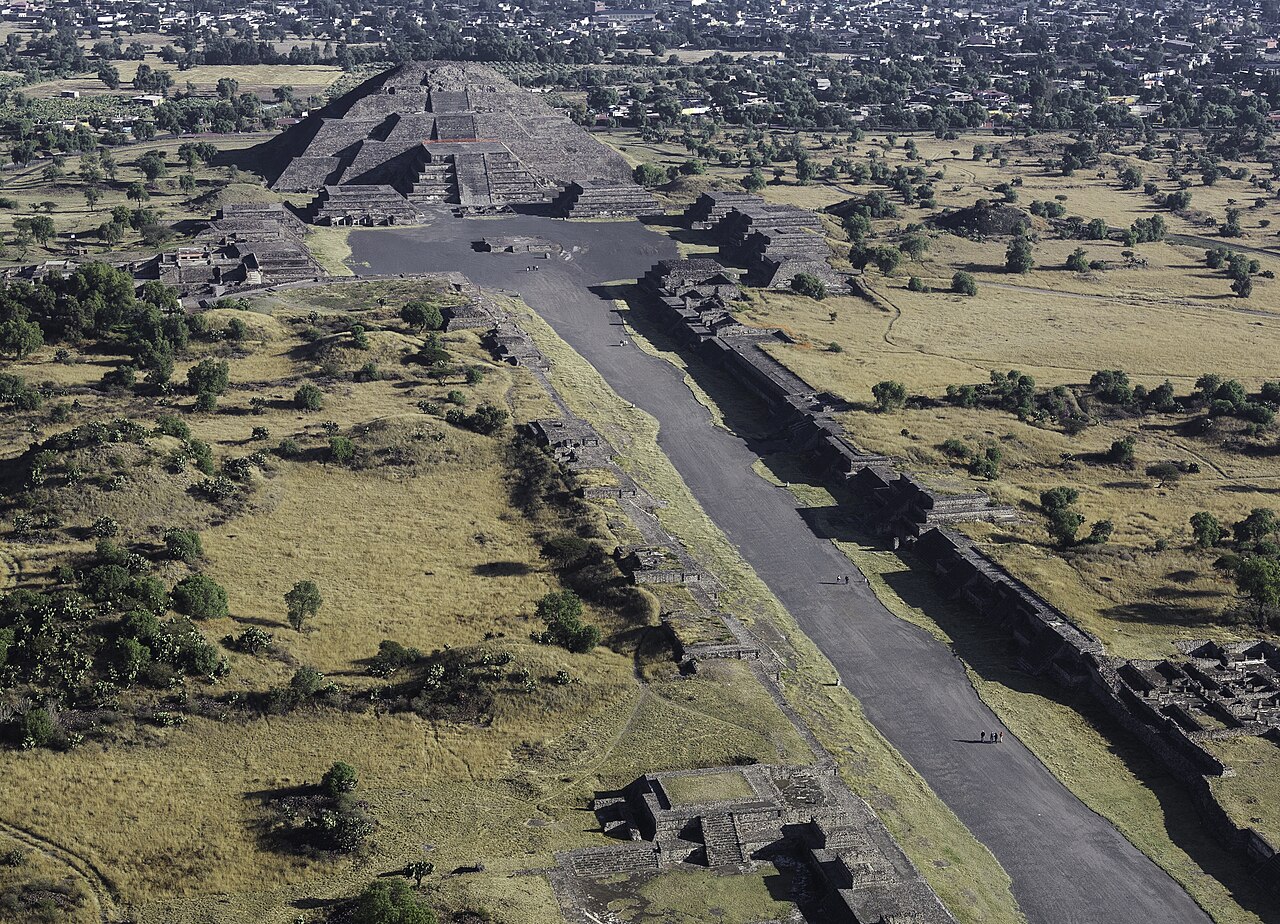
The Avenue of the Dead — the name again given by the Aztecs, who believed the platforms lining it were tombs — is the main ceremonial axis of Teotihuacan, running approximately 2.4 kilometres from the Citadel complex in the south to the Pyramid of the Moon at the north. The avenue is not a single flat road but a series of platforms at different elevations, connected by flights of steps, creating a processional sequence that moves through distinct spatial experiences as it ascends toward the Pyramid of the Moon. Flanking the avenue are the remains of hundreds of apartment compounds — the standardised residential units in which the city's inhabitants lived — many still containing traces of murals, offering deposits, and craft production workshops.
At the northern end of the avenue, the Pyramid of the Moon (approximately 43 metres tall) terminates the axis in a powerful visual closure — an effect that the ancient city planners appear to have consciously designed, since the pyramid's summit aligns precisely with the profile of the sacred mountain Cerro Gordo immediately behind it, creating the illusion that the pyramid and the mountain are a single geological form. At the southern end, the Citadel — a massive sunken enclosure surrounded by platforms — contains the Temple of the Feathered Serpent (Quetzalcoatl), Teotihuacan's third great pyramid, decorated with dramatically carved feathered serpent heads and goggle-eyed Tlaloc (rain deity) faces in alternating registers. Excavations beneath the Temple of the Feathered Serpent have found mass burials of sacrificed individuals — warriors in military costume — buried in the pyramid's foundations at the time of its construction, suggesting a dedicatory sacrifice of considerable scale.
The obsidian economy and long-distance trade
Teotihuacan's power was based partly on its control of obsidian — volcanic glass that, when knapped into sharp edges, was the primary cutting tool of Mesoamerica before metal. The Otumba and Pachuca obsidian deposits, relatively close to Teotihuacan, were among the most productive in the region, and the city appears to have dominated the production and distribution of obsidian across a vast area of Mesoamerica. Teotihuacan artefacts, architecture-style buildings, and iconography appear in Maya sites hundreds of kilometres to the south — at Tikal in Guatemala, Kaminaljuyu in the Guatemala highlands, and elsewhere — suggesting that Teotihuacan's influence extended across cultural and linguistic boundaries through trade, diplomacy, colonisation, or military intervention, or some combination of all four.
Among the most puzzling finds at Teotihuacan are large quantities of mica sheets found in the Pyramid of the Sun — a mineral that has no natural source within hundreds of kilometres of the site. The source of the mica is uncertain and debated; one hypothesis places it as far as Minas Gerais in Brazil, some 3,000 kilometres away, though closer sources within Mexico have also been proposed. The mica appears to have been deliberately incorporated into the pyramid's construction, spread in layers on its floors. Its purpose is unknown: mica is not structurally useful, but it is highly reflective and has properties that may have had ritual or symbolic significance. Its presence at Teotihuacan is one of many details that continue to resist straightforward explanation and that underline how much remains unknown about this extraordinary city and its builders.
Collapse and aftermath
Around 550 CE, Teotihuacan suffered a catastrophic collapse. Archaeological evidence — the deliberate burning of temples, palaces, and elite structures throughout the city — points strongly to an internal revolt rather than a foreign conquest: the destruction was selective, targeting the symbols of elite power rather than the residential compounds of ordinary inhabitants. The city was not immediately abandoned but experienced a dramatic and irreversible decline in population and political authority over the following century. By about 700 CE, Teotihuacan had ceased to function as a major urban centre.
The Aztecs, arriving in the Basin of Mexico centuries later, found Teotihuacan already ruined and overgrown, and they incorporated it into their own cosmological framework as a place of divine origin — a sacred landscape rather than a historical settlement they understood. It was designated a UNESCO World Heritage Site in 1987 and remains one of Mexico's most visited archaeological sites, receiving approximately 4 million visitors annually. Ongoing excavations, including a tunnel discovered and explored beneath the Pyramid of the Moon since 2017, continue to yield new discoveries about the city's rituals, rulers, and organisation, gradually filling in the portrait of a civilisation that, for all its grandeur, has left its builders almost entirely nameless.
Think you can place this building on the map?
Play Building Guessr