What it is
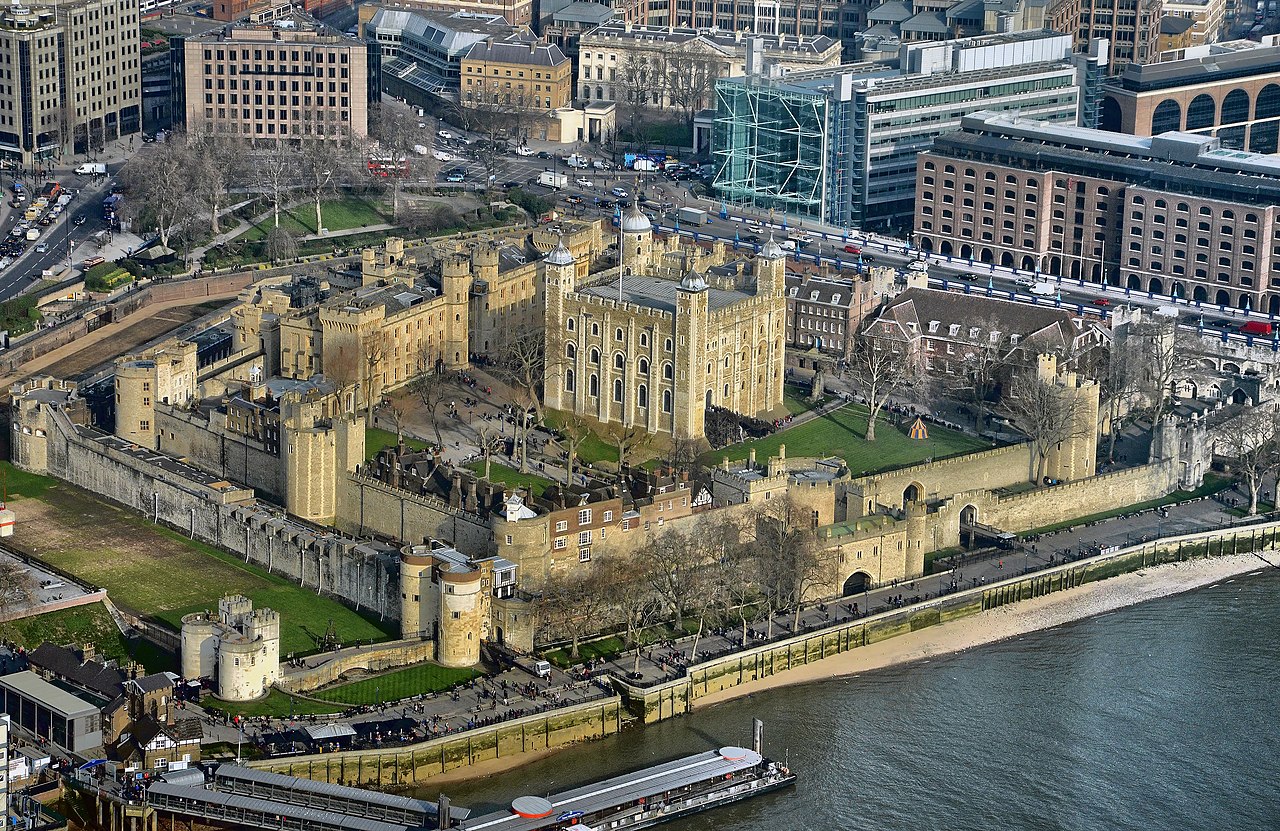
The Tower of London — formally His Majesty's Royal Palace and Fortress of the Tower of London — is a medieval castle complex on the north bank of the Thames in central London, immediately east of the City. It was founded by William the Conqueror following his victory at the Battle of Hastings in 1066, with the central keep, the White Tower, begun in 1078 and substantially complete by around 1100. In the nearly ten centuries since its foundation it has served, at various times and sometimes simultaneously, as a royal palace, a treasury and mint, an armoury, a prison, a place of execution, a menagerie, a records office, and the home of the Crown Jewels. Few buildings in the world have accumulated such a density of historical roles.
The complex as it exists today covers approximately 4.9 hectares within its outermost walls and comprises over 20 towers, including the White Tower at its centre, connected by two rings of walls — the inner ward and the outer ward — with the Traitors' Gate water entrance to the Thames. The site receives over three million visitors annually, drawn primarily by the Crown Jewels collection, the Yeoman Warder guided tours, and the Tower's extraordinary accumulation of English history. The resident Yeomen Warders — popularly known as Beefeaters — number 37 and live within the Tower walls with their families; they are uniformed ceremonial guards who also function as tour guides and custodians of the Tower's traditions.
Architectural significance
The White Tower is the finest surviving example of Norman military architecture in England and one of the most important Romanesque buildings in the British Isles. At 30 by 36 metres in plan and 27 metres tall to the battlements, it is a substantial structure by any standard, built of Caen limestone imported from Normandy and Kentish ragstone. Its walls are up to 4.6 metres thick at the base, tapering to about 3.3 metres at the top, and the design features the characteristic Norman features of the keep type: a single entrance at first-floor level accessible only by external wooden stair (later removed in an emergency), corner turrets that rise above the parapet, and a great hall and chamber arrangement on the upper floors for the royal household.
The architect of the White Tower is believed to have been Gundulf, Bishop of Rochester, who is credited with several major Norman building works in England. The design reflects the Romanesque building tradition brought from Normandy — round-headed windows, thick walls, pilaster strips on the exterior — but adapted to the English climate and to the specific requirements of a fortress that also had to function as a royal residence. The Chapel of St John the Evangelist, on the second floor of the White Tower, is one of the best-preserved Romanesque interiors in England: a simple barrel-vaulted nave flanked by aisles under a gallery, built of the same Caen limestone as the exterior, its severe geometry speaking directly to the Norman aesthetic of power through simplicity. Subsequent medieval kings extended and modified the Tower complex significantly: Henry III (1207–1272) was particularly active, adding the inner curtain wall with its towers and transforming the Tower from a single fortress keep into a concentric castle complex.
Key features
- The Crown Jewels: The collection of Crown Jewels — crowns, orbs, sceptres, swords, and other regalia used at the coronation of British monarchs — has been kept at the Tower since at least 1303, when Edward I moved them there after an attempted theft from Westminster Abbey. The collection includes the Imperial State Crown containing the Black Prince's Ruby (actually a spinel) and 2,868 diamonds, and the Cullinan I diamond, the largest top-quality cut white diamond in the world, set in the Sovereign's Sceptre with Cross.
- Famous prisoners and executions: The Tower held some of the most significant political prisoners in English history, including Anne Boleyn (executed 1536), Catherine Howard (executed 1542), Lady Jane Grey (executed 1554), Sir Thomas More (executed 1535), and Sir Walter Raleigh (imprisoned 1603–1616). The execution site on Tower Green, within the inner ward, was reserved for prisoners of high rank; more public executions took place on Tower Hill outside the walls. Two of Henry VIII's six wives were beheaded within the Tower walls.
- The Ravens: According to a legend codified in the 17th century, the kingdom will fall if the ravens ever leave the Tower. By Royal Warrant, at least six ravens must be kept at the Tower at all times. The current ravens — named Jubilee, Harris, Gripp, Rocky, Erin, Poppy, and Edgar — have one wing flight feather clipped to prevent them flying away. The Ravenmaster, a specialist Yeoman Warder, is responsible for their welfare.
- Traitors' Gate: The water gate on the Thames side, through which prisoners arrived by boat from Westminster, acquired its name from the Tudor period when many of those passing through it were headed for imprisonment and eventual execution. Anne Boleyn passed through it in May 1536; she returned through it as a corpse a few weeks later. The gate is now a viewing point within the outer ward rather than a functional entrance.
- The Royal Menagerie: From at least the 1230s until 1835, the Tower housed a royal collection of exotic animals — including lions, polar bears (who fished in the Thames), an African elephant, and a rhinoceros. The animals were housed in a series of dens at the Lion Tower, now demolished. The menagerie was closed by the Duke of Wellington (then Constable of the Tower) in 1835 and its animals transferred to the newly opened London Zoo in Regent's Park.
Construction and history
The White Tower was begun in 1078, approximately twelve years after the Norman Conquest, as part of William's systematic programme of castle building to consolidate his hold on England. The choice of site — at the southeastern corner of the old Roman city wall, commanding both the approach from the river and the eastern entrance to the city — reflects strategic calculation: the castle was as much a statement of dominance to the population of London as it was a military installation. By the time of William's death in 1087 the keep was substantially complete, though it was not yet whitewashed — the whitewashing that gave the White Tower its name dates from the 1240s under Henry III.
The subsequent history of the Tower complex is one of almost continuous expansion and modification. Richard I added the Bell Tower and began the inner curtain wall in the 1190s. Edward I (1272–1307) undertook the most systematic expansion, building the outer curtain wall with its nine towers and the moat, creating the concentric plan visible today. The Tudor period was the Tower's most historically intense: Henry VIII and his successors used it extensively as both prison and execution site, and the Tower's dark reputation dates primarily from this period. The moat was drained in 1843, and much of the Victorian work focused on restoration and making the medieval fabric accessible to the public, which began to visit in significant numbers from the mid-19th century.
Preservation and status
The Tower of London is a UNESCO World Heritage Site (inscribed 1988) and is managed by Historic Royal Palaces, a charity that manages the unoccupied royal palaces on behalf of the Crown. The White Tower underwent a major external conservation programme between 2016 and 2019, cleaning and repointing the Caen stone facades and repairing the battlements. The moat, drained since 1843, was temporarily filled with ceramic poppies in 2014 as an art installation commemorating the centenary of World War I — 888,246 poppies representing each British and Commonwealth fatality — an installation seen by over five million people and widely credited as one of the most successful public art projects in British history.
Think you can place this building on the map?
Play Building Guessr