Architecture in Cambodia
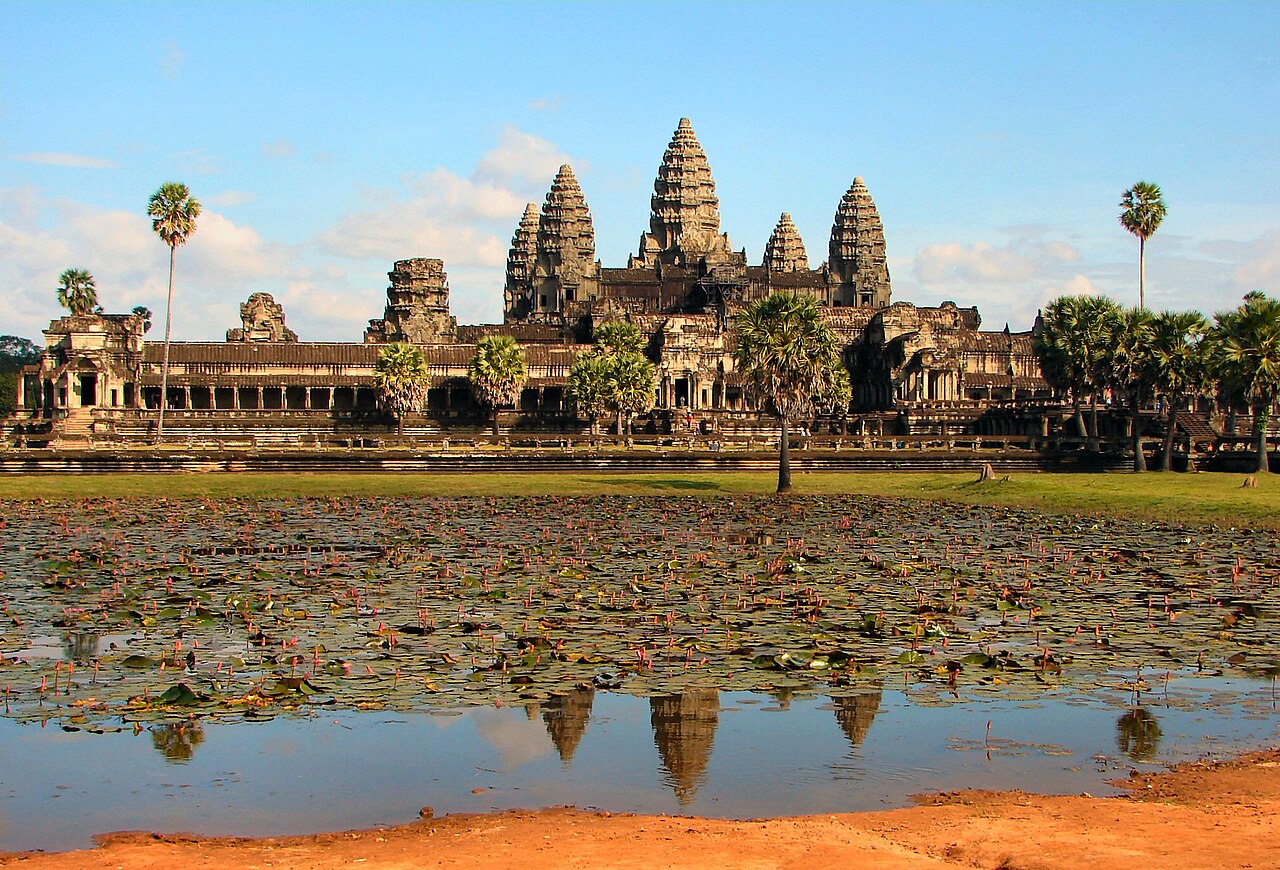
Cambodia is home to one of the most astonishing concentrations of medieval architecture on earth: the Khmer Empire, which ruled from Angkor between the 9th and 15th centuries, built a series of temple-cities of extraordinary scale and ambition. Angkor Wat alone covers approximately 400 hectares including its moat and is surrounded by a moat 5 kilometres in circumference. The Khmer temple-mountain form — a stepped pyramid representing Mount Meru, the cosmic axis of Hindu and Buddhist cosmology — was expressed in sandstone at a monumental scale, with bas-relief carving programmes that rival anything in the ancient world. After the empire's collapse in the 15th century, much of Angkor was abandoned to the forest and slowly claimed by the root systems of strangler figs and silk-cotton trees, creating the haunting image of architecture and jungle locked in permanent mutual embrace.
Notable Buildings
-
Khmer / Hindu
The largest religious monument in the world (covering 162 hectares within its outer enclosure), built by Suryavarman II in the 12th century as a state temple and mausoleum. Its five towers represent the five peaks of Mount Meru; 800 metres of continuous bas-relief carving depicts scenes from Hindu mythology and the king's military victories.
-
Khmer / Buddhist
Bayon Temple, Angkor Thom
The state temple of Jayavarman VII (late 12th c), famous for its 54 towers each carved with four enormous faces — serene, enigmatic, and slightly smiling — pointing to the cardinal directions. The identity of the faces (the bodhisattva Avalokitesvara, or the king himself, or both) remains debated.
-
Khmer / Buddhist
Ta Prohm
Built in 1186 by Jayavarman VII as a monastery and university. Left largely uncleared since rediscovery, Ta Prohm is famous for the massive roots of strangler figs and silk-cotton trees growing through and over the stone structures — the most vivid image of jungle reclamation of architecture anywhere in the world.
-
Khmer
Preah Khan
A temple-city built by Jayavarman VII (1191) covering 56 hectares, likely housing a population of 100,000 people in its support structures. Unlike the stone sanctuary, the surrounding wooden city has entirely disappeared, leaving only the carved stone at its centre.
-
Khmer
Banteay Srei
A small 10th-century temple dedicated to Shiva, considered by many scholars to have the finest stone carving in the Khmer world. Built from pink sandstone (which hardened over time), its intricate decorative programme of deities, demons, and narrative scenes is astonishingly well-preserved.
-
Colonial / Royal
Phnom Penh Royal Palace
The royal residence built in 1866 on the site of an earlier palace, combining Khmer traditional architecture with some French colonial modifications. The Silver Pagoda within the compound has a floor of 5,329 silver tiles weighing 1 kg each and contains a life-sized gold Buddha encrusted with 9,584 diamonds.
Architectural Character
Khmer architecture is temple architecture at urban scale. The great monuments of Angkor are not isolated buildings but entire planned cities: temple-mountains at the centre, surrounded by concentric enclosure walls, moats, approach causeways, and — in the case of the most important temples — entire urban support populations housed in wooden structures now vanished. The temple-mountain form encodes Hindu-Buddhist cosmology: the five towers represent the five peaks of Mount Meru; the moat represents the cosmic ocean; the causeway is the passage from the profane to the sacred.
Construction in sandstone — quarried from Phnom Kulen and floated downstream on rafts — allowed the Khmer to achieve a precision of carving unmatched in Southeast Asia. The transition from Hindu to Mahayana Buddhist patronage under Jayavarman VII (late 12th c) shifted the imagery without fundamentally changing the architectural system, producing the face-tower form of the Bayon.
Test your knowledge of Asian landmarks.
Play Building Guessr