Architecture in the Czech Republic
The Czech Republic — and particularly Prague — contains one of the best-preserved medieval urban cores in Europe, largely because the city escaped significant damage in both World Wars. Gothic, Romanesque, Renaissance, Baroque, Art Nouveau, and Cubist buildings stand within metres of each other in the Old Town, creating a palimpsest of European architectural history concentrated in a walkable city centre. The Bohemian Baroque of the 17th and 18th centuries, shaped by Italian architects working under Habsburg patronage, is as distinctive as any in Europe. The early 20th century produced a remarkable Czech Cubist architecture — a style with no close parallel elsewhere in the world, applying the visual language of Picasso and Braque to building facades, furniture, and even lampposts — making Prague uniquely the only city where Cubist architecture exists in the streets.
Notable Buildings
-
Gothic / Baroque
Prague Castle
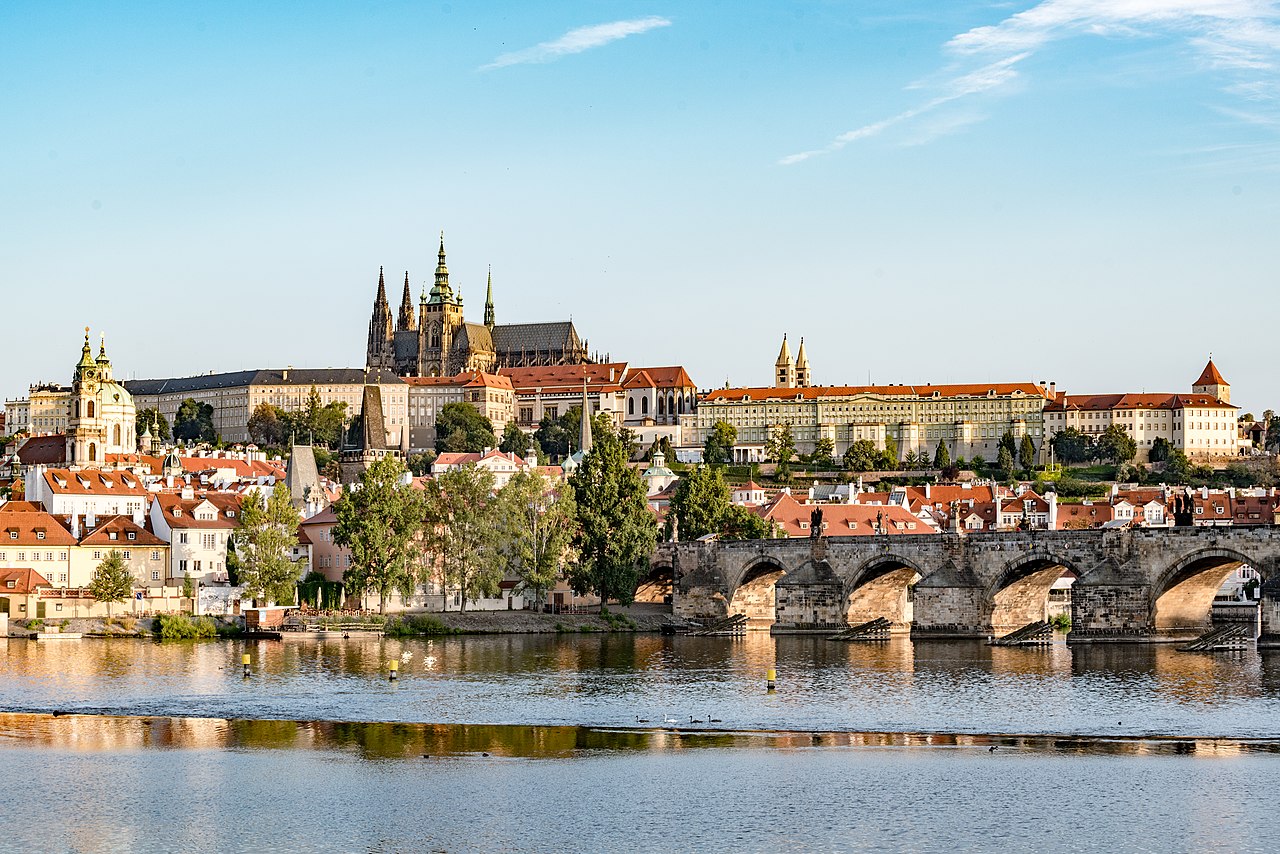
The largest ancient castle in the world by area (70,000 sq m), Prague Castle has been the seat of Bohemian kings, Holy Roman Emperors, and Czech presidents for over a millennium. Within its walls: the Gothic St Vitus Cathedral, the Romanesque St George's Basilica, the Renaissance Royal Palace, and the Baroque Schwarzenberg Palace — each layer of history still legible.
-
Gothic
St Vitus Cathedral
Begun in 1344 under Charles IV and completed only in 1929 — nearly 600 years of construction. The Wenceslas Chapel contains the Czech Crown Jewels; the interior mosaics are among the finest in Central Europe. The stained glass includes windows designed by Alfons Mucha in Art Nouveau style, sitting incongruously and beautifully alongside medieval glazing.
-
Medieval
Charles Bridge
A 516-metre Gothic stone bridge across the Vltava river, completed in 1402 under Charles IV. The 30 Baroque statues added in the 17th and 18th centuries — saints and martyrs watching over the crossing — are among the defining images of Prague. The bridge was the city's only river crossing for over 400 years.
-
Late Gothic
Prague Astronomical Clock (Orloj)
The Prague Orloj (1410) is the oldest astronomical clock still in operation anywhere in the world. Every hour a procession of apostolic figures appears at the windows above the clock face; the Grim Reaper rings a bell. The clock simultaneously displays solar time, Bohemian time, sidereal time, and the positions of the sun and moon.
-
Gothic
Sedlec Ossuary, Kutná Hora
A small Gothic chapel decorated with the bones of approximately 40,000 to 70,000 people, arranged into chandeliers, a coat of arms, and a central pyramidal structure. Created by a woodcarver in 1870 from bones accumulated over centuries of plague and crusade. It is one of the most extraordinary interior spaces in Central Europe.
-
Renaissance
Historic Town Square, Telč
A Moravian town whose central square is ringed by an unbroken run of Renaissance and Baroque burgher houses with arcaded ground floors and distinctive triangular, semicircular, or stepped gable ends. A UNESCO World Heritage Site representing the best-preserved Renaissance town planning in Central Europe — uniform in scale but endlessly varied in detail.
-
Czech Cubism
House of the Black Madonna, Prague
Josef Gočár's 1912 department store is the finest example of Czech Cubist architecture in Prague — faceted facade planes catch light at shifting angles, the whole building appearing as though carved from a single crystal block. The style was adapted from Picasso's paintings by a small group of Czech architects between 1911 and 1925, and exists nowhere else.
Architectural Character
Bohemia sits at the centre of Europe, and its architecture reflects exposure to every major Western architectural movement. Romanesque churches (11th–12th c) survive under many later buildings — the Basilica of St George within Prague Castle is the best-preserved example. Gothic arrived from France via the House of Luxembourg and was pursued with particular ambition under Charles IV, who made Prague the capital of the Holy Roman Empire in the 14th century and undertook the most extensive building programme the city had ever seen.
The Czech Baroque, imported from Italy under Habsburg patronage, produced the extravagant pilgrimage church at Zelená Hora and the palace complexes lining Prague's Malá Strana (Lesser Town), including the Wallenstein Palace with its exceptional Mannerist garden. Prague's Old Town, Malá Strana, and Hradčany districts together constitute one of the most complete Baroque urban ensembles in the world. The 19th century brought a wave of Neo-Gothic and Neo-Renaissance nationalism, and the brief Art Nouveau flowering that produced the Municipal House.
Czech Cubism (1911–1925) is the country's most unique architectural contribution. Inspired by the paintings of Picasso and Braque, a group of Czech architects — Josef Gočár, Pavel Janák, Josef Chochol — applied Cubist visual fragmentation to building facades, furniture, and street furniture, creating buildings with faceted, crystalline facades that generate dramatic light and shadow effects. There is no close parallel anywhere else in European architecture, and its existence within a few streets of medieval Gothic buildings makes Prague architecturally unlike any other city.
Test your knowledge of European landmarks in the game.
Play Building Guessr