Architecture in Iran
Iran is home to one of the oldest continuously inhabited urban civilisations on earth, and its architecture reflects 6,000 years of building tradition punctuated by empire, conquest, and renewal. Persepolis, the ceremonial capital of the Achaemenid Empire, demonstrates the ambition and organisational capacity of the world's first superpower. The Islamic conquest of 651 CE brought new forms — the iwan, the muqarnas vault, the minaret, geometric surface decoration — which Iranian craftsmen absorbed and transformed into some of the most sophisticated Islamic architecture in the world. Isfahan, rebuilt as the Safavid capital in the 16th and 17th centuries under Shah Abbas I, represents the high point of Iranian Islamic urbanism: a planned city centred on a vast public square (the Naqsh-e Jahan), surrounded by mosques, palaces, and a covered bazaar in perfect compositional balance.
Notable Buildings
-
Achaemenid
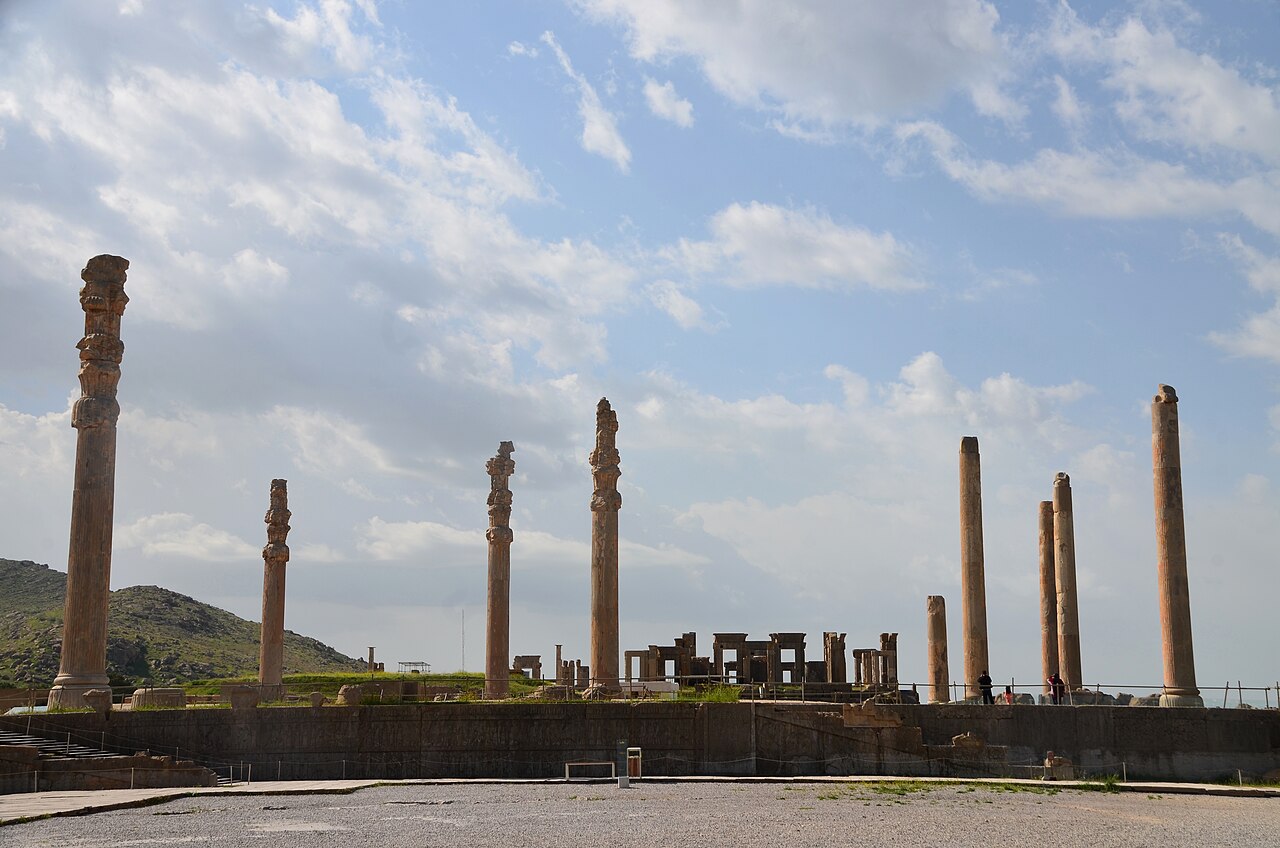
Persepolis
The ceremonial capital of the Achaemenid Empire, founded by Darius I c.515 BCE and burned by Alexander the Great in 330 BCE. The Apadana (audience hall, 100 columns), the Gate of All Nations, and the Throne Hall survive as stone columns and reliefs depicting delegations from 23 subject peoples bringing tribute.
-
Safavid
Imam Mosque (Shah Mosque), Isfahan
The principal mosque of the Naqsh-e Jahan Square (1629), entered through a monumental iwan 27 metres high covered in muqarnas and tile mosaic. The dome (54 metres) uses a double-shell system and is entirely clad in blue and turquoise tilework. Turned 45° from the square's axis to face Mecca.
-
Safavid
Sheikh Lotfollah Mosque, Isfahan
A private royal mosque built for Shah Abbas I's harem (1619), with no minarets and no courtyard — accessed directly from the Naqsh-e Jahan Square through a bent corridor that prevents sight of the interior until the final moment. Its interior dome of cream and buff tilework with arabesque patterns is considered the finest in Iran.
-
Safavid
Ali Qapu Palace, Isfahan
The six-storey gatehouse-palace on the Naqsh-e Jahan Square, from which the Shah watched polo games on the square below. The top-floor music room (talar-e musiqi) has its walls carved with the shapes of ceramic vessels — niches shaped like bottles, vases, and goblets — for acoustic effect.
-
Achaemenid
Pasargadae
The first capital of the Achaemenid Empire, built by Cyrus the Great c.546 BCE, and containing his tomb — a simple gabled stone chamber on a stepped platform. The complex represents the earliest known example of a formal Persian garden (pairi-daeza — the origin of the word paradise).
-
Qajar
Golestan Palace, Tehran
The royal court of the Qajar dynasty (19th c), a complex of 17 structures within a walled garden. The Mirror Hall (Talar-e Aineh) and the Marble Throne (Takht-e Marmar) represent the meeting of Iranian craft tradition with European decorative influences — combining Persian tilework with Venetian mirrors and Belgian glass chandeliers.
-
Late Qajar
Nasir al-Mulk Mosque (Pink Mosque), Shiraz
A late Qajar mosque (1888) famous for its stained-glass windows that cast coloured light across its tiled floor in the early morning — one of the most photographed interiors in Iran. The interior muqarnas vaulting and tile patterns are exceptional even by Iranian standards.
Architectural Character
Iranian Islamic architecture is among the most refined in the world, distinguished by its mastery of surface and by its handling of the transition from wall to vault to dome. The muqarnas — a honeycomb of small niches that fills the transition zone and dissolves the boundary between wall and ceiling — was developed in Iran to a degree of complexity unmatched elsewhere. Geometric surface decoration (girih), tilework (kashi-kari), and carved plasterwork (gach-buri) cover every surface with a mathematical precision that carries theological meaning: the infinite patterning of geometric ornament represents the infinite nature of God, while the absence of figural representation (mandated by Islamic law) directed creative energy entirely into abstract pattern.
The Iranian city, from its bazaar spine and caravanserai nodes to its mosque and madrasa complexes, represents one of the most complete systems of urban planning in the premodern Islamic world.
Test your knowledge of Middle Eastern landmarks.
Play Building Guessr