Architecture in Israel
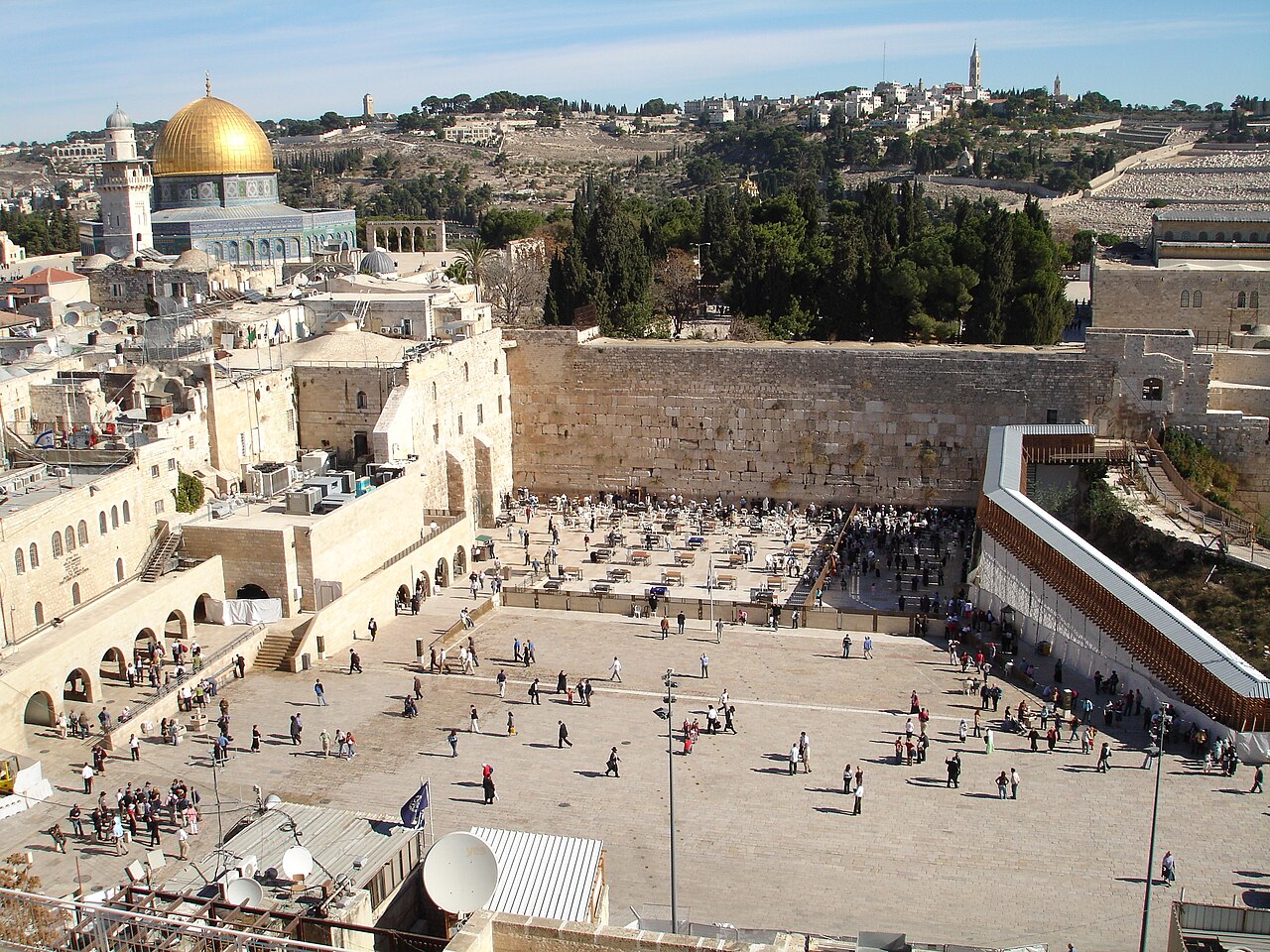
Israel and the Palestinian territories contain a concentration of sacred architecture with no parallel anywhere in the world: sites holy to Judaism, Christianity, and Islam occupy a few square kilometres of Jerusalem's Old City, each layered over earlier remains. The Western Wall — the last surviving retaining wall of Herod's Second Temple — stands metres from the Dome of the Rock, built by the Umayyad Caliph Abd al-Malik in 691 CE; the Church of the Holy Sepulchre, marking the site of the Crucifixion and Resurrection, is a few hundred metres further. Beyond Jerusalem, the landscape contains Crusader castles, Roman cities (Caesarea, Bet She'an), Bronze Age tells, and the UNESCO-listed White City of Tel Aviv — the world's largest concentration of Bauhaus architecture.
Notable Buildings
-
Jewish / Roman
Western Wall and Temple Mount
The Western Wall is a 488-metre retaining wall of Herod the Great's expansion of the Second Temple Mount (c.19 BCE). The upper courses are later Ottoman additions. The Temple Mount above — the Haram al-Sharif — contains the Dome of the Rock and Al-Aqsa Mosque, making it the site most contested in the history of religion.
-
Islamic
Dome of the Rock, Jerusalem
Built by the Umayyad Caliph Abd al-Malik in 691 CE — one of the oldest surviving works of Islamic architecture in the world. The octagonal plan, golden dome, and elaborate mosaic decoration were deliberate statements of the new religion's power and ambition, built on the most sacred site in Jerusalem.
-
Christian
Church of the Holy Sepulchre, Jerusalem
The church marks the traditional site of the Crucifixion, burial, and Resurrection of Jesus. The current structure is a Crusader rebuilding (1149) of an earlier Byzantine church. Six Christian denominations share the building under the Status Quo arrangement, maintaining distinct chapels and control of specific architectural elements.
-
Roman
Masada
Herod the Great's fortress-palace on an isolated mesa above the Dead Sea, famous for the siege of 73–74 CE in which the Jewish Zealot garrison chose collective death over Roman capture. The UNESCO site contains bathhouses, mosaic floors, and a synagogue that are among the best-preserved Roman remains in the region.
-
Bahá'í
Terraced Gardens, Haifa
The 19 terraced gardens ascending Mount Carmel above the Shrine of the Báb are the most formally ambitious landscape work in the Middle East. Designed by the landscape architect Fariborz Sahba, they are perfectly aligned with the Bahá'í administrative buildings above and below, creating a 1-kilometre axis.
-
Modern Movement
White City, Tel Aviv
Approximately 4,000 buildings constructed in the International Style (Bauhaus-influenced modernism) between 1930 and 1950 by Jewish architects who had studied in Germany and brought the Bauhaus aesthetic to the new city. UNESCO designated the district in 2003 as the world's largest concentration of buildings in this style.
-
Holocaust Memorial
Yad Vashem, Jerusalem
Moshe Safdie's 2005 museum building is a 180-metre concrete and glass prism that penetrates a hilltop, with one end open to a view over the Jerusalem forest. The triangular cross-section narrows toward the viewpoint — a spatial compression and release that mirrors the memorial's content.
Architectural Character
Jerusalem's Old City is an architectural palimpsest more compressed than almost any other site on earth. Roman columns are incorporated into medieval walls; Crusader capitals are reused in Ottoman mosques; Byzantine mosaics survive under Islamic tile revetment. The city's layering is not merely temporal — it is the physical record of successive conquests, conversions, and destructions, each new power building on, over, and sometimes through the last.
Israeli Modernism — the Bauhaus inheritance brought by Jewish architects fleeing National Socialism — produced a coherent urban experiment in Tel Aviv that represents the Modernist project at urban scale more fully than almost any other city. Contemporary Israeli architecture oscillates between the memorial — Yad Vashem, the Museum of the Holocaust History, the Children's Memorial — and the pragmatic housing blocks and commercial towers of a rapidly growing economy, with the Bauhaus inheritance providing an often-invoked thread of cultural identity.
Test your knowledge of Middle Eastern landmarks.
Play Building Guessr