Architecture in Morocco
Morocco's architecture is the western terminus of the Islamic architectural tradition, shaped by Amazigh (Berber) building cultures, Arab dynasties, Andalusian refugees who fled the Reconquista with their craft skills, and a distinctive Saharan vernacular of earthen construction. The Moroccan medina — the historic walled city — is among the most complex urban environments in the world: dense, pedestrian, organised around the mosque and madrasa rather than the street grid, with buildings oriented inward toward private courtyards rather than outward toward public facades. Moroccan craft traditions — zellij tilework, carved plasterwork, cedarwood carpentry — are among the most technically demanding in the Islamic world and have survived continuous practice from the medieval period to the present day.
Notable Buildings
-
Almohad
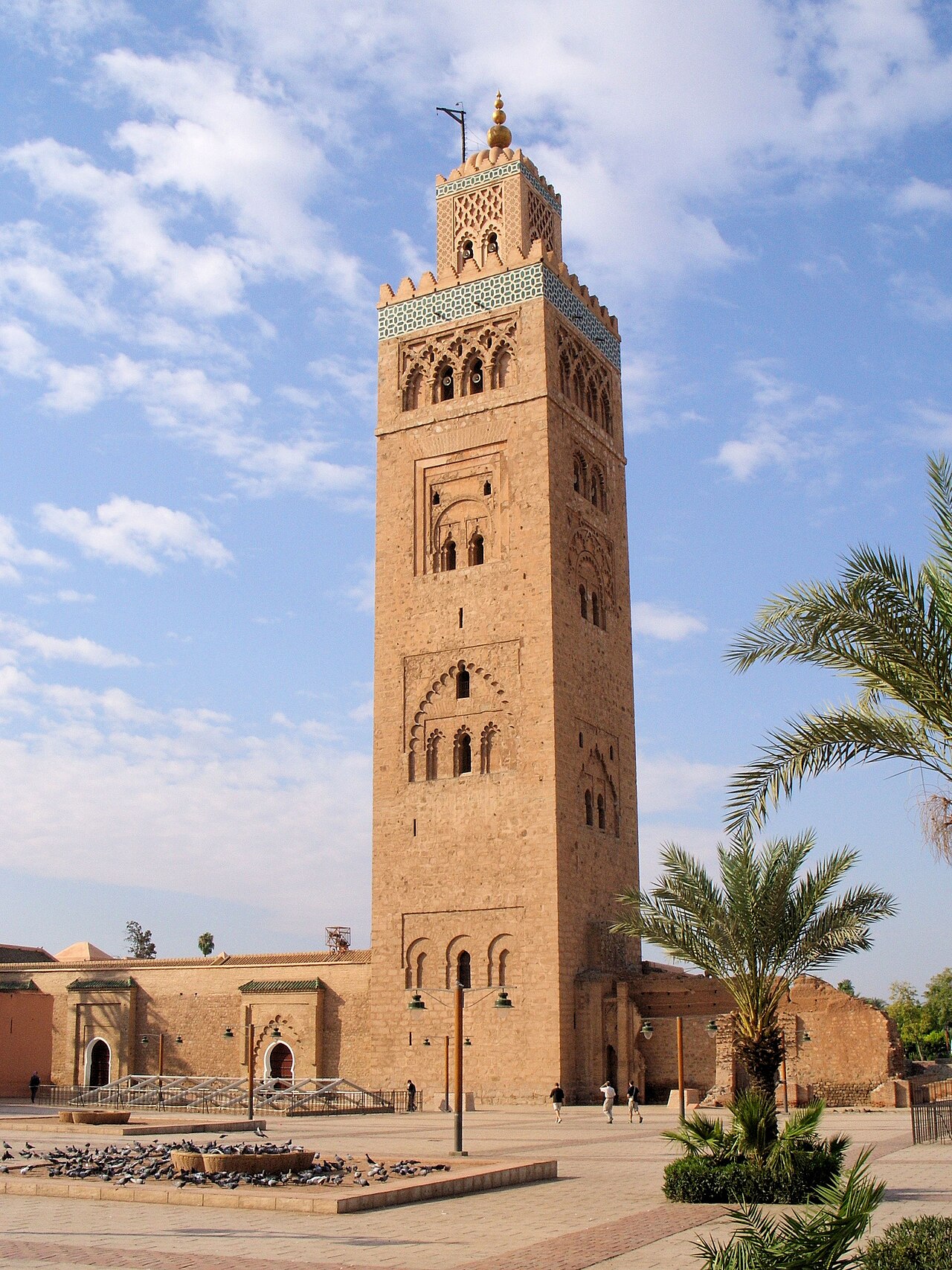
Koutoubia Mosque, Marrakech
The minaret of the Koutoubia Mosque (1158) is the prototype for the Giralda in Seville and the Hassan Tower in Rabat — a family of Almohad minarets that established the standard Moroccan minaret form: a square shaft topped by a smaller decorative pavilion, decorated with different geometric patterns on each face.
-
Islamic Modernism
Hassan II Mosque, Casablanca
The largest mosque in Africa and one of the largest in the world (1993), with a minaret of 210 metres — the tallest religious structure in the world. Built on a platform extending over the Atlantic Ocean, its floor is partially glass so worshippers pray above the sea. Commissioned by Hassan II to reinforce Morocco's Islamic identity.
-
Medieval Islamic
Fès el Bali (Old Fez)
The world's largest urban car-free zone and a UNESCO World Heritage Site. The medina of Fez contains approximately 9,000 alleyways, the al-Qarawiyyin university (founded 859 CE — often cited as the world's oldest continuously operating university), the Bou Inania Madrasa, and the famous Chouara tannery, unchanged in its technology since the medieval period.
-
Marinid
Bou Inania Madrasa, Fez
The finest surviving Marinid building (1351–1356), a religious school whose courtyard is the masterwork of Moroccan architectural decoration: zellij tilework to mid-wall height, carved cedar screens above, carved plasterwork (stucco) panels reaching the ceiling, and a cedar carved cornice between each layer — the complete grammar of Moroccan interior ornament in one space.
-
Alaouite
Bahia Palace, Marrakech
A late 19th-century palace complex built for a powerful vizier, covering 8,000 square metres of rooms, courtyards, and gardens. The name means "brilliance"; the palace's inlaid cedar ceilings, painted plasterwork, and zellige courtyard floors represent the summit of late Moroccan court architecture and the craft traditions it patronised.
-
Berber / Adobe
Aït Benhaddou
A ksar (fortified village) of earthen architecture on the pre-Saharan trade route, built in sun-dried mud-brick with organic forms — rounded towers, flat roofs, recessed windows with mud-brick grilles — that respond perfectly to the extreme desert climate: thick walls for thermal mass, high placement to catch wind, minimal openings on the west. A UNESCO World Heritage Site and one of the most-filmed locations in Morocco.
Architectural Character
Moroccan Islamic architecture is distinguished by its layered interior richness and its deliberately plain exterior. The Moroccan medina building presents a blank wall to the street — no windows, no ornament, no display — and turns all its decorative energy inward toward the riad courtyard (a garden courtyard with a central fountain) or the madrasa study court. This inward orientation is both functional (privacy, security) and cosmological (the paradise garden, the enclosed water of the fountain representing spiritual refreshment).
The three materials of Moroccan interior decoration — zellij (cut-tile geometric mosaic), gach (carved plasterwork), and cedarwood carving — are applied in horizontal bands: tiles from floor to dado, plasterwork from dado to cornice, cedarwood above. Each material has its own guild tradition, its own patterns, and its own vocabulary, and their combination — in mosques, palaces, madrasas, and private houses — constitutes the most consistent decorative system in the Islamic West.
Test your knowledge of African landmarks.
Play Building Guessr