Architecture in the Netherlands
The Netherlands has punched far above its weight in architecture, driven by the particular constraints of building on reclaimed land below sea level and by a Protestant culture that valued civic rather than religious display. The Dutch Golden Age (17th century) produced the canal-house facade as a distinct building type — narrow, tall, with decorative gables and hoisting hooks — and the country's first significant secular public buildings. The De Stijl movement (1917) — encompassing Mondrian in painting, van Doesburg in theory, and Rietveld in architecture — produced the Rietveld Schröder House and a geometric visual language that influenced Modernism worldwide. Postwar Rotterdam, rebuilt from near-total bomb damage after May 1940, became a laboratory for architectural experiment and today has one of the most adventurous contemporary skylines in Europe — a direct consequence of having almost nothing left to preserve.
Notable Buildings
-
Dutch Neo-Renaissance
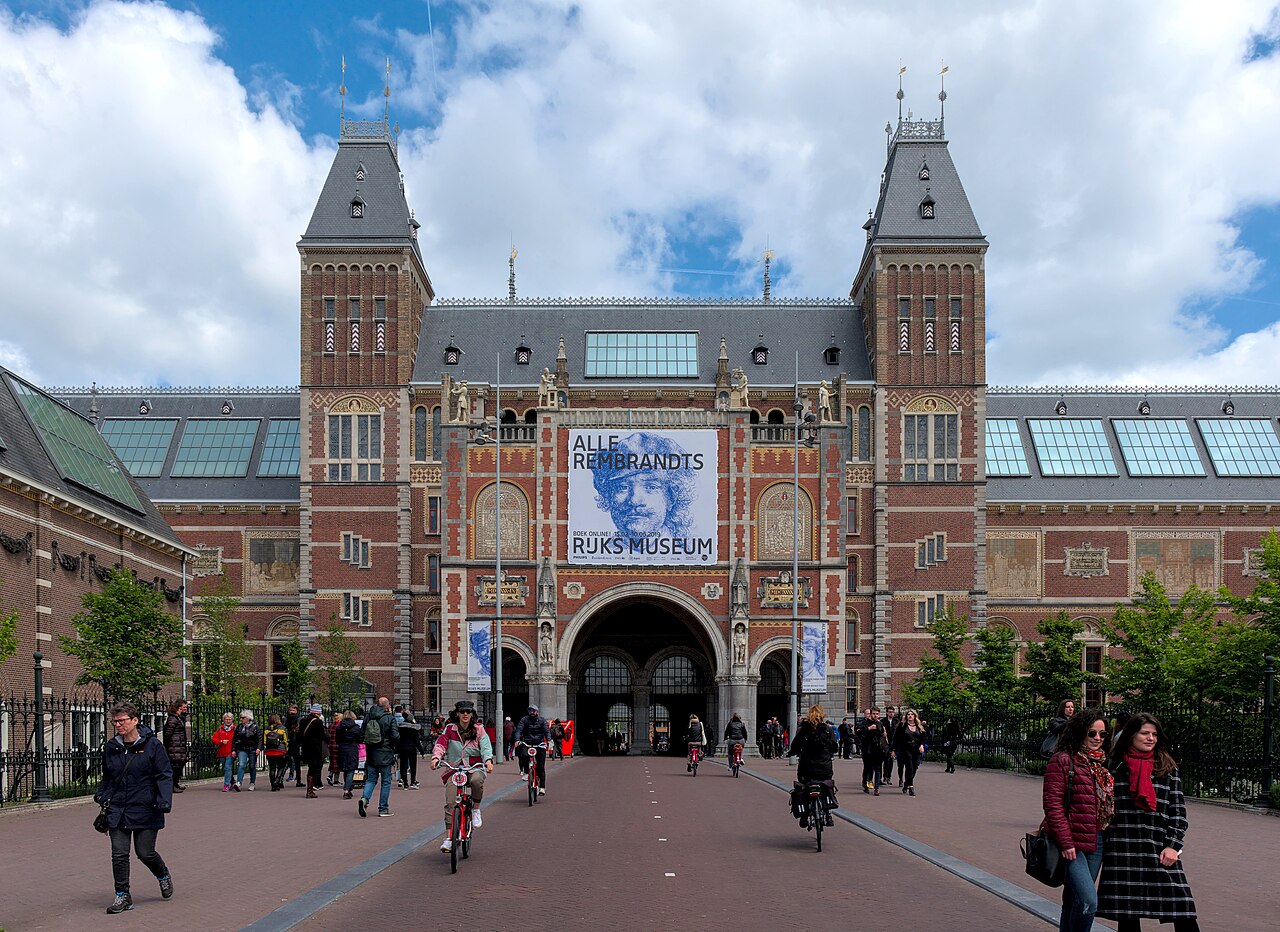
Rijksmuseum, Amsterdam
Pierre Cuypers's 1885 building houses the national collection, including Rembrandt's Night Watch and Vermeer's Milkmaid. The building's Gothic-Renaissance exterior was controversial at the time — Protestant critics objected to its ornate Catholic decorative programme, a tension that runs through Dutch cultural history. A major renovation completed in 2013 restored it to its original grandeur.
-
Merchant / Golden Age
Amsterdam Canal Ring
The 17th-century crescent of canals — Herengracht, Keizersgracht, Prinsengracht — lined with gabled merchant houses is a UNESCO World Heritage Site. The houses are narrow (to minimise tax assessed on street frontage), tall (storage above living quarters), and equipped with hoisting beams at the roofline for lifting goods through upper-floor doors.
-
De Stijl
Rietveld Schröder House, Utrecht
Gerrit Rietveld's 1924 house for Truus Schröder-Schräder applies De Stijl principles in three dimensions: primary colours on structural elements, an asymmetric composition of planes and volumes, and sliding partitions that transform the upper floor into one open space. It is the only building commissioned according to strict De Stijl principles and is a UNESCO World Heritage Site.
-
Gothic
Binnenhof, The Hague
The 13th-century Gothic castle complex at the heart of Dutch government — parliament has sat here since the 15th century. The Knights' Hall (Ridderzaal, 1280) hosts the annual throne speech (Prinsjesdag). The complex surrounds a rectangular courtyard with a moat and remains the working centre of Dutch democratic government.
-
Contemporary
Cube Houses, Rotterdam (Piet Blom)
38 cube-shaped houses tilted 45° and raised on hexagonal pylons over a pedestrian street in Rotterdam (1984). Each tilted cube is a complete three-floor house; the corners become the floor, walls, and ceiling of the living spaces. The design maximises light and creates a covered pedestrian arcade below. A permanent show cube is open to visitors.
-
High-Tech
Erasmus Bridge, Rotterdam
Ben van Berkel's asymmetric cable-stayed bridge (1996) over the Maas river, nicknamed the Swan for its single inclined pylon. It was one of the first major bridges to be analysed entirely by computer simulation and became the symbol of Rotterdam's postwar reinvention — a deliberate attempt to give the rebuilt city an iconic image.
-
Contemporary
NEMO Science Museum, Amsterdam
Renzo Piano's 1997 building rises from the water like the prow of a ship above the entrance to the Amsterdam harbour tunnel. The green copper roof functions as a large public plaza accessible by a grand exterior staircase. It is the largest science museum in the Netherlands and one of the most visited in Europe.
Architectural Character
Dutch architecture is shaped by four forces: land, water, money, and Protestantism. The flat, reclaimed polder landscape demanded sophisticated water management systems — dykes, sluices, windmills, and pumping stations — that were themselves works of civil engineering as carefully considered as any building. The constant battle to keep the sea out has made Dutch engineers among the most inventive hydraulic specialists in the world, a tradition that continues in the Delta Works flood protection system and the Maeslantkering storm surge barrier.
The Protestant Reformation stripped churches of ornament and redirected architectural ambition toward civic and commercial buildings — the town hall, the market hall, the merchant warehouse. Dutch Golden Age architecture developed a domestic scale and material culture — brick construction, stone trim, carved gable ends — that was exported to English colonies in North America (the Dutch legacy is visible in the architecture of New York, originally New Amsterdam) and to British architecture via William III, who brought Dutch influences to English court architecture after 1689.
The 20th century brought De Stijl's radical geometric abstraction and then postwar Rotterdam's experimental modernism, which has never stopped experimenting. Dutch architecture today — Rem Koolhaas and OMA, MVRDV, Ben van Berkel and UN Studio, Winy Maas — is among the most internationally published and discussed in the world, entirely disproportionate to the country's modest size. The Netherlands produces more significant architecture per capita than any other nation, a fact that architecture schools worldwide have tried and largely failed to explain or replicate.
Test your knowledge of European landmarks in the game.
Play Building Guessr