Architecture in South Africa
South Africa's built environment reflects the country's layered history of indigenous cultures, Dutch and British colonialism, the Apartheid regime and its deliberate spatial engineering, and the democratic era's attempts to create a new public architecture of reconciliation and memory. Indigenous building traditions — the Zulu beehive hut, the Ndebele painted house, the Sotho stone enclosure — predate European settlement by centuries and are now valued as heritage alongside colonial and modernist structures. Cape Dutch architecture — the whitewashed gabled farmhouses of the Western Cape — represents one of the most distinctive regional colonial styles in the southern hemisphere. Post-Apartheid South Africa has invested significantly in civic and cultural institutions as expressions of democratic aspiration, producing buildings that grapple explicitly with the country's history.
Notable Buildings
-
Georgian / Colonial
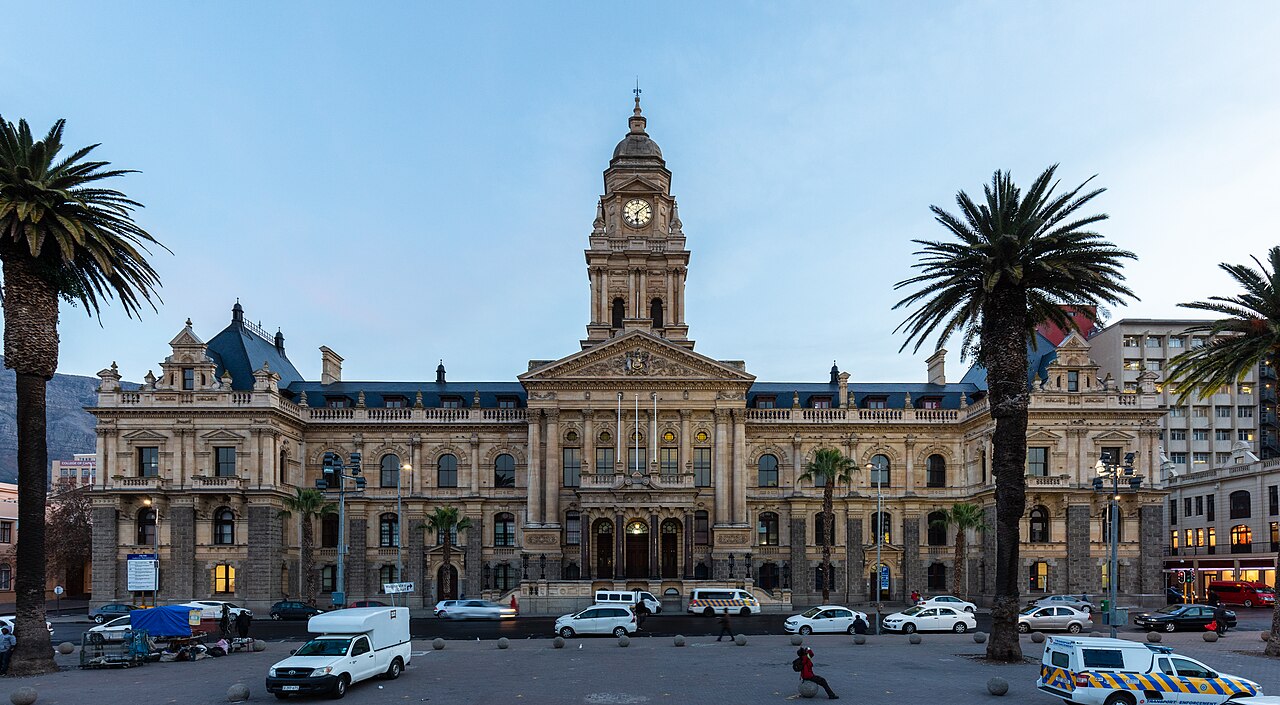
Cape Town City Hall
The Edwardian Baroque building (1905) on the Grand Parade where Nelson Mandela gave his first public speech after release from Robben Island in 1990. Its Portland stone facade, central tower, and arcaded ground floor follow the English civic hall model transplanted to the southern hemisphere.
-
Neoclassical
Union Buildings, Pretoria
Herbert Baker's seat of the South African government (1913) rises in twin wings from a terraced hillside above Pretoria, symbolically joining the English and Afrikaner cultures through shared classical references. Nelson Mandela was inaugurated as President on its amphitheatre steps in 1994 — the same building from which Apartheid was administered.
-
Contemporary
Constitutional Court, Johannesburg
The post-Apartheid Constitutional Court (2004) was deliberately built on the site of the old Fort Prison, where political prisoners including Nelson Mandela were held before Robben Island. The building incorporates prison walls, uses materials reclaimed from demolition, and displays 200 works of South African art — an architecture of memory and democratic aspiration.
-
Contemporary
Zeitz MOCAA, Cape Town
Thomas Heatherwick's Museum of Contemporary Art Africa (2017) hollows out a 1920s grain silo complex, cutting a cathedral-like atrium through the cylindrical grain tubes — the concrete tubes exposed and curved on the interior walls. It is the largest museum of contemporary African art in the world.
-
Colonial / Industrial
Victoria & Alfred Waterfront, Cape Town
The Victorian working harbour complex (1860s onward) preserved and adapted into a retail, hotel, and museum precinct, including the Nelson Mandela Gateway to Robben Island. The red-brick warehouses and cast-iron cranes make it the most-visited destination in sub-Saharan Africa.
-
Heritage
Robben Island
The prison island 12 kilometres off Cape Town where Nelson Mandela spent 18 of his 27 incarcerated years. The maximum-security prison, limestone quarry (where Mandela and other prisoners were forced to work, with permanent eye damage from glare), and Robert Sobukwe's isolation house are now a UNESCO World Heritage Site and museum.
Architectural Character
South African architecture cannot be understood apart from the spatial logic of race. The Group Areas Act (1950–1991) reorganised every city in the country by race, demolishing mixed-heritage neighbourhoods (Sophiatown, District Six in Cape Town) and creating the township as a deliberately impoverished dormitory settlement at maximum distance from white employment centres. This produced a built environment whose spatial injustice is still legible in every South African city's geography: the distance between township and centre, the absent city for most residents, the white suburb's relationship to a black invisible labour force.
Post-Apartheid architecture has grappled with this legacy in two modes: the memorial building (Constitutional Court, Apartheid Museum) that addresses history explicitly, and the infrastructure investment (housing, schools, clinics) that attempts to repair it spatially. Cape Dutch architecture — a synthesis of Dutch, German, and French Huguenot building traditions in the Western Cape — remains the most distinctive regional colonial style in the country.
Test your knowledge of African landmarks.
Play Building Guessr