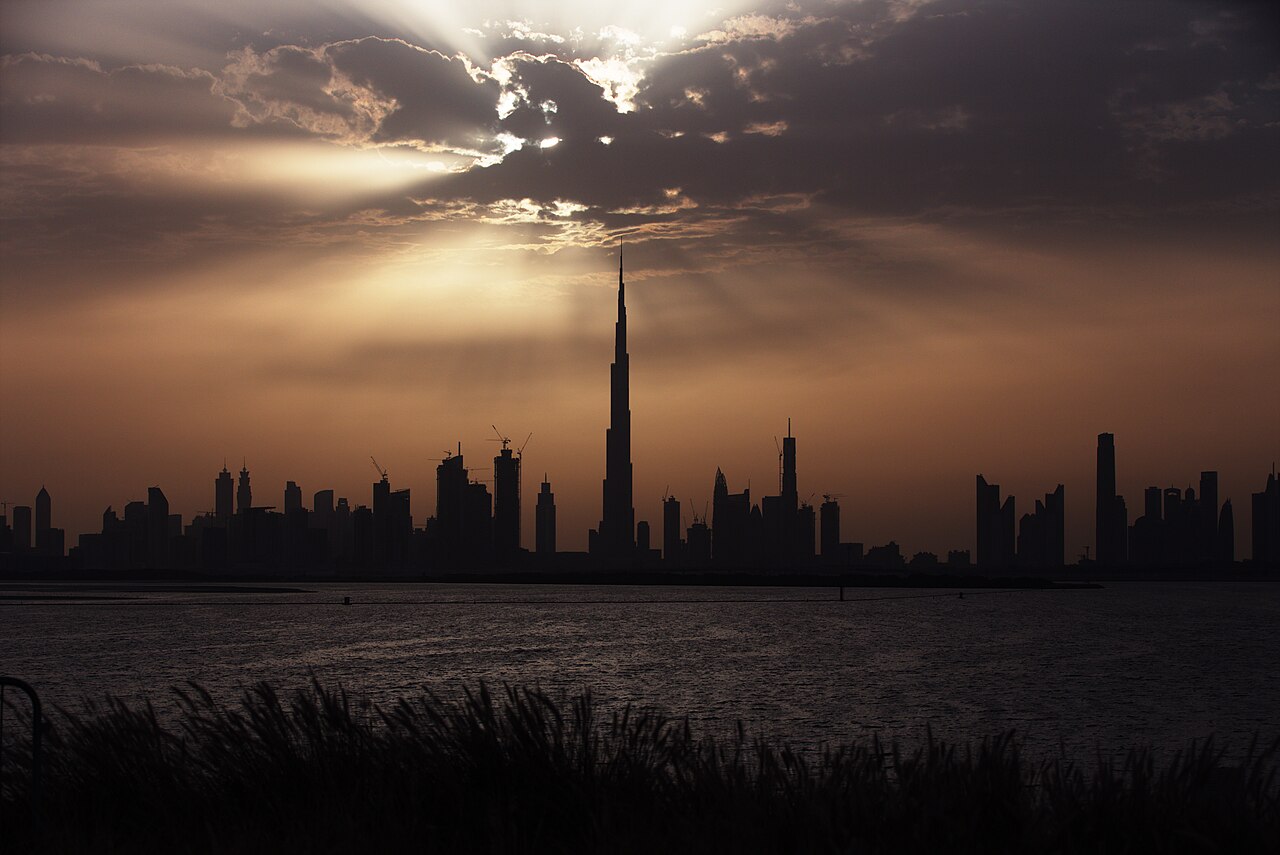
Architecture in the UAE
The United Arab Emirates, and Dubai in particular, has undertaken one of the most rapid and ambitious construction programmes in human history. In 1971, when the federation was formed, Dubai was a small pearl-fishing and trading port; by 2010 it had built the world's tallest building, the world's largest shopping mall, and the world's only seven-star hotel. This transformation — accomplished almost entirely with imported labour, imported materials, and imported architects — raises fundamental questions about authorship, identity, and the relationship between wealth and architectural quality that have preoccupied architectural discourse for two decades. Abu Dhabi, the UAE's capital, has pursued a different strategy: cultural institution-building, commissioning Jean Nouvel, Frank Gehry, and Zaha Hadid to create cultural landmarks alongside its oil-funded government buildings.
Notable Buildings
-
Contemporary Supertall
At 828 metres (2,717 feet), the world's tallest building (2010). Designed by Skidmore, Owings & Merrill, its Y-shaped plan with a buttressed concrete core allows the structure to resist wind loads that would defeat a conventional rectangular tower. The mechanical system pumps enough water daily for 440,000 baths.
-
Postmodern
Burj Al Arab, Dubai
The sail-shaped luxury hotel on an artificial island (1999) reaches 321 metres. Its distinctive profile — a biomorphic curve echoing a dhow sail — was specifically designed to be globally recognisable as a symbol of Dubai. The double-skin glass atrium is 180 metres tall.
-
Contemporary
Sheikh Zayed Grand Mosque, Abu Dhabi
The third-largest mosque in the world (2007), designed to accommodate 40,000 worshippers. Its 82 white marble domes, 1,000 columns inlaid with mother-of-pearl and semi-precious stones, and the world's largest hand-knotted carpet (5,627 sq m, woven by 1,200 Iranian craftswomen) make it the UAE's most significant religious building.
-
Futurist
Museum of the Future, Dubai
The egg-shaped torus building (2022) clad in Arabic calligraphy is the boldest of Dubai's recent civic buildings. The steel-and-glass facade is laser-cut with verses by Sheikh Mohammed bin Rashid — the calligraphy is structural, not decorative, formed by 1,024 uniquely shaped panels.
-
Modernist
Louvre Abu Dhabi
Jean Nouvel's 2017 museum is covered by a 180-metre dome constructed from 7,850 unique star-shaped steel elements that produce a dappled light effect — "a rain of light" — on the white stone galleries below. The museum sits on an artificial archipelago and contains works spanning human history from all cultures.
-
Contemporary
Frame Dubai
A 150-metre rectangular frame (2018) straddles the boundary between old Dubai and new, with a glass-floored sky bridge at the top. The concept — literally framing old and new Dubai in a single picture — is simple to the point of bluntness, but its visual presence in the skyline is undeniable.
Architectural Character
The UAE's architectural character is defined by speed, scale, and ambition operating outside the usual constraints of climate, context, and tradition. The Gulf climate — extreme summer heat, intense solar radiation, occasional sandstorms — theoretically demands architecture with shaded courtyards, wind towers, and thick walls, as in the traditional wind-tower houses of Dubai's Al Fahidi district. Instead, the post-oil construction boom largely ignored vernacular climate response in favour of globally recognisable curtain-wall towers cooled by massive mechanical systems.
The Emirati cultural project of the past two decades has attempted to correct this, investing in museums, cultural districts, and buildings that reference Islamic geometric tradition (Sheikh Zayed Mosque) or attempt to synthesise contemporary form with local identity (the Museum of the Future's calligraphic skin). Whether these buildings constitute an emerging regional architectural identity or remain branded objects by international starchitects is a debate that continues.
Test your knowledge of Middle Eastern landmarks.
Play Building Guessr