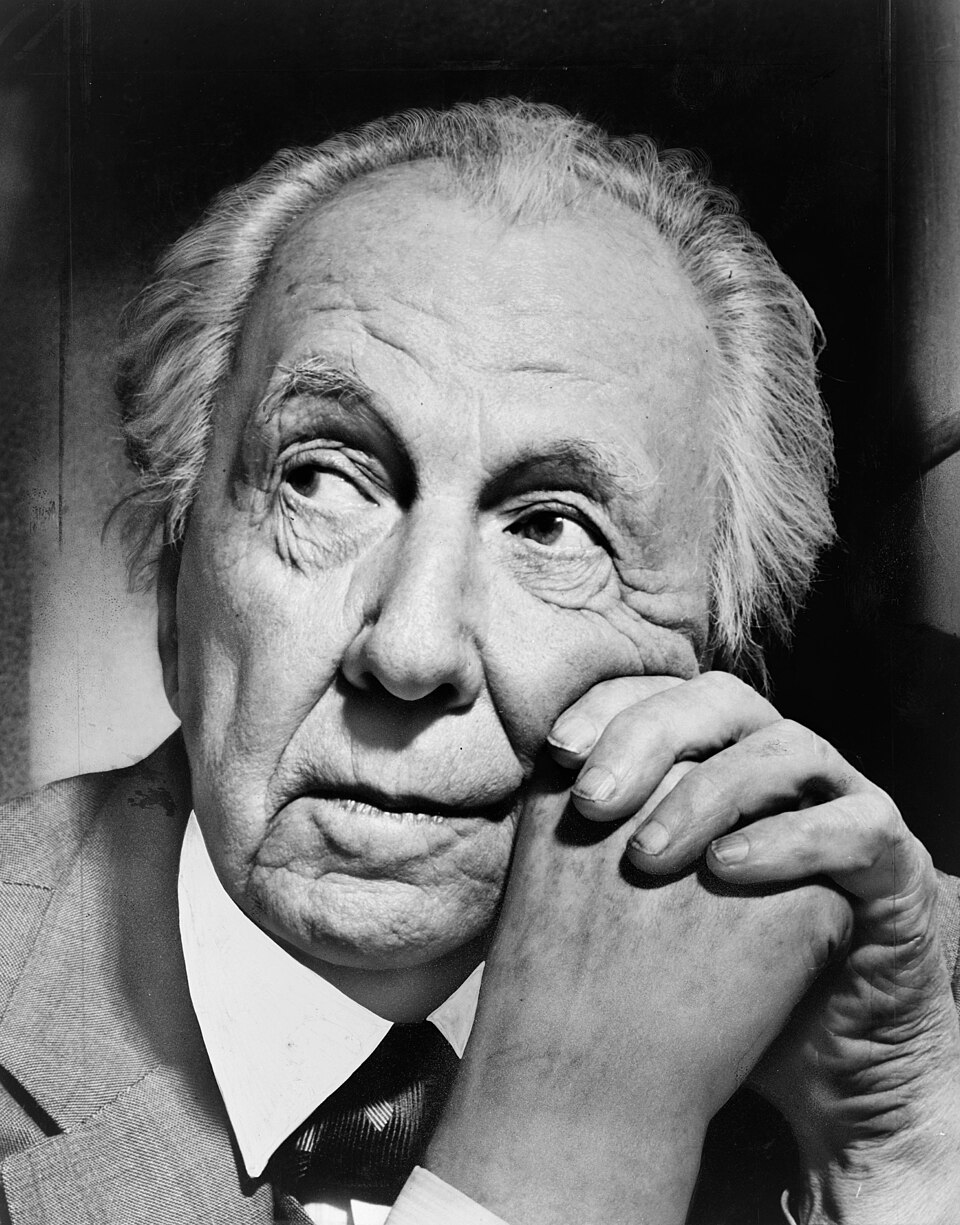
Life and Training
Frank Lloyd Wright was born on 8 June 1867 in Richland Center, Wisconsin. His mother, Anna Lloyd Jones, was a Welsh-American schoolteacher who later claimed to have known before his birth that her son would be a great architect — a story Wright himself promoted throughout his life. His childhood was shaped by the Wisconsin landscape and by the Froebel educational blocks his mother gave him: geometric wooden toys that Wright credited as an early influence on his sense of abstract form and spatial composition.
He studied civil engineering briefly at the University of Wisconsin before dropping out to move to Chicago in 1887, where he found work in the offices of Joseph Silsbee, then Louis Sullivan — the most important American architect of his generation. Sullivan became Wright's mentor, and Wright became his most gifted draftsman. The two men had an intense professional relationship until Wright, in financial need, began taking on private residential commissions in violation of his contract. Sullivan called it "bootlegged houses" and fired him in 1893. Wright never fully forgave him but called Sullivan his "Lieber Meister" — dear master — for the rest of his life.
Wright's personal life was turbulent to a degree unusual even among figures known for unconventional conduct. He abandoned his first wife and six children in 1909 to elope with a client's wife to Europe, a scandal that effectively ended his first career. His studio and home at Taliesin, Wisconsin, were the site of a 1914 murder and arson by a deranged servant who killed seven people. He married three times and conducted several high-profile affairs, and his financial management was catastrophic throughout his life. Yet he continued working until his death in April 1959, aged 91, leaving behind more than 1,000 commissioned designs, of which roughly 500 were built.
Architectural Philosophy
Wright's central concept was organic architecture: the idea that a building should grow from its site as naturally as a tree grows from the ground, and that interior space should be the primary reality of architecture — not the facades or the exterior form. He rejected the box. His Prairie Style houses of the early 1900s were organized around a central hearth with rooms flowing into one another under low, sheltering roofs that emphasized horizontal planes parallel to the earth. The effect was to pull the building into the ground rather than asserting it against the landscape.
Wright believed that a building should express the nature of its materials — he disliked paint, plaster over masonry, and any surface treatment that disguised what lay beneath. Brick should look like brick, stone like stone, and the structural logic of a building should be legible from its form. He was equally opposed to historical revivalism and to the emerging International Style of European modernism, which he found sterile and inhuman. His phrase "form follows function" — borrowed from Sullivan but developed independently — meant something more organic than Le Corbusier's machine aesthetic: function should generate form from the inside out, not be imposed on it from without.
He coined the term Usonian for an affordable, single-story house designed for the American middle class, featuring radiant floor heating, carport rather than garage, and an open-plan living space. The Usonian houses, built from the 1930s through the 1950s, were his attempt to make good architecture democratic and accessible rather than exclusive.
Key Works
- Fallingwater, Mill Run, Pennsylvania (1935–1939): The most celebrated American house of the 20th century, designed for department-store owner Edgar Kaufmann and his family. Wright positioned the house not overlooking the waterfall on the Bear Run stream, as Kaufmann had expected, but directly over it — the living room extends as a cantilevered concrete tray above the stream, and the sound of the water is audible in every room. The engineering was audacious; the reinforced concrete cantilevers exceeded standard safety factors and deflected more than anticipated. A major structural reinforcement was required in 2002. The building remains a private house open to the public as a museum.
- Solomon R. Guggenheim Museum, New York (1943–1959): Wright spent sixteen years designing and battling for permission to build this inverted spiral tower on Fifth Avenue. The continuous ramped gallery, which visitors descend from top to bottom, was radical — and remained controversial among curators who found it impossible to hang certain works of art effectively on its curved walls. Wright died six months before it opened. It remains one of the most recognized museum buildings in the world.
- Taliesin, Spring Green, Wisconsin (begun 1911): Wright's home, studio, and school in the Wisconsin hills he called the "Valley of the God-Almighty Joneses" after his Welsh family. He rebuilt it three times after fires and, from 1932, ran the Taliesin Fellowship here — a live-in apprenticeship program that trained dozens of influential American architects.
- Robie House, Chicago, Illinois (1908–1910): The definitive Prairie Style house — long, low, and deeply overhung, with a horizontal emphasis that merged with the flat midwestern terrain. Its open floor plan, where living and dining spaces flow without hard partition, was a radical departure from the compartmentalized Victorian domestic interior.
- Hollyhock House, Los Angeles, California (1921–1923): Built for oil heiress Aline Barnsdall, this was Wright's first California project and his first experiment with the "textile block" system — precast concrete blocks with abstract decorative patterns derived from the hollyhock flower, interlocked with steel rods. It introduced a formal grandeur appropriate to the California climate that his Prairie houses, designed for cold winters, did not attempt.
Legacy
Wright was named "the greatest American architect of all time" by the American Institute of Architects in 1991, a designation that has remained largely uncontested. His influence on residential architecture has been enormous: the open-plan living space, the integration of indoor and outdoor areas, the carport, the low-slung roofline, and the connection between a house and its landscape are all ideas that originate significantly from his Prairie and Usonian work. Many features of the postwar suburban American house trace back to his experiments. On a broader cultural level, Wright did more than any other architect to establish the idea of the architect as a public intellectual — he wrote prolifically, lectured constantly, and appeared on television in his eighties, arguing for his vision of a decentralized, car-based, low-density America that he called "Broadacre City." That vision was not adopted, but his buildings endure as some of the most visited architectural sites in America.
Explore Frank Lloyd Wright's buildings in the game.
Play Building Guessr