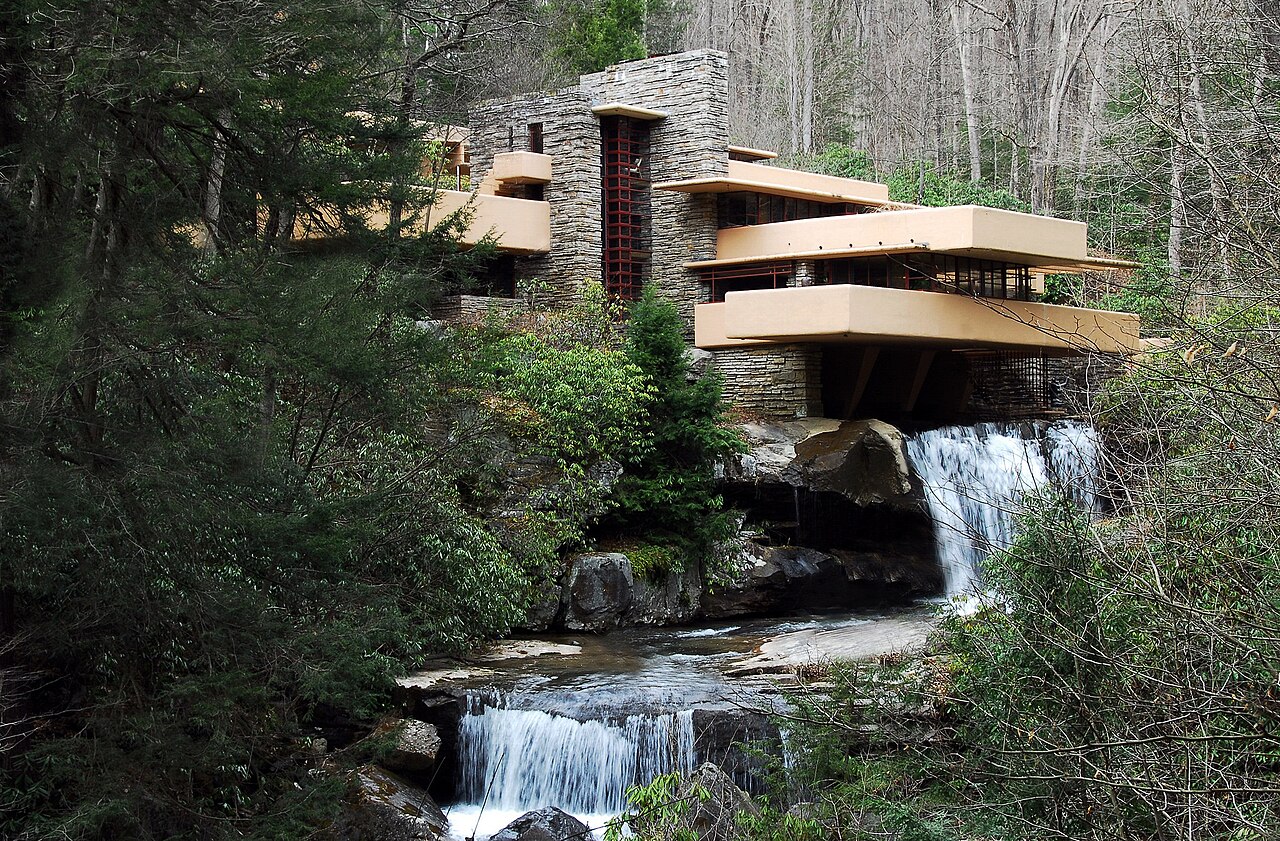
What it is
Fallingwater is a private weekend house commissioned by Edgar Kaufmann Sr. — the owner of Kaufmann's department store in Pittsburgh — and designed by Frank Lloyd Wright between 1935 and 1939. The story of its design has become one of architecture's founding myths. Wright accepted the commission in 1934 and made several site visits, but produced no drawings for months. When Kaufmann telephoned on September 22, 1935, to say he was driving from Milwaukee to Taliesin to see the design, Wright reportedly sat down at a drafting table and drew the complete scheme — three floors, two levels of cantilevered terraces, structural details, and material specifications — in the two hours before Kaufmann arrived. Whether accurate in every detail or somewhat embellished, the story captures something true about the building's character: it reads as a building conceived in a single instantaneous vision rather than assembled from deliberated parts.
Kaufmann had shown Wright a photograph of the site and described his family's habit of sitting on a rock ledge above a small waterfall on Bear Run, listening to the water. Wright's design therefore placed the house directly over the waterfall rather than facing it — a reversal of the expected relationship between house and landscape feature that has been cited ever since as the essential lesson of organic architecture: the building does not observe nature from a respectful distance but participates in it. The house was donated to the Western Pennsylvania Conservancy in 1963 by Edgar Kaufmann Jr. (an art historian and critic who wrote the most authoritative account of the building's design) and has been a museum and National Historic Landmark since. It receives approximately 180,000 visitors annually, making it one of the most visited private houses in the world.
Architectural significance
Fallingwater is the most fully realized expression of Wright's theory of organic architecture, which he had been developing since the Prairie Style houses of the early 1900s. Organic architecture, as Wright defined it, does not mean buildings that look like plants or incorporate organic shapes; it means buildings whose form derives entirely from the specific conditions of their site, their program, their materials, and their cultural context — so that a building in the Pennsylvania forest near a waterfall and a building on the Illinois prairie should look completely different, because they arise from completely different conditions. The abstraction of natural processes (the horizontal strata of sedimentary rock, the cantilever of a ledge over water, the compression of standing in a forest looking up through the canopy) is expressed in built form without literal imitation. Fallingwater's horizontally stratified concrete terraces echo the natural rock strata exposed in the Bear Run gorge; the rough sandstone walls and floors are continuous with the actual rock of the site; the sound of the waterfall is audible from every room.
The structural system of the building was also a source of significant controversy — both at the time and retrospectively. The three cantilevered terraces are reinforced concrete slabs extending as much as four and a half meters beyond their supports, making cantilever approximately 70 percent of the total floor area. The engineering was performed by Wright's own calculations, which the local structural engineer Mendel Glickman and his associate William Wesley Peters revised upward before construction. Even the revised specifications proved insufficient: by 1956, the primary cantilever had deflected seven inches from the horizontal, and independent structural surveys revealed that the reinforcement was about half what good engineering practice would have specified. In 2002, the Western Pennsylvania Conservancy undertook a major structural remediation: the cantilever was temporarily shored, the concrete was drilled, and post-tensioned steel cables were threaded through the slab and anchored to restore the structural integrity. The building is now structurally sound and expected to remain so for the foreseeable future.
Key features
- Three cantilevered terraces: The dominant formal element of the building — horizontal concrete slabs in ochre-tinted reinforced concrete that project dramatically over the waterfall, stacked vertically with each terrace offset from the one below. Approximately 70 percent of the building's floor area is cantilever, unsupported beneath.
- Rough local sandstone walls and floors: The vertical elements — walls, piers, fireplace core — are built from sandstone quarried on site from the same geological strata exposed in the Bear Run gorge. The same material appears in the floors, so that the boundary between building and bedrock is deliberately ambiguous. Actual bedrock protrudes through the hearth of the living room fireplace.
- Built directly over a waterfall: The lowest terrace projects over the main falls of Bear Run. The sound of the water is omnipresent inside the house; a hatch in the living room floor opens directly above the water, blurring the boundary between inside and out.
- Integration of living rock: A rock ledge that the Kaufmann family used as a sunbathing surface before the house was built protrudes through the hearth of the main living room fireplace — left in place by Wright as a literal continuation of the site into the interior.
- Continuous horizontal windows: Corner windows meeting at a glass-only corner (no structural column), horizontal bands of windows wrapping around the terraces, and minimal framing at glass junctions all work to dissolve the visual boundary between interior and exterior, so that the forest and waterfall remain in the field of vision from every room.
- Flat roof terraces: The roofs of each lower level serve as the terrace floors of the level above, creating a layered system in which interior and exterior spaces alternate vertically rather than being clearly separated.
- Guest house and covered walkway: A separate guest house connected to the main house by a covered walkway follows the contour of the hillside above, designed in the same material palette but in a more compressed, linear form that reads as an extension of the hillside rather than an intervention in it.
Preservation status
Fallingwater is in good condition following the 2002 structural remediation, which resolved the cantilever deflection that had been the building's primary engineering concern for five decades. The post-tensioning repair was carried out by Robert Silman Associates and involved temporarily supporting the first-floor cantilever with a timber scaffolding falsework system, then threading and stressing 36 high-strength steel tendons through drilled holes in the reinforced concrete slab. The operation took approximately three months and cost A$11.5 million. Subsequent monitoring confirms that the cantilever has not deflected further and that the post-tensioning load is stable.
Ongoing conservation challenges include moisture infiltration — the flat terraces are prone to pooling water, and the original waterproofing membranes have been replaced multiple times — and biological growth on the sandstone surfaces, which require periodic cleaning without use of chemicals that could damage the stone. The building is a National Historic Landmark (designated 1966) and was listed on the American Institute of Architects' list of the twenty greatest buildings of the twentieth century as the number-one entry. The Western Pennsylvania Conservancy manages visitation carefully to protect the building's surfaces and the Bear Run watershed, operating guided tours with limited group sizes rather than free self-guided access.
Think you can place this building on the map?
Play Building Guessr