Life and Training
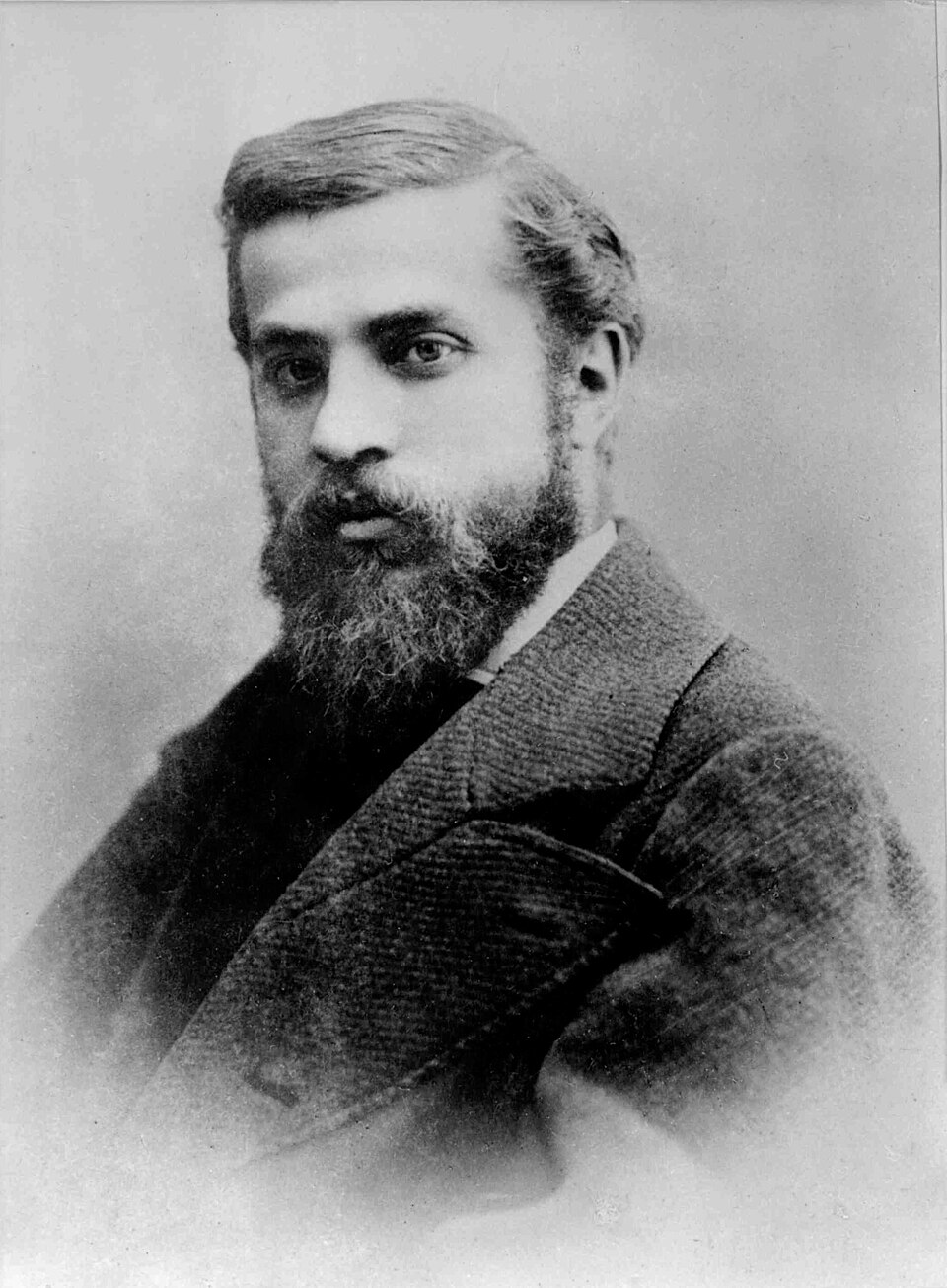
Antoni Gaudí i Cornet was born on 25 June 1852 in Reus, in the Catalan region of Spain, the youngest son of a coppersmith. He suffered from childhood rheumatism that made it difficult to walk, and this enforced solitude turned him into an acute observer of nature — of bones, shells, leaves, and the branching patterns of trees. He began his architectural studies in Barcelona in 1873 and graduated from the Barcelona School of Architecture in 1878. The school's director reportedly noted: "We have given this academic title either to a madman or a genius. Time will tell."
The crucial early relationship of his career was with the Catalan industrialist Eusebio Güell, who became his patron after seeing Gaudí's display case design at the 1878 Paris Universal Exposition. Güell funded several of Gaudí's early commissions and gave him the freedom to develop his increasingly unconventional ideas. Gaudí was deeply devout — his Catholicism intensified through his career — and from 1914 until his death he dedicated himself almost entirely to the Sagrada Família, living on site in spartan conditions. In June 1926, he was struck by a tram while walking to evening prayers; unrecognized because of his simple clothes, he was taken to a pauper's hospital, where he died three days later.
His beatification cause was opened by the Catholic Church in 2000, meaning he is currently a candidate for sainthood — an unusual distinction for an architect.
Architectural Philosophy
Gaudí's guiding conviction was that nature is the supreme architect, and that the straight line belongs to men while the curved line belongs to God. Where conventional 19th-century architecture was rooted in historical imitation — Gothic, Renaissance, or classical forms — Gaudí turned instead to the structural logic embedded in living organisms. He studied the branching angles of trees, the geometry of seashells, the bone structures of animals, and the way light behaves on organic surfaces.
This led him to develop two major structural innovations. The first was the catenary arch: rather than calculate the thrust of arches by mathematics, Gaudí built inverted models using weighted strings. A hanging chain under gravity forms a natural catenary curve; inverted, that curve becomes a self-supporting arch that carries load without lateral thrust, eliminating the need for buttresses. The second was the hyperboloid and paraboloid surface — mathematical forms found in nature that distribute stress efficiently and create extraordinary visual complexity from simple geometric rules. Both innovations allowed him to dispense with the buttress systems that Gothic cathedrals required while creating structures of extreme structural efficiency.
Color was equally fundamental. Gaudí used broken ceramic tile — trencadís — as both surface material and color medium, applying it to curved surfaces where conventional tiles could not follow the geometry. The result is the mosaic shimmer now instantly associated with his work: found most dramatically at Park Güell, where broken-tile benches undulate across a terrace overlooking Barcelona.
Key Works
- Sagrada Família, Barcelona (begun 1882, ongoing): The defining work of Gaudí's life and the most visited site in Spain. He took over the project in 1883 from an earlier architect and transformed it into a wholly original vision: a symbolic mountain of stone with eighteen towers representing Christ, the Virgin, the Evangelists, and the Apostles. The Nativity Façade, the only one completed in Gaudí's lifetime, is carved with extraordinary naturalistic detail. The interior forest of branching columns — designed so no column carries the same load as its neighbor — was completed after his death from his plaster models and drawings.
- Casa Batlló, Barcelona (1904–1906): A complete remodeling of a bourgeois apartment building on the Passeig de Gràcia. Gaudí replaced the façade with undulating bone-white stone columns, a scaly dragon-back roof in iridescent ceramic tiles, and skull-shaped balconies. The interior light well is lined with blue-glazed tiles that deepen in color from the top downward, creating the impression of looking up through deep water even at the lowest floors.
- Park Güell, Barcelona (1900–1914): Originally conceived as a garden city development that failed commercially, Park Güell became instead a public park of extraordinary sculptural invention. Its famous serpentine bench — the longest bench in the world at the time — zigzags around the main terrace covered in trencadís mosaic, and the park's viaducts are supported on inclined stone columns that mimic tree trunks.
- Casa Milà (La Pedrera), Barcelona (1906–1912): An apartment building whose stone façade undulates like a cliff face eroded by the sea. The rooftop is populated with sculptural chimneys and ventilation towers — warriors in helmets, some have called them — that are now as much a part of Barcelona's skyline as the Sagrada Família itself. The building's iron structure allowed Gaudí to design entirely free-plan apartments with no load-bearing interior walls.
- Palau Güell, Barcelona (1886–1890): Gaudí's first major commission from his patron Eusebio Güell, a townhouse of remarkable ambition for its date. The parabolic arches of the entrance portals, the central hall rising to a perforated dome, and the rooftop of ceramic-clad chimneys all anticipate ideas Gaudí would develop at grander scale in his later work.
Legacy
Gaudí's influence on architecture has been paradoxical: his work is so personal, so rooted in his faith and his deep engagement with natural form, that it resisted direct imitation. No school of "Gaudíism" emerged; no movement adopted his structural innovations wholesale. Yet his insistence that organic geometry could be structurally rational — not merely decorative — has found vindication in the computer age. Computational design tools now make it possible to generate the kind of complex curved surfaces Gaudí could only approximate by physical modeling, and architects from Zaha Hadid to Santiago Calatrava have acknowledged his structural and formal explorations as precursors of parametric design. The Sagrada Família, expected to be fully completed in 2026 — the centenary of his death — remains the most visited building in Spain and one of the most analyzed pieces of religious architecture in the world.
Explore Gaudí's buildings in the game.
Play Building Guessr