Life and Training
Jørn Oberg Utzon was born on 9 April 1918 in Copenhagen, the son of a naval architect who designed yachts and small vessels. The marine environment of his childhood — boats, harbors, sails billowing in the wind — exerted a formative influence on his visual imagination: the Sydney Opera House shells are widely read as sails or waves, and Utzon always acknowledged the sea as a primary source of formal inspiration. He studied architecture at the Royal Danish Academy of Fine Arts in Copenhagen, graduating in 1942, and then worked in the offices of several key figures of Scandinavian Modernism: Gunnar Asplund in Stockholm (briefly before Asplund's death in 1940) and Alvar Aalto in Helsinki. He also traveled to the United States, where he visited Frank Lloyd Wright at Taliesin.
These experiences gave him a rare combination: the structural rationalism of Scandinavian tradition, the organic warmth of Aalto's approach, and Wright's conviction that a building should grow from its site like a geological formation. He supplemented these influences with extensive travel to Mexico and Morocco, where he was struck by the Pre-Columbian platform traditions — buildings raised on massive podiums that separated the ceremonial from the earthly — and the tilework and geometric patterning of Islamic architecture. In 1957, working in obscurity with no major completed buildings to his name, he entered the competition for the Sydney Opera House. The rest of his career was defined by what happened next.
Architectural Philosophy
Utzon's central concern was with the relationship between a building and its natural setting — particularly the sky, the sea, and the horizon. He was fascinated by what he called "additive architecture": the idea that a building could be composed of identical or related modular units, like the cells of a living organism or the plates of a reptile's skin, which accumulate to form a whole greater than the sum of its parts. This principle informed the Sydney Opera House roof shells (all derived from the surface of a single sphere), the repetitive arched vaults of the Kuwait National Assembly, and the modular ceramic tile cladding systems he developed.
He was also preoccupied with the quality of transition — the threshold between exterior and interior, between the secular and the sacred, between the city and the sky. His buildings typically involve elaborate approach sequences: the great podium of the Sydney Opera House, the descending entry sequence of the Bagsværd Church, the terraced landscape of Can Lis. These sequences are not merely functional; they are choreographies of spatial and psychological transformation, preparing the visitor for the experience that lies within. His approach was intuitive rather than theoretical — he rarely wrote manifestos and resisted systematic formulation of his ideas — yet it was among the most consistently realized architectural visions of the twentieth century.
Key Works
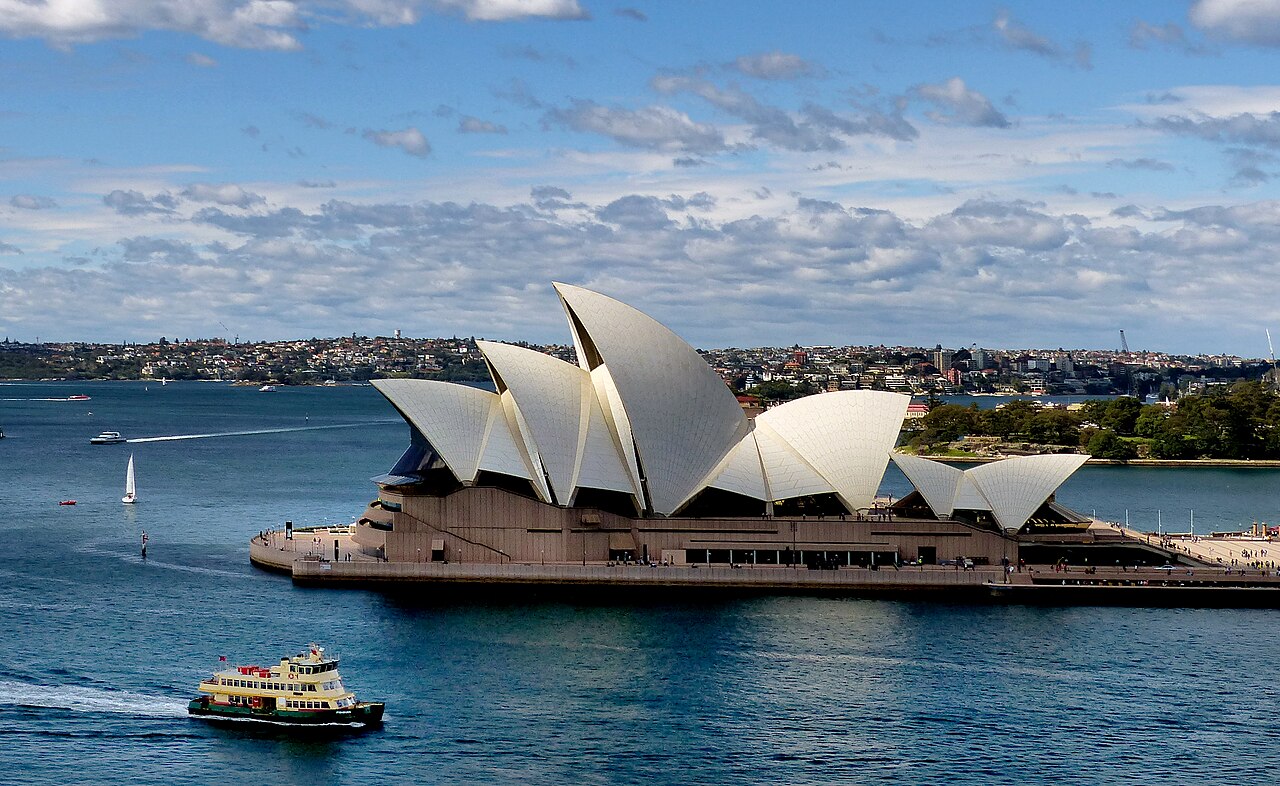
- Sydney Opera House, Sydney, Australia (1957–1973): Utzon's competition entry was selected from among 233 submissions in 1957 by a jury that included Eero Saarinen, who reportedly rescued the drawings from the rejected pile. The building — a series of interlocking concrete shell "sails" rising from a massive granite podium over Bennelong Point — was one of the most technically complex structures ever attempted. The structural solution for the shells, which Utzon developed over years with engineers Ove Arup & Partners, was eventually derived from the surface of a single sphere, giving all shells a common geometry that could be prefabricated. Utzon resigned in 1966 after a political dispute with the New South Wales government and never returned to Australia. He never saw the completed building. The Opera House was listed as a UNESCO World Heritage Site in 2007 — the fastest listing of a completed modern building in history.
- Bagsværd Church, Copenhagen, Denmark (1968–1976): Utzon's most personal and complete realized work, Bagsværd Church is a concrete building whose exterior is deliberately understated — almost industrial — while the interior vaults unfurl into a sequence of cloud-like concrete shells that transform the quality of light in the nave into something luminous and otherworldly. The building is widely cited by architects as one of the greatest religious spaces of the twentieth century and demonstrates the full range of Utzon's spatial invention outside the constraints of the Sydney saga.
- Kuwait National Assembly, Kuwait City, Kuwait (1972–1982): Designed for the newly independent state of Kuwait, the National Assembly is organized under a great cantilevered roof canopy that provides shade in the desert climate, beneath which assembly chambers, committee rooms, and public areas are arranged on a podium. The building's formal language — repeated arched roof elements derived from Bedouin tent forms — represents Utzon's engagement with regional building traditions, adapted to the demands of a modern democratic institution.
- Can Lis, Porto Petro, Mallorca, Spain (1971): Utzon's own holiday house on a clifftop in Mallorca, built from local sandstone, is a sequence of rooms opening to views of the Mediterranean. The house is organized as a series of pavilions connected by terraces, each pavilion framing a specific view of the sea and sky. Built for Utzon's personal use and occupation rather than for a client, Can Lis is the most direct expression of his ideas about the relationship between architecture and natural landscape.
- Paustian House (now Paustian Furniture), Copenhagen, Denmark (1987): A late but substantial commission on Copenhagen's harbor, Paustian House is a retail and cultural space organized beneath a triangulated roof structure that distributes natural light evenly across the interior. The building represents Utzon's continued engagement with structural expression and the integration of daylight after his self-imposed withdrawal from major public commissions following the Sydney controversy.
Legacy
Utzon received the Pritzker Architecture Prize in 2003, the jury noting that "there is no doubt that the Sydney Opera House is his masterpiece. It is one of the great iconic buildings of the twentieth century, an image of great beauty that has become known throughout the world — a symbol for not only a city, but a whole country and continent." He died in 2008 without ever returning to Australia to see the building completed. The reconciliation between Utzon and the Sydney Opera House Trust — brokered by his son Jan Utzon in 1999 — led to a set of design principles that govern all future changes to the building, ensuring that his intentions are honored in perpetuity. His career stands as one of architecture's great cautionary tales about the relationship between visionary architects and cautious public clients, but also as proof that a single building of sufficient power can define an architectural legacy of permanent significance.
Explore Utzon's buildings in the game.
Play Building Guessr