What a temple is — and is not
Most visitors to ancient temples carry a mental model derived from visiting a church, mosque, or synagogue: a large hall that fills with worshippers, who face a shared focal point and participate collectively in a ritual led by a religious professional. This model is almost entirely wrong for ancient temple traditions, and misunderstanding it leads to misreading the buildings completely.
In Greek, Egyptian, and most other ancient Mediterranean traditions, the temple was the house of the god — a residence for the deity's image or spirit, not a congregational gathering space. The public was not admitted into the inner sanctuary under ordinary circumstances. In the Greek tradition, the area around the temple was called the temenos — a sacred precinct bounded by a low wall — and this was where public religious life happened. Animal sacrifices took place at an outdoor altar in the temenos, not inside the temple. Processions moved through the precinct. The interior of the cella (the inner room housing the cult statue) was reserved for priests and for exceptional ritual moments.
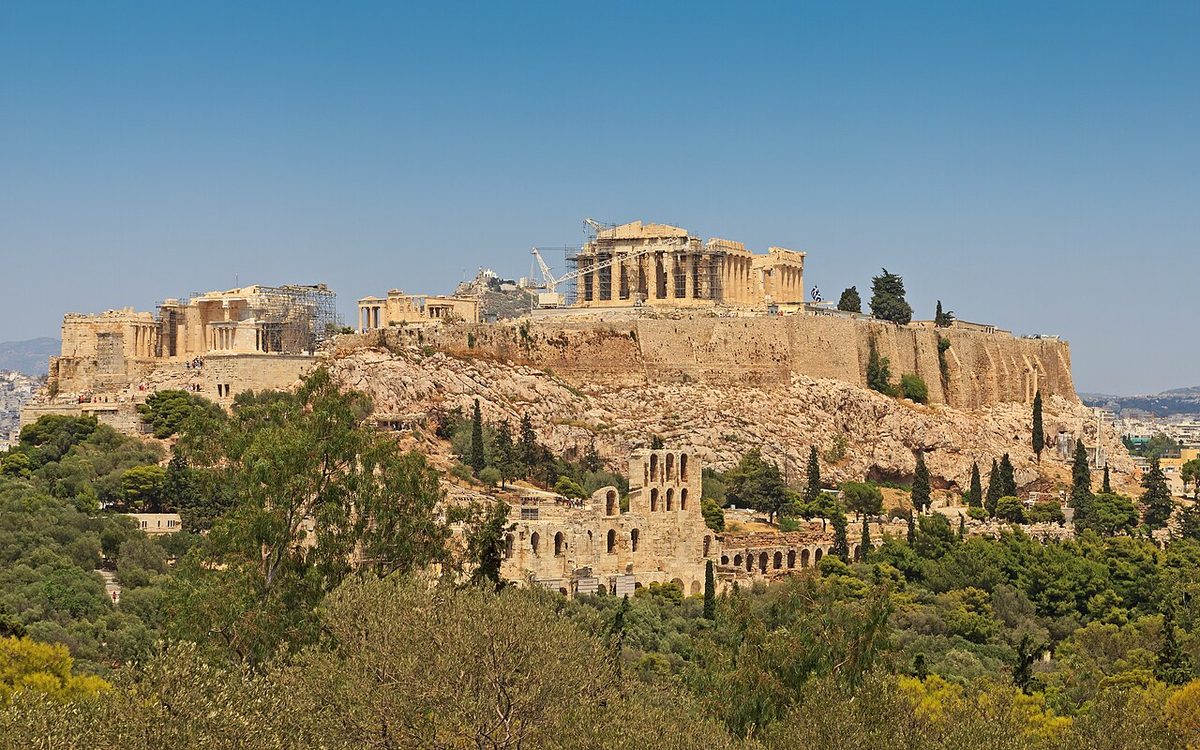
This explains something that puzzles first-time visitors to the Parthenon, or to any Greek temple ruin: the interior is surprisingly small given the grandeur of the exterior. The Parthenon's cella was designed to house the enormous gold-and-ivory statue of Athena Parthenos, not to accommodate crowds of worshippers. Its impressive size relative to other cellas was a matter of prestige, not practical need. The exterior colonnade — the peristyle — was the visible public face of the building, meant to be seen from outside the temenos, from the street, from approaching ships.
The important exception to this rule is the Hindu temple, where the inner sanctum (the garbhagriha, literally "womb chamber") is the destination of individual pilgrimage rather than a forbidden space. Devotees move inward toward the sanctum through a series of progressively more sacred halls, seeking the presence of the deity's image. The outer halls of large Hindu temples are designed to accommodate very large numbers of pilgrims and include dedicated spaces for music, dance, and instruction. This difference in ritual function produces an entirely different spatial structure — which is why Hindu temples look so different from Greek ones even when both use stone and both are highly decorated.
Egyptian temples: axis, pylons, and hypostyle halls
The ancient Egyptian temple follows one of the most rigidly standardized plans in architectural history. Walk toward any major Egyptian temple and you will encounter a predictable sequence of spaces arranged along a single processional axis, each space progressively more restricted, more elevated, and more sacred than the last.
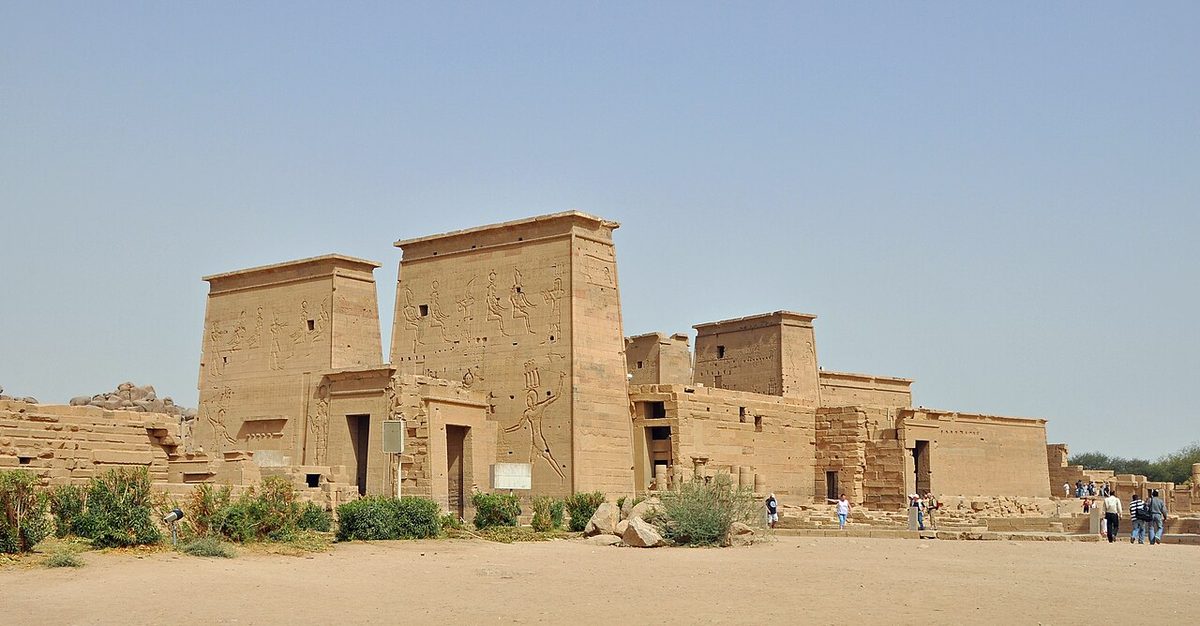
The sequence begins with a pair of pylons — massive sloping trapezoidal towers flanking an entrance gate. The sloping faces of the pylons are not structural accidents but intentional form: the profile echoes the hieroglyph for "horizon," placing the entrance to the temple symbolically at the boundary between the human world and the divine. Tall flagpoles ran in slots at the face of the pylons, their pennants visible from great distances across the Nile floodplain. In the game, two massive sloping trapezoid towers flanking a gate is the single most reliable Egyptian temple tell.
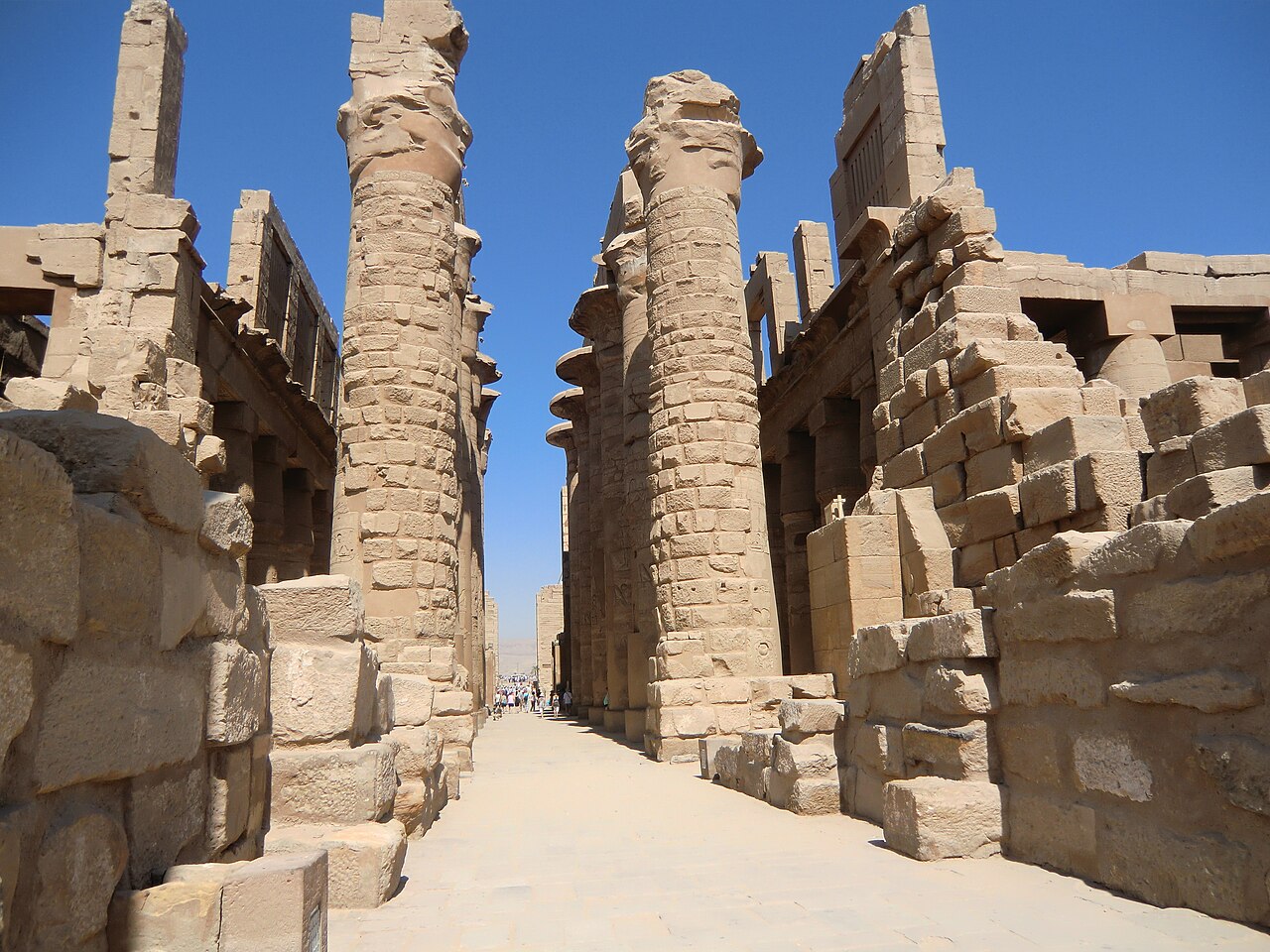
Beyond the pylons lies an open courtyard, open to the sky, where official religious ceremonies involving larger groups could take place. Beyond the courtyard, access narrowed: the hypostyle hall, roofed and lit only by high clerestory windows, contained a forest of columns so dense that it reduced visibility to a few columns in any direction. The Karnak Temple complex at Luxor — the product of construction spanning roughly 2,000 years from around 2000 BCE to 30 BCE — contains a hypostyle hall of 134 columns, the tallest reaching 21 meters. The columns and their connecting walls are covered in painted relief carvings: processions, offerings, battle scenes, religious texts. Beyond the hypostyle hall, smaller antechambers led to the inner sanctuary, where the deity's bark (processional boat carrying the cult image) rested on a stone podium.
The survival condition of Egyptian temples varies enormously. At Karnak and Luxor, most roofing has collapsed, exposing the column forests to the sky and changing their spatial character completely. At the Temple of Horus at Edfu (completed 57 BCE) — the best-preserved of all Egyptian temples — the roof survives and visitors can experience the intended darkness and restricted sightlines. In the game, densely packed columns of large diameter carrying painted relief decoration, opening toward a pyloned gateway, means Egypt.
Greek temples: the orders and the peristyle
The Greek temple is the most widely reproduced building type in Western architectural history. Its forms were adopted by Rome, revived by the Renaissance, redeployed by the Enlightenment, spread globally by colonialism, and are still being built for banks, museums, and government buildings today. To understand any of those derivative forms, you need to understand the original three orders.
The Doric order is the oldest and most austere. Its column has no separate base — it rises directly from the floor of the stylobate. Its capital is a simple cushion-like disk (echinus) under a square slab (abacus). Its entablature (the horizontal band above the columns) is divided into triglyphs (three vertical grooves) alternating with metopes (flat rectangular panels, often carved with figures). The Parthenon (Athens, 447–432 BCE, Iktinos and Kallikrates) is the supreme surviving example. Its columns taper gently as they rise and lean imperceptibly inward — deliberate optical refinements that make the building appear more perfect than pure geometric regularity would achieve.
The Ionic order, developed in Ionia (western Anatolia and the Aegean islands), uses a taller, more slender column with a base and a distinctive capital with two scroll ornaments (volutes). The entablature lacks triglyphs and metopes, using instead a continuous frieze. The Temple of Artemis at Ephesus — one of the Seven Wonders of the Ancient World — was Ionic. The Erechtheion on the Athenian Acropolis (421–406 BCE) includes the famous Caryatid porch, where female figures replace columns.
The Corinthian order is the most ornate: a tall column with a capital of acanthus leaves, typically used in a single prominent feature rather than an entire colonnade in classical Greek practice, but later becoming the preferred order of Rome and of subsequent classicizing architecture. The defining Greek temple plan is the peristyle — a colonnade surrounding all four sides of the central cella. When you see rows of columns on all four sides of a rectangular building with a triangular pediment at each end, you are looking at a Greek temple or a direct quotation of one.
Roman temples: the podium and the porch
The Romans admired Greek architecture intensely and adopted its vocabulary wholesale — but they changed the spatial organization of the temple in ways that had enormous consequences for every subsequent classical revival.
The key Roman modifications are two. First, the Roman temple is placed on a high podium — a solid raised platform — with steps leading up to it from the front only. The Greek temple's stylobate has steps on all four sides and can be approached from any direction. The Roman temple forces a single frontal approach, making the facade the whole point of the building and creating a formal axial relationship between the temple and the open space in front of it. This is why every Neoclassical government building since the 18th century faces its plaza with a dominant porch — they are following Roman temple spatial logic, not Greek.
Second, the Roman temple typically has a deep pronaos — a porch of columns at the front — while the rear and sides of the building above the podium are often solid wall with engaged (attached) half-columns providing ornamental continuity. The full peristyle of columns surrounding all four sides is rare in Roman temples. This means Roman temples look imposing from the front and relatively plain from the side and rear.
The Maison Carrée in Nîmes, France (dedicated approximately 16 BCE) is the best-preserved Roman temple in the world, nearly complete with its Corinthian columns on podium. It inspired Thomas Jefferson's Virginia State Capitol (1788). The Pantheon in Rome (rebuilt under Hadrian, c. 125 CE) is the spectacular exception: a circular domed rotunda attached to a conventional rectangular porch, its dome's diameter and interior height both equal to 43.3 meters. The Pantheon survived because it was converted to a Christian church in 609 CE — the same fate that preserved several other Roman buildings while purely pagan structures were quarried for building material.
Hindu temples: the shikhara and the gopuram
Hindu temple architecture is not one tradition but many, varying enormously across the Indian subcontinent's different regional kingdoms and across two thousand years of continuous construction. For game-identification purposes, the most useful distinction is between North Indian (Nagara) and South Indian (Dravidian) temple styles, which differ so dramatically in form that they can be mistaken for entirely different architectural traditions by newcomers.
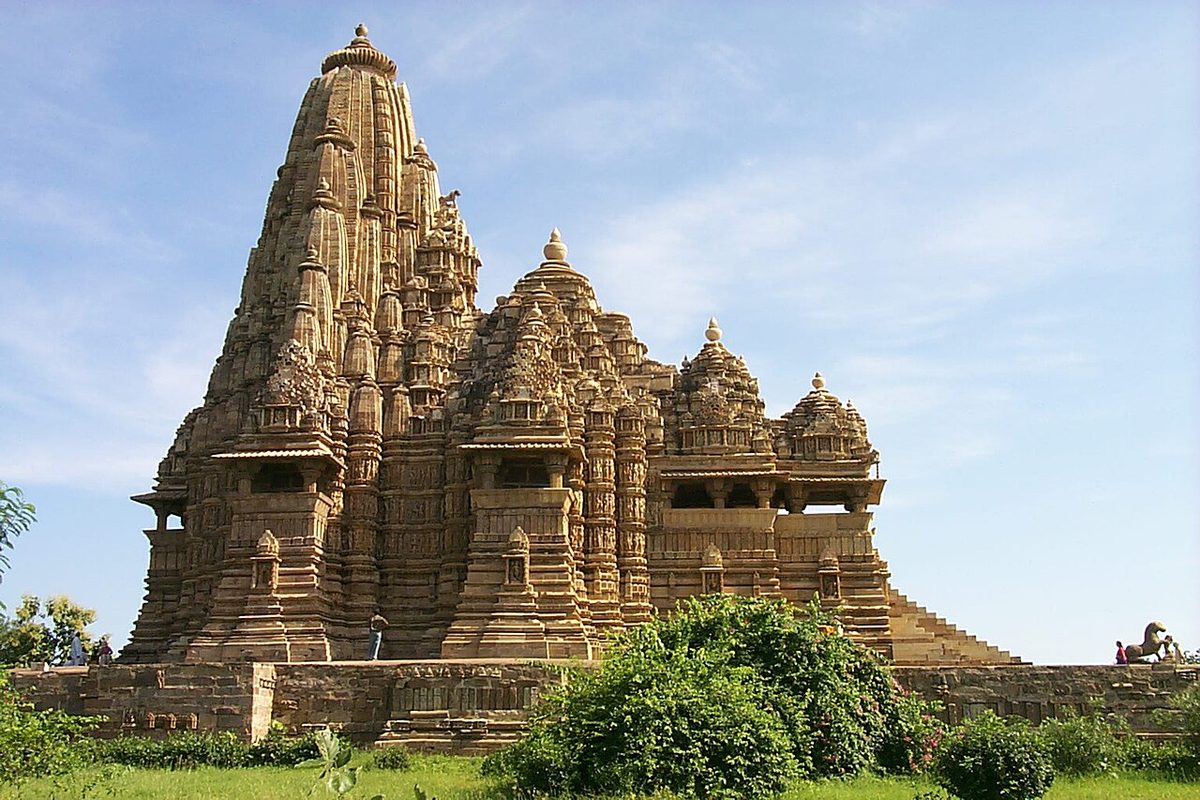
The North Indian temple is dominated by the shikhara — a tall curvilinear tower that rises directly above the garbhagriha (inner sanctum). The shikhara is organic in form, its outline not a straight vertical line but a curve that tapers toward an amla (a ribbed disk) at the top. The profile looks like a stone finger being squeezed from both sides, its surface covered in horizontal moldings that multiply and densify toward the top. The Khajuraho temple complex in Madhya Pradesh (constructed mainly 950–1050 CE) is the classic reference: clusters of shikhara towers of different heights rise from a shared plinth, the largest over the garbhagriha, smaller ones over subsidiary spaces, creating a mountain-like silhouette. The exterior walls below the shikharas are covered in intricate sculptural bands, including the famous erotic panels that represent only a small portion of the overall carved program.
The South Indian temple, by contrast, is identified by the gopuram — a monumental gateway tower. Large South Indian temple complexes have multiple concentric enclosure walls, each penetrated by a gopuram, with the outer gopurams being the tallest. The gopuram is a wide, trapezoidal form in elevation — it tapers toward the top but maintains a broad base. Every surface is covered in painted stucco figures: rows of deities, demons, guardians, and celestial beings compressed into the tower's surface at astonishing density. The Meenakshi Temple in Madurai (largely 17th century) has fourteen gopurams, the tallest approximately 52 meters, their multicolored surfaces visible from kilometers away.
Buddhist architecture: stupa and vihara
Buddhist architecture begins with the stupa — one of the oldest and most geographically widespread architectural forms in Asia. The original stupa was a hemispherical earthen mound built over the cremated remains of the Buddha or other holy persons, functioning as a reliquary. Unlike a temple, which is entered and inhabited, the stupa is solid and unpenetrated. Religious practice around a stupa consists of pradakshina — circumambulation, walking clockwise around the stupa — rather than entry into it.
The Great Stupa at Sanchi (Madhya Pradesh, India; 3rd century BCE to 1st century CE) is the earliest well-preserved example. It consists of a solid hemisphere (anda) on a circular drum base, surrounded by a processional pathway enclosed by a stone railing (vedika). A square harmika (railing enclosure) at the summit supports a stone umbrella (chhatri) symbolizing royal dignity and the cosmic axis. Four elaborately carved stone gateways (toranas) at the cardinal directions provide the main visual interest. The entire ensemble is unpainted gray sandstone, severe and powerful.
As Buddhism traveled across Asia, the stupa form evolved dramatically in different cultural contexts. In Southeast Asia and Burma, the stupa became taller and more elaborate, developing into the pagoda form. The Shwedagon Pagoda in Yangon, Myanmar (legendary founding in 6th century BCE, current structure largely 15th century onward) rises 98 meters and is covered entirely in gold leaf, its gilded spire visible from across the city. In Sri Lanka, the stupa became the low bell-shaped dagoba. In China, Japan, and Korea, the stupa became the multi-story timber pagoda, its floors stacking vertically with pronounced roof overhangs at each level. In Tibet, it became the chorten, more abstract and geometric. In the game, a white or gilded hemispherical or tiered form with no entrance and no windows, approached by circumambulatory paths, means stupa family — geography determines which specific type.
Reading ancient temples in the game
Ancient temple architecture appears frequently in the game because these buildings are among the most photographed structures in the world and because they survive in highly distinctive forms that reward careful visual analysis. Here is a practical identification summary.
Egyptian temple: Look for the pair of sloping trapezoidal pylon towers flanking a central gate. If you are inside or close to the building, look for densely packed thick columns of large diameter carrying painted relief decoration. The site will be in Egypt, usually near the Nile in Upper Egypt (Luxor, Karnak, Edfu, Kom Ombo, Philae/Aswan).
Greek temple: Look for a colonnade surrounding all four sides of a rectangular cella (peristyle), with triangular pediments at each short end. Columns will be one of the three orders, most often Doric on the Greek mainland. The site will be in Greece (Athenian Acropolis, Olympia, Delphi, Agrigento Sicily, Paestum Italy). Survival condition: typically ruined peristyle, missing roof, often missing cella walls.
Roman temple: Look for a high podium with steps at the front only and a deep columned porch (pronaos). The orders are usually Corinthian. The building faces a plaza or forum. Sites across the former Roman Empire: France (Maison Carrée, Nîmes), Spain, North Africa, the Middle East, and of course Italy.
North Indian Hindu temple: Look for curvilinear stone tower(s) with densely horizontal-molded surfaces tapering to a ribbed disk finial, rising over a sanctuary. Multiple towers of different heights clustered on a shared plinth. Rich sculptural surface covering all exposed walls.
South Indian Hindu temple: Look for a wide trapezoidal gateway tower covered in thousands of painted stucco figures, often brightly colored. Multiple concentric walls with gopurams growing taller toward the outside. Sites in Tamil Nadu and neighboring states.
Buddhist stupa/pagoda: Solid white dome on drum (India, Sri Lanka) or gilded tapering spire (Burma/Myanmar, Thailand) or multi-story tower with bracketed roof overhangs at each level (China, Japan, Korea). No entrance openings into the main form. For Islamic architecture and broader principles of reading religious architecture of any tradition, these companion guides cover the remaining major world traditions in similar depth.
Regional Variations
Each great temple tradition reflects a distinct theology of sacred space, and that theology is legible in the architecture. The Egyptian temple encodes a cosmological journey: the worshipper moves from the chaotic outer world through successive zones of increasing sanctity toward the innermost sanctuary where the divine resides. The processional axis is oriented toward the rising sun on specific festival days, so the light of dawn floods into the inner sanctuary at the culminating moment of the ritual calendar. Every spatial decision — the narrowing of corridors, the progressive raising of floor levels and lowering of ceilings, the controlled darkness of the hypostyle hall — is a physical enactment of that approach to the sacred.
Greek temple theology was different: the deity did not inhabit the sanctuary as a living presence requiring feeding, dressing, and daily attendance (as in Egypt), but was honoured there through the maintenance of a cult statue. Religious life happened outside the temple, in the temenos precinct, at the outdoor altar. This explains the Greek peristyle's outward orientation — the colonnade is a public facade addressing the landscape and the city, not a processional interior. Greek temples were positioned with exceptional care in the landscape: the Parthenon is placed so that its south flank is visible from ships approaching the Piraeus, its orientation catching the morning light. The relationship between a Greek temple and its hilltop or promontory is part of the architectural experience.
Hindu temples operate on yet another principle: the garbhagriha (womb chamber) houses the deity's icon, and the devotee moves inward through progressively more sacred halls — the mandapa, the antechamber, the vestibule — in a sequence that mirrors the journey of the soul toward the divine. The shikhara tower above the garbhagriha in the northern (Nagara) tradition represents the cosmic mountain, Mount Meru, the axis connecting earth and heaven. In the southern (Dravidian) tradition, the gateway tower (gopuram) marks the perimeter and grows taller on the outer walls — the sacred hierarchy inverted, so that the outermost boundary is the most theatrically marked while the inner sanctum is relatively modest. Both spatial logics are coherent; they just encode different understandings of where the sacred is concentrated.
Mesoamerican temples — at Teotihuacan, Chichen Itza, Tikal, and dozens of other centres — differ from all of the above in one fundamental respect: the flat-topped stepped pyramid was not a building in the conventional sense but a platform for public ritual performed at the summit, visible to large crowds assembled in the plaza below. Where Egyptian and Greek temples were architectures of restricted access, the Mesoamerican pyramid-temple was an architecture of spectacle. The staircase on one or more faces of the pyramid was wide enough for processions; the temple structure at the top was relatively small, housing only the ritual implements and the priests. The west orientation of many Mesoamerican temple facades, catching the setting sun, connected the ritual calendar to the agricultural cycle in ways that were visible to everyone in the plaza regardless of social rank.
Key Identifiers by Tradition
- Egyptian: massive sloping pylon gateway flanking entrance; hypostyle hall with densely packed thick columns; processional avenue of sphinxes; obelisks at entrance; painted carved reliefs covering all wall surfaces
- Greek: peristyle colonnade on all four sides; triangular pediment with sculpture at each short end; Doric (no base, cushion capital), Ionic (volute capital), or Corinthian (acanthus capital) order; no interior congregation — worship was outdoors
- Roman temple: high podium with steps at the front only; deep columned pronaos porch; Corinthian order predominant; solid wall with engaged half-columns on rear and sides
- North Indian Hindu (Nagara): curvilinear shikhara tower above garbhagriha, surface of horizontal moldings; mandapa pillared hall in front; shared plinth for multiple towers of different heights; rich sculptural program on exterior walls
- South Indian Hindu (Dravidian): monumental trapezoidal gopuram gateway covered in painted stucco figures; concentric enclosure walls; outer gopurams taller than inner; water tank nearby for ritual bathing
- Buddhist stupa: solid hemispherical dome (anda) on circular drum base; harmika (square railing) at summit; chattravali umbrella finial; circumambulatory path; no entrance into the main form
- Buddhist pagoda (East Asia): multi-story tower with pronounced bracketed roof overhangs at each level; timber construction in China/Japan/Korea; no solid dome — each story is a distinct floor
- Mesoamerican: flat-topped stepped pyramid; wide external staircase on one or more sides; small temple structure at summit; large plaza for public assembly at base; western orientation common
A Closer Look: Temple of Karnak
The Temple complex at Karnak, in modern Luxor (ancient Thebes), Egypt, is the largest religious complex ever constructed. Unlike a single-phase building, Karnak is an accretion — a palimpsest of construction spanning approximately 2,000 years, from the Middle Kingdom (around 2000 BCE) through the Ptolemaic period (ending 30 BCE). Roughly thirty pharaohs added pylons, obelisks, hypostyle halls, chapels, and sanctuaries to the complex over those two millennia, so that reading Karnak's construction sequence is like reading Egyptian political history in stone. Each new ruler added to the complex in order to associate themselves with Amun, the king of the gods and the theological guarantor of pharaonic power. The complex grew to cover roughly 200 acres (about 80 hectares), large enough to contain St Peter's Basilica in Rome several times over.
The most celebrated element is the Great Hypostyle Hall, built primarily under Seti I and Ramesses II in the 13th century BCE. It measures roughly 103 metres wide by 53 metres deep and contains 134 massive columns arranged in 16 rows. The two central rows carry taller columns — 21 metres tall and 3 metres in diameter — with open-papyrus capitals, flanked by shorter closed-bud capital columns along the remaining rows. The difference in height between the central and flanking columns created a clerestory lighting system: high windows ran along the gap where the roofs at different heights met, admitting shafts of light into an otherwise dark and forest-like interior. Every surface of columns, lintels, and walls was originally covered in painted relief carving — the current bare stone, while imposing, gives only a monochrome ghost of the original polychrome interior. A detailed restoration program using UV spectroscopy has been recovering the original colour schemes, and some of what has been found suggests an interior of intense vivid colour that would have transformed the spatial experience entirely.
The sacred lake at Karnak — a large rectangular body of water fed by groundwater from the Nile — served multiple ritual purposes: priests performed ablutions before entering the sacred precincts, ritual processions involving sacred boats took place on the lake during festivals, and water fowl kept on the lake were considered sacred to Amun. The lake is still present today and is used as a reflective surface in the sound-and-light shows that the site hosts nightly for tourists. The axis of the Karnak complex runs from the first pylon, through the successive courts and halls, toward a secondary processional way that once connected Karnak to the Temple of Luxor some 3 kilometres to the south — the entire route originally lined with ram-headed sphinxes, of which substantial portions survive.
Spotting It in Building Guessr
In the game, temple buildings appear across the Ancient filter and the Religious filter, and they surface on every continental setting. Egyptian temples are almost always in warm limestone or sandstone, with flat-topped pylons casting deep internal shadows and columns of unusually large diameter relative to their spacing. The telltale visual is the darkness inside: where Greek temples are airy and open, Egyptian temples are deliberately dim, and photographs taken from outside looking in show a sudden transition from bright stonework to interior shadow. Greek temples appear on hilltops or prominent positions — the photograph often includes landscape context (sea, valley, sky) that emphasises the building's integration with its site. North Indian Hindu temples are identifiable by the shikhara's curved profile rising above the sanctuary, with the surface covered in dense horizontal molding that creates strong shadow lines even in flat light. Southern Indian temples are identifiable by the broad, tapering gopuram covered in multicolored painted stucco figures — no other tradition produces that combination of scale and pictorial density.
Buddhist stupas in the game require rapid geographic disambiguation: a white hemispherical dome with an umbrella finial and a stone railing means the Indian subcontinent (Sanchi, Bodh Gaya region); a gilded tapering spire with tiered platform rings means Myanmar, Thailand, or Sri Lanka; a multi-story timber tower with strongly bracketed roof overhangs means China, Japan, or Korea. The country context visible in surrounding landscape or vegetation usually resolves any ambiguity within those regional groups. Mesoamerican pyramids are among the most geographically specific structures in the game: the stepped pyramid with an external staircase and a flat summit means Mexico, Guatemala, Belize, or Honduras, with very few exceptions. The stone type (pale grey limestone at Chichen Itza, dark volcanic stone at Teotihuacan), the degree of restoration, and the surrounding vegetation (tropical forest versus semi-arid scrub) all narrow the country quickly.
Ready to identify ancient temples from a single image?
Play Building GuessrFurther Reading
Sources & further reading
Reference material this page draws on, and where to read further. External links open third-party sites.
- Egyptian temple · Wikipedia
- Ancient Greek temple · Wikipedia
- Hindu temple architecture · Wikipedia
- Roman temple · Wikipedia
- Karnak · Wikipedia
- Parthenon · Wikipedia
- World Heritage listing: Karnak · UNESCO World Heritage Centre
- World Heritage listing: Parthenon · UNESCO World Heritage Centre