How architecture projects authority
When a government, a dynasty, or a state wants to communicate its power to citizens, subjects, visitors, and rivals, it builds. The built environment is not incidental to political authority — it is one of the primary languages through which authority is expressed, and the rules of that language are surprisingly consistent across cultures and centuries.
The tools are few but powerful. Scale is the most immediate: a building that is significantly larger than the domestic and commercial structures around it announces that its owner controls resources and labor beyond ordinary reach. A palace that takes up a city block — or a city — is making a statement that cannot be argued with. Axis is the second tool: a strong visual axis organizing an approach, a procession, or a view. When a building can only be approached along a single central line — when it is placed at the end of a long, symmetrical avenue — the approach itself is a spatial experience of submission to that building's authority. The visitor cannot approach casually or at an angle; the building demands a ceremonial approach.
Elevation reinforces axis: a building set on a hill, on a podium, on raised steps, or otherwise elevated above the surrounding level is visually dominant and physically harder to approach. The steps of a great government building are not just aesthetic — they are a reminder that access to power requires effort and ceremony. Material communicates wealth and permanence: marble, granite, polished stone, and precious metals are materials inaccessible to ordinary builders, and their presence in a public building signals resources that only the state can command. Finally, visual complexity — elaborate ornament, sculptural programs, detailed carved stone — communicates the availability of skilled labor, which in pre-industrial societies was inseparable from wealth.
The connection between these architectural tools and political power is neither accidental nor subtle. Every major government building in history has used some combination of scale, axis, elevation, material, and ornament to project its authority. Understanding this language is not just interesting as history — it is directly useful for identifying buildings in the game, where power buildings cluster around recognizable visual signatures that cut across cultures and centuries.
Versailles and the absolute palace
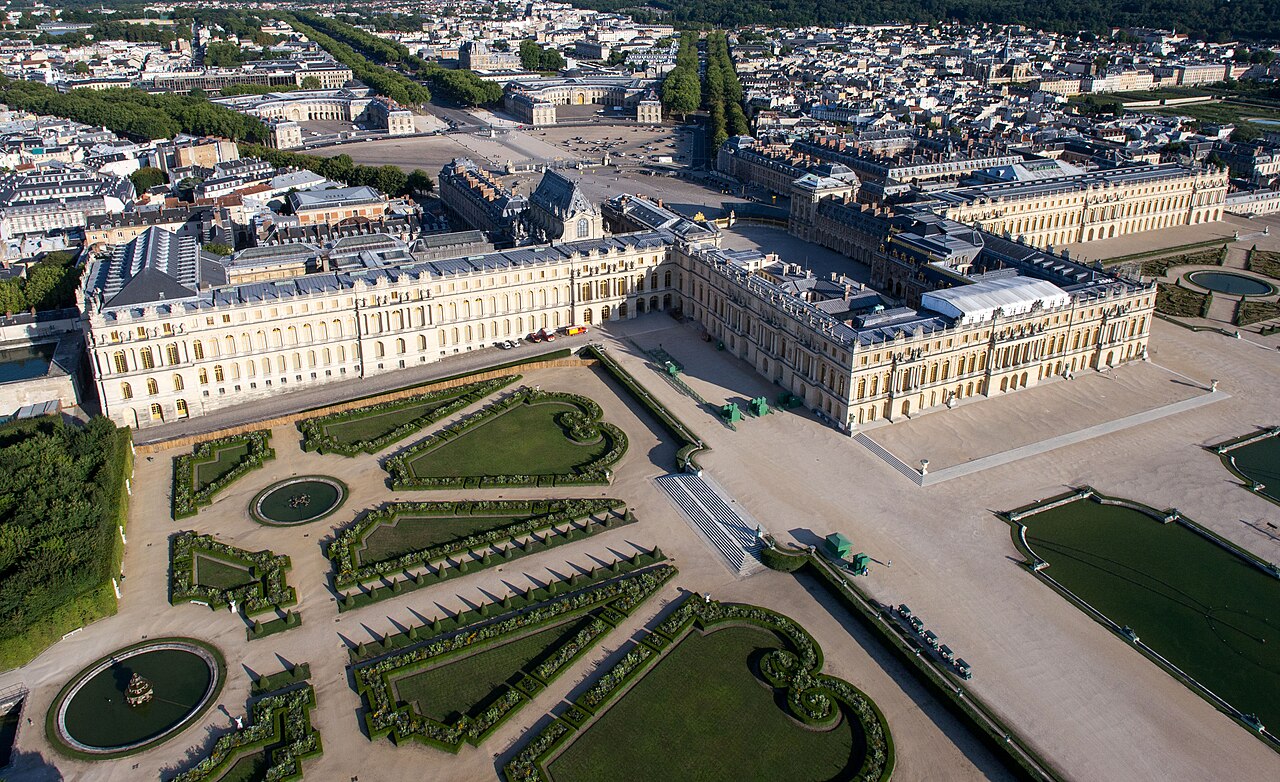
The Palace of Versailles (begun under Louis XIV in 1661, with major construction through the 1680s) is the defining example of the absolute royal palace — a building whose entire design is organized around the assertion of royal power as the center and source of all order. Nothing about Versailles is accidental. The main axis of the building extends in a straight line from the gilded iron gates of the outer forecourt, through the central block of the palace, through the Hall of Mirrors, and then onward through the formal gardens to the far horizon. The king's bedroom was positioned at the exact center of this axis — Louis XIV's daily ritual of rising and retiring (the lever and coucher) was a public ceremony of court attendance at the midpoint of the world's axis of order.
The forecourt sequence — from outer courtyard to middle courtyard to Royal Courtyard to the main facade — progressively narrowed access as it approached the king. The scale of the main facade (over 600 meters wide when including the wings) is deliberately overwhelming: it cannot be taken in with a single glance, and the visitor is continuously aware of its extension beyond the field of vision. The Hall of Mirrors (1678–1684, designed by Jules Hardouin-Mansart with painted decoration by Charles Le Brun) lines one long wall with mirrors reflecting the garden windows on the opposite wall — a room literally designed to show the king's court reflected and multiplied in a spectacle of magnificence, with the ceiling paintings recording Louis's military victories in allegorical form.
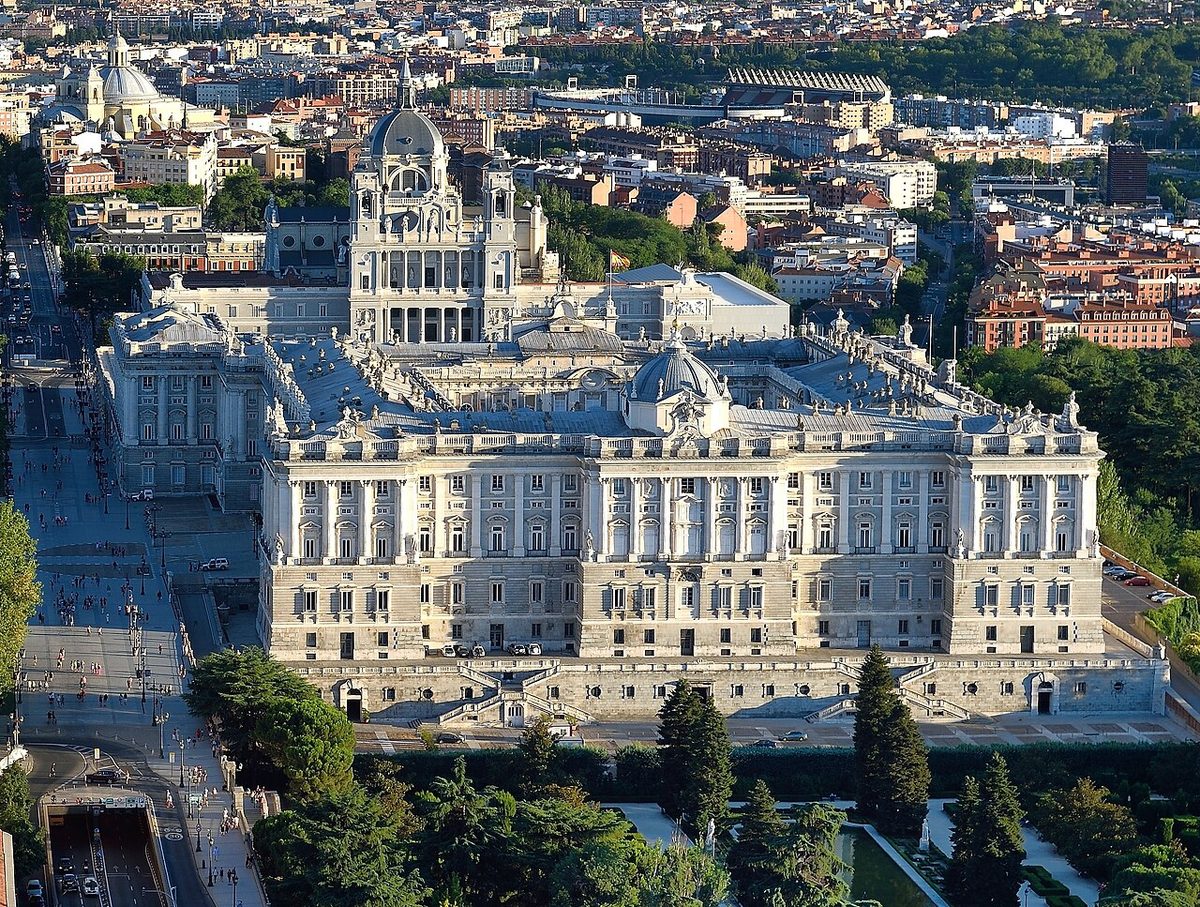
Every major European royal palace built after Versailles acknowledges its precedent. Schönbrunn (Vienna, rebuilt 1696–1713) uses the same forecourt-to-main-facade approach with symmetrical wings and axial gardens. The Royal Palace of Madrid (begun 1738) adopts the monumental stone facade and commanding hilltop position. The Catherine Palace at Tsarskoye Selo (Pushkin, Russia, rebuilt 1752–1756 by Bartolomeo Rastrelli) takes the wing-extended facade to an extraordinary length — over 300 meters — in turquoise and white, demonstrating that Russian imperial ambition could match and exceed French precedent. The visual DNA of the absolute palace — symmetrical facade, projecting central block, wings extending symmetrically, axial gardens — is one of the most consistently reproducible architectural types in the world.
The Forbidden City: a different logic
The Forbidden City (Beijing, begun 1406 under the Yongle Emperor, substantially complete by 1420) organizes imperial authority through a completely different spatial logic from Versailles, yet achieves comparable effects. Where Versailles is a building that displays itself — that puts its magnificence on view from the forecourt, that fills its principal room with mirrors to multiply the spectacle — the Forbidden City conceals. The emperor was at the center, hidden; the experience of approaching imperial power was a sequence of successive enclosures, each more restricted than the last.
The approach from the south passes through a series of gates: the Meridian Gate (Wumen) at the outer perimeter, then across a marble bridge over the Golden Water River, then through the Gate of Supreme Harmony into the first great courtyard, and so on through three progressively more restricted ceremonial courts to the innermost residential complex. At each gate, the number of people permitted to continue diminishes. Most officials would never pass beyond the outer courts. The emperor's daily life was conducted deep in the complex, shielded from direct sight by layers of enclosure.
The color coding of the Forbidden City communicates imperial hierarchy at a glance. Yellow — the emperor's color — appears on the glazed ceramic roof tiles of the most important ceremonial buildings: the Hall of Supreme Harmony, the Hall of Central Harmony, the Hall of Preserving Harmony. Secondary buildings use green or blue-green tiles. The red walls, golden roofs, and white marble terraces of the great halls create a color palette that is simultaneously beautiful and legible as a map of power. Even from outside the complex, the roofscape communicates the hierarchy within. The Forbidden City is one of the most immediately recognizable complexes in the world precisely because its visual vocabulary is so completely systematized — yellow tiles on triple-tiered white marble terraces, within red walls, on a perfectly north-south axis.
Washington DC and republican power
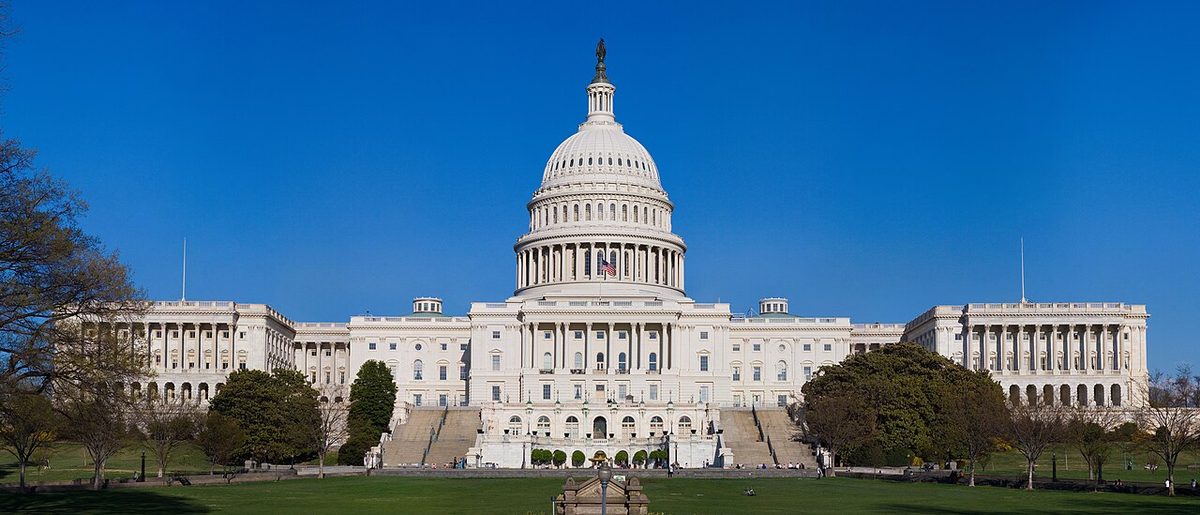
The design of Washington DC confronts a peculiar problem: how do you use the spatial language of absolute monarchy — axis, procession, visible civic building on elevated ground — for a republic that has consciously rejected monarchy? The answer, provided by Pierre Charles L'Enfant's 1791 plan and elaborated over the following two centuries, is to adapt the language without changing it. The tools of royal display turn out to be equally available to republican governments; the content changes while the form stays constant.
L'Enfant placed the Capitol on Jenkins' Hill — the most prominent rise in the area — at the center of a grid of diagonal avenues radiating outward across the city. The Capitol is visible from multiple approaches along these diagonal avenues, each approach offering a framed view of the dome. The Mall extends westward from the foot of Capitol Hill as a grand processional axis — originally conceived as a formal avenue, later developed (in the McMillan Plan of 1901–1902) as the great open lawn it is today. The axis ends at the Lincoln Memorial (Henry Bacon, 1922), a Greek temple in white marble that houses Daniel Chester French's enormous seated Lincoln — a building that uses the forms of classical antiquity to canonize the Union and the abolition of slavery. Midway along the axis stands the Washington Monument (Robert Mills, 1884), an Egyptian obelisk 169 meters tall that is both the tallest masonry structure in the world and the central vertical element of the entire composition.
The White House sits on a perpendicular axis running north from the Mall — the executive on a side axis, subordinate to the legislative center. The entire spatial composition of Washington is a legible diagram of republican government: Congress at the center and highest point, the executive to the side, the monuments extending the civic narrative westward in a sequence of memorials to presidents and to the nation's wars. It is the most explicit mapping of a political theory onto urban form in modern history, and it has been imitated, consciously and unconsciously, by governments around the world ever since.
The grand capital project: Brasília, Canberra, Chandigarh
The 20th century produced a distinctive building type — the purpose-built national capital — that represented the architectural ambitions of newly independent or newly self-conscious nations in especially concentrated form. Building a new capital from scratch is one of the most expensive and ambitious acts any government can undertake, and the results inevitably reflect the political moment and cultural aspirations of the moment of construction.
Brasília (inaugurated 1960, designed by Lúcio Costa with principal buildings by Oscar Niemeyer) was built to shift Brazil's capital from the coast to the interior, to open the Amazon basin to development, and to announce Brazil's arrival as a modern nation. Costa's Pilot Plan organizes the city as a giant cross — or, in his own description, like a bird in flight, its wings curving to follow the lakeshore — with the monumental axis running east-west to Lake Paranoá, where it terminates at the government buildings. The National Congress (1960) is the centerpiece: two horizontal slabs housing the Senate and Chamber of Deputies, flanked by two paired towers, the Senate chamber covered by a dome and the Chamber chamber by a bowl — identical volumes differentiated by orientation. Niemeyer's other government buildings along the Monumental Axis — the Presidential Palace (Palácio da Alvorada), the Supreme Court, the Ministries — use the same vocabulary of pure geometric form in white concrete against sky and water, creating an aesthetic of serene utopian authority.
Canberra (designed from 1913, Walter Burley Griffin and Marion Mahony Griffin) is organized around a different kind of geometry: landscape-scale triangles and circles anchored to the surrounding mountain peaks, with the Parliamentary Triangle at the center connecting Capital Hill (Parliament House), the War Memorial, and the city center. The new Parliament House (1988, Romaldo Giurgola) is embedded into Capital Hill — its roof is the hill — with a flagpole on the summit of what is technically the roof of the legislature, creating a building that is both monumental and deliberately understated. Chandigarh (Punjab, designed by Le Corbusier in the 1950s–1960s) takes the most explicit approach: the Capitol Complex at the north end of the city contains the High Court, the Secretariat, and the Legislative Assembly in massive Brutalist concrete forms, with an open-hand sculpture — Le Corbusier's conscious rejection of the clenched fist as a symbol of authority — standing in the open plain before them.
Monumental axes: the triumphal procession
The triumphal processional axis — a long, straight avenue designed for the movement of armies, dignitaries, and crowds — is one of the oldest and most persistent tools of architectural power. The route from the city gate to the palace or temple has organized spatial experience in cities from ancient Rome to contemporary Pyongyang, and its logic is unchanged: the length of the approach magnifies the importance of the destination, and the width and grandeur of the avenue communicate the power of the authority that commands it.
The Champs-Élysées (Paris) in its current form is largely the result of Baron Haussmann's transformation of Paris under Napoleon III (1853–1870). The axis runs from the Place de la Concorde — with its Egyptian obelisk brought from Luxor in 1833 — up the gentle rise of the Champs-Élysées to the Arc de Triomphe (1836), commissioned by Napoleon I to celebrate his victories. Haussmann widened the avenue to its current 70-meter width and cleared the surrounding blocks to make the Arc de Triomphe the pivot of twelve radiating avenues — a composition of radial axes visible on any map of Paris and felt as a spatial experience from the road. The axis was designed for military parades, royal processions, and national celebrations, and it still serves those functions.
Mussolini's Via della Conciliazione (Rome, 1936) cleared the medieval quarter between the Tiber and St Peter's Square to create a direct visual and processional axis from the river to the basilica — a project that destroyed a neighborhood but created the long approach to St Peter's that millions of visitors now experience as the defining approach to the Vatican. The logic of the triumphal axis is politically neutral: authoritarian and democratic governments use it equally. Pyongyang's axial plan, with the Tower of the Juche Idea (1982) and the grand boulevards designed for mass parades, uses spatial forms not fundamentally different from those of Washington or Paris. The form does not encode a particular ideology; it encodes the claim to power itself.
How to read power buildings in the game
Power buildings cluster around a set of visual signatures that are consistent across centuries and continents, making them among the most identifiable building types in the game once you learn to read the cues.
A large building on a podium — raised on steps, set back from a wide forecourt, with a symmetrical facade and a central dome or tower — indicates a legislature, government palace, or major university in the Neoclassical tradition. This type appears from the United States Capitol to the Panthéon in Paris to the Parliament of India (Herbert Baker, New Delhi, 1927) to countless state capitols and city halls worldwide. The dome is the single most consistent identifier: a central dome on a symmetrical classical building almost invariably indicates government or civic function. The specific style varies — American civic buildings tend to white marble and Roman scale, British tend to Portland stone and more restrained proportions, Indian tend to red sandstone with Mughal inflections — but the dome-on-podium type is recognizable everywhere.
A vast horizontal facade with wings extending symmetrically on both sides — especially if set in formal grounds behind gates — indicates a royal or imperial palace. The key distinguishing feature from a government building is the residential character: many windows, often three or four stories of regular fenestration, with a central projecting block but no dome. Versailles, Schönbrunn, and their descendants in Spain, Russia, Scandinavia, and beyond all share this horizontal, extended, symmetrical DNA. The palette varies — yellow stucco at Schönbrunn, rose-pink at Jaipur's City Palace, white marble at the Taj Mahal complex — but the bilateral symmetry and horizontal extension are consistent.
A tall obelisk, column, or shaft in an open public space almost invariably signals a victory monument from the 19th century — named after a battle (Trafalgar Square, London; Place Vendôme, Paris) or a leader (Washington Monument; Nelson's Column). These are vertical markers in otherwise horizontal civic compositions, serving as orientation points for the processional axis. A white marble or granite building set well back from the road with an axial approach, classical portico, and inscription on the entablature suggests a Washington-tradition memorial or monument: the Lincoln Memorial type, adapted into civic memorials worldwide from the early 20th century onward.
Finally, a Brutalist building with monumental scale, abstract sculptural concrete roofline, and a deliberately austere plaza usually indicates a postcolonial or mid-20th-century government building — a state that was asserting its modernity and independence through architecture at the moment of decolonization. Chandigarh, Dhaka (Louis Kahn's National Assembly, 1982), and the civic centers of many African capitals built in the 1960s–1980s use this vocabulary. For more on the Neoclassical tradition in civic buildings, see our guide to Neoclassical architecture, and for the role of imperial power in shaping building traditions around the world, see our piece on colonial architecture.
Regional Variations in Power Architecture
Roman imperial architecture made its statements through engineering as much as ornament. The Colosseum (completed 80 CE) held 50,000 to 80,000 spectators in a concrete-and-travertine oval whose four-storey facade deployed the three classical orders in sequence — Doric at ground level, Ionic above, Corinthian at the top — as a demonstration of architectural literacy as well as engineering confidence. Trajan's Forum (dedicated 112 CE), the largest public forum ever built in Rome, covered roughly 38,000 square metres with basilicas, libraries, temples, and the 38-metre Trajan's Column documenting his Dacian campaigns in a continuous spiral frieze of 2,662 figures. The imperial investment in public space was a direct political act: feeding, entertaining, and sheltering the Roman population at state expense was the price of legitimacy.
Ottoman power architecture combined religious and secular authority in the same complex in a way that had no precise Western parallel. Topkapi Palace (begun 1459) in Istanbul was the administrative heart of an empire that at its peak stretched from Hungary to Yemen, organized as a series of nested courts with progressively restricted access — the outermost open to the public, the inner courts accessible only to officials, the innermost to the sultan and his household. The Süleymaniye Mosque (1557, architect Sinan), on a promontory visible from across Istanbul and from the Bosphorus, was designed to cascade downward from dome to semi-dome to smaller domes in a profile visible from every direction on the water. Sinan composed the skyline of Istanbul as a single integrated composition, placing his mosques so that each new building enhanced the total silhouette of the hill above the Golden Horn. That skyline management — using individual buildings to make arguments about the whole city — is perhaps the most sophisticated exercise in architectural power in history.
French Baroque absolutism under Louis XIV transformed the palace itself into a governing instrument. Versailles was not merely where Louis lived: it was where the entire French nobility was required to live and attend court, creating a system in which the aristocracy's physical presence at a palace 20 kilometres from Paris kept them under the king's eye, dependent on royal favour, and unable to build independent power bases in their provincial estates. The architecture was the enforcement mechanism. Every room, corridor, and garden feature had an assigned audience and a ceremonial function. The geometry of Le Nôtre's gardens — their mathematical regularity, their demonstration of human mastery over natural growth — was a direct visual argument for the king's mastery over human nature. Versailles was built as philosophy as much as residence.
Soviet Stalinist architecture revived the classical vocabulary with maximalist scale to express the power of the socialist state and its inevitable historical triumph. The Seven Sisters — the seven skyscrapers built in Moscow between 1947 and 1957 — use Gothic spires, classical column orders, and socialist realist sculptural programs at skyscraper scale, producing buildings that are simultaneously familiar (they quote the Empire State Building and the Woolworth Building) and alien (they quote them in the service of an entirely different political program). The Moscow Metro stations of the 1930s to 1950s are even more extreme: marble-lined halls with crystal chandeliers and bas-relief friezes, each station a small palace, the subway system as a whole an argument that socialist modernity was more beautiful than capitalist modernity. A very different counter-argument came from Norman Foster's Reichstag dome in Berlin (1999): a glass cupola installed atop the restored 19th-century parliament building, open to the public, with an internal ramp spiraling around a central light-reflective cone — so that citizens could literally stand above their parliament, looking down through a glass floor at the debating chamber below. Transparency as power architecture: democratic legitimacy expressed through the visibility of its own mechanisms.
Key Identifiers: Architecture of Power
- Bilateral symmetry across a central axis — a building that cannot be approached from the side without the viewer being aware of the main facade's centrality
- Elevated entrance requiring ascent — steps as submission ritual, the visitor physically smaller than the building before they enter
- Scale significantly larger than human body or functional need — halls wider than any acoustic or practical requirement could justify
- Expensive or rare materials (marble, gold leaf, granite, polished porphyry) signalling resource command inaccessible to private builders
- Prominent hilltop, axial, or waterfront position in the city plan — the building visible from multiple approach routes simultaneously
- Monumental inscription or iconographic program — heraldry, reliefs, coats of arms, or inscribed names identifying the authority that built it
- Long formal approach — forecourt, gate sequence, avenue, or garden that forces a ceremonial rather than casual arrival
- Central dome or tower marking the apex of a symmetrical composition — the vertical accent that makes the building readable as a landmark from distance
A Closer Look: Palace of Versailles
Louis XIV moved his court from Paris to Versailles in 1682, transforming a hunting lodge begun by his father into the physical seat of the French state and requiring the aristocracy of France to attend upon him there rather than govern their own estates. The strategic genius of Versailles as a power instrument is inseparable from its architecture: the palace was the cage in which the king kept the nobility. By making court attendance the only route to royal favour, patronage, and military commissions, Louis simultaneously controlled the aristocracy and deprived them of the provincial independence that had made them dangerous. The building's physical scale was the scale of that ambition. The garden facade stretches approximately 680 metres — longer than six football pitches laid end to end — and was designed to be seen in its entirety only from across the formal parterre, a distance at which the individual is reduced to near-invisibility against its expanse. Every visiting dignitary approached across Le Nôtre's formal gardens, the geometry of the landscape itself a demonstration of human mastery over nature, which is to say the king's mastery over France.
The Hall of Mirrors (Galerie des Glaces, 1678–1684) is 73 metres long, 10.5 metres wide, and 12.3 metres tall, lined on one long wall with 357 mirrors in 17 arched frames and on the opposite wall with 17 arched windows looking onto the garden. The mirrors double the light of the windows and the image of the garden, so that on a clear day the Hall fills with a cascade of reflected light that makes the entire room seem to vibrate. The ceiling paintings by Charles Le Brun record the military campaigns of Louis XIV's first 17 years of rule in allegorical form: the king appears as Hercules, as Mars, as the sun itself. Walking the length of the Hall — which all visitors were required to do when attending upon the king at his daily lever and coucher — was walking through a compressed narrative of French power and royal magnificence. The Hall of Mirrors was where the German Empire was proclaimed in 1871 and where the Treaty of Versailles was signed in 1919: the most consequential room in Western diplomatic history, used for both because of the weight that its architectural programme was understood to add to any act performed within it.
The gardens at Versailles, designed by André Le Nôtre between 1661 and 1700, cover roughly 800 hectares and represent the largest single commissioned landscape design in history. The main axis runs from the Hall of Mirrors westward through the Grand Canal (a cruciform body of water 1,500 metres long) and onward to the horizon. Every element of the garden — the parterres of clipped box, the allées of pleached limes, the fountains, the statuary, the bosquets of hornbeam — is arranged in precise bilateral symmetry along this axis. The fountains required the largest hydraulic engineering project in 17th-century France: a chain-pump system on the Seine at Marly powered by a machine of 221 pumps drove water 150 metres uphill to reservoirs that fed the palace. On days when all fountains were operating simultaneously, the system could not sustain pressure for more than a few hours — but those hours were calculated for maximum effect during royal processions.
Spotting It in Building Guessr
Government and civic buildings in the game are often identifiable by their deliberate grandeur — a scale and ornamentation that consistently exceeds functional requirements. The Government/Civic type filter surfaces these buildings directly. The most reliable initial signal is formal symmetry combined with a monumental entrance: if the building has a central projecting element (a portico, a central block, a dome) flanked by symmetrical wings, and if the entrance requires ascending a flight of steps, you are almost certainly looking at a power building. The material finish narrows the geography: white marble or light limestone suggests American, Western European, or colonial-era construction; red sandstone suggests India (the colonial capital at New Delhi used local red sandstone throughout, connecting modern imperial architecture to Mughal precedent); yellow stucco with elaborate window surrounds suggests central European Baroque or Rococo; heavy dark granite suggests Stalinist-era Soviet or postcolonial monumental.
In photographs, power buildings often appear with no other buildings visible at the same height — they occupy elevated or cleared sites specifically designed to be seen unobstructed. A building that appears to command its surroundings, with a clear sky behind it and a formal approach visible in the foreground, is a strong signal. The presence of a guard post, a formal gate, flagpoles at the entrance, or a ceremonial forecourt reinforces the identification. When the photographic angle is from low and close — looking up at a flight of steps toward a columned portico — that composition itself was usually built in to the design: the architect wanted visitors to feel that exact combination of ascent and diminishment.
Try the palaces filter and see how many you can place.
Play Building GuessrFurther Reading
Sources & further reading
Reference material this page draws on, and where to read further. External links open third-party sites.
- Palace · Wikipedia
- Palace of Versailles · Wikipedia
- United States Capitol · Wikipedia
- Monument · Wikipedia
- Forbidden City · Wikipedia
- World Heritage listing: Palace of Versailles · UNESCO World Heritage Centre
- World Heritage listing: Forbidden City · UNESCO World Heritage Centre