Why colonial architecture is a geography tool
Colonial architecture is one of the most powerful location-reading tools available to anyone trying to identify a building from a photograph. The reason is simple: buildings constructed under colonial administration encode two layers of information simultaneously. The first layer is climate and local material — the adjustments that any sensible builder makes to hot or humid weather, available stone, timber, or brick, and local craft traditions. The second layer is the home country's architectural fashions at the moment of building — and that second layer is often more legible than the first, because it reflects deliberate choices about what kind of building should represent authority, commerce, or civic pride in a colonial context.
This double encoding means that a single building photograph can tell you both roughly where in the world you are looking and who was in charge. A wide-verandahed bungalow with louvred shutters and a corrugated iron roof tells you tropical climate and British Empire simultaneously. A cream-painted arcade with green shutters and iron balconies puts you firmly in French colonial territory. The combination of climate adaptation and metropolitan style is the grammar you need to learn. Once you can read it, large portions of Asia, Africa, and the Americas that might otherwise be ambiguous become identifiable to within a colonial tradition — and often to a specific territory.
Colonial architecture is also among the most geographically widespread building tradition in the world. The British Empire at its peak covered roughly a quarter of the earth's land surface; French, Portuguese, Spanish, Dutch, and Belgian colonial territories covered much of the rest. The architectural imprints of these empires survive in thousands of cities and towns that are regularly featured in geography games. Understanding which empire built which building type, and what each empire's characteristic decorative and structural vocabulary looked like, will improve your location accuracy dramatically — adding tens or hundreds of points to scores that otherwise rely on natural landscape cues alone.
British colonial: the bungalow and the civic classical
The bungalow is the most widely distributed domestic building type produced by British colonialism. The word derives from the Gujarati bangalo, meaning "of Bengal" — the form originated in Bengal as a simple single-story structure with a deep thatched roof extended on all sides to create a shaded veranda. British administrators adopted it as the standard officer's quarters and civil servant's residence because its open plan and wraparound veranda suited the tropical climate: cross-ventilation through every room, continuous shade at every elevation, and a raised floor to keep damp and insects at bay.
As British administration spread across India, Ceylon (Sri Lanka), Burma (Myanmar), Malaya (Malaysia), Singapore, East Africa, West Africa, and the Caribbean, the bungalow traveled with it, adapting its materials to what was locally available while maintaining its essential spatial logic. The result is that a very similar domestic building type appears across an enormous geographic range — identifiable by its single story (or low two stories), the prominent wraparound veranda, the pitched roof with deep overhanging eaves, and the generally open, airy quality of its exterior. The veranda columns might be timber, cast iron, or painted concrete depending on location and era, but the spatial grammar is consistent.
For civic and government buildings the British colonial tradition drew on Greco-Roman classicism as interpreted through successive metropolitan periods. Regency classicism (first quarter of the nineteenth century), High Victorian Gothic (second half of the nineteenth century), and Edwardian Baroque (turn of the twentieth century) all left deposits in different territories at different moments. The most dramatic example is Mumbai's Chhatrapati Shivaji Maharaj Terminus (completed 1888, designed by Frederick William Stevens): a building that takes High Victorian Gothic — pointed arches, stone tracery, gargoyles, a prominent central dome — and collides it with Hindu and Mughal decorative ornament in carved capitals, peacock screens, and ornate surface patterns. The result is neither purely Gothic nor purely Indian but an exuberant hybrid that could only have been produced at the intersection of two ambitious architectural traditions. Colombo, Nairobi, Singapore, and Rangoon (Yangon) all have recognizable British colonial civic cores built in Greco-Roman or Victorian Gothic modes.
French colonial: the arcade and the tropical modern
French colonial architecture is characterized above all by the arcade: a covered walkway at ground floor level running along the street frontage of buildings, creating a continuous shaded pedestrian path between the building face and the roadway. The arcade was a rational response to tropical heat and intense seasonal rain — it allowed street life to continue in comfort during the hottest part of the day and kept pedestrians dry during monsoon downpours — but it also expressed a specifically French vision of the colonial city as an ordered, legible, European-style urban space.
The arcaded streetscape is most intact in Hanoi's Old Quarter and along what was Rue Catinat (now Dong Khoi) in Ho Chi Minh City (Saigon). The buildings along these streets follow a consistent aesthetic: cream or pale yellow painted plaster facades, green louvred shutters on tall narrow windows, wrought-iron balconies at the upper floors, and pitched Mansard or simple hip roofs that recall the residential architecture of provincial France. The combination of cream plaster, green shutters, and iron balconies is among the most immediately recognizable colonial signatures in Southeast Asia.
France also colonized large parts of North and West Africa — Morocco, Algeria, Tunisia, Senegal, Côte d'Ivoire — and its architectural deposits there show similar arcade-and-plaster urbanism adapted to a drier climate. After the Second World War, France maintained several overseas territories and began commissioning a more explicitly modernist tropical architecture for new public buildings. The architect Georges Candilis, working in Dakar, Senegal and other Francophone West African cities in the 1950s and 1960s, developed an approach that combined the open plans and pilotis (pillar supports) of Le Corbusier's tropical modernism with deep brise-soleil (sun-breaking) screens on exposed facades, creating a recognizable "tropical modern" variant of French colonial design. The brise-soleil — projecting horizontal or vertical concrete fins that shade windows from direct sun while admitting diffuse light — became a signature element of late French colonial and early post-independence public architecture across much of Francophone Africa and the Caribbean.
Portuguese colonial: the azulejo and the Baroque church
Portuguese colonial architecture is marked by two signatures that are among the most distinctive in any colonial tradition: the azulejo tile and the Baroque church facade. The azulejo is a glazed ceramic tile, typically decorated in blue-and-white patterns (though earlier tiles also used yellow, green, and manganese brown), that the Portuguese applied to church facades, palace interiors, and the walls of grand houses across their empire. The tradition derives ultimately from Moorish tile work but was developed in Portugal into a distinctive art form that traveled with Portuguese traders and missionaries to Brazil, Angola, Mozambique, Goa, Macau, and East Timor. When you see a building with its exterior walls sheathed in blue-and-white ceramic tile panels depicting landscapes, historical scenes, or geometric patterns, you are almost certainly looking at a building in the Portuguese colonial sphere of influence.
The Baroque church is the other defining element. Portuguese missionaries built churches across their empire from the early sixteenth century, and the architectural style of those churches tracked metropolitan fashion in Lisbon and Porto — which in the seventeenth and early eighteenth centuries meant the exuberant carved stone facades and gilded interior decoration of Portuguese Baroque. Brazilian Baroque represents the tradition at its most intense: the Igreja de São Francisco in Salvador, Bahia (completed 1723), conceals behind a relatively restrained exterior facade an interior entirely sheathed in gilded carved woodwork — walls, ceiling, altarpiece, and column capitals all covered in gold leaf over intricately carved designs. This combination of plain exterior and overwhelming gilded interior is characteristic of Portuguese Baroque in Brazil.
In Goa, India, the Basilica of Bom Jesus (1605) houses the preserved remains of St. Francis Xavier in an elaborate Baroque altar and represents the high point of Portuguese ecclesiastical architecture in Asia. In Macau, the Ruins of St. Paul's Cathedral (destroyed by fire in 1835, with only the stone facade remaining) is one of the most photographed colonial remnants in Asia — its free-standing Baroque stone facade, elaborately carved with religious imagery, stands isolated in the city without a building behind it. All three of these examples — Salvador, Bom Jesus, and the Macau ruins — are UNESCO World Heritage Sites, and all three are regularly encountered in geography games set in former Portuguese territories.
Dutch colonial: the VOC warehouse and the gabled townhouse
Dutch colonial architecture reflects the specific priorities of the Dutch East India Company (VOC), the most powerful trading corporation of the seventeenth century. The Dutch were primarily interested in trade — in establishing secure trading posts, warehouses, and fortified depots — rather than in large-scale territorial administration or religious conversion. Their architectural legacy is consequently less about civic grandeur and more about commercial infrastructure and urban planning transplanted directly from the Netherlands.
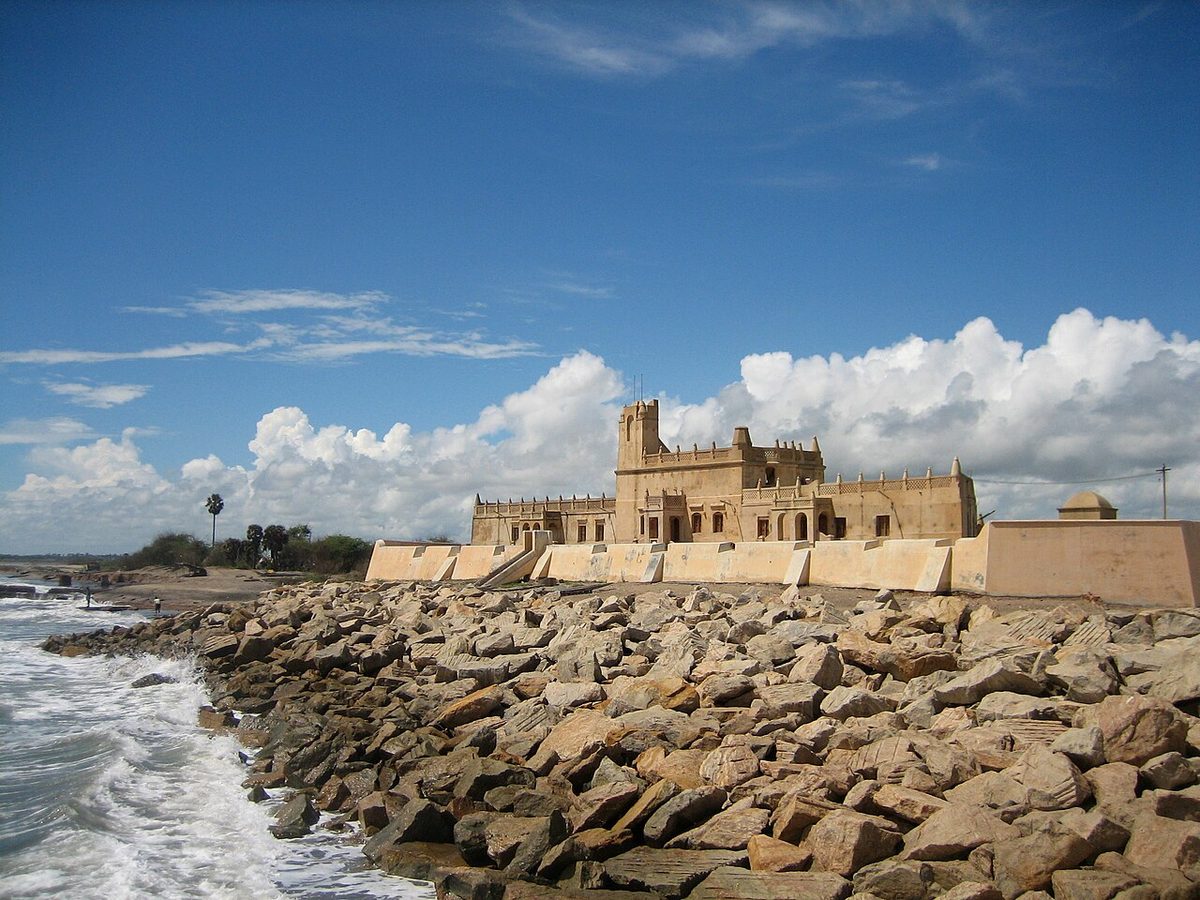
The clearest Dutch colonial signature in defensive architecture is the star fort: a fortified enclosure designed with projecting triangular bastions at each corner, so that defenders could provide overlapping fire coverage of every section of the walls. The Castle of Good Hope in Cape Town (begun 1666, completed 1679) is the oldest surviving colonial building in South Africa and the best-preserved VOC star fort in the world. Its pentagonal plan, with five bastions named after the titles of the Prince of Orange, is clearly legible from aerial photographs and represents the most direct surviving evidence of Dutch colonial military architecture anywhere in the Dutch colonial sphere.
In Batavia (now Jakarta), the Dutch attempted to recreate Amsterdam in the tropics: a gridded city of canal-lined streets, brick warehouses, and gabled townhouses directly modeled on those of the Netherlands. The experiment was a costly mistake — the canals in tropical conditions became disease vectors, spreading malaria and typhoid among the colonial population. The original Batavia townscape was largely demolished as a result. The surviving example of Dutch colonial urban planning at its most intact is Willemstad on the island of Curaçao in the Caribbean, where a row of brightly colored gabled Dutch townhouses faces directly onto the harbor waterfront. Willemstad's historic centre is a UNESCO World Heritage Site; its candy-colored gabled facades — reflecting the local tradition of painting buildings in vivid yellows, greens, and pinks rather than the sober brick and white that characterized Amsterdam — are one of the most photogenic colonial streetscapes in the world and an unmistakable game identifier for the Dutch Caribbean.
Spanish colonial: the plaza mayor and the mission church
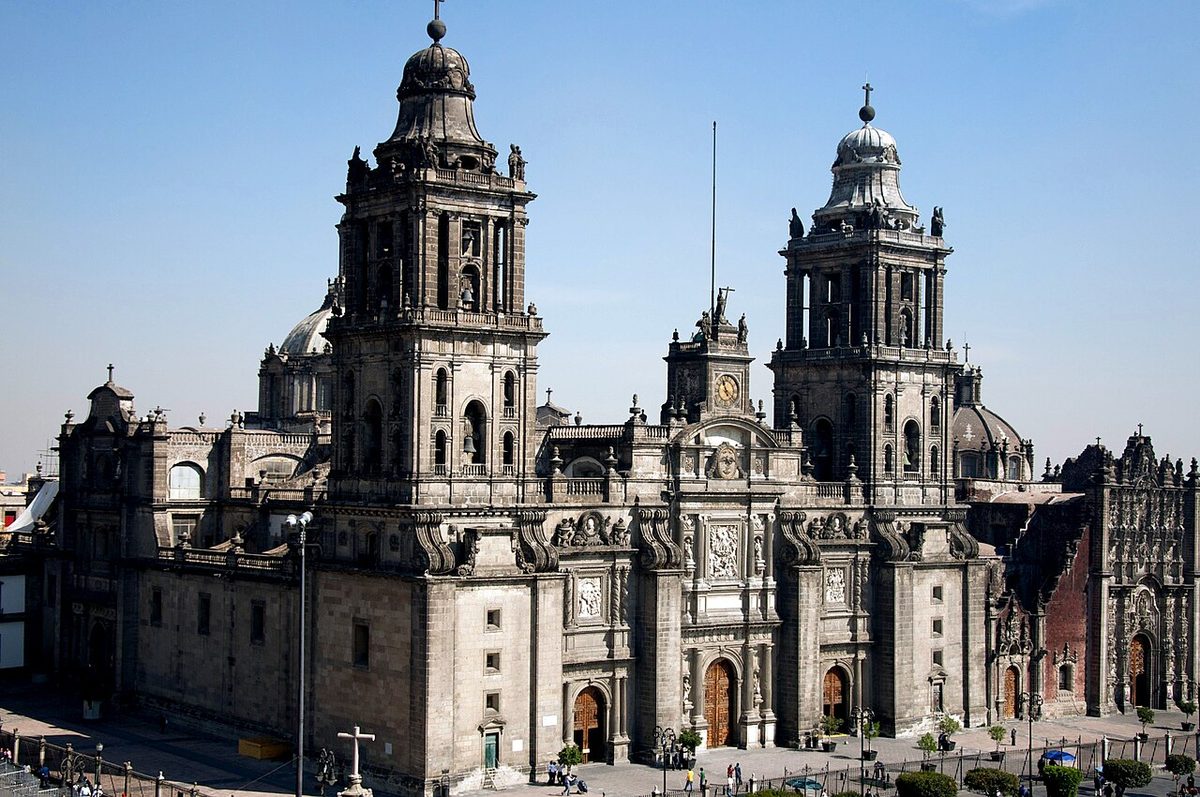
Spanish colonial urbanism was codified with unusual precision by the Laws of the Indies, a comprehensive set of regulations issued by Philip II in 1573 governing the layout of all new towns in the Spanish Americas and Philippines. The regulations specified a central plaza mayor (main square) of specified proportions, with the principal church on one side, the government palace on another, and a regular grid of streets radiating outward from the plaza. This template was applied with remarkable consistency from Mexico City and Lima to Manila and Buenos Aires, creating a recognizable urban grammar that spans three continents and four centuries.
The Spanish colonial church is the most visually distinctive building type of the tradition. At its grandest — in the viceregal capitals of Mexico City, Lima, and Cuzco — the church facade takes the form of Churrigueresque Baroque: an intensely ornate carved stone frontispiece with twin bell towers, a deeply recessed portal surrounded by layered columns and carved saints, and surface decoration so dense it reads as almost sculptural rather than architectural. The thick adobe or stone walls behind the facade are a practical response to seismic zones; the brilliantly white or ochre-painted plaster over those walls is an aesthetic one. Inside, the retablo — the carved and gilded altarpiece behind the main altar — amplifies the Baroque exuberance of the exterior into a fully immersive golden environment.
Under frontier conditions, on the northern frontier of New Spain that is now California, Arizona, and New Mexico, the Spanish mission church shows the same grammar in simplified form. Mission San Juan Capistrano (1806) and Mission Santa Barbara (1820) in California both show the characteristic twin-tower facade, arched arcade, thick white walls, and red tile roof of the mission tradition — all constructed from local adobe brick and stone by indigenous labor under Franciscan direction. The mission aesthetic — white plaster, red roof tiles, arcaded cloister, bell tower — has become so deeply embedded in California regional identity that it continues to influence domestic and commercial architecture in the American Southwest to this day, making it one of the most persistently influential colonial architectural traditions in North America.
Reading colonial buildings in the game
The practical game application of colonial architecture knowledge depends on building a mental decision tree based on the most visible architectural cues. Work through the following hierarchy and you will correctly place the colonial tradition in most cases.
Start with the domestic scale. A wide-verandahed single-story house with deep overhanging eaves, louvred or slatted screens, a pitched corrugated or tile roof, and an open airy character is British colonial domestic architecture. It could be in South Asia, Southeast Asia, East or West Africa, or the Caribbean — the climate context (vegetation, light quality) and secondary details (timber type, roof material, decorative ironwork) will help narrow it down. A cream or yellow painted building with an arcade at ground level, green louvred shutters, and wrought-iron balconies points firmly toward French Indochina or French North/West Africa. The arcade is the most reliable single identifier — no other colonial tradition used it as consistently or as programmatically.
At the monumental scale: a facade sheathed in blue-and-white ceramic tiles (azulejo) immediately signals Portuguese colonial territory — Brazil, Portugal itself, Goa, Macau, or Angola. A Baroque twin-tower church facade with thick walls, white or ochre plaster, and red tile roof points toward the Spanish colonial sphere (Latin America, Philippines) or Portuguese (Brazil, Goa). The Spanish version tends toward more elaborate carved stone portals; the Portuguese toward tile work on the exterior. A star fort with angular bastions visible from above on a coastal site signals Dutch, Portuguese, or British trading-post military architecture from the seventeenth or eighteenth century. Candy-colored gabled facades on narrow townhouses facing a waterfront are a near-certain signature of the Dutch Caribbean, specifically Curaçao or Sint Eustatius. Use local context — vegetation, sea color, surrounding landscape — to confirm, but the architectural grammar of the home country always remains legible even after centuries and across enormous geographic distances.
For more on how imperial power expressed itself architecturally, see our guides to Neoclassical architecture and the architecture of power.
Regional Variations
British colonial architecture across India shows a remarkable internal range driven by period, climate, and the ambitions of individual administrators and architects. The earliest Company-era buildings in Madras (Chennai) and Calcutta (Kolkata) follow the Palladian model — colonnaded facades, symmetrical composition, temple-front porticos — appropriate to Enlightenment-era prestige. By the mid-nineteenth century, the Gothic Revival had become fashionable in Britain and its influence spread immediately to India: the Bombay (Mumbai) High Court, the Victoria Terminus, and the University of Mumbai's Rajabai Clock Tower are all Gothic Revival structures adapted with varying degrees of integration of Indian ornamental motifs. The Indo-Saracenic style, which emerged as a deliberate official policy in the later nineteenth century under architects like Robert Fellowes Chisholm and Frederick William Stevens, attempted to blend Western structural logic with Mughal, Rajput, and Hindu ornamental vocabulary: chhatris (pavilion-like dome structures), jalis (pierced stone screens), and cusped arches applied to otherwise conventional Victorian masonry buildings. The result is a hybrid tradition specific to British India that reads as both familiar and unfamiliar to a Western eye trained on European architectural history.
Spanish colonial architecture across Latin America presents a different kind of regional variation: not between stylistic periods but between levels of wealth and accessibility. In the viceregal capitals — Mexico City, Lima, Potosí, Cuzco — the Spanish built on a grand scale using the enormous wealth generated by silver and gold extraction, and the local baroque achieved an exuberance of carved stone ornament (particularly in the Churrigueresque mode) that has no equivalent in metropolitan Spain. In provincial towns and mission settlements, the same architectural grammar was simplified to what could be built with local materials and unskilled or semi-skilled indigenous labor: thick adobe walls, timber roof structures, and whitewashed plaster facades with simple classicizing portals. The Philippines represent the colonial frontier case: Spanish missionary churches on the main islands of Luzon and the Visayas are built of volcanic stone with extremely thick walls designed to function as refuges during typhoon and earthquake — the walls are sometimes three to four meters thick, far beyond any defensive or thermal requirement — and the overall forms are simplified baroque without the ornamental richness of New World Churrigueresque.
Dutch colonial architecture shows the clearest separation between its commercial and its domestic registers. The VOC fort and trading post, of which examples survive in Galle in Sri Lanka, Fort Jesus in Mombasa, and the castle at Cape Town, follows a consistent military-engineering tradition regardless of geography: the star fort plan, the bastion at each angle, the thick walls, the central parade ground. The domestic and civic architecture transplanted to colonial towns was straightforwardly Dutch: the stepped or curvilinear gable, the relatively narrow facade, the brick construction. In Batavia (Jakarta) this produced the disaster noted above — canals in a tropical climate, brick townhouses in a hot-humid environment. In Willemstad on Curaçao the same forms survived and were embellished with the bright colors that distinguish the Dutch Caribbean from the Dutch metropolitan tradition. In the Cape Colony, Dutch domestic forms mixed with German and French Huguenot settler influences to produce the distinctive Cape Dutch farmhouse with its ornate white-painted gable ends, which became a regional tradition lasting well into the nineteenth century.
French colonial architecture in Indochina (Vietnam, Cambodia, Laos) and in North and West Africa differs in subtle ways that reflect the different contexts. In Hanoi and Saigon, the French built extensively in the late nineteenth and early twentieth centuries during the peak period of Haussmann's influence on urban design, and the result is cities with genuine boulevard networks, continuous building frontages, and an overall urban grain that recalls provincial French cities — particularly noticeable in Hanoi, where the French quarter survives more intact than in Ho Chi Minh City. In North Africa, French colonial urbanism often developed alongside rather than replacing existing Arabic cities: the French built new quarters (villes nouvelles) in cities like Rabat, Tunis, and Algiers, leaving the medinas relatively intact. The architectural language in North Africa was sometimes more explicitly "orientalist" — incorporating Moorish arches and decorative tile work into French-plan buildings — than in Southeast Asia, reflecting a different colonial ideology of inclusion-through-assimilation.
Key Identifiers
- Classical orders (Doric, Ionic, Corinthian columns or pilasters) applied to buildings in non-European contexts: likely British, French, or Spanish colonial civic architecture
- Wide verandah or wraparound veranda on a single-story house with deep eaves: British colonial domestic (bungalow type), tropical Asia or Africa
- Arcaded ground floor, cream or yellow plaster, green louvred shutters, wrought-iron balconies: French colonial, Indochina or North/West Africa
- Blue-and-white ceramic tile panels on building exteriors (azulejo): Portuguese colonial, Brazil, Goa, Macau, or Angola
- Baroque twin-tower church facade with thick white-plastered walls and red tile roof: Spanish colonial (Latin America, Philippines) or Portuguese (Brazil, Goa)
- Star fort with angular bastions visible from above on a coastal promontory: Dutch, Portuguese, or British trading-post fortification, 17th–18th century
- Stepped or curvilinear gable on a narrow facade, brick construction: Dutch colonial, particularly in the Caribbean or South Africa
- Grid street plan with central plaza flanked by church and government building: Spanish Laws of the Indies urban planning, Latin America or Philippines
- Hybrid stylistic mixing of European structural forms with non-European ornamental motifs: Indo-Saracenic (British India), Churrigueresque (Spanish Americas)
- Colonnaded or arcaded civic buildings on a seafront or harbor: any of the major colonial powers, typically 19th-century administration buildings
A Closer Look: The Victoria Memorial, Kolkata
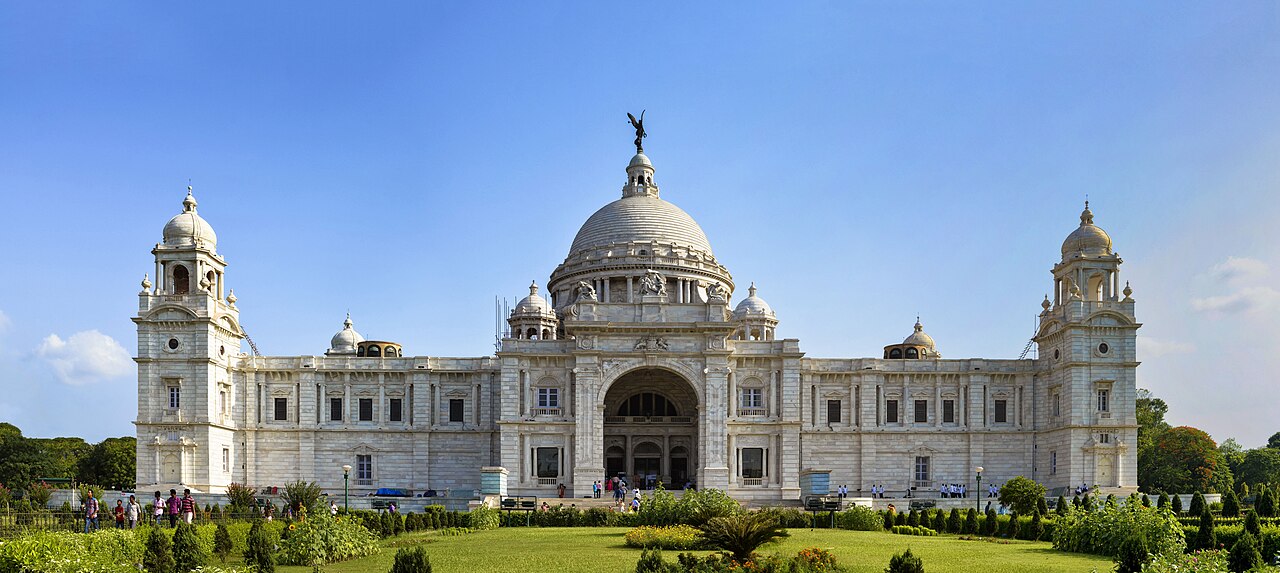
The Victoria Memorial in Kolkata (completed 1921, designed by William Emerson) is the definitive statement of British colonial monumental architecture in South Asia, and its story encapsulates both the ambition and the contradictions of the entire colonial architectural project. The building was proposed immediately after Queen Victoria's death in 1901 by Lord Curzon, Viceroy of India, as a museum and monument to the Queen-Empress. Curzon's concept was explicitly intended to match and surpass anything the British had built in India to that point: a building that would announce, in permanent stone, the permanence of British rule and the civilizational confidence of the empire at the height of its power.
The architectural result is a hybrid of extraordinary ambition and revealing contradiction. The structural and compositional model is essentially Baroque: the central dome (modeled on St. Paul's Cathedral in London, which was itself modeled on St. Peter's in Rome), the corner pavilions, the great colonnaded entrance wings, and the overall symmetrical axial composition all belong to a European tradition of royal and civic monumentality running from Versailles to the Parliament buildings at Westminster. The material is white Makrana marble from Rajasthan — the same marble used for the Taj Mahal — a choice that simultaneously signals British awareness of Indian architectural precedent and British determination to assert equivalence with the most admired building on the subcontinent. The ornamental vocabulary includes some Indian elements (the corner chhatris, the overall whiteness) but is predominantly European in its columns, cornices, and sculptural programme. The effect is of a building that is trying very hard to be simultaneously familiar to British visitors and overwhelming to Indian ones, and largely succeeds on both counts.
What makes the Victoria Memorial particularly useful as a case study is that it illustrates the specific form of colonial architectural authority at its most self-conscious. Unlike the Indo-Saracenic buildings of Mumbai, which make a genuine attempt to synthesize European and Indian traditions into something new, the Victoria Memorial uses Indian materials in the service of an essentially European monumental programme. The white marble is Indian but the grammar is metropolitan. The building is not trying to understand India; it is trying to make India legible in European terms. That tension — between the colonial power's desire to use local materials and motifs and its simultaneous insistence on metropolitan formal authority — runs through almost all British colonial monumental architecture, and the Victoria Memorial states it with unusual clarity.
Spotting It in Building Guessr
Colonial buildings often appear in contexts where the architectural style is distinctly inconsistent with the surrounding vernacular — a Baroque church in a Filipino town built of volcanic stone, a Palladian customs house facing an African harbor, an arcaded French administrative building surrounded by low-rise Indochinese shophouses. This inconsistency is itself the most reliable first-order clue: if the most prominent building in a streetscape looks like it belongs to a completely different architectural tradition from everything around it, you are almost certainly looking at a colonial building or complex. The more self-consciously grand the building, the higher in the colonial administrative hierarchy it sat, and the more closely it will reflect metropolitan fashion at the moment of construction rather than any local influence.
Use the colonial tradition as a filter, not a destination: identifying "this is British colonial" narrows your location from the entire world to the territories of the British Empire, but it does not yet tell you whether you are in India, Nigeria, Jamaica, or Australia. Secondary cues — vegetation, landscape, language on surrounding signage, the quality of light, the surrounding vernacular buildings, the specific adaptation of the colonial form to local climate — are what close the identification to a specific country or city. The colonial building is a starting point; the context around it is the finishing move.
Try identifying colonial-era buildings from their silhouettes alone.
Play Building GuessrFurther Reading
Sources & further reading
Reference material this page draws on, and where to read further. External links open third-party sites.
- Colonial architecture · Wikipedia
- Spanish colonial architecture · Wikipedia
- Architecture of India · Wikipedia
- Indo-Saracenic architecture · Wikipedia
- Dutch Colonial Revival architecture · Wikipedia
- French colonial architecture · Wikipedia