Why the 18th century looked to Rome
Neoclassical architecture was not simply a fashion preference. It emerged from a specific intellectual moment — the European Enlightenment — and it carried explicit political meaning in every building it produced. To understand why an 18th-century designer would reach for columns and pediments rather than inventing a new vocabulary, you have to understand the era's passionate engagement with the idea of Rome as a model for modern civilization.
For Enlightenment thinkers, ancient Rome and Greece represented rational governance, civic virtue, and the subordination of individual caprice to public good. These were precisely the qualities that reformers and revolutionaries wanted to claim for their political projects. When the American founders chose to design their new republic's public buildings in a classical idiom, they were not being conservative — they were making a radical statement that their experiment in self-governance stood in direct continuity with the Roman republic. The portico of a government building was an argument.
The Grand Tour played a crucial practical role. Wealthy young Europeans — overwhelmingly British, but also French, German, and others — spent months traveling through France and Italy examining ancient ruins. This created a shared visual vocabulary among the ruling class across national boundaries. An architect working in Edinburgh, Warsaw, or Virginia could rely on his clients immediately recognizing a Corinthian capital or a triumphal arch because those clients had seen the originals in Rome.
The publication of accurate measured drawings made the vocabulary available to architects who had never traveled. Giovanni Battista Piranesi's etchings of Roman ruins (1740s–1770s) circulated across Europe, their dramatic scale conveying the authority and grandeur of ancient architecture more powerfully than any earlier illustration. James Stuart and Nicholas Revett's Antiquities of Athens (1762) was the first measured publication of Greek architecture (rather than Roman), and it triggered a new wave of interest in the Greek originals that would eventually develop into a distinct Greek Revival movement. Neoclassicism as a style was inseparable from Neoclassicism as an ideology: to build like Rome was to claim Rome's virtues.
The defining elements: portico, pediment, column
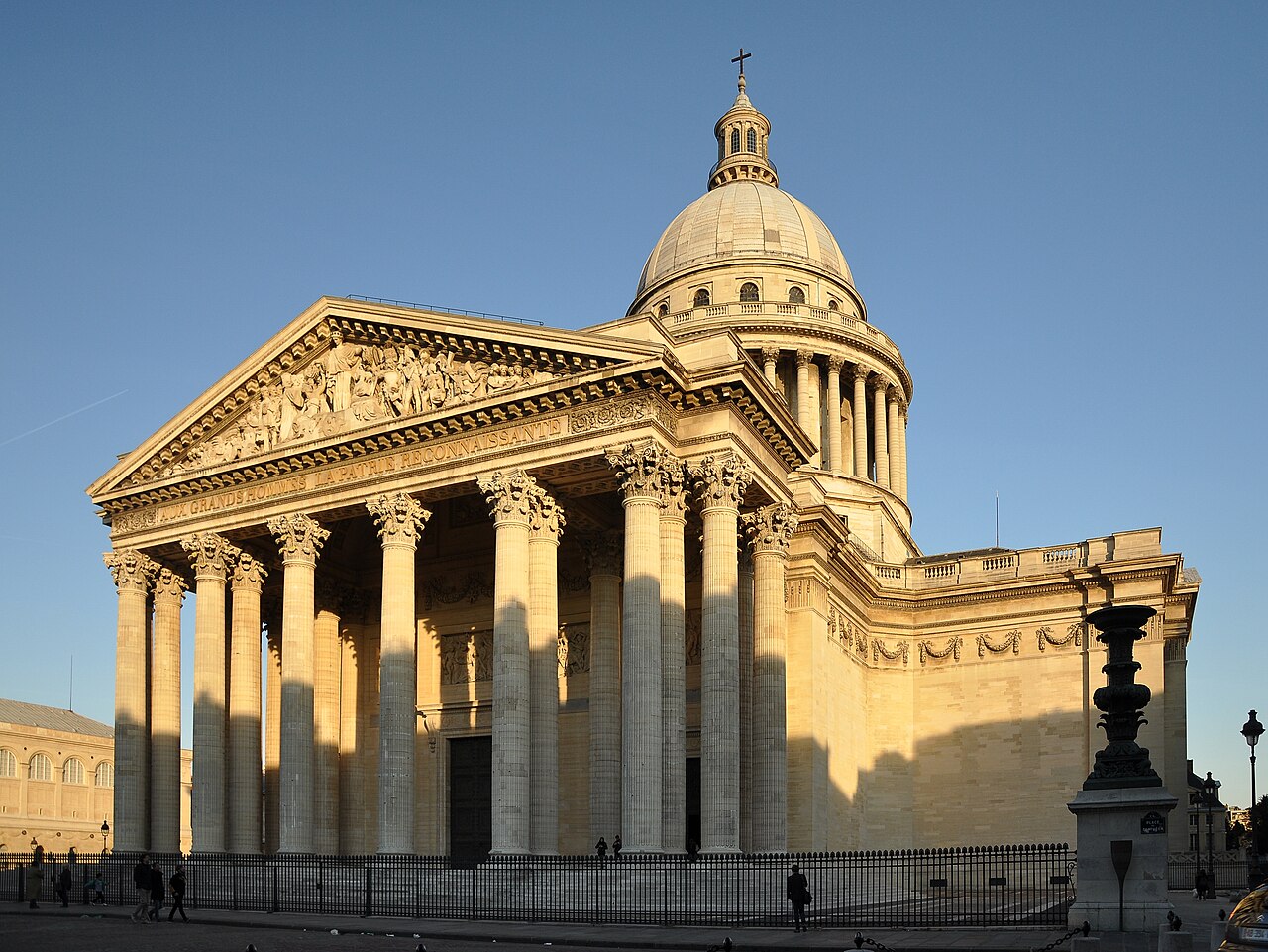
The most instantly recognizable element of any Neoclassical building is the portico — a porch of columns supporting a triangular pediment, set against the facade of the main building mass. The portico derives directly from the front porch of a Roman temple and announces public, civic, and permanent character. It says: this building is not a private dwelling or a commercial premises but a structure of lasting significance to the community. Every bank, courthouse, university library, or government ministry that adopted the portico in the 18th and 19th centuries was broadcasting that message.
The columns of the portico use one of the three classical orders, following the rules established in ancient practice and codified by Renaissance theorists. The Doric order — column without base, simple capital, triglyph-and-metope entablature — appears on buildings meant to project austerity, strength, or military virtue. The Ionic order — slender column with volute (scroll) capital, continuous frieze — conveys intellectual refinement. The Corinthian order — ornate acanthus-leaf capital — signals the highest level of civic prestige and is used for the most important Neoclassical buildings. The entablature (the horizontal band above the columns) is treated carefully according to the order: Doric entablatures include triglyphs and metopes; Corinthian entablatures use a plain frieze or continuous carved ornament; the details are not decorative choices but a controlled grammatical system.
Beyond the portico, Neoclassical buildings follow strict rules of bilateral symmetry: the facade has a central axis, and everything on the left is mirrored exactly on the right. Wings extend at equal length. Window spacing is regular. Pediments cap end pavilions. This symmetry is not merely visual preference but a philosophical statement about order, rationality, and human control over nature — all core Enlightenment values. A Neoclassical facade that breaks symmetry is making a deliberate point; an asymmetric Neoclassical building is almost a contradiction in terms.
Many Neoclassical buildings are also raised on a base of steps or a rusticated ground floor, separating the noble piano nobile from the street and echoing the Roman temple podium. This elevation, combined with the projecting portico and the hierarchical column orders, creates a building that reads immediately as significant and authoritative — which is exactly what its patrons intended.
The White House, the Panthéon, and the pattern
Three buildings from the decades around 1800 illustrate the range of Neoclassical solutions and demonstrate how architects adapted the ancient vocabulary to modern programs.
The White House (Washington DC, begun 1792, James Hoban) represents Neoclassicism adapted to a domestic program. Hoban based his design closely on Leinster House in Dublin — a British Palladian country house — giving the American president's residence the appearance of an aristocratic villa rather than a Roman temple. The south facade's Ionic portico was added later (1824), but the fundamental composition of a central block with balanced wings was already a Neoclassical statement: ordered, symmetrical, restrained, and clearly European in its reference points. The White House demonstrates that Neoclassicism operated across scales, from the modest plantation house to the full civic institution.
The Panthéon (Paris, 1758–1790, Jacques-Germain Soufflot) represents Neoclassicism's most ambitious attempt to synthesize all three ancient sources simultaneously. Soufflot wanted to combine the peristyle of Greek temples, the dome of Roman imperial architecture (specifically the Pantheon in Rome), and the light interior volumes of Gothic cathedrals — an extraordinary programmatic ambition. The result is a Greek-cross plan church (later secularized as a mausoleum for distinguished French citizens) with a Corinthian peristyle colonnade at the entrance and a shallow dome over the crossing. The dome is triple-shelled, an engineering feat that allowed the external drum and dome silhouette to be much more dramatic than the interior required.
The Brandenburg Gate (Berlin, 1788–1791, Carl Gotthard Langhans) is particularly historically significant because it was one of the first major buildings to use Greek rather than Roman precedent as its primary source. Langhans based the gate's proportions and Doric order directly on the Propylaia — the monumental gateway to the Athenian Acropolis — rather than on Roman triumphal arches. This was a deliberate intellectual choice, reflecting the growing conviction among German intellectuals of the 1780s that Greek civilization represented a purer, more authentic model than Roman. The Brandenburg Gate thus marks the beginning of the Greek Revival as a distinct movement within Neoclassicism.
Neoclassicism as state architecture
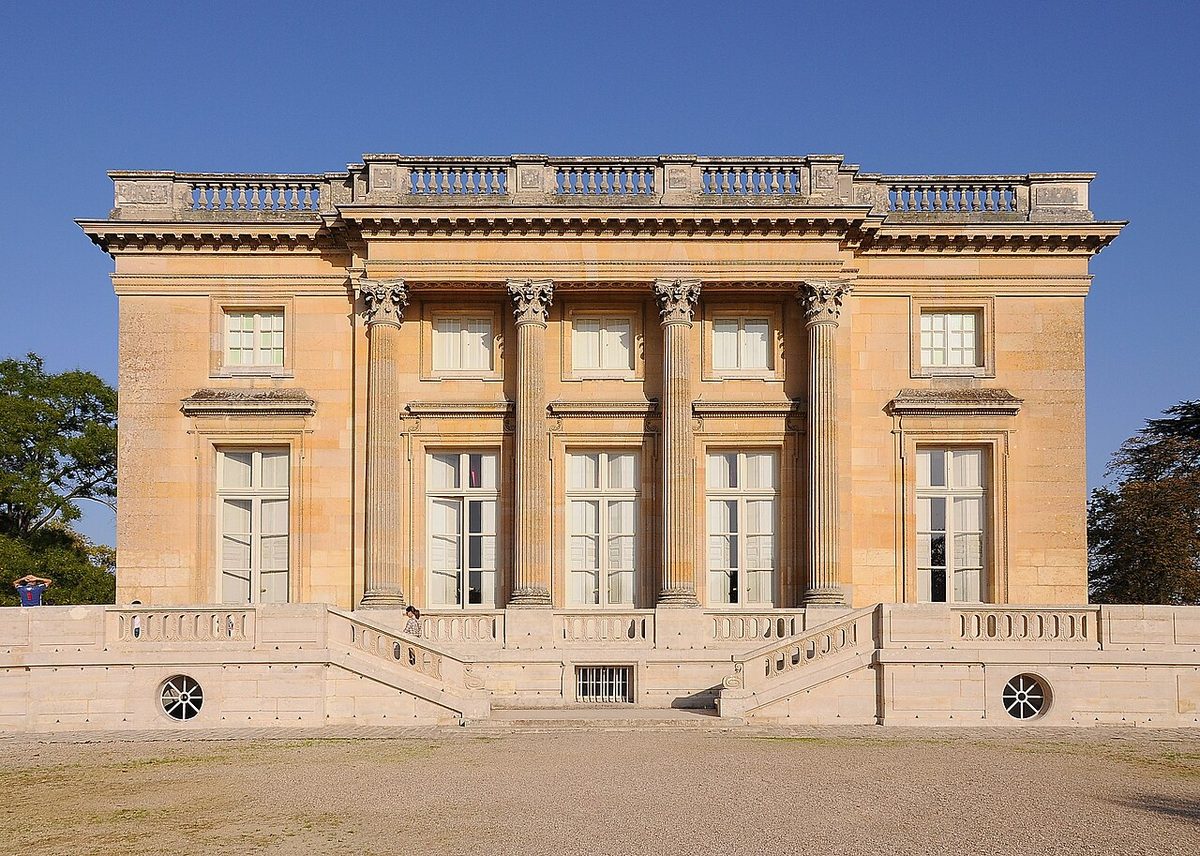
No style in the history of architecture has been adopted more consistently and globally by governments and state institutions than Neoclassicism. From the late 18th century through the mid-20th century, the classical vocabulary of columns, porticoes, pediments, and domes appeared on public buildings on every continent, carried first by European colonial administration and then retained or adopted independently by newly formed states seeking visual legitimacy.
The United States Capitol (Washington DC, current cast-iron dome completed 1868, Thomas U. Walter) is perhaps the most powerful example of classical symbolism adapted to a specific political claim. The Corinthian colonnade, the high drum and dome derived from St. Paul's Cathedral London and the Paris Panthéon, and the colossal scale all announce democratic governance conducted in the visual language of Rome's greatest civic monuments. That the dome is cast iron painted to look like stone — a material deception — is beside the point; the symbolism is what matters.
The British Museum (London, 1823–1852, Robert Smirke) deployed an Ionic colonnade of 44 columns across its main facade to claim the authority of Greek learning for the British imperial project of collecting and classifying the world's knowledge. The Bolshoi Theatre (Moscow, rebuilt 1853, Albert Kavos) used a prominent Corinthian portico to confer cultural prestige on Russian opera and ballet. Napoleon was an especially aggressive adopter: the Arc de Triomphe (Paris, begun 1806, Jean Chalgrin) quotes the form of Roman triumphal arches but scales them up dramatically for imperial self-glorification, and the Madeleine church (completed 1842) was originally intended as a Temple of Glory for Napoleon's army — a literal Roman temple placed in the center of Paris.
By the mid-19th century, the spread of Neoclassical state architecture was truly global. Colonial governments in India, Southeast Asia, Africa, and the Americas built administrative buildings, courthouses, and banks in classical idioms. These buildings simultaneously projected metropolitan cultural authority and displaced local architectural traditions.
Greek Revival: the purer strain
Within Neoclassicism, the Greek Revival deserves separate treatment because it developed a distinct character — more severe, more archaeological, more ideologically weighted — that sets its buildings apart from mainstream Roman-derived Neoclassicism even to an untrained eye.
The Greek Revival preferred the Doric order over Corinthian. Where Roman-derived Neoclassicism was comfortable with ornate Corinthian columns and rich entablature detail, Greek Revival designers favored the austere Doric — no column base, minimal capital, triglyph-and-metope entablature. The visual effect is heavier, darker, more monumental. Greek Revival buildings often have a slightly compressed, earthy quality compared to the verticality and elegance of Corinthian Neoclassicism.
The Walhalla (Bavaria, Germany, 1842, Leo von Klenze) is a deliberate reproduction of the Parthenon on a hill above the Danube, built by Ludwig I of Bavaria as a hall of fame for distinguished Germans. It reproduces the Parthenon's Doric order and peristyle plan with near-archaeological accuracy. The Lincoln Memorial (Washington DC, 1922, Henry Bacon) deploys 36 Doric columns on a podium, one column for each state of the Union at the time of Lincoln's death, with Lincoln himself seated inside in the role that a Greek cult statue would have occupied in an ancient sanctuary.
The full-scale Parthenon reproduction in Nashville, Tennessee (originally built 1897 for the Tennessee Centennial Exposition, rebuilt in concrete 1931) stands as perhaps the most literal example of Greek Revival architecture anywhere in the world: not a classical-inspired design but an attempt at exact replication. Inside it houses a reproduction of the Athena Parthenos statue, making the building function as a 19th-century American Greek temple in every intended detail — a remarkable statement about how American culture positioned itself in relation to classical antiquity at the turn of the 20th century.
How to distinguish Neoclassical from actual Roman and Greek
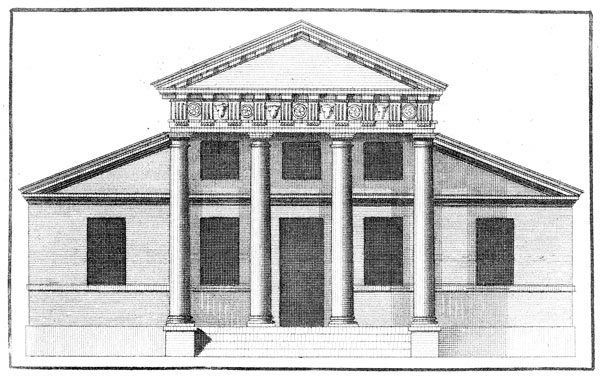
Players in the game regularly confuse photographs of Neoclassical buildings with photographs of actual ancient temples, and vice versa. The confusion is understandable — that is entirely the point of Neoclassical architecture — but several reliable tells distinguish the imitation from the original.
The most reliable tell is windows. Ancient Greek and Roman temples had either no windows at all or small, high, unglazed openings designed only to admit minimal light to an interior that was not meant to be used by large numbers of people. Neoclassical buildings have full-size multi-pane sash windows or casement windows, arranged regularly across the facade and visible on the side and rear elevations. When you see what appears to be a Greek temple with sash windows on the side elevation — even if the windows are small and discreetly placed — you are looking at a Neoclassical building, not an ancient one.
The second tell is scale and multi-story structure. Ancient temples are single-story buildings on a low podium. Neoclassical buildings are frequently multi-story: the portico may be full-height (spanning multiple floors) or the building may add floors above a rusticated base. The White House's Ionic portico spans two floors. Government buildings routinely rise three, four, or five stories behind their classical facades. No ancient temple does this.
The third tell is construction material. Even the most expensive Neoclassical buildings are typically built from brick with a stone or stucco facing, or from cast iron painted to look like stone. Ancient Greek temples were built from solid marble or limestone throughout. The difference is often visible in the texture of the surface, the jointing, and the relationship between columns and walls. A Neoclassical column is almost always either solid stone or a stone-faced brick or cast-iron core; an ancient Greek column consists of stacked cylindrical drums of solid marble.
Finally, the peristyle vs. portico distinction. A Greek temple has columns surrounding all four sides. Most Neoclassical buildings apply the columned portico only to the principal facade, with plain walls (possibly with pilasters) on the sides and rear. A building with columns only on the front, windows on the sides, and a plain rear wall is almost certainly Neoclassical rather than ancient.
Neoclassicism's long tail: the 20th century and beyond
Neoclassicism did not end when modernism arrived. It transformed, persisted, and continues to be built today — a fact that many people find surprising but that makes sense once you understand the style's deep entanglement with institutional power and cultural legitimacy.
The first 20th-century mutation was stripped classicism — Neoclassical proportions, massing, and symmetry retained, but ornamental detail stripped away. Columns become plain rectangular piers. Pediments flatten into plain cornices. Entablature detail disappears. The result is a building that reads as classical in scale and organization but is smooth-faced and unornamented. Stripped classicism appeared across political systems in the 1920s and 1930s: the Supreme Court of the United States (1935, Cass Gilbert Jr.) has its Corinthian colonnade fully intact; Paul Cret's Federal Reserve buildings use stripped classicism; Albert Speer's Nazi Berlin designs and the Soviet Palace of Culture in Warsaw (1955, Lev Rudnev) both use heavily stripped classical massing to project state authority. The style transcends ideology — it is power-architecture in a form that any government can adopt.
Postmodernism in the 1980s revived classical motifs ironically and playfully. Philip Johnson's AT&T Building (550 Madison Avenue, New York, 1984) added a Chippendale broken pediment to the top of a 37-story granite tower — a deliberate quotation of classical form placed where it was structurally meaningless and visually absurd, commenting on Modernism's rejection of ornament rather than sincerely reviving classicism. The gesture triggered enormous controversy and is still argued about today.
A sincere New Classical architecture continues to be designed and built by architects including Quinlan Terry, Robert Adam, and Leon Krier for government buildings, university campuses, private estates, and churches. The debate between modernists and classicists remains live and sometimes acrimonious. In the game, a building with full classical ornament that is clearly modern in construction (no weathering, clean stone joints, precise machined detail) is most likely either stripped classicism from the mid-20th century or a new classical building from the late 20th or early 21st century. Context — particularly the surrounding urban fabric — will usually help you date it. For more on how classical architecture intersects with political power, see our article on colonial architecture and the architecture of power.
Regional Variations
Although Neoclassicism is an international style with a shared vocabulary, the way each nation adopted and inflected it tells a story about political priorities, cultural identity, and the local building traditions that architects had to negotiate. The differences are real and visible once you know what to look for.
French Neoclassicism is monumental and civic in character. The Panthéon, the Palais Bourbon (seat of the National Assembly), and Soufflot's church of Saint-Sulpice all share a quality of heavy gravitas and controlled grandeur — this is architecture serving the French state's ambition to project rational order. French buildings tend toward very large, smooth-cut stone surfaces punctuated by strongly projecting porticoes. The Palais Bourbon's south facade, facing the Seine, uses a Corinthian colonnade of unusual depth and authority. Ornamental detail is restrained but precisely executed; no surface goes unattended, but nothing is gratuitous. The overall impression is of immense seriousness, which is exactly what the Revolutionary and Napoleonic state wanted to project.
British Neoclassicism, by contrast, is more restrained and more comfortable with domestic scale. The Bank of England (Sir John Soane, rebuilt 1788–1833) famously replaced its entire perimeter with a blank screen wall punctuated by shallow niches and projecting bays — a radical simplification that produces an architecture of pure surface and void. The British Museum uses a full Ionic colonnade, but even here the scale feels slightly human compared to its French equivalents. German Neoclassicism — particularly the work of Karl Friedrich Schinkel — synthesizes Greek and Roman sources with a clarity and structural logic that is sometimes called Prussian or Reformed Classicism. Schinkel's buildings use precise Greek proportions with Roman planning ambition, and they never feel baroque or excessive. American Neoclassicism is explicitly Republican in intent: the US Capitol and the many state capitols built on its model treat the dome and colonnade as democratic symbols, deliberately evoking Rome as the model for a republic governed by law. Colonial powers — Britain, France, the Netherlands, Spain — exported Neoclassical civic buildings globally wherever they built administrative centers. Many of the most impressive Neoclassical government buildings in the world are in former colonial capitals: Kolkata, Cape Town, Havana, Sydney.
One consequence of global export is that Neoclassical buildings in non-European settings often show a fascinating tension between the imported style and local climate. Deep verandas replace stone colonnades. Tropical roof overhangs supplement shallow pediments. Whitewash substitutes for Portland stone. These adaptations produce regional variants — Anglo-Indian classicism, Caribbean colonial classicism — that are recognizably in the Neoclassical family but subtly inflected by place. In the game, looking for these climate adaptations can help you identify both the style and the region in a single photograph.
Key Identifiers
- Triangular pediment at the apex of the main facade or entrance porch
- Doric, Ionic, or Corinthian column order — capital type is the clearest indicator of civic ambition level
- Strictly symmetrical facade with a clear central axis
- Flat or very shallow dome on a cylindrical drum, often with a lantern on top
- Rusticated base or podium of steps elevating the principal floor above street level
- Balustrade at the roofline concealing the roof structure behind a classical parapet
- Inscribed frieze or dedicatory inscription in the entablature or tympanum of the pediment
- Projecting portico — the columned porch that brings the facade forward from the main wall plane
- Pilasters (flat-profile columns) applied to side and rear elevations where full columns are absent
- Regular sash or casement windows with classical surrounds, distinguishing it from actual ancient buildings
A Closer Look: The Altes Museum, Berlin (Schinkel, 1830)
Among all Neoclassical buildings, the Altes Museum in Berlin stands as perhaps the most elegant solution to the essential problem of the style: how to create a public building that is undeniably civic and authoritative without becoming merely grandiose. Karl Friedrich Schinkel solved this problem by doing something unexpected — instead of centering a temple-front portico on the facade, he ran a single long Ionic colonnade of eighteen columns continuously across the entire width of the building, with no projecting central accent at all. The result is a horizontal civic threshold: a sheltered walkway that mediates between the Lustgarten square and the museum interior, inviting entry without demanding it.
The colonnade reads differently from any distance. From across the Lustgarten, it is an extended screen of columns that frames and defines the edge of the square — it belongs to the urban space as much as to the building. From within the colonnade itself, walking along it, the rhythm of columns and the views across the Lustgarten create a processional experience of exactly the kind Schinkel intended: an architecture of civic preparation, gradually shifting the visitor from street life to the contemplation of art. Behind the colonnade, the building plan is organized around a spectacular top-lit rotunda — a Pantheon in miniature — that delivers the visitor from the public colonnade to the most intensely classical interior Schinkel ever designed.
The Altes Museum illustrates a principle that applies across Neoclassical buildings: the most interesting examples are those where a skilled architect solved a specific problem with the classical vocabulary rather than simply applying it by convention. The long colonnade at Berlin answers the question of how to relate a museum to a major public square better than many conventional temple-front solutions. When you encounter Neoclassical buildings in the game, looking for these moments of genuine design thinking — rather than merely counting columns — tends to reveal the building's character most fully.
Spotting It in Building Guessr
Columns and pediment together are almost a guaranteed signal of Neoclassical or Greek Revival architecture. The combination of a triangular pediment atop a row of columns, on a building that clearly has windows and multiple stories, narrows the field dramatically. From there, the column capital type helps you identify the ambition level of the building: Doric columns suggest a more austere, Greek Revival-influenced design; Corinthian columns indicate high civic prestige, usually a government building, bank, or major museum. The building's purpose, visible from context — a large urban block, central placement in a city plan, the presence of flag poles or official vehicles — combined with the column order gives you a strong starting position for date and geography.
National inflection also registers in photographs. A building with very large, smooth stone surfaces, a deeply projecting colonnade, and a sense of heavy formality leans French or central European. A building with a shallower colonnade, smaller scale, and more restrained ornament is more likely British or American. A building in a tropical or subtropical setting — with modified roof overhangs, lighter materials, and whitewashed surfaces — is probably colonial classicism, which you can then place geographically by climate, vegetation, and urban texture. The key is to treat the Neoclassical vocabulary as what it always was: a communicative language, with regional dialects.
Try spotting the column order on government buildings in the next round.
Play Building GuessrFurther Reading
- Colonial Architecture: Power Written in Stone — how Neoclassical civic buildings were exported to every corner of the world
- Gothic, Romanesque, and Byzantine — the medieval styles that Neoclassicism deliberately rejected
- The Architecture of Power — how authoritarian and democratic states use buildings to make political arguments
- Brutalism Explained — the 20th-century reaction against classical convention that Neoclassicism had to survive
Sources & further reading
Reference material this page draws on, and where to read further. External links open third-party sites.
- Neoclassical architecture · Wikipedia
- Palladian architecture · Wikipedia
- Andrea Palladio · Wikipedia
- Greek Revival architecture · Wikipedia
- Brandenburg Gate · Wikipedia
- Karl Friedrich Schinkel · Wikipedia